
Four big IT companies, four completely different hiring processes, and timelines that never seem to line up. Honestly, for any fresher, the hardest part is rarely the syllabus itself. It is just figuring out when to apply, whether a test portal is actually open, what a specific company cares about, and what to focus on first. It is so easy to spend three weeks prepping for something like the TCS NQT, only to realize a registration window closed right under your nose.
That is why having a single reference point for the 2026–27 IT placement calendar helps. Just keep in mind that recruitment dates can shift, so always double-check the active portals before you submit anything.
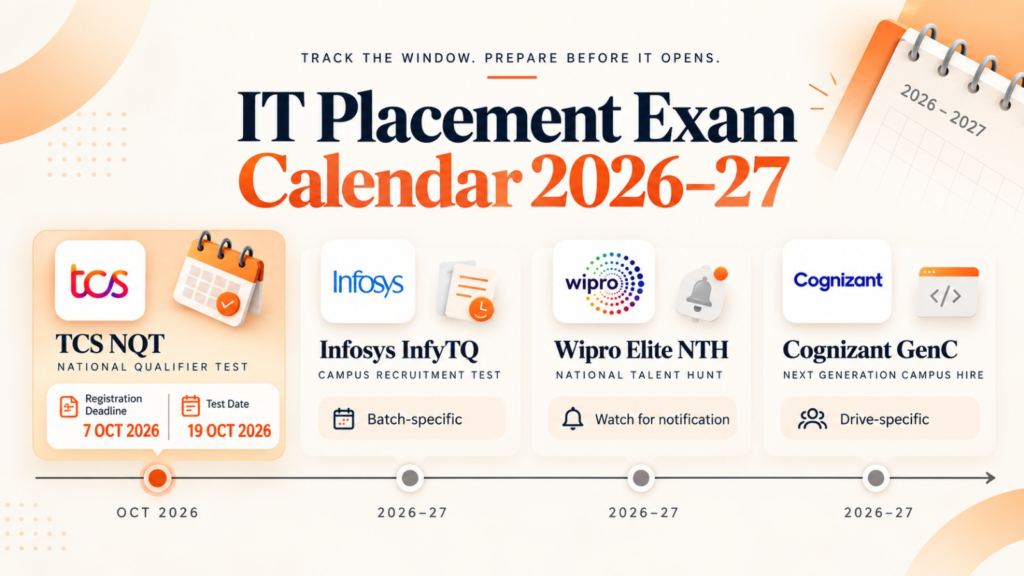
Quick Calendar Breakdown
- TCS NQT: The October 2026 TCS iON NQT cycle currently lists an application deadline of 7 October 2026, with the test scheduled for 19 October 2026. Keep in mind that the iON NQT route operates independently from dedicated TCS All India hiring drives, so take a quick look at the active test listings first.
- Infosys InfyTQ: InfyTQ acts as Infosys’ core learning and certification platform. Because exact recruitment schedules depend heavily on your graduating batch and specific drives, rely on current Infosys notifications rather than banking on a fixed window.
- Wipro Elite NTH: Wipro runs Elite as its flagship Technical Graduate Hiring Program. A fresh public NTH registration window hasn’t been widely visible on their main careers portal lately, even though historical trackers often point to a July–September opening.
- Cognizant GenC: Cognizant structures its GenC process around role-based applications, screening, assessments, and interviews. Since there isn’t one permanent national exam date for this, you have to keep an eye out for active GenC openings matching your specific batch.
Smart Prep Strategy
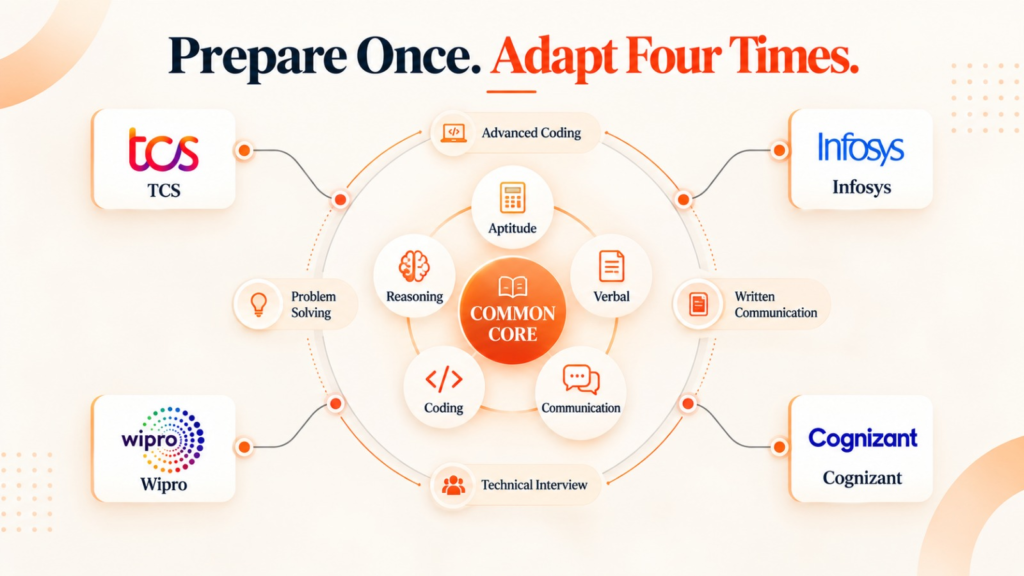
Fortunately, you don’t need to reinvent the wheel for every single test. Aptitude, logical reasoning, verbal ability, programming basics, and interview skills overlap heavily across all four processes.
Nail down that shared core first. Once you have got the fundamentals solid, you can easily pivot and layer in company-specific topics right before your test date.
Why this calendar matters more than most freshers realise
The biggest mistake with placement exams is treating them like college exams. With a college exam, you normally know the date well in advance, and everyone in the class is working towards the same paper. Fresher hiring is messier. One company may open applications while another is still hiring from the previous batch.
That is why an IT company hiring calendar for freshers in India is actually useful. You are not trying to prepare for four completely unrelated exams. You are trying to build one strong base and then adjust it for each company’s process.
TCS, for example, has both specific hiring drives and the broader TCS iON NQT assessment route. The current TCS All India NQT hiring page lists 2024, 2025, and 2026 batches for its specific drive, while the October TCS iON NQT test is a separate recurring assessment.
Third-party hiring calendars also publish estimates for the scale of mass hiring across large IT services companies. Those figures can be useful for understanding the size of the market, but they should not be treated as guaranteed openings for a particular student or batch. IT mass hiring drives 2026 calendar and intake estimates
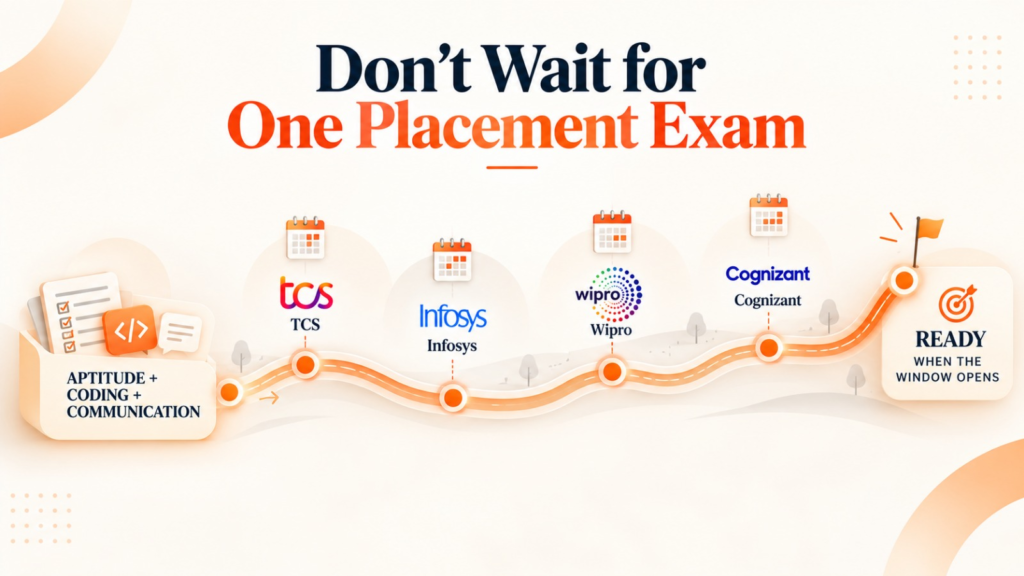
The practical lesson is simple: do not wait for one perfect placement exam. Keep your profile ready, monitor the company portals, and prepare the common subjects before the registration window appears.
TCS NQT 2026: everything confirmed for the October cycle
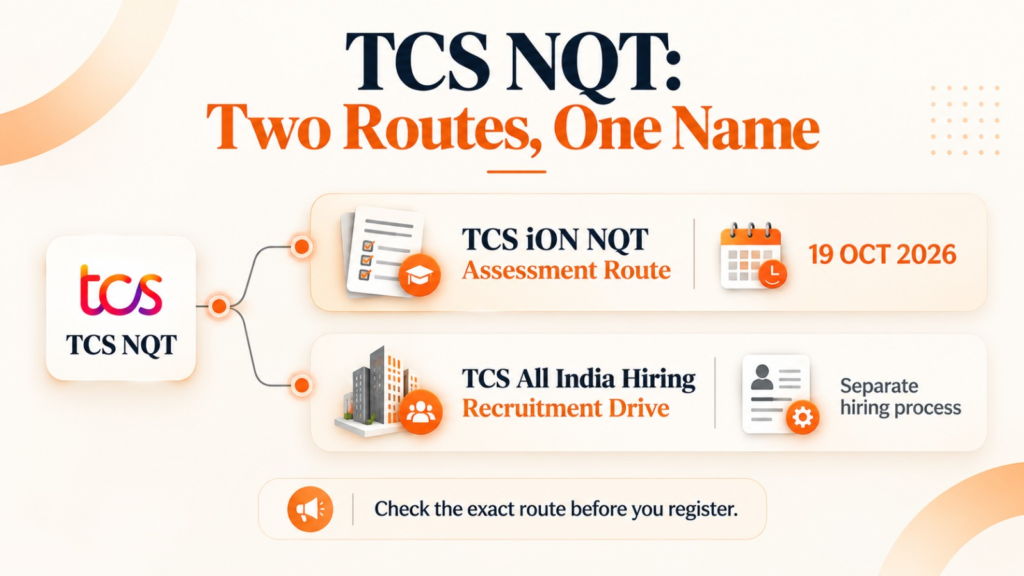
TCS NQT is useful to understand because “TCS NQT” can refer to more than one route. The recurring TCS iON NQT assessment is broader than a single TCS recruitment drive, while TCS also runs specific All India hiring processes through TCS careers.
What TCS NQT is and why it matters beyond TCS
TCS NQT is an assessment conducted through TCS iON that can be used by candidates to demonstrate their skills to participating employers. It should not be confused with a guarantee of a TCS interview or offer. The actual hiring process depends on the relevant company or recruitment drive.
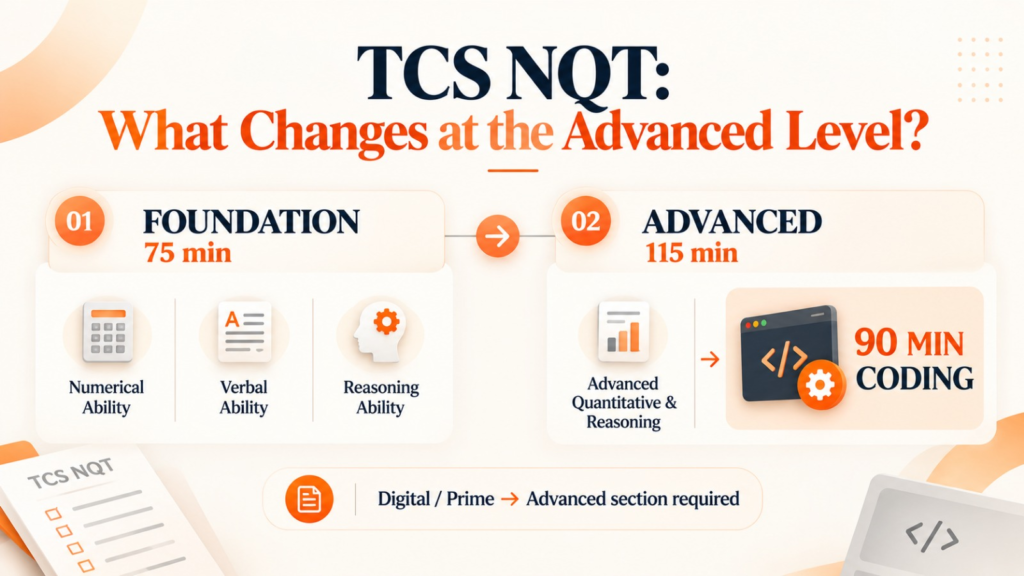
For TCS’ own hiring, the current official All India NQT page describes an integrated Foundation and Advanced assessment. The Advanced section is required if you are targeting Digital or Prime opportunities in that drive.
That distinction matters because you may see a social media post saying “TCS NQT” and assume every candidate is applying for exactly the same job. They are not necessarily doing so.
October 2026 confirmed dates
The current October TCS iON NQT listing is being reported with:
- Registration deadline: 7 October 2026
- Test date: 19 October 2026
- Assessment: TCS iON NQT
- Mode: Depending on the active NQT variant, online or test-centre arrangements may apply
- Registration: TCS iON official page for NQT registration
Current reporting based on the TCS iON schedule lists 19 October 2026 as the next test date and 7 October as the application deadline.
Before paying for or registering for an NQT variant, check the exact test displayed in your active TCS iON account. This is especially important because TCS has separate recruitment drives. The current TCS All India NQT hiring page, for example, shows its 2026 drive as closed and lists a March 2026 test schedule.
Eligibility
Eligibility depends on the specific NQT or TCS hiring route.
For the current TCS All India NQT hiring drive, TCS lists 2024, 2025, and 2026 engineering and postgraduate batches, with a minimum 60% aggregate requirement across the specified academic qualifications, no pending backlogs at the selection stage, and other conditions covering education gaps, course type, age, and experience.
So do not copy eligibility from an old TCS NQT article and assume it applies to every 2026 test. The batch and qualification rules can be different between an assessment product and a particular hiring drive.
Exam pattern
For the current TCS All India NQT hiring process, the test has two parts:
| Section | Duration |
| Foundation | 75 minutes |
| Numerical Ability | 25 minutes |
| Verbal Ability | 25 minutes |
| Reasoning Ability | 25 minutes |
| Advanced | 115 minutes |
| Advanced Quantitative and Reasoning | 25 minutes |
| Advanced Coding | 90 minutes |
| Total | 190 minutes |
TCS says the Advanced section is mandatory for candidates targeting Digital or Prime in this hiring process. Performance can determine whether a candidate moves towards Prime, Digital, or Ninja interview consideration.
Salary by track
The current TCS All India NQT page gives the following undergraduate CTC ranges for candidates with 0 to 1 year of experience:
- Ninja: minimum ₹3.4 LPA for UG candidates
- Digital: ₹7.09 to ₹7.30 LPA
- Prime: ₹9.09 to ₹9.30 LPA
The exact compensation varies by qualification, experience, and job location.
These figures should not be copied as a guaranteed salary for every person who takes TCS NQT. The offer category and compensation depend on the hiring process and selection outcome.
Cutoffs
TCS does not publish one universal public cutoff that applies to every NQT route.
You will often see numbers such as 65% or 70% quoted on preparation websites. Treat those as reported or suggested preparation benchmarks, not official TCS cutoffs.
A better way to prepare is to avoid planning around the minimum possible score. For aptitude, aim for consistent accuracy under time pressure. For Advanced, spend enough time on coding that you can solve problems without depending on memorised patterns.
What to prepare
For the Foundation section, focus on:
- Percentages, ratios, averages, profit and loss
- Time and work
- Time, speed and distance
- Basic probability
- Number-based problems
- Reading comprehension
- Grammar and vocabulary
- Number series
- Coding-decoding
- Syllogisms
- Logical arrangements
For Advanced preparation, coding becomes much more important. Practise arrays, strings, searching, sorting, recursion, data structures, and algorithmic problem solving.
You can use C, C++, Java, or Python for programming practice, but choose one language and become comfortable solving problems in it rather than jumping between four languages.
Students who want a more detailed preparation routine can continue with Teknowell’s TCS NQT preparation guide for freshers.
Infosys InfyTQ 2026: certification + hiring in one platform
InfyTQ is different from a conventional one-day placement test because Infosys has used it as a learning, assessment, and certification platform. It combines learning material, assessments, and certification rather than functioning only as an exam sitting.
How InfyTQ works, different from every other exam
Think of InfyTQ as a platform where preparation and assessment are connected.
Infosys describes InfyTQ as a digital learning platform designed for engineering students, with learning programs, assessments, and certification.
That means a student preparing for Infosys should not think only in terms of “What questions will come in the exam?” The better question is whether you actually understand programming, problem-solving, and the concepts being assessed.
Two certification levels and what they unlock
The supplied salary structure for InfyTQ is commonly described as:
- Foundation: Systems Engineer, around ₹3.6 LPA
- Master: Specialist Programmer or Digital Specialist Engineer opportunities, with higher compensation depending on the role and selection process
The exact role and compensation attached to a certification route can change by hiring cycle, so candidates should check the current Infosys notification before treating these figures as an active 2026 offer structure.
Infosys’ certification examination guidelines also state that candidates who clear the relevant Advantage Round can receive a pre-placement interview opportunity for Specialist Programmer or Digital Specialist Engineer roles based on performance.
The important takeaway for a student is that stronger coding ability can matter beyond simply clearing the basic certification.
Registration and timeline
InfyTQ is available through Infosys’ learning ecosystem, and Infosys has historically used the platform for learning and certification.
There is not one permanent national InfyTQ hiring date that every 2026 graduate should blindly follow. Recruitment windows and eligible batches can change, so check the current InfyTQ and Infosys Careers notification before assuming that a particular November to January window applies to you.
For the same reason, the phrase Infosys InfyTQ registration 2026 should not lead you to an old registration page from a previous batch.
Eligibility
InfyTQ eligibility is batch and programme dependent. Infosys has historically positioned InfyTQ primarily around engineering students and has used certification as part of its talent and recruitment ecosystem.
Check the current certification or recruitment notice for your graduating batch before applying. Do not assume that a 2024 or 2025 eligibility rule automatically carries into the 2026 cycle.
What to prepare
Coding should be a major part of your preparation.
Focus on:
- Python or Java programming
- Arrays and strings
- Functions and recursion
- Data structures
- Basic algorithms
- Problem solving
- Object-oriented programming
- SQL and database basics where required
- Communication and interview preparation
If you are already preparing for TCS NQT, there is considerable overlap. The main difference is the way Infosys structures its learning and certification process.
Students comparing the two can also read Teknowell’s InfyTQ vs TCS NQT: which to prepare for first.
Wipro Elite NTH 2026: window, pattern, and what to expect
Wipro Elite is Wipro’s Technical Graduate Hiring Program for newly graduated engineers. Wipro’s current Early Careers page confirms the programme, but detailed assessment rules and dates should be taken from the active recruitment notification for your batch.
Registration window
Recent Wipro Elite NTH cycles have often been associated with a July to September opening period. However, as of September 2026, current tracking sources reported that the next public NTH registration had not yet appeared on Wipro’s official careers portal.
That is worth highlighting because several older articles still present July to September as if it were a confirmed 2026 registration window.
For the Wipro Elite NTH exam pattern 2026, use the active Wipro notification rather than an old article. Wipro’s official site currently confirms Elite as its Technical Graduate Hiring Program, but the detailed batch-specific assessment information can change.
Eligibility
Previous Elite NTH drives have commonly focused on engineering graduates and used academic percentage requirements, but the exact eligible batches, branches, marks, backlog rules, and other conditions can change.
Current third-party tracking of the upcoming cycle also advises candidates to wait for the official notification rather than relying on older eligibility rules.
So, if you are applying, keep your Class 10, Class 12, graduation marksheets, resume, and other academic information ready. Then check the active Wipro posting before submitting the form.
Exam pattern
Historically reported Wipro Elite NTH assessments have included aptitude, coding, and written communication or essay components. However, platform, duration, proctoring, navigation rules, and section structure can change between drives.
That means a preparation plan can safely cover the common areas without pretending that an old 60-minute pattern is guaranteed for the next assessment.
Practise quantitative aptitude, logical reasoning, verbal ability, coding fundamentals, and short structured writing. That preparation remains useful even if the exact test interface changes.
Salary
Wipro has not published one universal 2026 Elite NTH salary figure that can be applied to every candidate.
Recent third-party reports commonly place the standard Project Engineer offer around ₹3.5 LPA, but that is a reported figure rather than a current universal Wipro commitment.
Do not choose your preparation strategy based only on a salary number. The immediate goal is to understand the assessment, meet eligibility requirements, and be ready when the actual hiring notification opens.
What to prepare
For the common Wipro assessment areas, practise:
- Percentages and averages
- Ratios and proportions
- Time and work
- Time, speed and distance
- Probability
- Number series
- Logical arrangements
- Directions and blood relations
- Syllogisms
- Reading comprehension
- Sentence correction
- Basic programming
- Arrays and strings
- Short structured writing
Writing deserves a little extra attention because it is less common in the other three processes. Practise writing 180 to 250 words on a simple topic with a clear beginning, two or three connected points, and a short ending.
Cognizant GenC 2026: two tracks, one registration
Cognizant GenC is a fresher hiring and development programme, but there is no single permanent national exam date for every GenC candidate. Cognizant says its off-campus drives are open for specific streams, roles, and batches, and its recruitment process can vary by role.
GenC vs GenC Next, the salary difference most students miss
Students often treat GenC and GenC Next as if they are two fixed exams that happen on the same national date. The actual hiring structure is more dependent on the specific drive and role.
Salary figures such as ₹4 LPA for GenC and around ₹6.5 LPA for GenC Next are widely reported for particular hiring cycles, but they should be treated as cycle-specific figures rather than a permanent Cognizant salary guarantee.
Cognizant’s official GenC page focuses on the recruitment process itself. It says assessments may evaluate communication, aptitude, and technical skills depending on the role, followed by interviews for candidates who progress.
Registration and dates
Cognizant’s official careers page currently directs candidates to apply through campus recruitment drives or open positions for off-campus hiring. The company does not present one permanent GenC exam date that applies to every batch.
This is why the Cognizant GenC exam dates 2026 should be tracked from the specific opening for your batch rather than from a generic calendar published months earlier.
If you are graduating in 2026 and looking for a GenC opportunity, keep your Cognizant Careers profile and resume ready and monitor the official GenC openings.
Eligibility
Eligibility is drive-specific. Cognizant says its off-campus hiring drives are designed for particular streams, roles, and batches.
Do not assume that a single “2024 to 2026 batch” rule applies to every GenC opening. Read the eligibility section of the actual job or drive before applying.
Exam pattern
The exact assessment can vary by role, but Cognizant’s official process describes the broad stages as:
- Application
- Initial screening
- Assessment or assessments
- Interview
- Result
The assessments can cover communication, aptitude, and technical skills depending on the position.
That makes communication preparation worth taking seriously. A student who spends every evening solving coding questions but ignores communication may be preparing for only one part of the process.
What to prepare
Build the same aptitude base used for TCS and Wipro:
- Quantitative aptitude
- Logical reasoning
- Verbal ability
- Reading comprehension
Then add:
- Arrays and strings
- Basic sorting
- Recursion
- Object-oriented programming
- Basic data structures
- Project explanation
- Communication practice
- Technical interview questions
For a beginner, communication practice does not mean trying to sound fluent or using complicated English. Practise explaining your project, your role in the project, what went wrong, how you fixed it, and what you learned.
Students preparing for both companies can use Teknowell’s Wipro Elite NTH and Cognizant GenC preparation guide for a more focused preparation plan.
Full placement exam calendar at a glance
The table below is designed as a working calendar, not a promise that every company will keep the same dates throughout the year.
| Company | Programme | Registration window | Exam/Hiring period | Salary information | Batch eligibility |
| TCS | NQT / TCS iON NQT | October cycle deadline reported as 7 Oct 2026 | TCS iON test reported for 19 Oct 2026 | TCS All India NQT: Ninja from ₹3.4 LPA UG; Digital ₹7.09 to ₹7.30 LPA; Prime ₹9.09 to ₹9.30 LPA | Depends on NQT route |
| Infosys | InfyTQ | Depends on certification and hiring cycle | Batch-specific | Foundation and higher certification-linked roles vary by cycle | Depends on current notification |
| Wipro | Elite NTH | Recent cycles often open Jul to Sep, but the 2026 public window was not confirmed on the official portal as of Sep 2026 | Depends on active drive | Around ₹3.5 LPA reported for recent standard Elite offers | Engineering graduates, subject to active notification |
| Cognizant | GenC / related fresher drives | Drive-specific | Drive-specific | GenC compensation varies by hiring drive | Batch and role-specific |
TCS’ current official All India NQT page shows its 2026 drive as closed and lists 2024, 2025, and 2026 eligibility, while the October 19 TCS iON test is a separate current NQT listing. Wipro’s official page confirms the Elite programme, but the detailed current NTH notification should be checked before relying on a date or eligibility rule. Cognizant similarly says that its GenC drives are specific to streams, roles, and batches.
Always verify the active company notification before registering. Hiring calendars move, and a date published for one batch or assessment route does not automatically apply to the next one.
How to prepare for all four without burning out
You do not need four completely separate study plans. The smarter approach is to build a shared base and then add the pieces that are specific to each company.
The shared core: prepare once, use everywhere
Start with quantitative aptitude, reasoning, and verbal ability. Percentages, ratios, averages, time and work, time-speed-distance, probability, number series, coding-decoding, syllogisms, reading comprehension, grammar, and vocabulary are useful across several fresher assessments.
Coding should sit alongside this rather than being postponed until the end. Pick one language, such as Java, Python, or C++, and practise small problems regularly. Arrays, strings, loops, functions, searching, sorting, and basic data structures are a much better starting point than immediately jumping into difficult competitive-programming questions.
The easiest way to manage this is to give yourself a weekly structure. For example, spend four days on aptitude and reasoning, practise coding every day for 45 to 60 minutes, and reserve one or two sessions for mock tests and reviewing mistakes.
Company-specific additions: prepare these separately
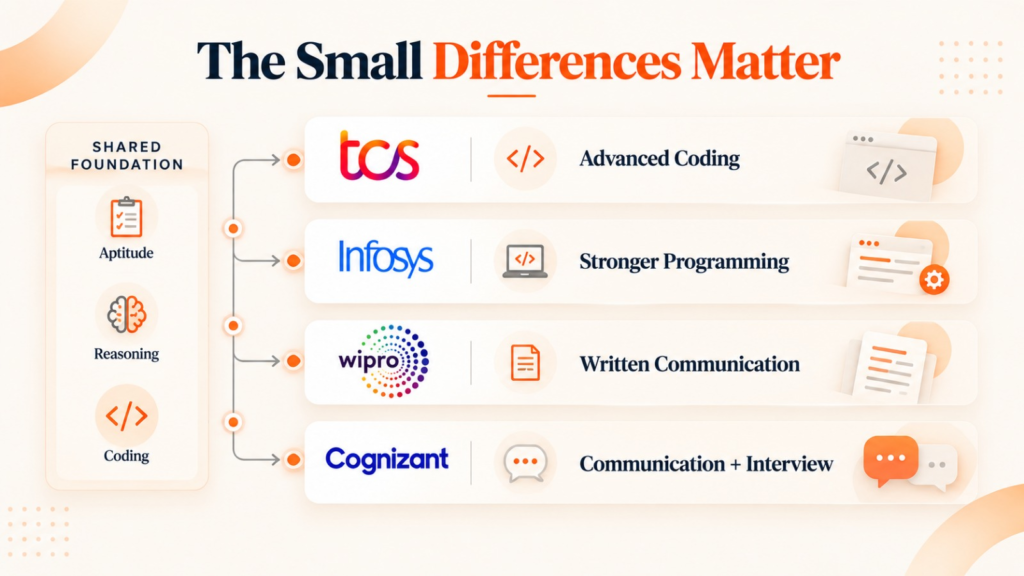
TCS needs more attention on Advanced Quantitative and Reasoning and Advanced Coding if you are targeting Digital or Prime. The current TCS All India NQT pattern gives the Advanced section 115 minutes, including 90 minutes for coding.
Infosys requires stronger programming and problem-solving preparation for higher certification-linked opportunities. Its certification guidelines specifically connect stronger performance in the Advantage Round with interview opportunities for Specialist Programmer or Digital Specialist Engineer roles.
Wipro preparation should include written communication if that component appears in the active drive. Cognizant preparation should include communication and interview practice because Cognizant explicitly says its assessments can evaluate communication, aptitude, and technical skills.
Recommended sequence
For a student starting from scratch, spend the first four to six weeks building the common aptitude, reasoning, verbal, and coding base.
From week three, add daily coding practice. You do not need to solve the hardest problems. The useful milestone is being able to understand a problem, write a solution, test it, and explain why it works.
At the same time, register for every relevant company drive for which you are actually eligible. Do not wait to become “100% ready” before registering. Registration and preparation can happen together.
If a TCS NQT window is open, prepare specifically for that test while keeping Infosys, Wipro, and Cognizant in your pipeline. This is much less stressful than preparing for one company, waiting for the result, and then starting from zero for the next one.
Knowing the dates is only half the job. Being ready when the date arrives is the part that takes consistent practice.
Knowing the dates is the first step. The second is being prepared by the time each window opens. Teknowell’s placement preparation in Pimpri Chinchwad focuses on aptitude, coding, mock technical interviews, and resume preparation for students preparing for IT fresher hiring processes. Book a free demo at Teknowell to understand the programme before deciding whether structured preparation is right for you.
Common mistakes freshers make with placement exam timelines
The first mistake is waiting for the “right time” to start. There usually is not one. TCS iON NQT has recurring assessment opportunities, while company-specific hiring drives can open at different times, so preparation started today can still be useful for the next application window.
The second mistake is preparing only for TCS. TCS may be the company a student hears about most often, but the other hiring processes can test different things. Wipro can include written communication, Infosys can place more weight on coding for higher roles, and Cognizant says its assessments can include communication, aptitude, and technical skills.
Another common mistake is treating salary figures as if they are permanent. A ₹4 LPA or ₹6.5 LPA figure found in a 2025 article may belong to a particular Cognizant drive. The same applies to Wipro or Infosys. Always check the offer information in the active notification instead of planning your career around an old salary table.
The final mistake is not checking the official portal. This matters more than it sounds. A third-party website may have the right company name but an old batch, old deadline, or old eligibility criteria. Before entering your personal information, open the company’s official careers page and confirm that the drive is actually live.
The practical takeaway for the 2026–27 placement season
Do not build your entire placement plan around one exam date.
If you are eligible for the October TCS iON NQT cycle, the reported 7 October registration deadline and 19 October test date give you a clear immediate target. At the same time, keep checking Infosys, Wipro, and Cognizant because their fresher hiring processes do not all follow the same calendar.
The best use of your preparation time is to build the common foundation first: aptitude, reasoning, verbal ability, coding, and communication. Then add the company-specific parts when a relevant drive opens.
If you are in Pune and want structured mock-test preparation, aptitude practice, and interview support alongside a Teknowell full stack or data science course, book a free demo at Teknowell Pimpri Chinchwad and see how the programme works before enrolling.