India’s IT industry is not slowing down anymore. That prediction phase is over. The hiring wave that started after AI adoption accelerated has now changed the way freshers enter the industry altogether. Companies in Pune are no longer asking only for degrees. They are asking one thing first: can this person actually work on real tools, real projects, and real systems from day one?
That is exactly why so many freshers feel confused in 2026.
There are too many courses. Every institute claims placement. Every ad says “high salary”. Every course suddenly has “AI” attached to its name. But the real question is much simpler than most people realise:
Which IT course actually leads to a job?
That answer depends on three things: background, career goal, and how fast someone wants to become employable. Some courses have faster placement cycles. Some have higher salary ceilings. Some are safer for non-IT students. Some look exciting on social media but are extremely difficult for freshers without strong fundamentals.
This guide breaks down the best IT courses for freshers in 2026, honestly, what each course teaches, how long it takes, expected fresher salaries in Pune, and which path realistically suits different kinds of students.
At-a-glance comparison: Best IT courses for freshers in 2026
| Course | Duration | Fresher Salary | Best For | Time to First Job |
| Full Stack Development | 4–6 months | ₹4.5–8 LPA | CS/IT graduates | 2–4 months |
| Data Science & AI | 6–9 months | ₹5–8 LPA | Analytical minds | 3–5 months |
| Software Testing | 3–5 months | ₹3.5–6 LPA | Any background | 1–3 months |
| Cloud Computing & DevOps | 4–6 months | ₹4–7 LPA | CS/IT graduates | 2–4 months |
| AI & ML Engineering | 9–12 months | ₹6–10 LPA | CS + maths background | 4–6 months |
Where to learn these courses in Pune
Teknowell runs four of these tracks at its centre near Chinchwad Station, with classroom and online batches.
| Course | Start here if you |
|---|---|
| Full Stack Development | have a CS/IT degree and want a developer job |
| Data Science & AI | like numbers and want to work with data |
| Cloud Computing & DevOps | enjoy systems, servers and automation |
| Generative AI | already code a little and want to build with AI |
What actually makes an IT course worth doing in 2026?
A lot of freshers still choose courses the same way students chose them five years ago. They look at old placement screenshots, outdated salary promises, or whichever course is trending on YouTube that month.
That approach is becoming dangerous now because the IT market has changed much faster than most institutions have.
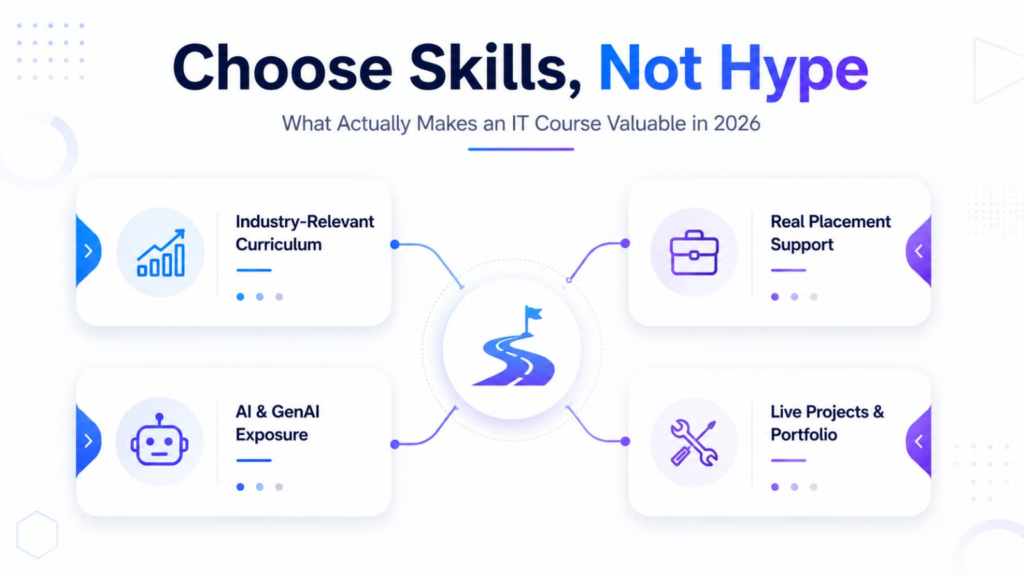
The course must match where hiring is happening right now
One thing became very clear in the last two years across Pune’s hiring market. Companies are hiring around workflows, not just programming languages anymore.
A student who knows basic JavaScript but can integrate OpenAI APIs, deploy projects on AWS, and manage GitHub properly often gets shortlisted faster than someone who has only completed traditional programming modules.
AI hiring has exploded across India, cloud adoption is creating continuous demand for DevOps professionals, and data analytics is now being used in industries that had nothing to do with tech a few years ago. Banks, hospitals, logistics companies, retail chains, everyone wants data teams now. If data is where you are headed, our guide on choosing between data analytics and data science is a good place to start.
Meanwhile, some institutes are still teaching curriculums that look frozen in 2019.
That gap matters more than students realise.
Gen AI is no longer optional
A lot of freshers still think AI is a “specialisation” they can learn later.
The market already moved past that.
In 2026, Gen AI is becoming part of almost every technical role. Full-stack developers are integrating AI APIs into products. Testing engineers are using AI-assisted automation tools. Data science roles increasingly expect prompt engineering familiarity.
Freshers with hands-on exposure to tools like LangChain, OpenAI APIs, vector databases, and AI workflows are entering interviews with a visible advantage.
Hiring managers notice it immediately because most candidates still do not have those skills.
Placement support needs to be real, not decorative
“100% placement assistance” has become one of the most overused phrases in India’s training market.
Most students discover too late that it sometimes means three interview calls and a WhatsApp group.
Real placement support looks very different.
Good institutes run mock interviews repeatedly. They force students to improve communication. They review resumes line by line. They push students into live projects before interviews start. Most importantly, they continue sending opportunities until the student is placed.
That difference changes outcomes completely.
A lot of students realise this only after joining the wrong institute once. The difference between real placement support and marketing promises becomes painfully obvious during interview season. Students comparing institutes carefully should also read this detailed breakdown on choosing the best IT training institute in Pune for job-oriented courses before enrolling anywhere.
Top 5 IT courses for freshers in 2026
1. Full Stack Development
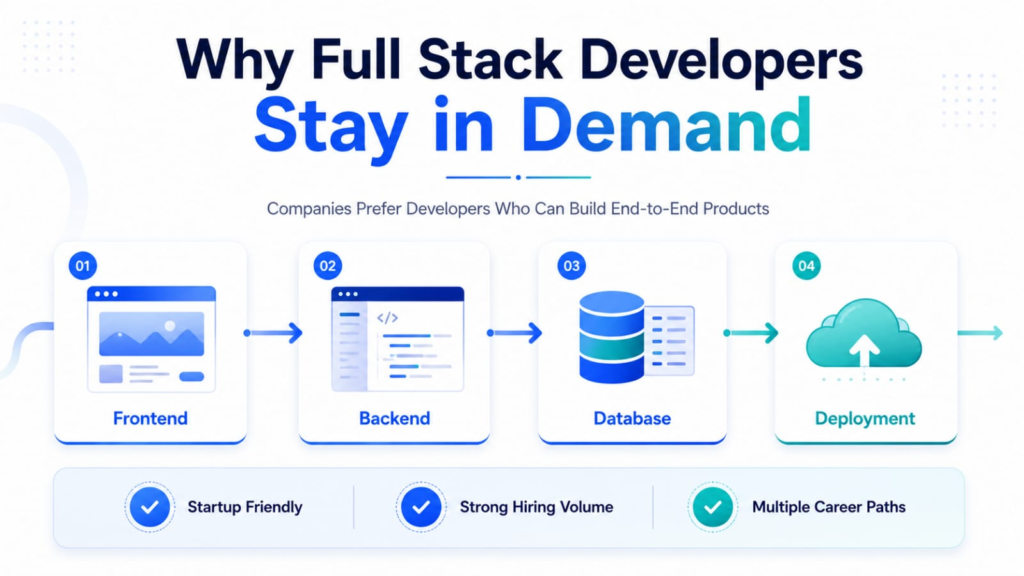
The safest answer for most CS and IT graduates in 2026 is still Full Stack Development.
Not because it is easy. It is not.
But because hiring volume remains massive.
Every startup needs developers. Every company building internal software needs developers. Product companies, SaaS firms, fintech companies, and agencies all hire full-stack engineers constantly because modern businesses run on web applications. If this path interests you, start with our realistic plan for learning full stack development from scratch.
The students who do best here usually enjoy building things. They like seeing visible output. A dashboard. A website. An app feature. A working backend.
That motivation matters because full-stack development can feel overwhelming at first.
A proper fresher-level full-stack course now includes HTML, CSS, JavaScript, TypeScript, React or Angular, Node.js or Spring Boot, databases like MongoDB and MySQL, Git, Docker, cloud basics, and increasingly AI integration modules.
In Pune specifically, MERN stack with TypeScript has become extremely valuable inside startups and mid-sized product companies. Meanwhile, Java Full Stack with Spring Boot still dominates large enterprise hiring and MNC ecosystems.
Freshers entering the market with strong projects, deployed applications, and GitHub activity usually get interview calls faster than candidates who have only completed theoretical modules.
Typical fresher salary in Pune ranges between ₹4.5–8 LPA, though candidates with AWS and TypeScript exposure are increasingly crossing that range.
Duration usually stays around 4–6 months, with job readiness depending heavily on project quality.
Students exploring a structured full-stack development course in Pune should focus more on project depth than certificate count.
2. Data Science & AI
This is where the highest salary growth potential exists right now.
But this is also the course that many students underestimate before joining.
Data Science and AI are not “easy, high-paying fields”. They require consistency, analytical thinking, and patience with problem-solving.
The students who succeed here usually enjoy patterns, logic, numbers, and systems thinking. They do not necessarily need advanced mathematics initially, but comfort with analysis helps enormously.
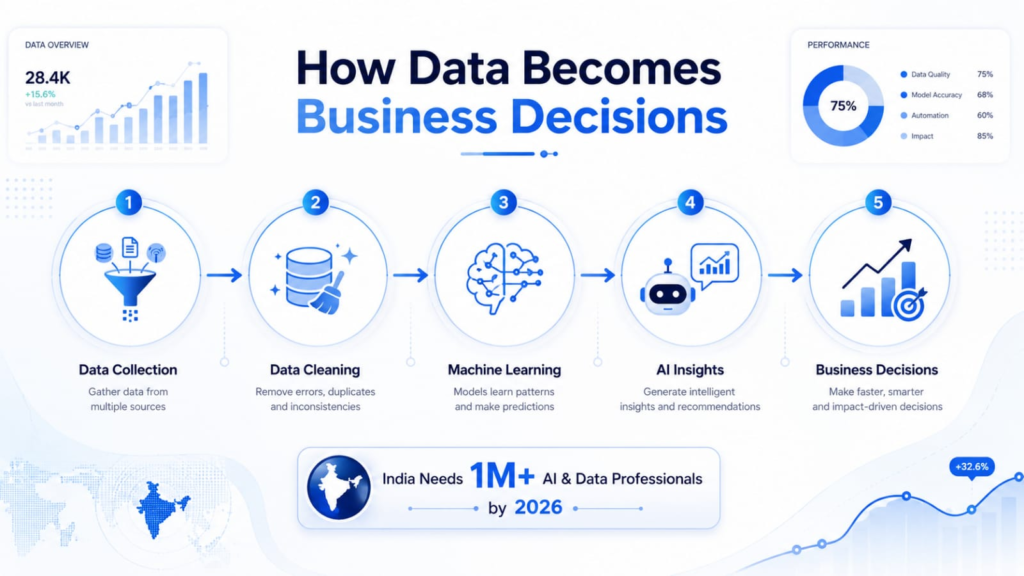
A modern data science course in 2026 looks very different from older analytics programs. It now includes Python, SQL, statistics, Pandas, machine learning, Power BI, NLP, deep learning basics, and increasingly Gen AI workflows involving LangChain and LLM integrations.
One major shift happened recently in Pune’s hiring ecosystem.
Global Capability Centres (GCCs) are aggressively hiring AI and analytics talent locally. JPMorgan, HSBC Tech, Goldman Sachs India, and Walmart Global Tech have all expanded data-related hiring significantly.
That changed salary expectations dramatically.
Freshers with strong portfolios, ML fundamentals, and Gen AI projects are entering the ₹8–15 LPA range in some product and GCC environments.
The average fresher salary still sits closer to ₹5–8 LPA overall, but the ceiling here is much higher than most fresher tracks.
This course usually takes 6–9 months, realistically.
One thing most institutes avoid saying openly: students who dislike problem-solving often struggle here. Memorisation does not work in data science interviews. Recruiters usually test thinking ability directly.
Students considering a data science and AI course in Pune should prioritise live projects and portfolio depth over marketing claims.
3. Software Testing (Manual + Automation)
This remains one of the smartest entry points for non-IT freshers.
And strangely, it is still underestimated.
A lot of students wrongly assume testing means “less technical” work. That misunderstanding disappears quickly inside real software companies.
Good testing engineers are extremely valuable because modern products cannot survive poor quality releases anymore.
Testing has also changed massively in 2026.
Earlier, manual testing alone could get someone placed. Today, automation tools, API testing, and AI-assisted testing are becoming standard expectations.
A solid software testing course now teaches SDLC/STLC concepts, test case writing, Selenium WebDriver, Postman API testing, JIRA workflows, automation frameworks, and basic performance testing. We compare both routes in software testing in Pune: manual, automation or both.
This path suits almost every academic background. BCom, BBA, BSc, and engineering graduates all can enter testing if the training quality is strong.
The biggest advantage here is speed.
Testing usually has the shortest route from training to placement. Many freshers begin interviews within weeks of course completion because companies continuously need QA resources.
Average fresher salaries in Pune range between ₹3.5–6 LPA, while automation-focused profiles increasingly move into ₹5–8 LPA territory.
Students looking for the fastest employability path often prefer a software testing course in Pune for freshers because coding barriers are lower initially, while career stability remains strong.
4. Cloud Computing & DevOps
This field became much bigger than most freshers realise.
Every company moving applications to the cloud needs professionals who understand deployment, scalability, infrastructure, security, automation, and monitoring.
Cloud and DevOps roles are particularly attractive for students who prefer systems, infrastructure, and operations over frontend product development.
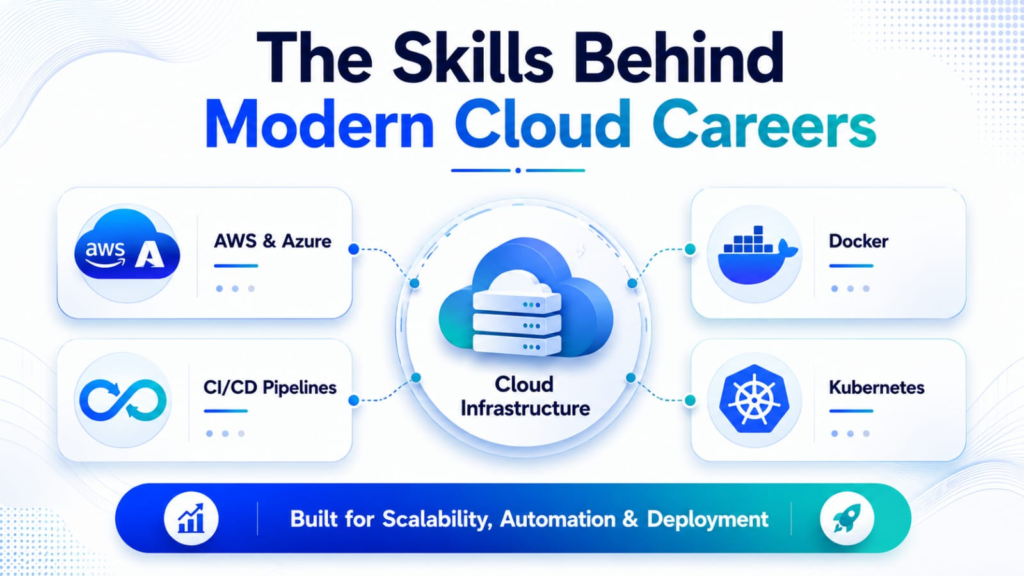
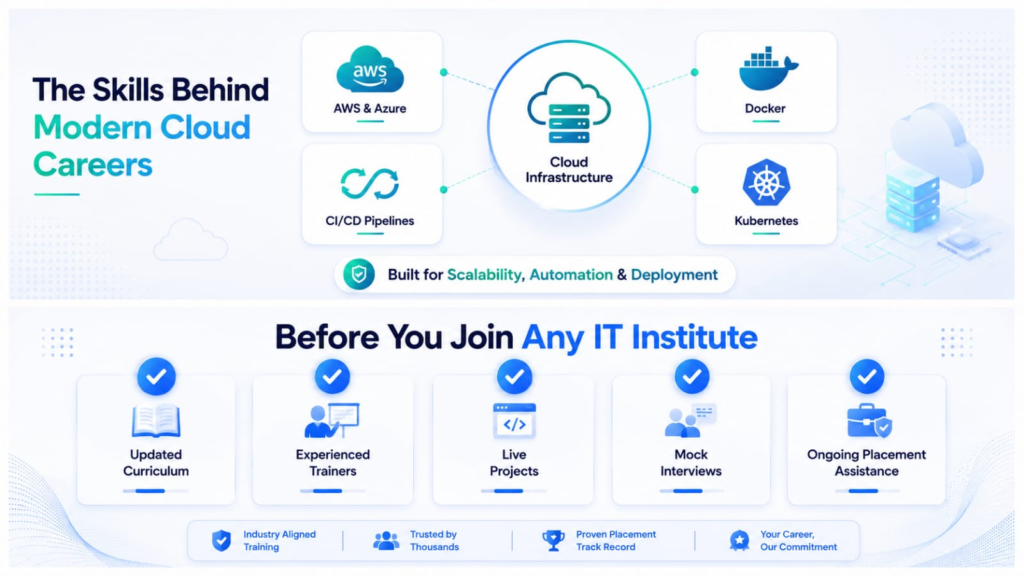
A modern cloud computing course includes Linux, AWS services, Azure basics, Docker, Kubernetes, Jenkins, CI/CD pipelines, infrastructure automation, and deployment workflows.
One interesting thing about this field is how heavily certifications influence hiring.
AWS certifications still carry strong credibility because they are objective skill indicators. Recruiters actively filter resumes using them.
That creates an advantage for freshers because certification-backed profiles reduce hiring uncertainty for companies.
Pune’s mid-sized tech ecosystem has especially increased demand for DevOps talent due to startup growth and SaaS expansion.
Freshers typically enter around ₹4–7 LPA, while candidates combining AWS certifications with Kubernetes and CI/CD knowledge often reach much higher packages.
This path generally takes 4–6 months.
Students researching cloud-focused career paths should evaluate whether the course includes hands-on lab environments and deployment projects before enrolling.
5. AI & Machine Learning Engineering
This has the highest ceiling on the list.
It also has the steepest learning curve.
A lot of freshers are attracted to AI because of the salary numbers without understanding how technical the field actually becomes at advanced levels.
Machine Learning Engineering is not just “using AI tools”. It involves mathematics, modelling, optimisation, training systems, deployment pipelines, and large-scale data handling.
The students who perform best here usually have strong logical reasoning and are comfortable with programming fundamentals.
A serious AI & ML engineering course includes advanced Python, supervised and unsupervised learning, deep learning, TensorFlow or PyTorch, NLP, computer vision, MLOps, LLM fine-tuning, and cloud deployment.
The market demand is real.
AI hiring across India has grown aggressively, and Pune’s GCC ecosystem is actively competing for strong AI talent.
Freshers entering product companies with practical AI deployment projects can reach the ₹10–18 LPA range surprisingly early compared to traditional IT paths.
But this track is usually not ideal for absolute beginners from non-technical backgrounds.
For most non-IT students, data analytics or testing provides a much safer starting point before transitioning toward AI later.
Which IT course is actually best for different backgrounds?
This is where most freshers make the wrong decision.
They choose based on hype instead of compatibility.
1. For CS/IT graduates
- Full Stack Development remains the fastest route to employment because job volume is enormous. Students who enjoy building applications generally do very well here.
- Data Science and AI work best for analytical students comfortable with logic-heavy problem solving and continuous learning.
- Cloud & DevOps suits students who prefer systems, deployment, infrastructure, and structured certification-based growth.
None of these paths is “better” universally. Personality fit matters more than students expect.
2. For non-IT freshers
- Software Testing remains the most practical starting point because entry barriers are lower while demand stays strong.
- Data Analytics is another excellent option because Excel, SQL, and Power BI can open doors without requiring deep programming initially.
A lot of non-IT students try jumping directly into advanced AI or hardcore development tracks because of salary expectations. That usually creates frustration halfway through training. Commerce graduates can start with our guide on moving into IT after BCom or BBA.
A stable entry point often produces faster long-term growth.
3. For working professionals switching careers
Career switchers usually care about two things: learning speed and salary improvement.
- Full Stack Development works well for professionals wanting maximum job volume and switch opportunities.
- Software Testing offers the quickest transition curve.
- Data Science often delivers the highest long-term salary jump, though learning intensity is much higher.
Weekend and hybrid learning formats become extremely important here because consistency matters more than course duration.
| Background | Best Course | Coding Needed | Duration | Avg Salary Jump |
| CS/IT Graduate | Full Stack / Data Science | Medium–High | 4–9 months | ₹4–10 LPA |
| Non-IT Fresher | Software Testing | Low | 3–5 months | ₹3.5–6 LPA |
| Working Professional | Data Science / Full Stack | Medium–High | 4–9 months | ₹5–12 LPA |
IT course fees in India in 2026
One thing students rarely hear honestly before joining a course: cheaper training often becomes more expensive later.
A ₹15,000 course with no placement support, weak projects, and outdated curriculum can easily waste an entire year.
Meanwhile, a structured ₹40,000–₹60,000 programme that leads to placement within months changes earning trajectory immediately.
| Course | Typical Fee Range | What’s Usually Included | Year 1 ROI |
| Full Stack Development | ₹28,000–₹70,000 | Live classes, projects, and placement support | 7–15x |
| Data Science & AI | ₹35,000–₹80,000 | AI projects, Gen AI modules, portfolio building | 8–15x |
| Software Testing | ₹18,000–₹45,000 | Manual + automation training | 8–12x |
| Cloud & DevOps | ₹25,000–₹60,000 | Certification prep, cloud labs | 7–12x |
| AI & ML Engineering | ₹45,000–₹1,00,000 | Deep learning + deployment modules | 8–18x |
Free courses vs. paid courses: the honest trade-off
Free learning platforms still have value. YouTube, NPTEL, and Coursera can teach fundamentals very well.
But free learning usually breaks at the exact point where freshers need help most: accountability, projects, mentorship, resume building, interview preparation, and placement access.
That is why structured programmes still dominate fresher hiring pipelines.
IT fresher salaries in Pune in 2026
Pune has quietly become one of India’s strongest fresher IT markets.
The interesting part is not just the number of jobs. It is the diversity of hiring environments.
Service companies still hire at scale around the ₹3.5–5 LPA range.
Mid-sized product companies increasingly hire around ₹5–9 LPA.
But the biggest shift came from GCC expansion.
Global Capability Centres operating in Pune now pay dramatically higher salaries for specialised roles involving cloud, AI, data engineering, and backend systems.
The salary gap between average and skilled freshers has widened massively.
Two freshers with the same degree can end up with completely different outcomes depending on portfolio quality and modern tooling exposure.
Some skills are consistently increasing fresher salaries in 2026:
- TypeScript over plain JavaScript
- AWS certifications
- Gen AI integration experience
- Strong GitHub project portfolios
- API development and deployment knowledge
Those small additions often change shortlist rates immediately.
How to choose the right IT training institute in Pune
Most freshers spend more time comparing fees than comparing outcomes.
That usually becomes a mistake later.
1. Updated curriculum matters more than branding
A course still centred around jQuery, outdated PHP stacks, or purely theoretical modules is already behind the market.
Students should check whether the curriculum includes Gen AI tools, cloud deployment, Docker, TypeScript, API workflows, and modern frameworks.
2. Placement proof should be transparent
The best institutes openly show where students are placed.
Not generic logos. Actual outcomes.
Students should ask how many placements happened recently, what roles students entered, and how placement support actually works after course completion.
A strong Teknowell’s placement track record matters more than marketing promises.
3. Trainers change the learning experience completely
Industry practitioners teach differently because they solve production problems daily.
They explain debugging differently. Architecture differently. Interview preparation differently.
That difference becomes visible very quickly inside projects.
4. Internship structure matters more than students realise
Internships happening during the course are far more valuable than vague “internship assistance” after completion.
Real project exposure builds confidence faster than theory.
5. Batch size quietly affects placement outcomes
Smaller batches generally produce better portfolios and stronger mentoring because students receive actual feedback instead of mass instruction.
That detail gets ignored surprisingly often.
Why do many freshers in Pune choose Teknowell?
A lot of freshers enter IT training with one fear underneath everything else:
“What if the course finishes and nothing changes?”
That fear is valid because many programmes stop at certification.
The stronger training models operate differently.
Teknowell focuses heavily on making students interview-ready through projects, internships, assessments, mock interviews, and continuous placement preparation instead of only classroom delivery.
Students struggling with “no experience” problems work on live projects during training itself, which changes resume quality immediately.
Mock interviews modelled on actual company formats also reduce rejection anxiety significantly because students stop walking into interviews blindly.
That preparation matters more than most freshers expect. A surprising number of candidates lose opportunities not because they lack technical skills, but because of avoidable interview mistakes, weak resumes, poor communication, or inconsistent preparation habits. This guide on the top mistakes freshers make while preparing for IT placements explains the patterns trainers repeatedly see during placement drives.
Another major advantage is curriculum updates.
Most institutes add AI modules as optional extras. Teknowell integrates Gen AI concepts directly into modern technical tracks because employers increasingly expect those skills already.
The institute also offers structured placement support rather than limited interview windows, which matters enormously for freshers still building confidence.
Students interested in exploring the environment first can book a free IT course demo in Pune before making any decision.