

If you have been thinking about a software testing career and someone hit you with “AI is going to replace testers,” you probably Googled this in a mild panic.
Fair enough. The headlines are alarming. And honestly, they are not entirely wrong, which is part of why this question is so hard to get a straight answer on.
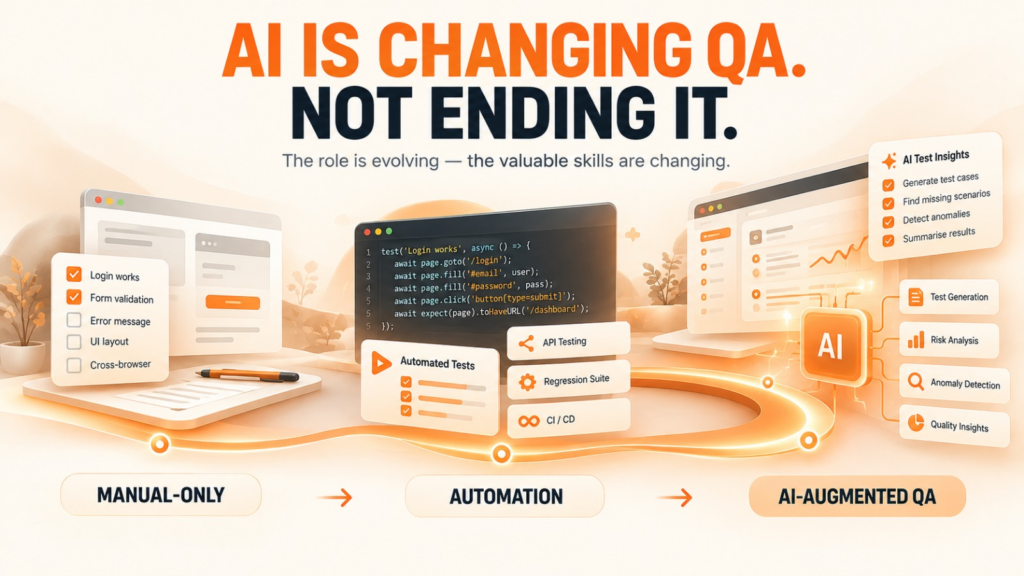
Here is the thing: AI is replacing certain testers. Specifically, it is replacing the repetitive, mechanical, checklist-execution layer of manual testing, the part that never required much judgment to begin with. At the same time, the same shift is creating urgent demand for a different kind of tester. Automation engineers, SDETs, and QA professionals who know how to work alongside AI tools are being hired faster than companies can find them, and they are earning significantly more than manual-only testers were earning two years ago.
So the honest answer to “will AI replace software testers” is: it depends entirely on which kind of software tester you are talking about.
Quick answer: will AI replace software testers in India in 2026?
Partially, and the split is specific. Manual-only testers doing repetitive script execution face compressing demand. Automation testers, SDETs, and AI-augmented QA engineers are in rising demand.
“QA Engineer with AI” job postings in India are up 180% in 2026. Automation and SDET engineers earn 50 to 100% more than manual-only testers.
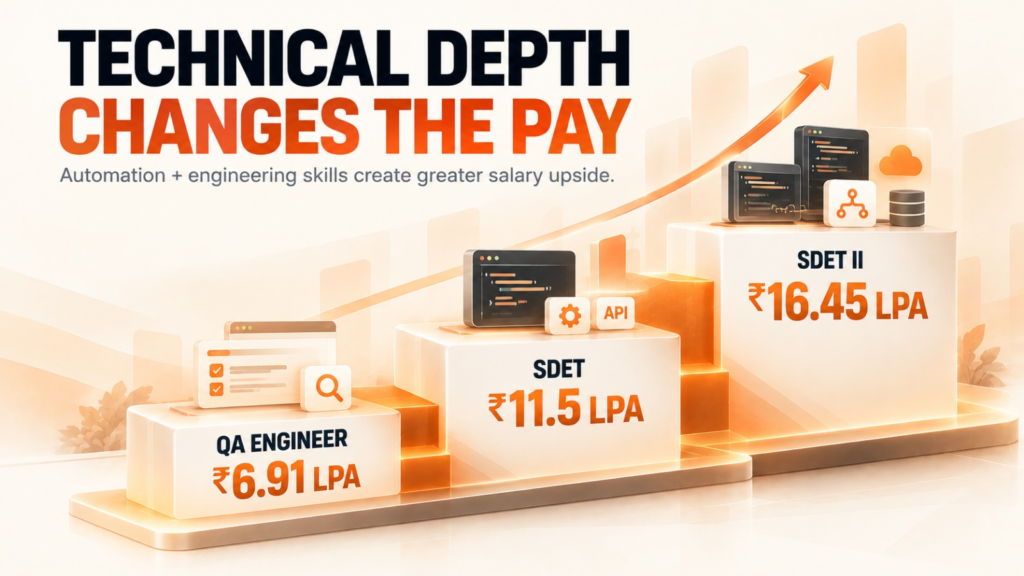
QA Engineer average salary in India: ₹6.91 LPA. SDET average: ₹11.5 LPA. SDET II: ₹16.45 LPA.
Bottom line: QA is a strong career, but only if you move beyond manual testing. The testers AI is not replacing are the ones who learned to use AI as a tool rather than compete with it.
What AI is actually doing to software testing right now
Before you can decide what this means for your career, you need to understand what AI is actually handling in QA today versus what it cannot touch.
What AI can already automate
Repetitive test case generation from requirements documents. Basic regression test maintenance, updating tests when the UI changes without a human having to rewrite every affected script. Log analysis. Visual UI testing across browsers and devices at a scale that would take a human team days. Reporting, test result summarisation, and anomaly flagging.
Three years ago, these tasks filled a significant portion of a junior manual tester’s week. Today AI tools handle them faster and more consistently. A QA team that needed four manual testers to run regression cycles every sprint may now run them with two people and a set of AI-assisted tools.
That is a real compression of certain roles. It would be dishonest to pretend otherwise.
What AI genuinely cannot do
AI is non-deterministic. It produces inconsistent outputs, hallucinates, and generates software that behaves unpredictably in edge cases. As AI generates more code and more tests, the harder problem becomes verifying that AI-generated artifacts are themselves correct, which actually increases the value of skilled testers rather than removing it.
Think about what that means practically. Every company that is using AI to write code now needs someone to test that code. And testing AI-generated code is not easier than testing human-written code. It is harder, because AI code can look correct and pass simple test cases while failing in edge cases no one thought to write a test for.
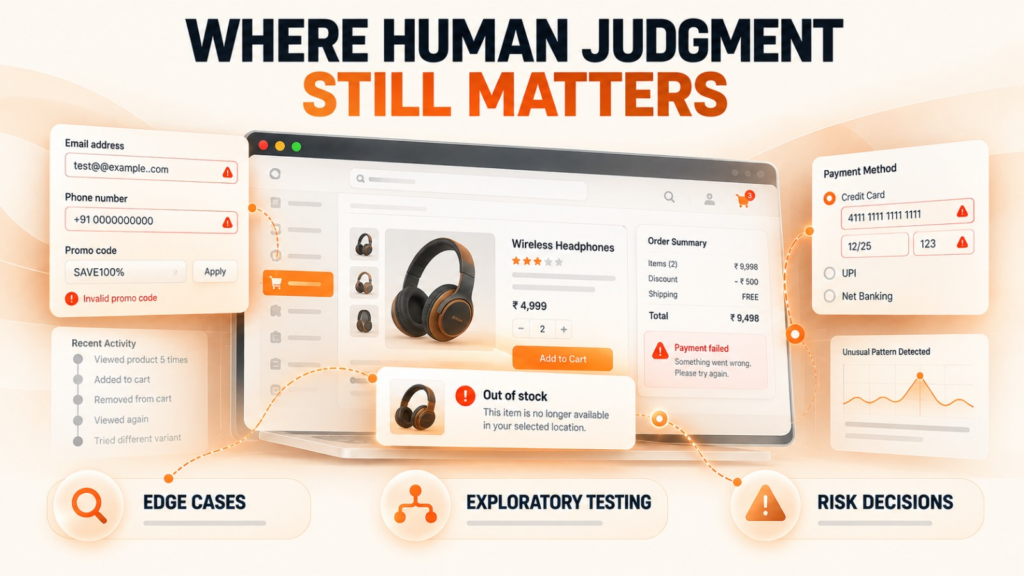
Exploratory testing is another area AI cannot replicate. This is the kind of testing where a skilled tester wanders through an application thinking like a frustrated user at 11 pm who clicks on the wrong thing and somehow ends up in a state the developers never anticipated. That instinct, that “what if I do this instead” thinking, comes from experience and human judgment. No amount of training data produces it reliably.
Test strategy and risk prioritisation also stay human. Deciding which features need the most rigorous testing given a two-week deadline, understanding the business cost of a bug in the payment flow versus a cosmetic issue on the dashboard, knowing when to push back on a release because the testing coverage is not adequate, all of that requires context and accountability that AI tools do not carry.
How AI Is Creating New Software Testing Jobs?
Here is the thing that makes this question genuinely complicated: AI is not just changing existing QA work. It is creating an entirely new category of it.
The demand for AI-aware testers has never been higher. With global software spending reaching $1.4 trillion in 2026, generative AI has become the foundation for building and shipping products at record speeds. Every one of those AI-built products needs to be tested. Someone needs to build the testing infrastructure for AI systems, validate that AI recommendations are trustworthy, and catch the places where AI-generated features behave correctly in isolation but break something unexpected downstream.
That person is a software tester. A more technically skilled one than the manual tester of five years ago, but a tester.
“QA Engineer with AI” job postings are up 180% in 2026. 78% of software testers use AI to enhance productivity. That second statistic is worth sitting with. The overwhelming majority of working testers are already using AI as a productivity tool. The testers who are losing jobs are not the ones using AI. They are the ones who have no automation skills and no AI tool familiarity, still doing purely manual work in a market that has moved on.
What QA Skills Are Companies Hiring for in India?
The roles being filled today concentrate heavily on automation engineers, SDETs, and AI-aware testers. The Global Capability Centre wave is the single biggest force shaping QA hiring in India today. Automation engineers and SDETs earn 50 to 100% more than manual testers in 2026.
In Pune specifically, the companies actively hiring QA professionals right now include Persistent Systems, TCS Digital, Infosys, Deutsche Bank India Technology, Barclays India, and a growing number of product startups in Hinjewadi and Baner. Scroll through current job postings at any of these companies, and the pattern is consistent: Selenium or Playwright, API testing with Postman or RestAssured, CI/CD integration, and increasingly, familiarity with AI-powered testing tools.
What is declining in these same postings: roles listing only manual testing skills with no automation requirement. These roles still exist at smaller companies and in IT services firms for very entry-level positions. But the volume is shrinking, and the salary differential between these roles and automation-heavy roles is widening every quarter.
The conclusion the market is delivering is not subtle. The QA function is not shrinking. The purely manual layer of it is. Every data point from India’s 2026 QA hiring market points toward the same place.
QA Engineer Salary in India: Manual vs Automation vs SDET
Numbers make the picture concrete.
According to Glassdoor India data from April 2026, the average QA Engineer salary in India is ₹6.91 LPA. The average SDET salary is ₹11.5 LPA. SDET II at mid-senior level reaches ₹16.45 LPA. These figures vary by company type, city, and portfolio, but the gap between manual and automation tracks is consistent across every salary source
| Role | Average salary India 2026 | Notes |
| Manual QA Engineer | ₹6.91 LPA | Glassdoor April 2026 |
| Automation QA Engineer | ₹8 to 13 LPA | Multiple 2026 sources |
| SDET | ₹11.5 LPA | Glassdoor April 2026 |
| SDET II (mid-senior) | ₹16.45 LPA | Glassdoor April 2026 |
| AI/ML testing specialist | +30 to 50% above SDET | Fastest-rising premium in 2026 |
The jump from manual to automation is not a small nudge. It is 50 to 100% more for comparable years of experience. And the AI/ML testing specialist premium, the salary bump for testers who specifically work on testing AI systems and AI-generated code, is the fastest-rising premium in the entire QA salary landscape in 2026.
For the full breakdown from fresher to senior across every testing track in India, the software testing salary guide on Teknowell has the detailed numbers by experience level and skill combination.
Which Software Testing Skills Are Safe From AI?
This is what the career decision really comes down to. Not whether to pursue QA, but which layer of QA to build toward.
Skills that are safe and growing
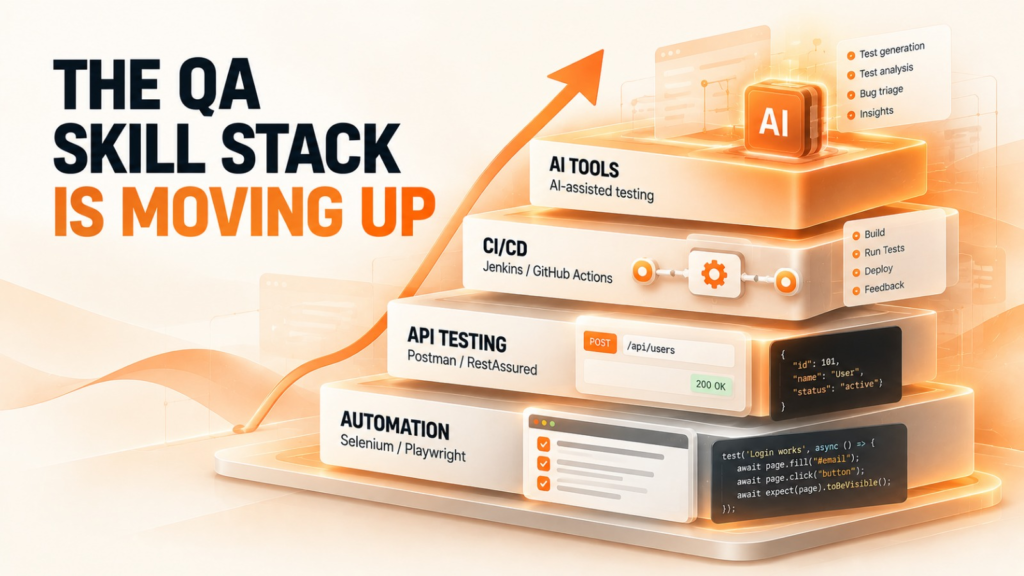
1. Automation testing with Selenium or Playwright. Selenium with Java or Python is the most asked-for skill in Indian QA interviews across IT services and product companies right now. Playwright is rising fast, particularly at product companies and startups. Either one done properly, with real project work and a GitHub portfolio, is the difference between a manual-only profile and an automation-ready one.
2. API testing with Postman or RestAssured. Most modern applications are API-first, which means most bugs live in the API layer rather than the UI. API testing is moving from a differentiator to a baseline requirement even at junior automation roles. Candidates with solid Postman and basic RestAssured knowledge are in a measurably stronger position than those without.
3. CI/CD integration. Writing automated tests is one thing. Integrating them into a Jenkins or GitHub Actions pipeline so they run automatically on every code push is another. Testers who work at this intersection of QA and DevOps are rare at the junior level and consistently offered more than those who work in isolated test environments.
4. AI-augmented testing familiarity. Testsigma, Copilot for test generation, AI-assisted test case creation, these tools are being adopted across product companies and GCCs. Testers who can direct these tools, validate their output, and embed them into a testing workflow are being fast-tracked into senior positions at a pace that the traditional manual-to-automation ladder did not allow.
5. Skills that are under pressure
Manual test script execution with no automation component. Repetitive regression testing from a fixed checklist. Test case writing that follows a template without understanding the feature or the risk it carries. These are the tasks most at risk from AI automation, and they are the tasks that most purely manual testing job descriptions still revolve around. The market for these roles is not gone, but it is compressing, and the salary ceiling is low
Is QA actually worth pursuing? The honest answer for someone deciding
The fear version of this question is “will AI take my job.” The useful version is “what does the QA career look like for someone who starts training now.”
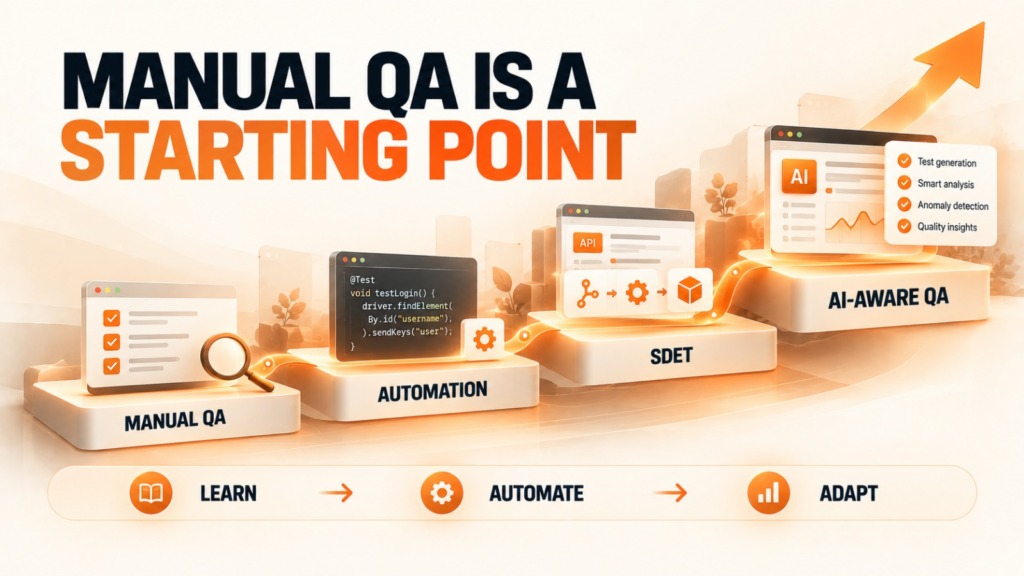
Manual testing as a starting point is still a valid entry into the field. It builds foundational skills, SDLC, STLC, test case writing, bug reporting, and understanding what software quality actually means, that are prerequisites for everything in automation. The mistake is treating manual testing as the destination rather than the first twelve to eighteen months of a longer journey.
Automation testing is where the career becomes genuinely strong. Selenium, API testing, CI/CD integration, and growing AI tool familiarity form the skill stack that unlocks the salary numbers in the table above. The path from manual to automation is documented, learnable, and consistently producing well-employed engineers across Pune’s QA market.
For freshers worried that QA is a dead end because of AI: the data says the opposite. The QA function is not shrinking; it is shifting. Demand for AI-augmented automation engineers is rising faster than supply in India right now. The risk is real only for testers who do not adapt, and adapting has a clear, learnable path.
If you want to understand what companies in Pune actually ask QA candidates in technical interviews before committing to the path, the IT interview questions for freshers guide covers what QA technical rounds look like at IT services companies and startups.
If the direction makes sense and you want to build toward it with structured guidance rather than figuring out tool combinations alone, Teknowell’s placement preparation in Pimpri Chinchwad covers automation testing, API testing, CI/CD basics, and mock technical interview rounds modelled on what Pune companies are testing for right now.
Book a free demo class at Teknowell and see what the programme involves before making any decision.
Will AI Replace Software Developers? How QA Compares
The same fear cycle happened with developers two or three years ago. Would AI replace coders? Would ChatGPT put junior developers out of work? The answer that emerged from actual market data was the same pattern playing out in QA now: developers who learned to use AI as a tool became more productive and more valuable, while those who ignored it fell behind. The role did not disappear. It evolved.
Software testing is following a similar curve. If you are also considering development as a career, our guide on whether AI will replace software developers in India looks at how AI is changing developer roles, the skills that are becoming more valuable, and what this means for freshers.
Future of Software Testing in India: What Should Freshers Do?
Here is the thing about the “will AI replace testers” panic: it is asking the wrong question.
AI does not decide whether software testing is a good career. The market decides that, and the market in India in 2026 is paying ₹11.5 LPA on average for SDETs and adding a 30 to 50% premium for testers who work on AI systems. That is not a market that is phasing out the profession. That is a market that is aggressively upskilling it and paying accordingly.
The testers AI is replacing were always in a vulnerable position because their value came from execution speed, not judgment. The testers AI is not replacing are the ones who were always doing the harder work, designing tests, catching edge cases, building automation infrastructure, understanding what a product should do and whether it is doing it.
If you are starting now, you get to choose which kind of tester to become. That choice is the whole answer.
Book a free demo at Teknowell, Pimpri Chinchwad, and see how the QA preparation programme is structured before you decide anything.