

You may have started looking into QA because someone told you it is one of the easier ways to enter IT without becoming a programmer. Then you searched for software testing and immediately ran into Selenium, Java, Python, automation frameworks, and CI/CD.
That is usually the point where beginners think, “Okay, so I need to code after all.”
Not necessarily.
Software testing without coding is a real starting point, particularly through manual testing. A BCom, BBA, BSc, arts, or other non-CS graduate can learn the fundamentals, practise them on real applications, and apply for suitable QA roles. The important part is knowing what employers actually expect at entry level, rather than trying to learn every testing technology before applying.
What manual software testing actually is and what your day would look like
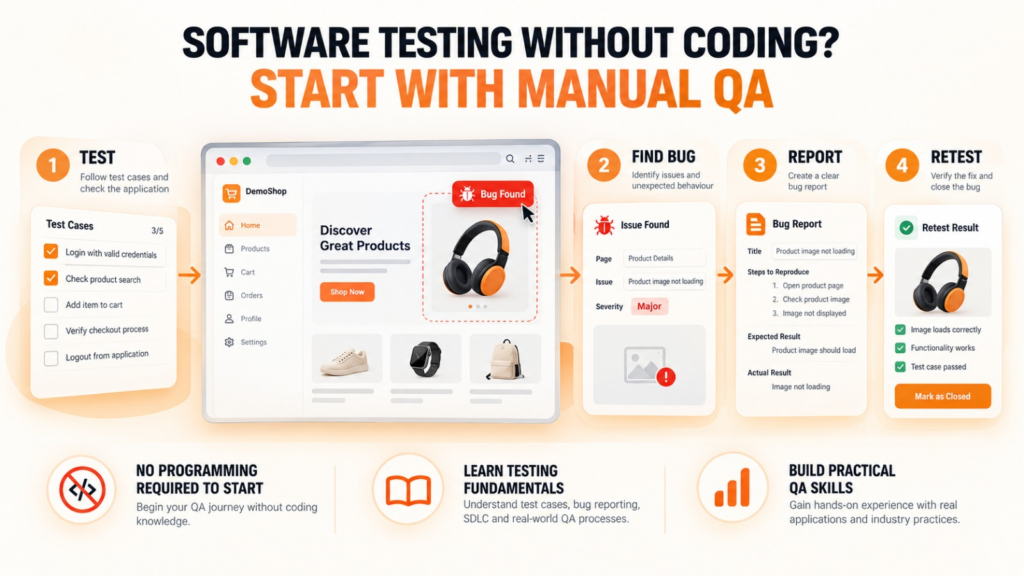
Manual software testing means checking an application yourself to find problems before users do. You do not build the feature. You check whether it works the way it is supposed to work.
Imagine a fintech company has just added a new loan application form. A tester might check whether the form accepts valid information, rejects an incorrect PAN number, shows the right error when a required field is empty, saves the application correctly, and behaves properly when a user clicks Back or Refresh at the wrong time.
The tester is basically asking, “What happens if I do this?”
The daily work
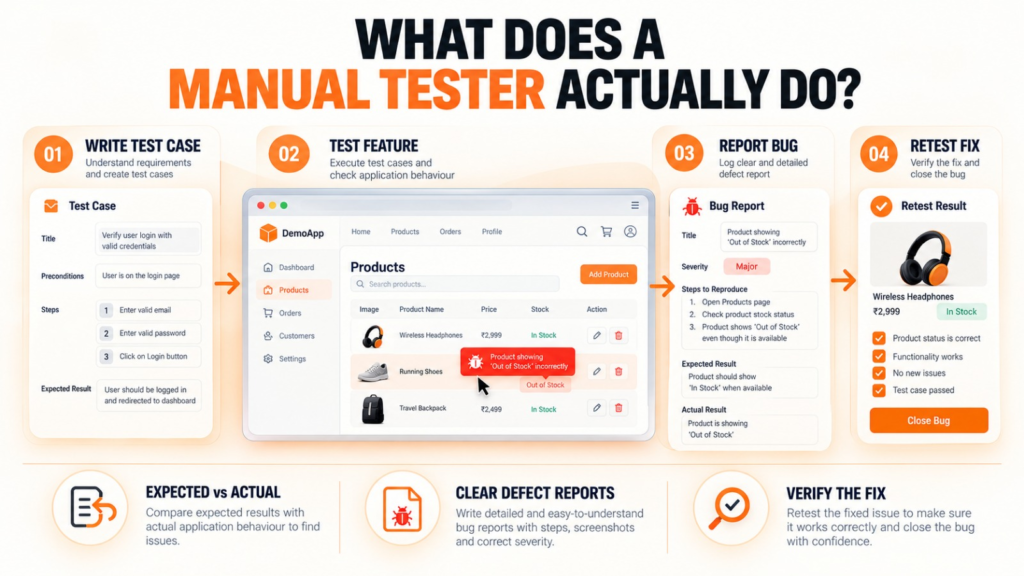
A typical manual tester writes and executes test cases. A test case is simply a documented set of steps for checking one part of an application.
If the feature is a login page, one test case might be:
- Enter a registered email address.
- Enter the correct password.
- Click Login.
- Check whether the user reaches the dashboard.
Then you test the less obvious cases. Wrong password. Empty password. Invalid email. Very long password. Multiple failed attempts.
If something behaves incorrectly, you create a bug report in a tool such as Jira. You explain what happened, how to reproduce it, what you expected and what actually happened. After the developer fixes it, you test the same issue again.
That is the basic QA loop. Test, find something wrong, report it, retest it.
What makes someone good at this?
You need to notice details, think logically, and explain problems clearly. Those skills are not exclusive to computer science graduates.
Someone from finance may be good at checking whether a payment calculation makes sense. Someone from BBA may naturally think about customer journeys. Someone from writing or operations may already be comfortable documenting things clearly.
You still need technical knowledge, but you do not need to arrive with a programming background.
The difference between manual testing and automation testing, and why it matters for beginners
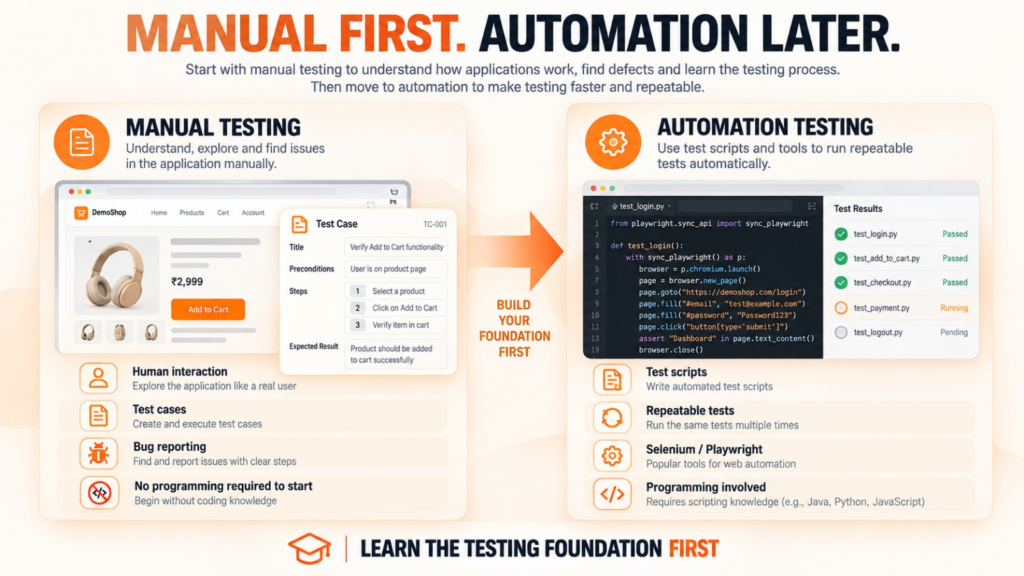
The simplest difference is: manual testing is performed by a person, while automation testing uses code and tools to run tests automatically.
Manual testing
In manual testing, you interact with the software yourself. You click buttons, enter information, check results, compare expected and actual behaviour, and report defects.
This is why manual testing can be a sensible entry point for someone who has never written code.
You still need to understand testing concepts. “No coding” does not mean “no technical learning.”
Automation testing
Automation testing involves creating scripts that perform tests automatically. Selenium, Playwright, and Cypress are examples of tools used in web testing, and programming languages such as Java, JavaScript or Python may be involved.
Current Pune QA listings also show how the two areas increasingly overlap. For example, a recent ZenTrades QA opening listed manual testing alongside Cypress, Selenium, Playwright, JavaScript, API testing, Postman, and SQL.
That does not mean a fresher should learn all of those things on day one.
A practical route is to learn manual testing first, get comfortable with how QA teams work, and then add automation skills as your career develops. The exact timeline varies by role and employer, so treat automation as a progression, not a guaranteed salary shortcut.
Skills you actually need to get hired as a manual tester in Pune
For an entry-level manual testing role, focus on the skills that let you actually perform testing work.
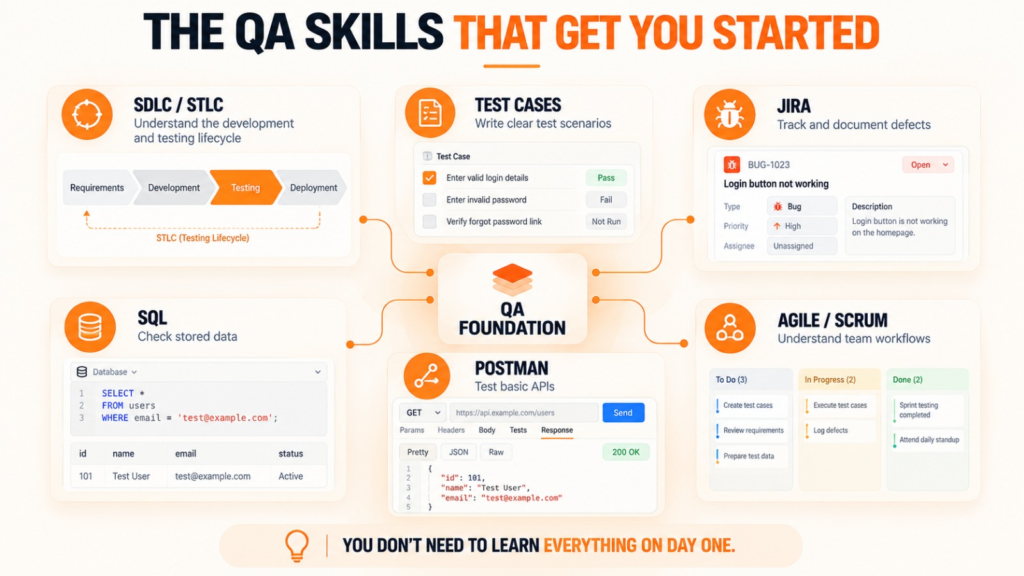
SDLC and STLC are a good starting point. SDLC means Software Development Life Cycle, the overall process through which software is planned, built, and maintained. STLC means Software Testing Life Cycle, the testing activities carried out during that process.
You should also be comfortable writing test cases, understanding functional testing, regression testing, smoke testing, and UAT, and reporting defects properly.
Jira is worth learning because bug tracking tools are part of everyday QA work. You should know how to describe a defect clearly rather than simply writing, “Login is not working.”
A few additional skills can make your profile stronger:
- Basic SQL: enough to run simple queries and check whether information was stored correctly in a database.
- Postman: useful for basic API testing. You can send requests and inspect responses without being a programmer.
- Agile and Scrum: useful for understanding sprints, standups, backlogs, and how QA fits into a development team.
You do not need to master Selenium, Java, Python, or CI/CD before learning the basics of manual testing. However, do not assume those skills will never matter. Some current QA roles combine manual testing with automation, API testing, and programming, especially beyond entry level. A recent Pune QA listing from Thinkitive, for example, included manual testing, SDLC/STLC, Jira-type tools, database knowledge, and API or automation exposure among its requirements.
Who is actually hiring manual testers in Pune in 2026
There are genuine QA opportunities in Pune, but the job market is not as simple as “learn manual testing and every company will hire you.”
Current listings show a mix of manual, automation, and hybrid QA roles. Thinkitive has had Pune openings focused on manual testing, while ZenTrades has advertised QA work combining manual and automation testing. NonStop io Technologies has also listed Pune QA positions involving manual testing and Playwright.
There are fresher and trainee opportunities too, although eligibility varies. A recent Amura Marketing Technologies Web QA trainee listing in Pune, for example, involved test cases, web application testing, SQL, and SDLC, but its specific eligibility was aimed at technical degree backgrounds.
So do not assume that every company accepts “any graduate.” Read the eligibility section carefully before applying.
You can also check current fresher software testing jobs in Pune on Internshala to see what entry-level employers are asking for at the time you apply.
Salary: what manual testers actually earn in Pune in 2026
There is no single salary that every fresher will receive. Company, location, experience, technical skills and the exact QA role all make a difference.
Glassdoor’s India Manual QA Tester data currently shows 50 submitted salaries, while recent entries include manual QA salaries from different Indian cities and experience levels. Its Pune data also contains individual reported salaries, showing why a single “Pune average” should not be treated as a guaranteed fresher package.
The salary figures in the supplied market data are roughly:
| Experience | Manual Testing | Manual + Automation | Automation-focused |
| Fresher, 0 to 1 year | ₹3 to 5 LPA | ₹4 to 6 LPA | ₹4 to 7 LPA |
| 1 to 3 years | ₹4.5 to 8 LPA | ₹6 to 10 LPA | ₹8 to 14 LPA |
| 3 to 5 years | ₹7 to 12 LPA | ₹10 to 16 LPA | ₹12 to 20 LPA |
These are market ranges, not promises. Actual offers can fall outside them.
If you want a broader look at testing salaries, including different QA roles and experience levels, see Teknowell’s software testing salary guide.
Can a BCom, BBA, or arts graduate become a software tester? Real answer.
Yes, a non-IT graduate can move into software testing, but the degree alone will not get you the job. You need to prove that you understand testing and can actually perform basic QA tasks. Coming from commerce? Read how to switch to IT after BCom or BBA as well.
Think about a BCom graduate testing a finance application. Their commerce background may help them understand invoices, payments, taxes or accounting workflows. A BBA graduate may already understand customer journeys and business processes.
That background can be useful. It does not replace testing knowledge, though.
During an interview, you may be asked to write test cases for a login page, explain the difference between regression testing and retesting, or describe how you would report a bug. If you cannot answer those questions, having a BCom or BBA degree will not solve the problem.
There is another important point: eligibility varies by company. Some openings accept broader graduate backgrounds, while others specifically ask for BCA, BTech, BE or another technical degree. Check each job description instead of assuming that “QA” always means “any graduate.”
How to get your first manual testing job in Pune: realistic steps
Give yourself a few months to build the foundation rather than trying to finish everything in a few weeks.
Start with SDLC, STLC, test cases, testing types and defect reporting. Then practise. Open a website or app you already use and write test cases for its login, search, checkout or registration process.
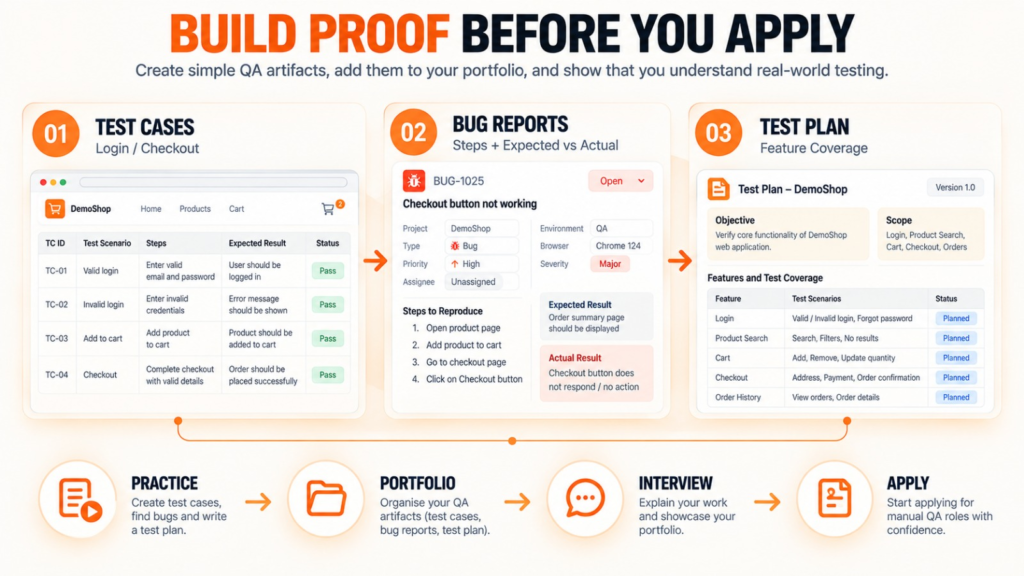
Create a small portfolio with two or three pieces of work. You could include test cases for an e-commerce checkout, sample Jira-style bug reports and a basic test plan. It gives you something concrete to discuss when an interviewer asks, “Have you actually practised testing?”
Then add basic SQL, Postman and Agile concepts.
Your resume should show these skills clearly instead of filling the skills section with phrases such as “hardworking” and “quick learner.” Students preparing for their first IT role can also use Teknowell’s guide on how to write a resume for your first IT job.
Interview preparation matters just as much. Expect questions around SDLC, STLC, test cases, regression testing, retesting, defect life cycle and practical testing scenarios. You can also review Teknowell’s guide to what IT interviewers actually ask freshers in Pune.
Then start applying across company career pages and job platforms rather than waiting until you feel “100% ready.”
A useful checkpoint
Before applying, ask yourself three things:
Can I write a sensible test case? Can I explain a bug clearly? Can I explain how I would test a simple feature?
If the answer is yes, you have something much more useful than simply saying “I completed a software testing course.”
If you want structured practice with test cases, Jira, SQL, API testing and interview preparation, you can book a free demo class at Teknowell and understand what the learning path involves before deciding.
Manual testing to automation testing: the career path that opens after your first job
Manual testing does not have to be the end of your career. It can be the starting point.
Once you understand how software is tested in a real project, automation becomes easier to understand because you already know what needs to be tested. You can then learn a programming language and tools such as Selenium or Playwright, depending on the roles you target.
Later, QA careers can branch into API automation, performance testing, test infrastructure, SDET roles or QA leadership. The timeline is different for every person, and moving into these areas requires genuine technical practice.
The important thing is not to look at the entire path on day one and panic.
You do not need to become a manual tester, automation engineer, API tester and programmer before applying for your first job. Learn the first layer properly, get practical experience, and add the next layer when it makes sense.
If you discover that you actually enjoy building software more than testing it, you can also explore full-stack development courses in Pune as a different technical career route.
The coding part can come later.
If you started researching QA and stopped when you saw Selenium or Java, that does not mean software testing is closed to you. Manual testing gives beginners a way to understand how QA actually works before they decide whether automation is the direction they want to take. When you are ready for that next step, our guide on manual vs automation testing courses in Pune explains how the two fit together.
The sensible goal is not to avoid technical skills forever. It is to learn them in the right order.
Start with the testing foundation. Practise it. Build enough confidence to discuss real testing situations in an interview. Then decide whether you want to add automation and greater technical skills.
If you want help understanding what structured QA preparation looks like, you can book a free demo class at Teknowell, Pimpri Chinchwad.