
Short answer: To become a Generative AI engineer, learn Python first, then learn how large language models (LLMs) work, build retrieval (RAG) apps, build AI agents, learn to fine-tune open models, and finally deploy what you build. Finish with three portfolio projects on GitHub. Most freshers need 6 to 12 months on their own, or about 3 months of focused learning in a structured course plus project time.
Every week, a student walks into our Chinchwad centre and asks the same thing: “I keep hearing about GenAI jobs. Where do I even start?” The internet does not help much. One video says learn maths for a year, another says just learn prompts, a third tries to sell you a certificate in a weekend. None of that is how people actually get hired.
This guide is the roadmap we give those students. It is written for freshers and early-career developers in India, it is honest about how long things take, and it skips the hype. Read it once end to end, then come back to the step you are on.
What does a Generative AI engineer actually do?
A Generative AI engineer builds software products on top of large language models. Think of a chatbot that answers from a company’s own documents, a tool that reads invoices and fills a spreadsheet, or an AI agent that books meetings. The engineer does not usually train a model from scratch. They pick the right model, connect it to data and tools, test that the answers are correct, and ship it so real users can use it.
A normal week might include writing Python code that calls a model, cleaning up a messy set of PDFs so the chatbot can search them, checking why the bot gave a wrong answer on Tuesday, and cutting the monthly bill because the prompts were longer than they needed to be. It is a building job, much closer to software development than to research.
In simple terms, a data scientist finds answers in data, while a GenAI engineer builds apps that use AI to do a job.
Why this career is worth it in 2026
The demand numbers are not small, and they come from sources worth trusting:
- AI Engineer is the 2nd fastest-growing job in India, just behind Prompt Engineer, in LinkedIn’s Jobs on the Rise 2026 list. The top skills LinkedIn lists for the role are LLMs, PyTorch and deep learning.
- India’s AI talent pool needs to roughly double. A Nasscom and Deloitte report projects it growing from about 6 to 6.5 lakh people today to over 12.5 lakh by 2027, and says demand is still growing faster than supply.
- AI and machine learning specialists are among the three fastest-growing jobs worldwide, according to the World Economic Forum’s Future of Jobs Report 2025. The same report names AI and big data as the fastest-growing skill.
- 84% of developers now use or plan to use AI tools, and 51% of professional developers use them daily, per the Stack Overflow Developer Survey 2025. Companies need people who can build these tools, not only use them.
If you are worried AI will take developer jobs, read our take on whether AI will replace software developers in India. The short version: the people who build with AI are the ones being hired.
Skills you need: a quick checklist
Before the step-by-step plan, here is the full list in one place. You do not need all of it on day one. You need it by the time you apply for jobs.
| Skill | Why it matters | Tools to learn |
|---|---|---|
| Python | Almost every GenAI library is built for it | Python, requests, pandas |
| LLM basics and prompting | You cannot build on something you do not understand | OpenAI or Gemini API, open models |
| Retrieval (RAG) | The most common GenAI project in companies | FAISS, Qdrant, embeddings |
| AI agents | Models that take actions, not just answer | LangGraph, CrewAI |
| Fine-tuning and open models | For private data and lower costs | Hugging Face, Ollama, Unsloth |
| Evaluation | Proving your app gives correct answers | Ragas, test sets |
| Deployment and monitoring | Turning a demo into a product | FastAPI, Docker, LangSmith, vLLM |
| Git and GitHub | How recruiters see your work | Git, GitHub, README files |
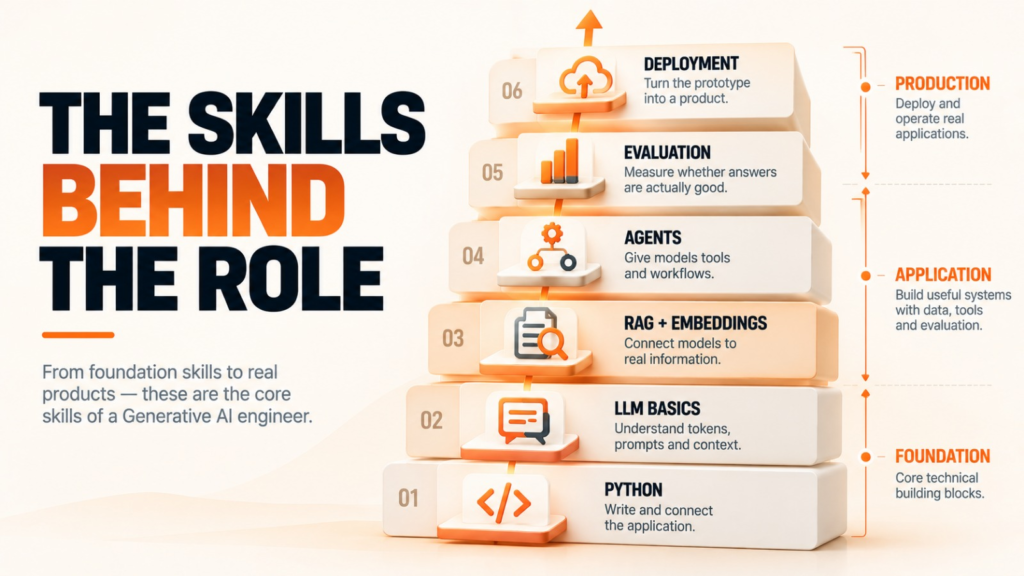
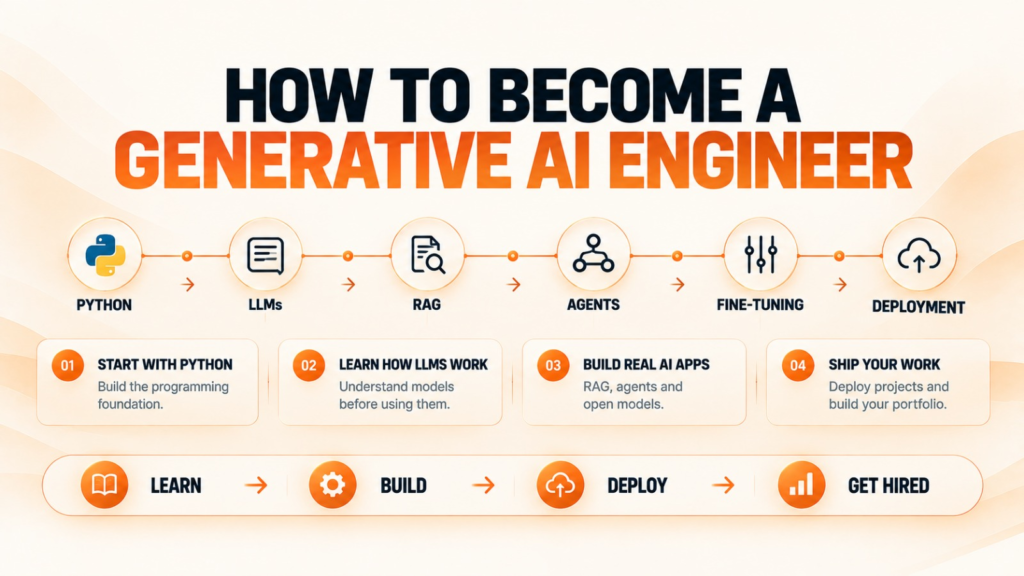
How to become a Generative AI engineer: the 6-step roadmap
The time for each step is a typical range for a fresher studying 2 to 3 hours a day. Move on when you pass the checkpoint, not when the calendar says so.
Step 1: Get comfortable with Python (3 to 4 weeks)
Almost every GenAI tool is written for Python. You need variables, loops, functions, lists and dictionaries, reading files, and calling an API with the requests library. You do not need advanced data structures yet. If you are still choosing a language, our comparison of Java vs Python for freshers explains why Python wins for AI work.
Also learn the small habits that save hours later: virtual environments, installing packages with pip, keeping API keys in a .env file instead of inside your code, and pushing your work to GitHub every day.
Common trap: spending two months on Python theory. Once you can read and write simple scripts, move on and learn the rest while building.
Checkpoint: you can write a script that calls a public API, reads the JSON reply and saves it to a CSV file.
Step 2: Understand how LLMs work (2 weeks)
Learn what tokens, embeddings and context windows are, why models make things up (hallucinate), and how temperature changes an answer. Then learn prompting properly: clear instructions, examples in the prompt, and asking for structured output such as JSON. You do not need to derive the maths behind transformers to build good products, but you should be able to explain the idea in plain words.
Try the same task on two or three different models and compare the answers, the speed and the cost. That habit alone will put you ahead of most freshers, because choosing the right model is a real part of the job.
Common trap: treating the model like a search engine. It predicts text; it does not look anything up unless you give it the information. That is exactly why Step 3 exists.
Checkpoint: you can call an LLM from Python and get back clean JSON that your code can use.
Step 3: Build retrieval apps with RAG (3 to 4 weeks)
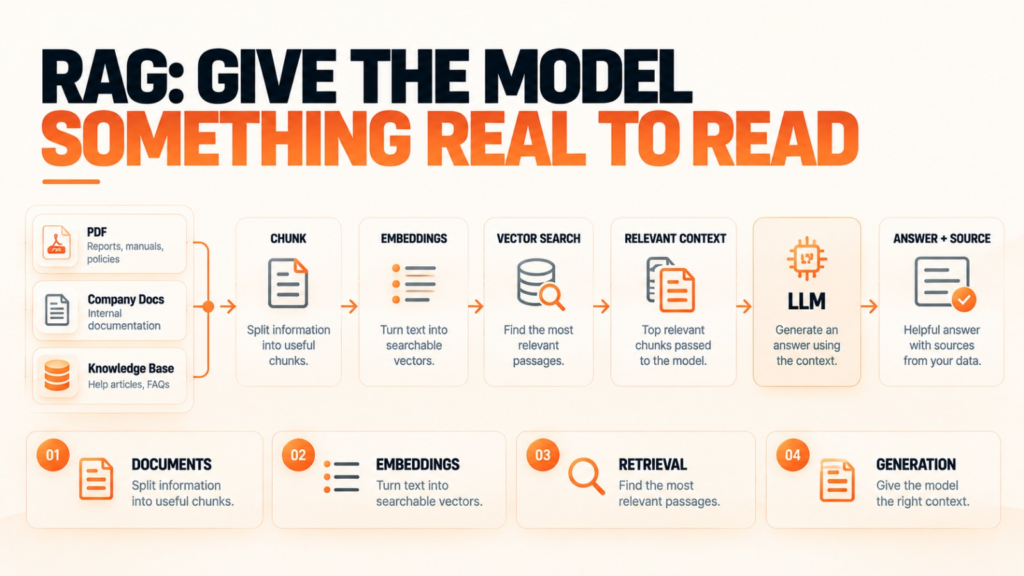
RAG (retrieval-augmented generation) means the model looks things up in your documents before it answers. It is the most common GenAI project in companies today because it lets a chatbot answer from private data. Learn how to split documents into chunks, turn them into embeddings, store them in a vector database such as FAISS or Qdrant, and pass the best matches to the model.
Then learn to measure answer quality with a tool like Ragas, because “it looks right” is not a test. Build a small set of 20 to 30 questions with known correct answers and check your app against it every time you change something.
Common trap: blaming the model when answers are wrong. Most bad RAG answers come from bad chunking or bad retrieval, so check what was retrieved before you touch the prompt.
Checkpoint: a chatbot that answers questions from a 50-page PDF and shows which page each answer came from.
Step 4: Build AI agents (3 weeks)
An agent is an LLM that can decide which tool to use next: search the web, run code, query a database, send an email. Frameworks such as LangGraph and CrewAI help you build agents that follow steps and recover from mistakes.
Agents are still new: the same Stack Overflow survey found only 14.1% of developers use AI agents daily at work, which is exactly why this skill stands out on a fresher’s CV. Start with one agent and two tools. Add more only when the simple version works every time.
Common trap: giving an agent too much freedom. Good agents have clear limits: which tools they can use, how many steps they can take, and when they must stop and ask a human.
Checkpoint: an agent that takes a question, searches two sources, compares them and writes a short report.
Step 5: Work with open models and fine-tuning (2 to 3 weeks)
Not every company can send data to a paid API. Learn to run open models on your own machine with Ollama, find models on Hugging Face, and fine-tune a small model with LoRA using a library such as Unsloth. Learn when fine-tuning is worth it and when better prompts or RAG are enough, because interviewers love that question.
A simple rule to remember: use RAG when the model needs new facts, and fine-tuning when it needs a new style, format or behaviour. Many real projects use both.
Common trap: fine-tuning first. It is slower and costlier than fixing the prompt or the retrieval, so try those before you train anything.
Checkpoint: a small model fine-tuned on your own dataset, with a before-and-after comparison.
Step 6: Deploy, monitor and control costs (2 weeks)
A project on your laptop is a demo. A project with a URL is a product. Wrap your app in an API with FastAPI, put it in a Docker container, and deploy it. Add tracing with a tool like LangSmith so you can see every prompt, answer, delay and cost. Serving tools such as vLLM matter once many users hit the model at once.
Keep an eye on the numbers companies care about: how long an answer takes, how much each request costs, and how often the app fails. Being able to talk about these in an interview shows you think like an engineer, not a student.
Common trap: leaving API keys in public GitHub code. Bots scan GitHub for keys within minutes, and the bill lands on you.
Checkpoint: a live link you can paste on your CV, plus a note on what each request costs.
A 12-week study plan you can follow
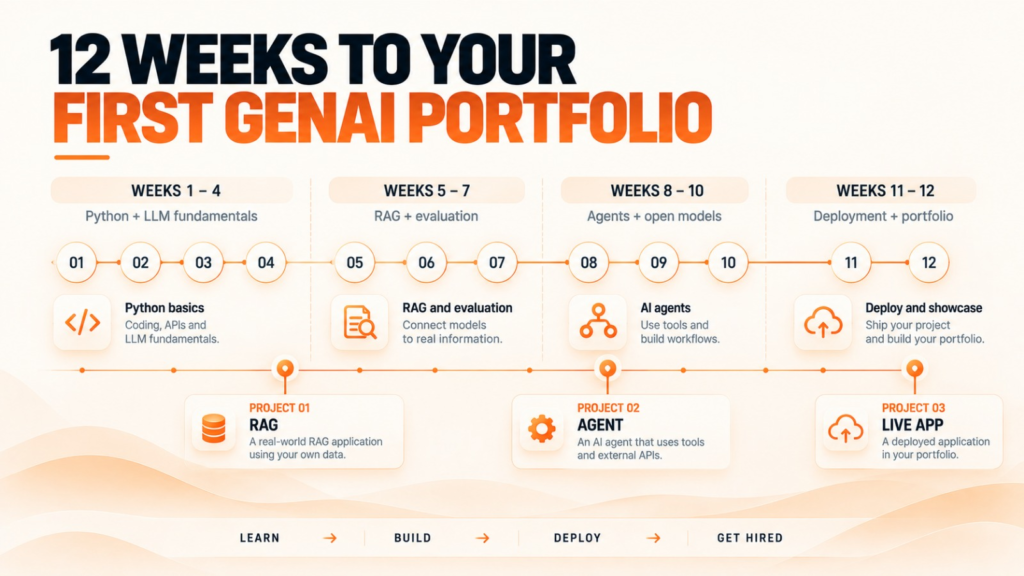
If you can give 4 to 5 hours a day, the six steps fit into about 12 weeks. At 2 to 3 hours a day, expect roughly double. Either way, keep the order.
| Week | Focus | What you finish that week |
|---|---|---|
| 1 to 2 | Python basics, APIs, Git | A script that pulls data from an API into a CSV |
| 3 | LLM basics and prompting | Compare three models on the same task |
| 4 | Structured output | A small tool that turns messy text into clean JSON |
| 5 to 6 | RAG: chunking, embeddings, vector databases | A PDF question-answer bot |
| 7 | Evaluation | A 30-question test set and scores for your bot (Project 1 done) |
| 8 to 9 | AI agents | A research agent with two tools (Project 2 done) |
| 10 | Open models and fine-tuning | A small fine-tuned model with before-and-after results |
| 11 | Deployment and monitoring | Your best project live on a public URL (Project 3 done) |
| 12 | Portfolio and interviews | READMEs, demo videos, CV and mock interviews |
Build three portfolio projects
Recruiters hiring freshers for GenAI roles look at GitHub before they look at marks. Three solid projects beat ten half-finished tutorials:
- A RAG assistant for a real domain, for example a college rulebook or a product manual, with answer-quality scores.
- A multi-step agent that uses at least two tools and handles failures without crashing.
- A fine-tuned or locally hosted model with a short write-up of what improved and what it cost.
Give each project a clear README that says what problem it solves, how to run it, what results you measured and what you would improve next. Add a short demo video and a live link. If you are wondering how to get noticed without work experience, our guide on getting an IT job without experience covers the CV and interview side.
Interview questions you should be ready for
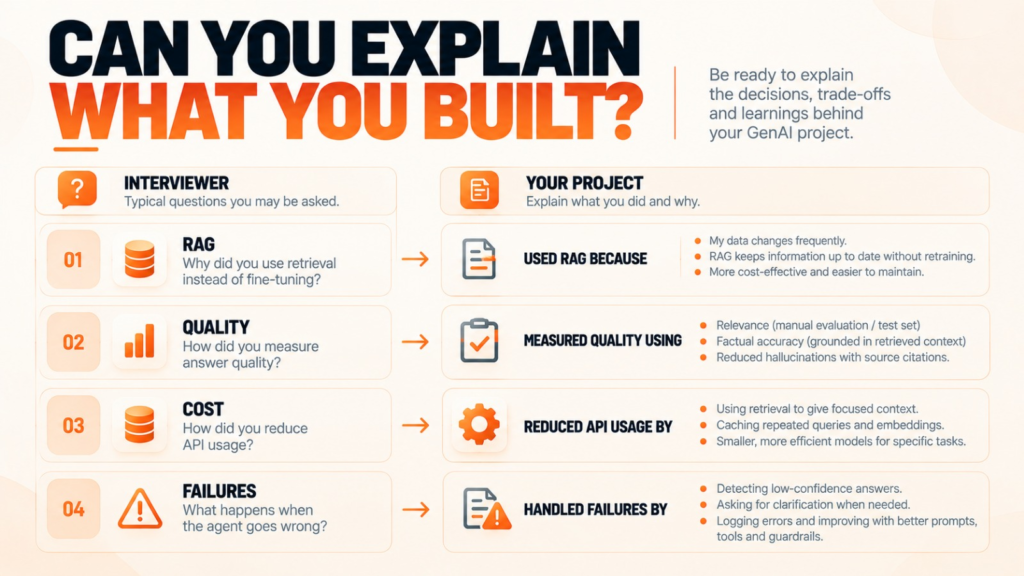
GenAI interviews for freshers are usually practical. Expect questions about your own projects and the choices you made.
These come up again and again:
- What is RAG and when would you use it? Explain it in two lines, then describe your own RAG project.
- How do you stop a model from hallucinating? Talk about retrieval, clear prompts, asking the model to cite sources, and testing with known answers.
- RAG or fine-tuning: how do you choose? New facts point to RAG; a new style or format points to fine-tuning.
- What are embeddings? Numbers that capture the meaning of text, so similar sentences sit close together.
- How do you measure if your chatbot is good? Describe your test set and the scores you tracked.
- How would you cut the cost of an LLM app? Shorter prompts, smaller models for easy tasks, caching repeated answers.
- What is an AI agent and what can go wrong? Loops, wrong tool choices and runaway costs, and how you put limits in place.
- Walk us through a bug you fixed. Have one real story ready from your projects.
GenAI engineer vs data scientist vs ML engineer
| Generative AI engineer | Data scientist | ML engineer | |
|---|---|---|---|
| Main job | Builds apps on top of LLMs | Finds insights and predictions in data | Trains and deploys custom models |
| Daily tools | Python, LLM APIs, LangGraph, vector databases, FastAPI | Python, SQL, pandas, statistics, dashboards | Python, PyTorch, MLOps pipelines |
| Maths needed | Basic | Strong statistics | Strong linear algebra and statistics |
| Good fit if you | Like building products | Like analysis and business questions | Like model research and optimisation |
If the middle column sounds more like you, look at our Data Science and Data Analytics course instead. Many students start with data science and add GenAI later.
What about salary?
You will find salary numbers for GenAI freshers all over the internet, and they rarely agree. Most come from course sellers, not from payroll data.
Our honest advice: search current openings on job portals for your city, filter by 0 to 2 years of experience, and look at the ranges companies actually post. Pay depends far more on what you can show in your portfolio than on the job title.
What is clear from the reports above is the direction. Demand for AI skills is growing faster than the number of trained people, and that gap is what gives a well-prepared fresher bargaining power.
Common mistakes freshers make
- Collecting certificates instead of projects. A certificate says you watched something. A deployed project shows you can build.
- Stopping at prompt engineering. Prompting is step 2 of 6. Companies pay for people who connect models to data and tools.
- Skipping evaluation. If you cannot show your RAG app is correct 9 times out of 10, it will not survive an interview question.
- Chasing every new tool. Frameworks change every few months. The concepts (retrieval, tool use, evaluation, deployment) do not.
- Learning alone without feedback. Nobody tells you your code is fragile until an interviewer does. Get your projects reviewed early.
Self-study or a structured course?
You can learn all of this for free online, and many people do. The catch is time: without a plan, most self-learners lose months deciding what to study next. A course helps when you want a fixed order, a mentor who reviews your code, and deadlines that keep you going.
Teknowell’s Generative AI course follows the same order as this roadmap across 3 months, with 36 live lectures covering LLMs, RAG, fine-tuning and AI agents, and you finish with portfolio projects.
You can join online or in the classroom in Chinchwad. If you are comparing options for a Generative AI course in Pune, book a free demo class first and judge the teaching yourself. You can also see where our past students were placed.