

Most people don’t start searching for an IT course because they’re passionate about coding, frameworks, or databases. They start because something in their career feels stuck. A degree didn’t lead anywhere. Salary growth has slowed down. Interviews keep ending with “we’ll get back to you.” Or the gap between what colleges teach and what companies actually expect has become too big to ignore.
If you’re trying to find the best IT courses in Pune or a Full Stack Developer course in Pune for job-ready skills in 2026, the real challenge is not availability; it’s clarity. Almost every institute claims “industry-ready training,” but very few actually prepare students for real technical interviews.
That’s why Pune has become a major hub for IT training institutes in Pune. With its mix of IT parks, startups, and hiring activity, it gives learners both exposure and opportunity, but also a lot of confusion about where to start.
The real difference is not just which institute you choose, but how job-oriented the training actually is. Because in interviews, nobody asks where you studied. They check whether you can actually build, explain, and solve problems under pressure.
Teknowell courses in Pune at a glance
Teknowell runs job-oriented IT courses at its centre near Chinchwad Station, Pune. Here is a quick overview. Click a course name to see the full syllabus and details.
| Course | What you learn | Good for |
|---|---|---|
| Full Stack Development | Frontend and backend development, APIs, databases, Git and deployment, built through projects | Freshers and career-switchers who want to build web applications |
| Data Science and AI | Python, Pandas, NumPy, SQL, machine learning and data visualisation | Students comfortable with numbers who enjoy analysing data |
| Cloud Computing and DevOps | AWS, Azure, Linux, Docker, Kubernetes and CI/CD pipelines | Students who prefer systems and infrastructure over design |
| Generative AI | Applied Generative AI: building real applications with AI models and tools | Graduates and developers who want to build with AI |
| Upskilling courses | Short certificate programs focused on one skill | Working professionals who want to add a skill quickly |
What actually makes an IT course “job-oriented”?
A lot of institutes use the phrase because it sounds good on banners. In practice, a job-oriented course looks very different from a normal classroom program.
The biggest difference is whether students are learning concepts for exams or learning skills for hiring rounds. Those are not the same thing. Someone can score well in theory and still freeze when asked to build an API, debug a SQL query, explain Git workflows, or optimize a Python function during an interview.
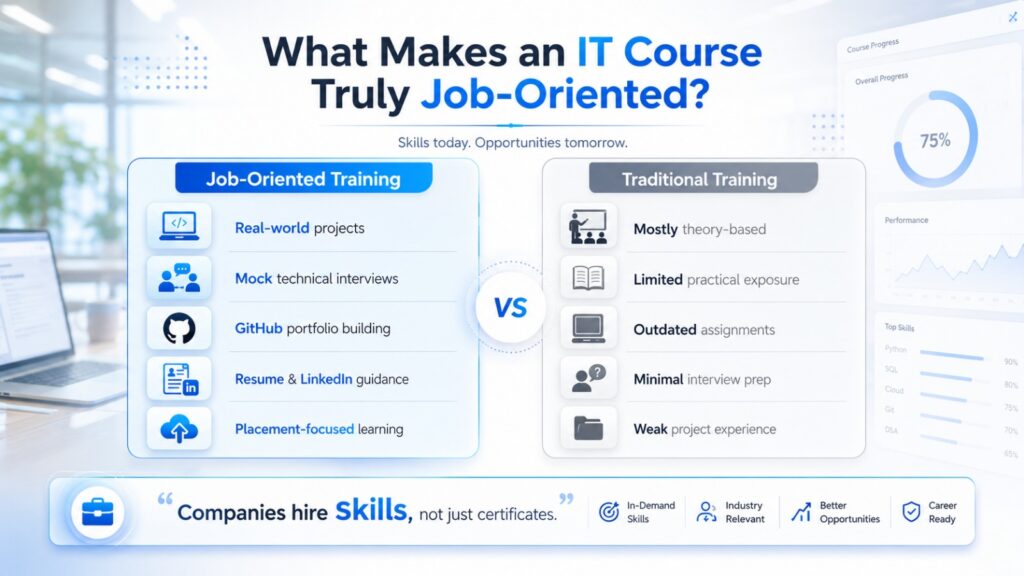
A genuinely job-oriented course usually includes:
- Real project work instead of only assignments
- Mock interviews with technical questioning
- Resume and LinkedIn guidance
- Exposure to GitHub and deployment workflows
- Trainers who understand current hiring expectations
- Placement support that continues after course completion
One thing experienced students notice quickly is this: institutes focused only on lectures often avoid practical accountability. There’s a lot of “watch this demo” learning. The better institutes force students to build things even when they struggle through it.
That discomfort matters because companies don’t hire based on how comfortable someone feels during training.
Good IT Training Institute vs Average Institute in Pune
Not every institute that teaches IT skills actually prepares you for jobs. The difference usually shows up in how training is delivered, not what is promised on brochures.
Here’s a simple comparison to help you understand what actually matters:
| Factor | Good IT Training Institute | Average IT Training Institute |
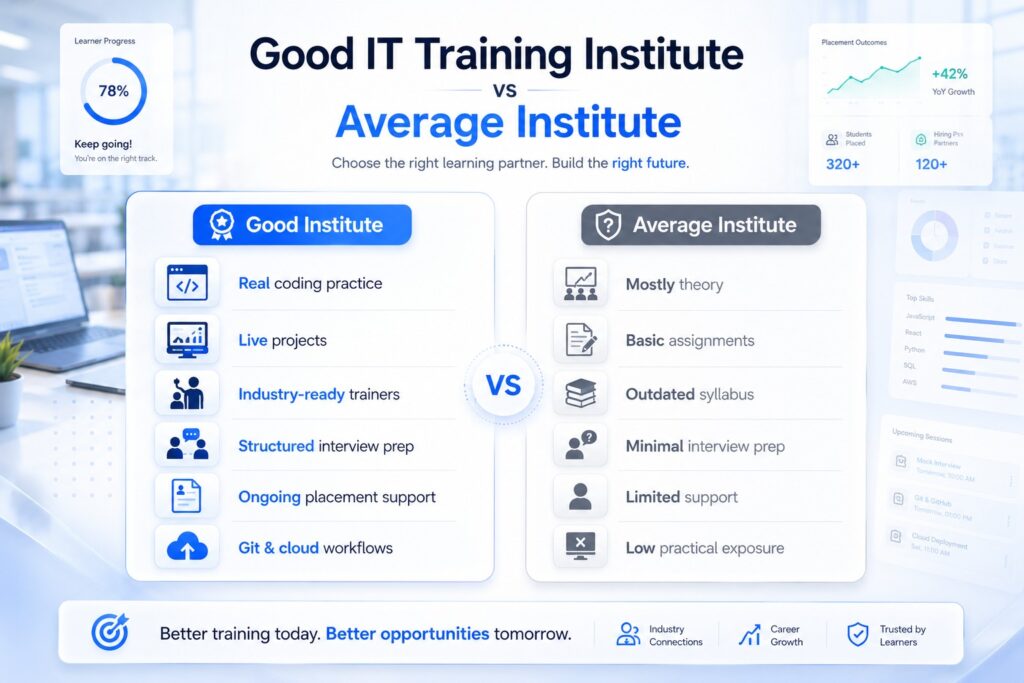
| Teaching style | Focus on practical learning with real coding and problem-solving | Mostly theory-based lectures with limited hands-on practice |
| Projects | Students build real, industry-style projects (API, full apps, deployments) | Small assignments that don’t reflect real job requirements |
| Trainer quality | Trainers are actively aware of current industry tools and hiring trends | Trainers often follow an outdated syllabus or recycled content |
| Batch size | Smaller batches with personal attention and doubt-solving | Large batches with limited interaction |
| Interview preparation | Structured mock interviews, resume building, and communication training | Basic or optional interview preparation sessions |
| Placement support | Structured mock interviews, resume building, and communication training | Limited or short-term placement assistance |
| Learning outcome | Students become interview-ready with portfolio and GitHub projects | Students mostly complete the course without job readiness |
| Industry exposure | Exposure to tools like Git, cloud, deployment, and Agile workflows | Minimal exposure to real-world workflows |
| Student accountability | Assignments, deadlines, and regular evaluations | Relaxed structure with low accountability |
Why this comparison matters
Most students don’t struggle because they choose the wrong course; they struggle because they choose the wrong type of training environment.
A good institute pushes you to build, fail, fix, and repeat until interviews feel familiar.
An average one mostly focuses on completing the syllabus.
That difference decides whether you stay “trained” or become “employable.”
Why Pune became a major IT training hub
There’s a reason students from smaller cities move to Pune specifically for IT courses in Pune instead of random online learning.
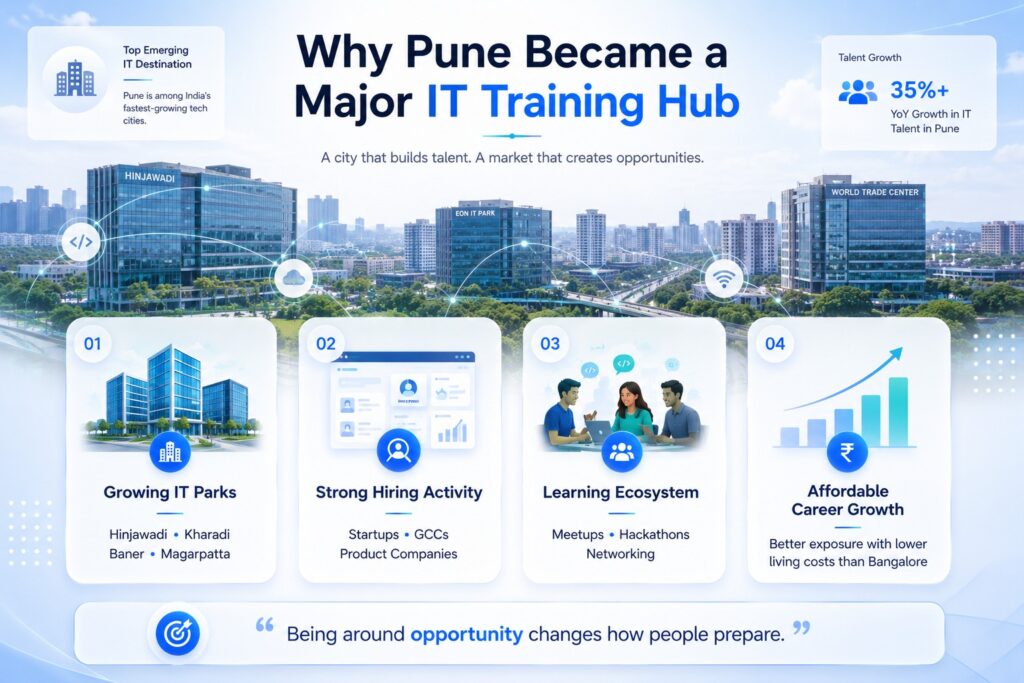
The city sits in a practical middle ground. It has enough tech hiring activity to create real opportunities, but it’s still more affordable than cities like Bangalore or Hyderabad for many students starting out. Areas like Hinjawadi, Kharadi, Baner, Wakad, and Magarpatta have turned into dense tech ecosystems where training institutes, recruiters, startups, and software companies all operate close to each other.
That proximity changes things.
Students preparing in Pune often hear about walk-ins faster, find internship opportunities quicker, and interact with people already working in tech companies. Even casual conversations in shared flats or cafés around Hinjawadi become useful because everyone is discussing interviews, projects, layoffs, certifications, or salary negotiations.
Online learning can teach skills. But being physically around people trying to break into tech creates a level of urgency most self-paced courses can’t replicate.
The courses students are actually choosing in 2026
A few years ago, students mostly chased Java because that’s what everyone else was doing. Now the decision-making has become more practical. People want to know which skills companies are actively hiring for right now.
That shift changed the most popular job-oriented IT courses in Pune.
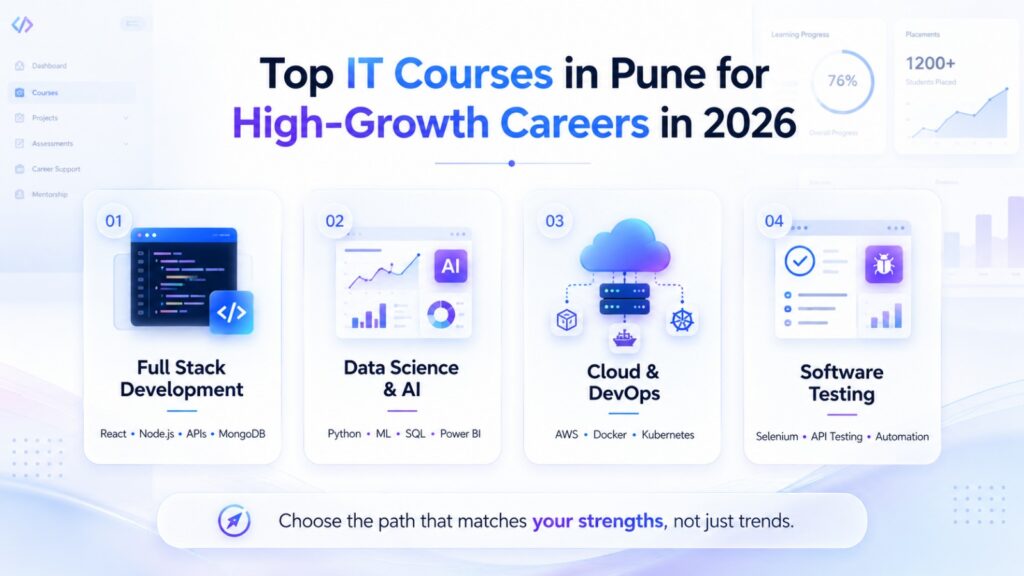
Full Stack Development
The Full Stack Course in Pune remains one of the strongest career paths because companies prefer developers who can handle both frontend and backend.
A strong Full Stack Developer Course usually includes React, Node.js, APIs, MongoDB or SQL, Git, deployment, and cloud basics.
Recruiters don’t care how many tutorials you watched. They care whether you can build and explain projects like:
- Authentication systems
- CRUD applications
- API integrations
- Dashboard projects
- Responsive frontend interfaces
- Deployment-ready applications
Without projects, “full-stack developer” becomes just another line on a resume.
Data Science and AI
This field attracts a huge number of freshers because AI feels exciting right now. The problem is that many students jump in without understanding how mathematical and analytical the work actually is.
Strong data science courses in Pune usually cover Python, Pandas, NumPy, machine learning basics, SQL, visualization tools, and model-building workflows. Better institutes also introduce students to real datasets instead of only polished classroom examples.
One thing trainers rarely say openly is that data science rewards consistency more than speed. Students who survive are usually the ones comfortable sitting with confusion for long periods while debugging models or cleaning messy data.
That patience matters more than hype.
Cloud Computing and DevOps
Cloud roles have grown because companies increasingly depend on scalable infrastructure and automation. AWS, Azure, Docker, Kubernetes, CI/CD pipelines, and Linux administration are now common parts of many advanced training programs.
This path suits students who enjoy systems, troubleshooting, and infrastructure more than frontend design.
The interesting part is that DevOps interviews often expose weak fundamentals quickly. Someone can memorize cloud terminology, but if they can’t explain deployment pipelines or networking basics properly, interviewers notice immediately.
Software Testing and QA Automation
Testing used to be treated like the backup option nobody talked about. That perception changed once automation skills started becoming valuable.
Modern testing courses usually include Selenium, Java or Python basics, automation frameworks, API testing, and Agile workflows. For students who are detail-oriented and less interested in hardcore development, this path can lead to stable opportunities surprisingly fast.
A lot of working professionals switch into QA because the learning curve feels more manageable compared to some development tracks.
What separates a good institute from a marketing-heavy one
This is usually where students make expensive mistakes.
Many institutes look impressive during counseling sessions. Fancy offices, placement banners, and promises of guaranteed jobs create confidence quickly. But the real quality becomes visible only after classes begin.
Students who’ve attended weak training programs often describe the same patterns:
- Trainers rushing through modules
- Large batches with almost no individual attention
- Outdated curriculum
- No real coding practice
- Placement support is disappearing after fees are paid
- Mock interviews that feel scripted and unrealistic
The better institutes behave differently in small ways.
They track attendance seriously. Trainers ask students to explain concepts back instead of blindly copying notes. Assignments become progressively harder. Weak students are pushed instead of ignored. There’s visible pressure to improve communication, project quality, and interview readiness.
One detail many people overlook is the trainer’s background.
Institutes where trainers actively understand current industry tools tend to produce stronger students. Someone teaching outdated workflows from five years ago creates candidates who sound outdated in interviews, too.
What should you check before joining an IT training institute in Pune?
Before joining any institute, don’t rely only on advertisements or placement claims. Focus on practical signals that show real training quality.
Look for things like real project work, trainer experience, batch size, mock interviews, and whether students are actually building and explaining projects confidently. Also, check if placement support continues after course completion or ends after a few calls.
The simplest test is this: if students can clearly explain their projects and tools, the training is working.
Which IT course is best for freshers vs working professionals?
The right course depends on your current stage, not just market trends.
Freshers usually benefit from structured paths like Full Stack Development or Data Analytics because they build fundamentals and project experience. Working professionals often prefer Cloud Computing or DevOps because these skills help with faster role transitions and salary growth.
The goal is not to pick the most popular course, but the one that matches your learning speed and career direction.
Why Teknowell Is Frequently Mentioned in Pune?
Students searching for the best IT training institute in Pune usually come across Teknowell sooner or later because the institute focuses heavily on practical training and placement-oriented learning.
What stands out is the emphasis on implementation rather than passive learning. Their programs in Full Stack Development, Data Science, Cloud Computing, and Software Testing are structured around hands-on work instead of only theoretical sessions.
The placement preparation side also matters.
Many students underestimate how stressful technical interviews become until they start giving them regularly. Mock interviews, resume building, communication training, and project presentation practice often end up being the difference between “almost selected” and actually getting hired.
Teknowell’s approach aligns more closely with what companies currently expect from entry-level candidates. The curriculum evolves around hiring trends instead of staying frozen for years. That matters because technologies move faster than most institutions update their teaching material.
For fresh graduates, especially, structured guidance helps reduce the confusion that usually comes from learning everything randomly through YouTube playlists.
Freshers and working professionals need different things
This gets ignored in most course advertisements.
A fresher entering IT training after graduation has very different concerns compared to someone already working a support job and trying to switch careers.
Freshers usually need:
- Strong fundamentals
- Communication improvement
- Project experience
- Confidence during interviews
- Resume-building support
Working professionals often care more about:
- Flexible timings
- Weekend or online batches
- Skill upgrades tied to salary growth
- Faster transition paths
- Interview preparation focused on switching roles
The best institutes understand this difference instead of teaching everyone exactly the same way.
One working professional who moved from non-technical support into cloud computing described something interesting after completing training in Pune. The hardest part wasn’t learning AWS. It was rebuilding confidence after years of feeling technically behind.
That psychological side of career switching rarely gets discussed enough.
Placement guarantees sound great until you ask the right questions
“100% placement assistance” appears almost everywhere now. Students should slow down and ask what that phrase actually means.
Some institutes count interview calls as placements. Others stop supporting after a few weeks. Some only push top-performing students aggressively while average students struggle quietly in the background.
A smarter approach is asking direct questions during counseling:
- How many companies have you visited recently?
- What roles were students hired for?
- Are mock interviews included?
- Does placement support continue after course completion?
- What is the average package range?
- Are students building live projects?
- Can alumni experiences be verified?
Institutes confident in their process usually answer clearly. The vague ones tend to rely on emotional selling.
The hidden problem nobody mentions about online-only learning
Online platforms are useful. They’re affordable, flexible, and packed with content. But many students quietly struggle because self-learning demands discipline that most beginners haven’t developed yet.
Watching tutorials creates the illusion of progress. Building projects independently exposes whether learning actually happened.
That’s why structured classroom or hybrid training still works well for many students in Pune. Deadlines, trainer feedback, peer competition, and interview preparation create accountability.
Without that structure, people often spend six months collecting certificates while avoiding actual implementation.
The gap between consuming content and becoming employable is larger than most beginners expect.
So, which IT course should someone choose?
The honest answer depends less on trends and more on personality.
Students forcing themselves into AI because it sounds prestigious often burn out quickly if they dislike analytical problem-solving. Someone choosing full-stack development only because friends recommended it may realize later that they actually prefer testing or cloud infrastructure.
A practical way to decide is to ask:
- Do you enjoy building interfaces and applications?
- Do you like working with data and patterns?
- Do systems and infrastructure interest you?
- Do you enjoy debugging and process improvement?
- Are you willing to spend hours solving technical problems repeatedly?
The right course usually feels difficult but interesting. That combination matters more than chasing whichever technology currently dominates social media discussions.
Questions worth asking before joining any IT training institute in Pune
Before paying fees anywhere, students should spend less time looking at advertisements and more time observing how the institute actually functions.
A few useful questions reveal a lot quickly:
- Can current students share their learning experience?
- Are trainers actively teaching current technologies?
- How much project work is included?
- Are mock interviews realistic?
- Is placement support ongoing or limited?
- What happens if a student struggles midway?
- How large are the batches?
- Are sessions practical or mostly lecture-based?
The atmosphere inside a classroom says more than any brochure.
How long does it actually take to become job-ready?
This is where expectations become dangerous.
A lot of students join IT courses thinking three months of training will completely transform their careers. Technically, some institutes do offer 3–6 month programs. But becoming employable depends heavily on what happens outside classroom hours, too.
Students who improve fastest usually treat training like a full-time responsibility. They revise after class, rebuild projects independently, practice interview questions repeatedly, and spend weekends fixing things they still don’t understand.
The ones who struggle often attend lectures passively and assume completion certificates will carry the weight during interviews.
Recruiters can tell the difference within minutes.
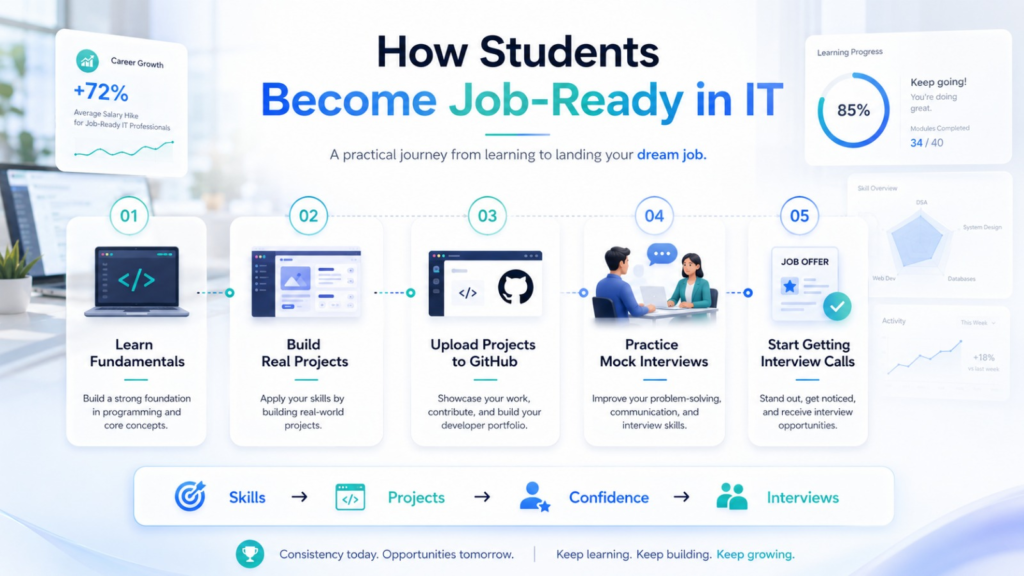
For most freshers, realistic timelines look like this:
- 3–4 months for learning fundamentals properly
- 2–3 additional months for project building and interview preparation
- Continuous practice until interviews become comfortable
Some students get placed quickly. Others need longer. The dangerous mistake is expecting instant transformation without sustained effort.
Tech rewards consistency far more than intensity.
The interview phase changes people
Students usually imagine placements as a straight line: learn skills, give interviews, and get selected.
The real experience feels messier.
Most candidates face rejection repeatedly before getting their first offer. One company rejects because the communication feels weak. Another says projects lack depth. Another asks DSA questions that nobody prepared for properly. Someone else gets eliminated after HR rounds because confidence disappears midway.
That cycle affects people emotionally more than they expect.
Good institutes understand this and keep students engaged during the rejection phase instead of treating placements like a numbers game. The support matters because confidence drops quietly after multiple failed interviews, especially for students already dealing with pressure from family expectations or financial stress.
One thing experienced trainers notice is that students often improve drastically after their first few failures. Interviews expose weaknesses faster than classrooms ever can.
The students who eventually crack good roles are usually the ones willing to look uncomfortable for a while without quitting.
Pune’s IT ecosystem still gives learners an edge
There’s a reason many students still prefer learning in Pune even after the rise of online education.
The city creates momentum.
Hackathons, tech meetups, startup communities, internship openings, referral networks, and peer competition all exist in the same environment.
A student preparing seriously in Pune can stay connected to what’s happening in the industry instead of learning in isolation.
That exposure matters more than people realize.
Sometimes a casual referral from a former batchmate leads to an interview. Sometimes attending a local meetup introduces someone to technologies they hadn’t considered before. Sometimes just being surrounded by ambitious learners changes how seriously a student approaches preparation.
Career growth rarely happens in complete isolation.
Final thought
The best IT training institute in Pune is not automatically the one with the biggest advertisements or the flashiest placement banners. It’s the one that forces students to become capable enough to survive real technical interviews without depending on memorized answers.
Because once the interview starts, nobody cares how impressive the classroom looked. They care whether the candidate sitting across the table can actually do the work.
Not sure which IT course is right for you?
If you’re confused between Full Stack, Data Science, Cloud, or Testing, a short counseling session or demo class can help you understand what actually fits your background before you commit to a full program.
It saves time, avoids wrong course choices, and gives clarity in just one discussion.