
Here is the situation a lot of freshers find themselves in right now. You have a TCS NQT date circled on the calendar. Infosys is also on your list. Someone mentioned InfyTQ, and you are not entirely sure whether it is an exam, a platform, or something else. And somewhere in the middle of all this, you are trying to figure out where to actually start. To see all the major dates in one place, check the IT placement exam calendar 2026-27.
The question most people ask is “which exam is harder?” That is the wrong question. It does not help you make a decision or build a plan. The right question is: given your timeline, which should you prepare for first so that both attempts go well? That is what this guide answers, directly and without the usual vagueness.
Quick snapshot before you read further: TCS NQT is a single-session exam with 82 questions, 190 minutes, a fixed exam date, and three salary bands: Ninja at ₹3.36 LPA, Digital at ₹7 LPA, and Prime at ₹9.36 LPA. Register through the TCS iON NQT page.
InfyTQ is a self-paced certification platform that you attempt on your own schedule. It has two levels (Foundation and Master), and the salary outcome changes significantly between them: Foundation gives a DSE role at ₹3.6 LPA; Master unlocks the SP track at ₹8 LPA and above. Check current openings and registration on the Infosys careers page.
Key insight: preparation for InfyTQ and TCS NQT overlaps significantly. Preparing for one does not come at the expense of the other. The sequencing just needs to be deliberate.
What TCS NQT actually tests
Before comparing anything, you need to understand the structure of each exam clearly. Most students have a vague idea that they know TCS NQT involves aptitude and coding, but the details matter.
The TCS NQT 2026 has two parts. The Foundation Section runs for 75 minutes and has 65 questions across three areas: Numerical Ability (20 questions, 25 minutes), Verbal Ability (25 questions, 25 minutes), and Reasoning Ability (20 questions, 25 minutes). This section alone determines whether you qualify for a Ninja band role. The cutoff sits around 40 to 45 out of 65 correct answers, though it varies slightly by cycle.
The Advanced Section runs for 115 minutes and has 17 questions. The first part is Advanced Quantitative and Reasoning MCQs, 15 questions in 25 minutes. The second part is the Coding section, 2 problems, 90 minutes. This section is what separates Ninja from Digital and Prime. Solving one coding problem fully is generally enough for Digital. Solving both correctly with strong Advanced MCQ scores pushes you toward Prime.
Two rules matter more than anything else. First, there is no negative marking anywhere in the exam. Attempt every question. Second, sections lock when the timer ends. You cannot go back to a section once its time is up. Practice switching your focus completely between sections before the actual exam.
Registration happens through the official TCS iON NQT page. Avoid unofficial registration links.
What InfyTQ actually is, and why most freshers get this wrong
InfyTQ is not a single exam. That is the most common misconception, and it changes how you approach preparation entirely.
InfyTQ is a free learning and certification platform that Infosys built specifically for freshers who are not from IITs or NITs, or who do not go through campus placements. Any engineering fresher can register, complete the free courses, and attempt the certification. College tier does not matter. The CGPA threshold is checked during hiring, but the platform itself is open to all.
The certification has two levels, and they are not equal in value.
Foundation is the first level. It covers core programming concepts and basic DBMS. Clearing Foundation certifies you as a DSE (Digital Specialist Engineer) candidate, which corresponds to a salary of approximately ₹3.6 LPA. Here is the part most students do not realise until it is too late: Foundation does not give you a meaningful salary advantage over walking in through a standard Infosys aptitude test. The SE track for non-InfyTQ candidates starts at the same general range. Foundation is useful as a confidence-builder and a stepping stone, but it should not be the end goal.
Master is what actually changes your financial outcome. Master covers DSA at a real level, advanced coding (three problems under exam conditions), and deeper problem-solving. Clearing Master with 65% or above makes you eligible for the SP (Specialist Programmer) interview track at ₹8 LPA and above. Infosys contacts shortlisted candidates directly; check the careers page for the current process. The SP role is the reason to do InfyTQ at all. If you are going to invest preparation time in this platform, set Master as the target from day one and plan accordingly.
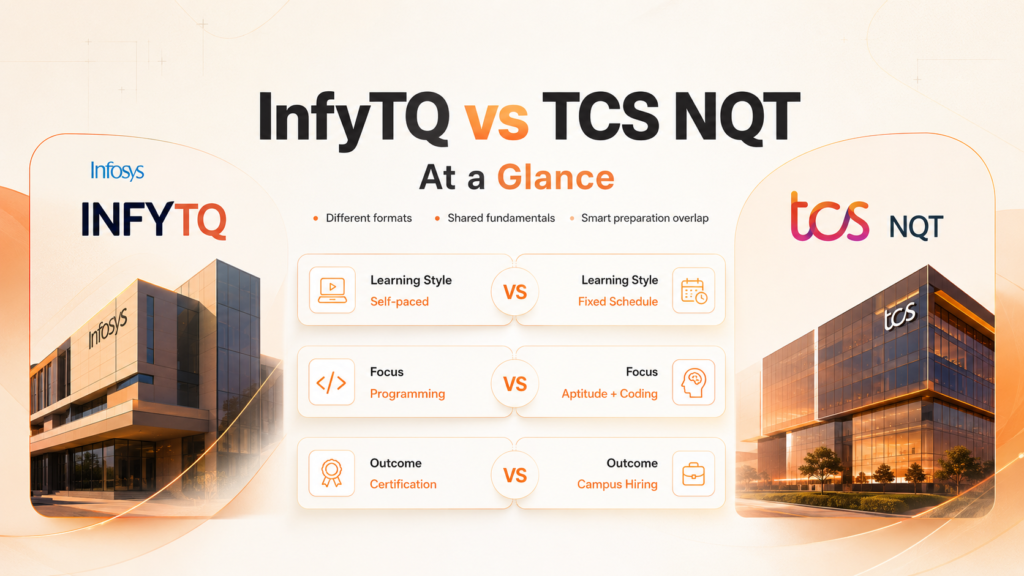
Side-by-side: how InfyTQ and TCS NQT compare
| Factor | TCS NQT | InfyTQ |
| Format | Single timed exam, fixed date | Self-paced certification, year-round |
| Foundation sections | Numerical, Verbal, Reasoning | Core programming, DBMS basics |
| Advanced sections | Quant MCQs + 2 Coding problems | DSA + 3 Advanced coding problems |
| Negative marking | None | None |
| Salary bands | Ninja ₹3.36 LPA, Digital ₹7 LPA, Prime ₹9.36 LPA | DSE ₹3.6 LPA (Foundation), SP ₹8 LPA+ (Master) |
| Retake policy | No retake within the same cycle | Recertification allowed, certificate valid for 24 months |
| Registration | TCS iON NQT page | Infosys careers page |
| Exam timing | Fixed date, must book in advance | Flexible slot booking any time |
The single most important difference is format. TCS NQT is an event with a date. You prepare, you show up, you perform. InfyTQ is a process you control. You can attempt Foundation whenever you are ready, then shift to Master preparation before attempting the second level. That flexibility is an advantage if you use it. It becomes a disadvantage if you keep deferring the attempt indefinitely.
The salary comparison is worth sitting with for a moment. TCS Digital at ₹7 LPA versus Infosys SP at ₹8 LPA, the SP track is more lucrative at base. But TCS Prime at ₹9.36 LPA is higher than SP. Which target is more realistic for you depends on your coding depth. If you can solve two medium-difficulty problems in 90 minutes consistently, Prime is achievable. If your coding is solid but not exceptional, SP via InfyTQ Master is the more realistic premium target.
The honest answer: which should you prepare for first?
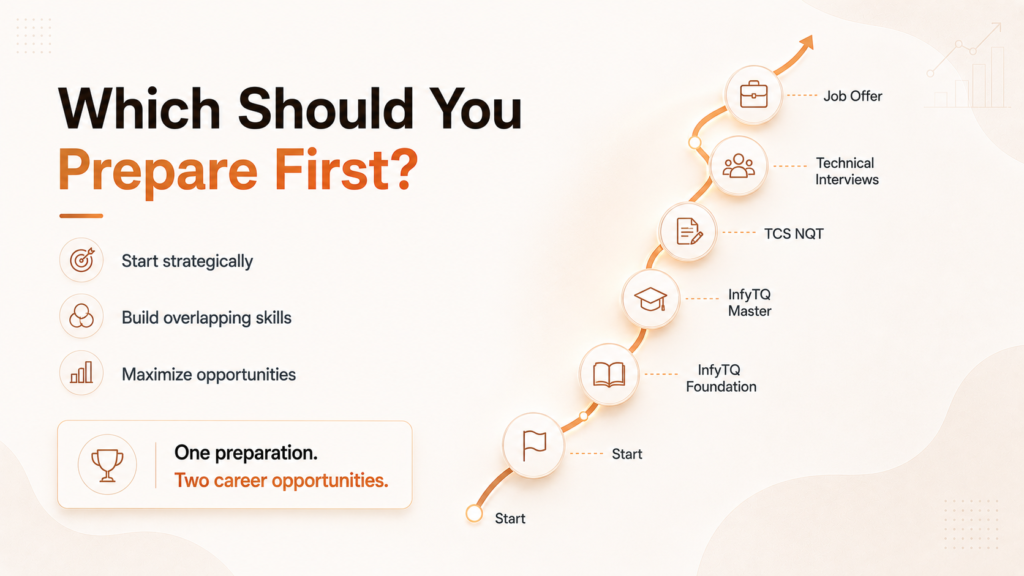
Start with InfyTQ. Not because it is easier, but because the preparation logic works better that way.
InfyTQ is available year-round. You can begin today. The Foundation level takes roughly two to three weeks of preparation to clear comfortably. The Master preparation takes another four to six weeks of focused DSA and coding practice. By the time you have done that, you have also covered most of the material that the TCS NQT Foundation and Advanced sections test. You have not split your energy. You have stacked it.
The reverse is not equally efficient. If you prepare specifically for TCS NQT and then move to InfyTQ, you will have covered Numerical Aptitude, Reasoning, and basic Coding, but you will not have touched DBMS, which InfyTQ Foundation requires and TCS NQT does not test at all. You end up with a gap.
If TCS NQT has a fixed date within four weeks, prioritise Foundation prep for those four weeks: daily aptitude, verbal, and reasoning practice, timed. Attempt the NQT. Then immediately pivot to InfyTQ Master preparation starting the week after. The overlap means you are not starting from zero.
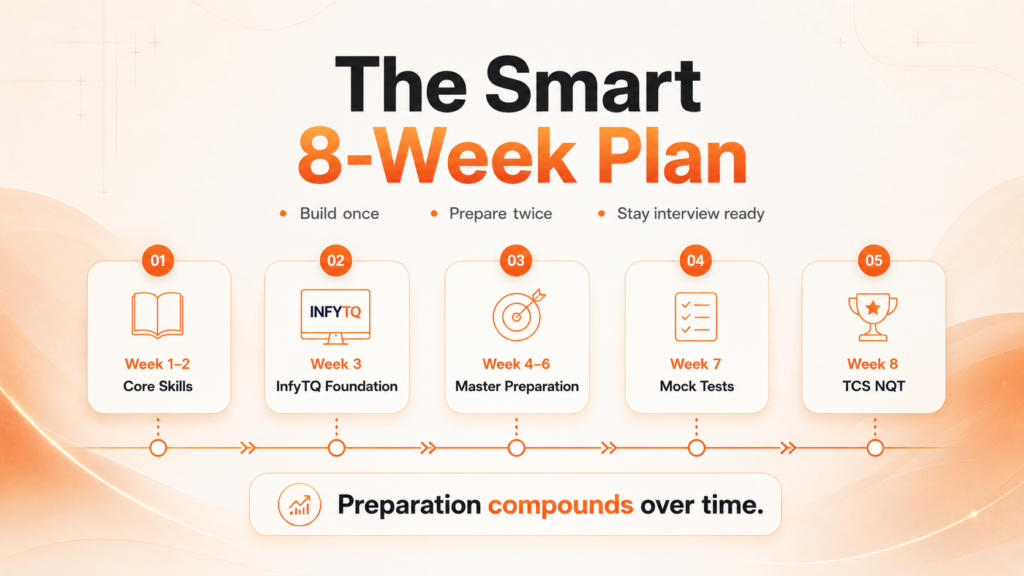
If you have eight weeks and no exam date yet, start InfyTQ Foundation in Week 1 and attempt it by Week 3. Spend Weeks 4 through 7 on InfyTQ Master DSA, SQL, advanced coding problems, and timed sessions. Sit TCS NQT in Week 8. By that point, the NQT Foundation section will feel significantly lighter than it would have without the InfyTQ preparation behind you.
STOP HERE if you want structured preparation with actual feedback rather than going at it alone. Here is what Teknowell offers.
Teknowell EduTech in Pimpri Chinchwad runs structured aptitude and technical preparation as part of every full-stack, data science, and software testing programme. The preparation covers all core sections tested in both InfyTQ and TCS NQT: timed aptitude sessions, verbal and reasoning practice, coding problem-solving under exam conditions, and mock technical interviews modelled on both Infosys and TCS hiring formats.
Students who train at Teknowell do not just pass the exam. They walk into the technical interview round that follows with the same depth of preparation. That is what gets the offer, not just the clearance.
Book a free demo class at Teknowell; see the preparation structure before you decide on anything.
What to prepare and how the overlapping skill map
Once the sequencing is clear, the actual preparation becomes much less overwhelming. Here is how the skills map across both exams.
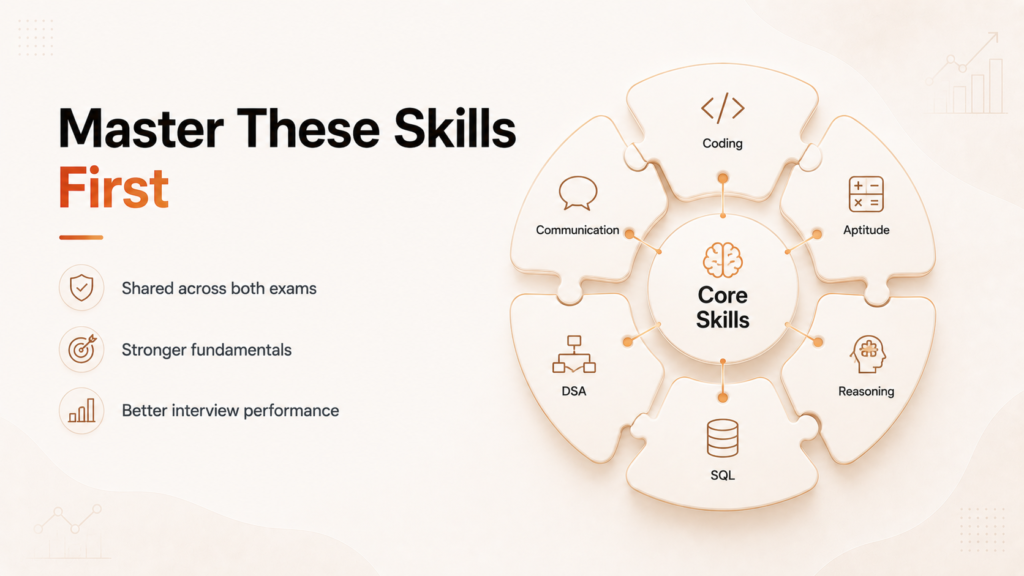
Skills that count for both, prepare these first, always
Quantitative aptitude covers the same core topics on both exams: percentages, ratios, profit and loss, time and speed, averages, and basic probability. Logical reasoning, number series, coding-decoding, blood relations, and seating arrangements are present in both TCS NQT Foundation and InfyTQ Foundation. Verbal ability (reading comprehension, sentence correction, para-jumbles) is tested in TCS NQT and appears in InfyTQ Foundation as well. Basic coding, arrays, strings, loops, functions, and basic sorting are the foundation for both the NQT coding section and InfyTQ Foundation programming tests.
Spend the first two weeks of preparation covering only these overlapping areas. Daily targets: 20 aptitude questions, 15 reasoning questions, 10 verbal questions, and one easy coding problem. Everything timed.
Skills specific to InfyTQ where most students fall short
DBMS and SQL. This is the section that catches students off guard the most. InfyTQ Foundation and Master both test database fundamentals: basic SQL queries (SELECT, JOIN, GROUP BY, subqueries), normalisation, entity-relationship diagrams, ACID properties, and basic transaction concepts. TCS NQT does not test any of this. Students who focus entirely on aptitude and coding for their NQT preparation arrive at InfyTQ completely unprepared for this section. Allocate one dedicated week specifically to SQL and database theory before attempting the InfyTQ certification.
For InfyTQ Master specifically, the coding section has three problems and runs for three hours. That is longer and harder than the NQT Advanced coding section. Practice three-problem sessions for three hours before attempting Master. The stamina required is different from that of doing one problem at a time.
Skills specific to TCS NQT Advanced
The Advanced Quantitative section covers topics like permutations, combinations, and more complex data interpretation that go beyond what InfyTQ tests. These show up only in the NQT and are worth one dedicated week of preparation in the final stretch before your exam date. Do not front-load these topics. Save them for the last week when the core skills are already solid.
Five mistakes that cost freshers the outcome they were aiming for
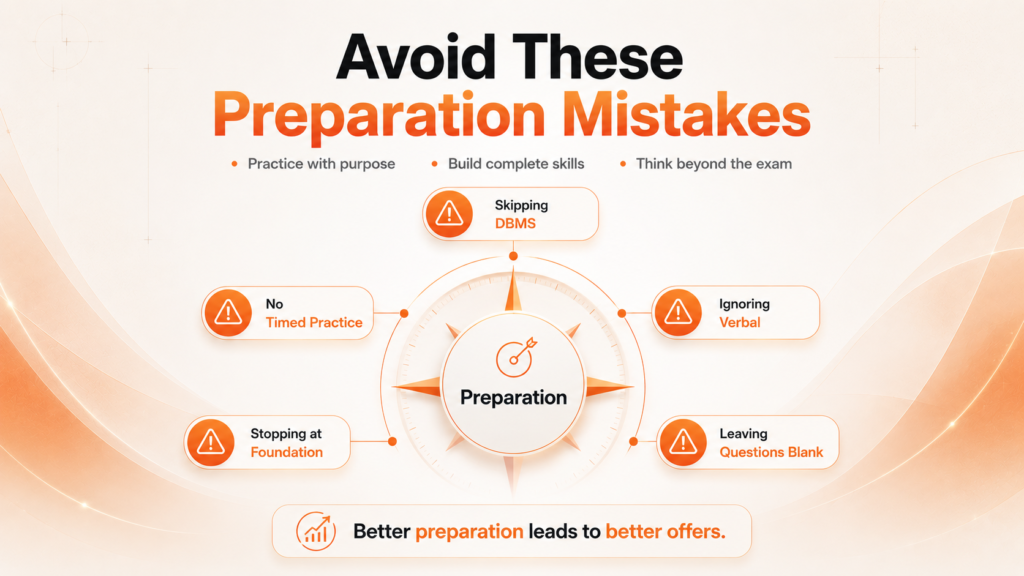
1. Treating InfyTQ Foundation as the destination. Foundation at ₹3.6 LPA is in the same general salary band as a standard Infosys SE role. There is no premium for clearing Foundation alone. Students who stop at Foundation have done half the work for no financial advantage over the standard hiring route. Master is the only level that changes the outcome.
2. Ignoring DBMS entirely. The most common reason students clear Foundation but fail Master is SQL and database under-preparation. This section has no equivalent in TCS NQT, so students who build their entire preparation around the NQT have a genuine gap here. One focused week fixes it. Skipping it entirely costs the Master attempt.
3. Practising without a timer. Both exams are time-pressured. Solving a question correctly in three minutes in a notebook is not the same skill as solving it correctly in 45 seconds under exam conditions. Every practice session from Week 2 onwards should be timed. No exceptions.
4. Neglecting the Verbal section for TCS NQT. This is the single most common Foundation failure pattern. The Verbal section has 25 questions in 25 minutes. CS and engineering students consistently underprepare for it and fail the Foundation sectional cutoff despite strong aptitude and reasoning scores. Strong overall performance does not compensate for a weak section score if the cutoff is missed.
5. Leaving questions blank. Neither exam has negative marking. On TCS NQT and on InfyTQ, a blank answer and a wrong answer give the exact same score: zero. Attempt every question on both exams. A 25% guess is always better than nothing.
After you clear both of the interview rounds that follow
Clearing InfyTQ or TCS NQT is the first filter. The interview is where the actual offer is decided.
After TCS NQT, Ninja band candidates face one technical round covering OOP fundamentals, basic SQL, and project discussion. Digital and Prime candidates face a harder technical round with DSA problem-solving and deeper project architecture questions. HR round follows for all bands. The technical interview tests the same core skills as the exam, but in a live conversation where you have to explain your reasoning, not just select an option.
After InfyTQ Master, shortlisted SP candidates go through a technical round and a behavioural round. Infosys contacts Master-certified candidates directly, so keeping your InfyTQ profile updated and active after certification matters. The SP technical interview expects you to talk through a coding problem while explaining your approach, which requires verbal fluency alongside technical knowledge.
Both interviews test the same underlying areas: your project work, your problem-solving under pressure, and your ability to communicate technical reasoning clearly. If you want a round-by-round breakdown of what each interview actually involves and how to prepare for each stage, the software developer interview preparation guide covers it in full detail.
Also, if the TCS NQT is your immediate focus and you want a complete 30-day preparation plan for it specifically, the TCS NQT preparation guide for 2026 breaks every section down with daily targets and the exact topics to cover each week.
The exam gets you the interview. Preparation gets you the offer.
Clearing InfyTQ Master or TCS NQT Digital is a real achievement. A lot of freshers do not get there because they prepared the wrong sections or ran out of time. But clearing the exam is the beginning, not the end. Both Infosys and TCS have technical interview rounds after the initial filter, and those rounds test the same skills in a live, conversational setting.
The students who do best at both stages are the ones who built their preparation around actual skill development rather than just exam familiarity. That is the difference between someone who barely clears the NQT Foundation and someone who clears it comfortably and then performs well in the Digital technical interview.
If you want structured preparation that covers both the exam and the interview, timed aptitude sessions, coding practice, SQL and DBMS, and mock technical interviews, book a free demo class at Teknowell. The demo gives you a live session, access to the trainer, and a clear picture of what preparation looks like before you commit to anything.