You are 28, 31, or 34. You already have a job, maybe in banking, teaching, sales, accounting, manufacturing, or operations around Pune and PCMC. You are looking at IT courses and wondering whether a career switch to IT after 30 in India is actually realistic when younger candidates are entering the field every year.
There is also the practical side. You have rent, family responsibilities, and a salary that cannot simply disappear for six months. You cannot afford to quit first and figure everything else out later.
So let’s answer the real questions: Are you too old? Can you learn technical skills from scratch? Will companies consider you for entry-level IT roles? And what kind of salary can you realistically expect after the switch?
Can a working professional switch to IT after 30 in Pune?
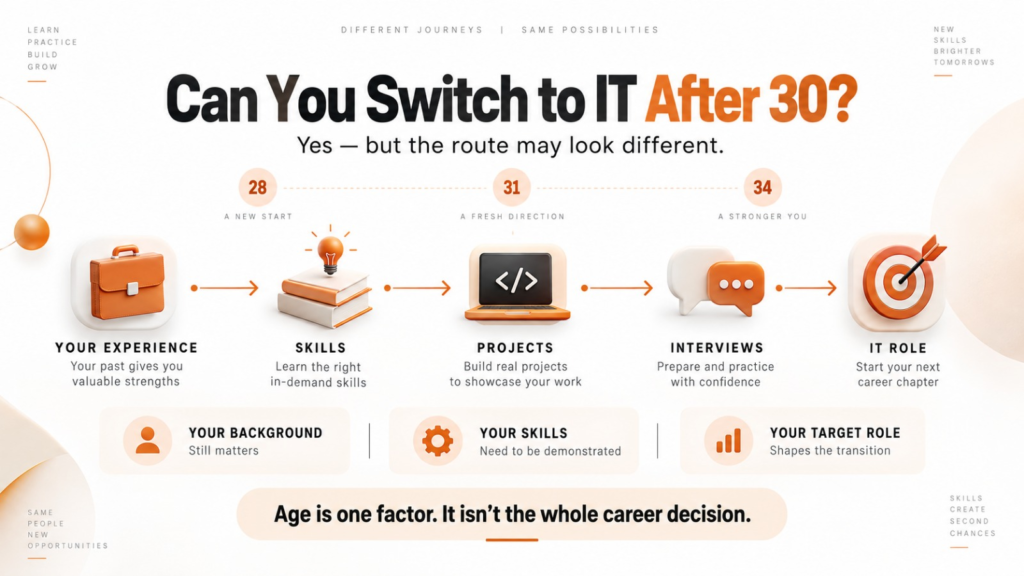
Yes, but the route looks different from the route followed by a 21-year-old graduate. Your age alone does not decide whether the switch works. Your choice of role, existing domain experience, technical skills, portfolio, and the companies you target matter much more.
LinkedIn’s Workforce Confidence survey, as reported by career coach Sandeep Anand, found that 32% of Gen X professionals in India were considering new functions or roles in 2026.
For a career switcher, the practical options include data analytics, business analysis, Power BI-focused roles, and full-stack development. Training can take several months, but the job search still depends on your portfolio, interview performance, and the market you target.
The honest answer to “am I too old to switch to IT?”
Age alone does not make a career change impossible. The bigger question is whether you are trying to enter IT through a route designed specifically for recent graduates or through roles where your previous work experience can still add value. That distinction can save you months of applying to jobs that were never designed for your profile.
According to the LinkedIn Workforce Confidence survey cited by Sandeep Anand, 32% of Gen X professionals in India were considering new functions or roles in 2026. Anand’s career-switch guide also makes a useful point for professionals over 30: the objective should not be to erase your previous career, but to identify which parts of it can transfer into the new one. Sandeep Anand’s career switch guide for India professionals
That matters because “switching to IT” does not necessarily mean becoming a software engineer overnight. Someone from banking may move toward data analytics. Someone from sales operations may move toward reporting or business analysis. Someone with a genuine interest in programming may choose full-stack development. Your existing experience helps determine which transition makes sense.
The age concern becomes more real when you look at certain fresher hiring programmes. For example, TCS iON’s current NQT eligibility includes students passing out from 2022 to 2028 and freshers with less than two years of experience, with an age limit of 30 in its eligibility information. That means a 31-year-old career changer should not build their entire strategy around standard fresher drives.
Instead, look at skills-based roles where employers can evaluate what you can actually do. A portfolio, relevant projects, technical interview performance, and your ability to understand business problems become much more useful in that situation
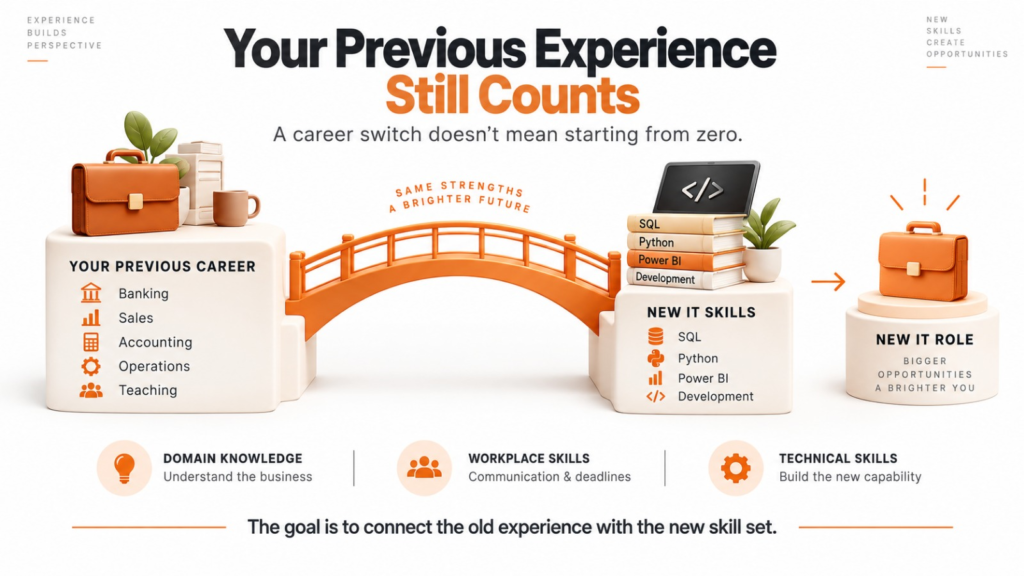
What you are actually bringing to an IT role that a 21-year-old is not
A career switcher does not arrive empty-handed. You may be new to SQL, Python, Power BI, or JavaScript, but you are not new to working with people, handling deadlines, understanding customers, or dealing with business problems. Those skills have value when the target role involves more than writing code.
Domain knowledge can become an advantage
Imagine someone who spent six years working in banking before learning data analytics. They are still learning SQL and Power BI, but they already understand transactions, financial reports, customer behaviour, compliance processes, and the language used by banking teams.
That combination can make more sense for a BFSI analytics role than simply saying, “I completed a data analytics course.” The same idea applies elsewhere. Someone from sales may understand funnels and targets, while someone from operations may already understand process reports, productivity metrics, and recurring business problems.
This is also why a career switch from banking to IT does not have to mean throwing away everything you learned before. The technical skills create the bridge, while your previous industry experience can help you understand where those skills are useful.
Professional skills take time to build
Technical skills are only one part of working in an IT environment. People also have to communicate with managers, explain findings, handle feedback, document work, participate in meetings, and deal with changing requirements.
A professional who has already spent several years in a workplace has usually experienced those situations before. That does not automatically make them a better candidate, but it can reduce the amount of workplace adjustment required after the switch.
Data analyst and business analyst roles make this especially visible because the job often sits between technical information and business decisions. You may have to explain why a number changed, ask the right question about a report, or present a dashboard to someone who does not care how the SQL query was written.
You also know what you do not want
Someone who has worked for eight years and is deliberately changing careers has usually thought about the decision differently from someone choosing their first course after college.
That does not guarantee better results. It does mean the decision can be more informed because you have experienced a real workplace and understand what you want to change. The useful question becomes less “What is the hottest IT course?” and more “What kind of work do I want to be doing five days a week?”
That question should guide the course choice.
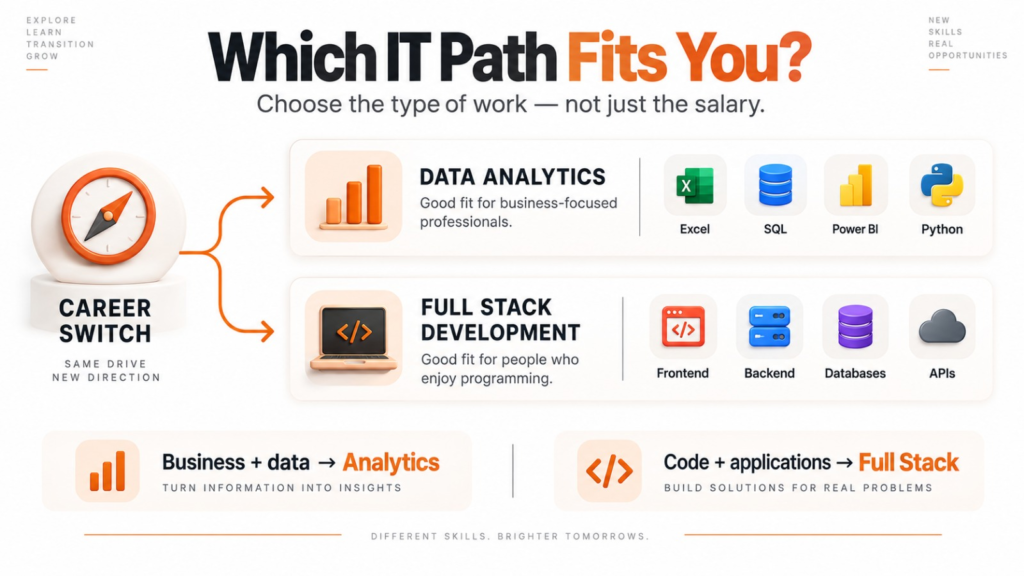
Which IT course makes sense for a career switcher in Pune?
Choosing an IT course only because someone online said it has a high salary can create another problem six months later. A career switch works better when the type of work matches your background, learning style, available time, and genuine interest in the work.
For many non-technical professionals, data analytics provides a more direct introduction to technology. For people who genuinely want to build software and enjoy programming, full-stack development can make more sense.
Data Analytics for non-technical switchers
Data Analytics can suit professionals from banking, finance, accounting, operations, sales, and other business-focused roles because much of the work revolves around understanding information rather than building software from scratch.
Teknowell‘s current Data Analytics course has a six-month duration and covers Excel, Advanced Excel, SQL, Power BI, and Tableau, along with dashboard creation, reporting, data cleaning, visualization, and business insights. The programme also includes practical projects, interview preparation, and placement assistance.
That makes this route worth considering if you are asking, “Can a BCom or BBA professional become a data analyst after 30?” Your commerce or business background does not give you SQL automatically, of course. You still have to learn the tools and prove that you can use them. But you may already understand the type of business information those tools are used to analyse.
If you want a more detailed look at the transition itself, you can also read a guide on switching to IT from a commerce or business background.
Full Stack Development for people who want to build software
Full stack development is a different kind of transition. Instead of mainly analysing existing business data, you learn how applications are built, from the user interface through the backend, database, APIs, and other development components.
Teknowell has a three-month MERN/MEAN stack course covering technologies including MongoDB, Express.js, React.js or AngularJS, Node.js, JavaScript, and REST APIs. Its Java Full Stack programme has a six-month duration and covers Java, Spring Boot, Hibernate, HTML5, CSS3, JavaScript, React.js, and MySQL.
It also has a four-month Python Full Stack track. Its current course information describes Python Full Stack as a route for beginners and backend-focused learners, with Python, Django, frontend technologies, databases, APIs, and project work.
The learning curve can be steeper if you have never programmed before. If the idea of spending several hours debugging one missing bracket sounds unbearable, that is useful information to discover before choosing a development track. If you enjoy figuring out why something does not work and then fixing it, full stack may be worth the extra effort.
You can compare the available options through Teknowell’s full stack development course in Pune before deciding which stack fits your goals.
The salary reality for a career switch to IT after 30 in Pune
Salary expectations need a little more care than most course advertisements suggest. Your first IT salary is not determined by age alone, and completing a course does not automatically place you at the top of a salary range.
According to GrowAI’s April 2026 data analyst salary guide, which cites Glassdoor data from March 2026, the national average salary for data analysts was ₹6.87 LPA, while the fresher range was ₹3.5 to ₹6 LPA. GrowAI also reports that candidates with Python, SQL, and Power BI skills can earn 25% to 35% more than peers at the same experience level, although individual offers still vary by employer and candidate profile. Data analyst salary breakdown India 2026 by experience and skill stack
For Pune, salary data should be treated as a market reference rather than a promise for someone changing careers. Glassdoor’s current Pune data shows a Business Analyst base-pay range of roughly ₹5 lakh to ₹11.2 lakh per year, with an average around ₹8 lakh, while individual submissions vary significantly by experience and employer.
| Role after switch | Possible entry range | After 2 to 3 years | What can affect the offer |
| Data Analyst | ₹3.5 to ₹6 LPA | ₹8 to ₹12 LPA | SQL, Power BI, Python, portfolio, and domain knowledge |
| Business Analyst | ₹4 to ₹7 LPA | ₹9 to ₹14 LPA | Domain experience, communication, requirements, and analytical skills |
| Power BI Developer | ₹4 to ₹6 LPA | ₹8 to ₹12 LPA | Dashboard quality, SQL and reporting experience |
| Full Stack Developer | ₹4 to ₹7 LPA | ₹9 to ₹16 LPA | Coding ability, projects, GitHub, interviews and company type |
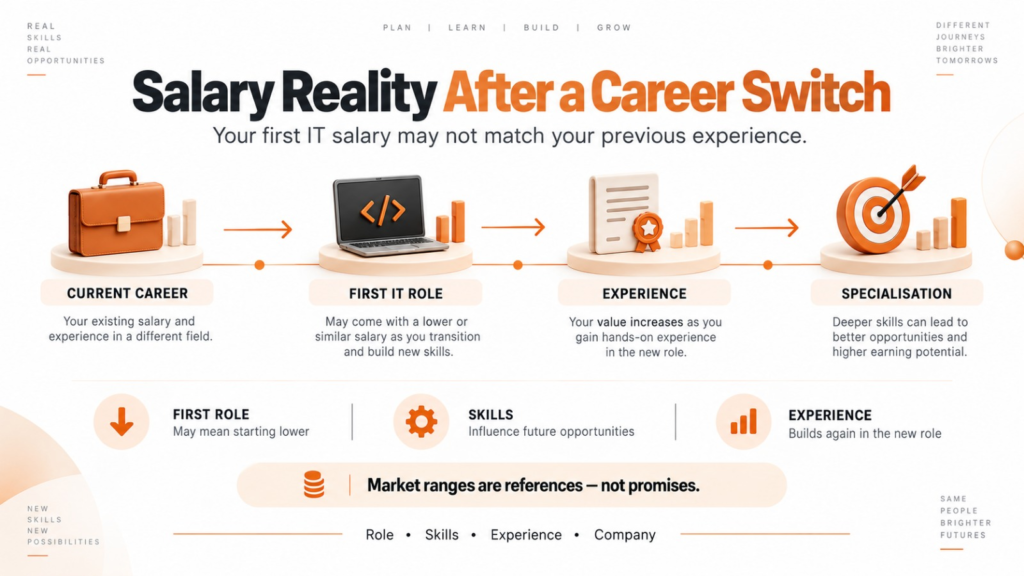
These are market-oriented ranges, not guaranteed packages. Actual compensation varies by company, skills, previous experience, portfolio quality, interview performance, and the role itself. For context, Glassdoor’s current Pune data for full stack developers includes junior postings around ₹3 lakh to ₹6 lakh as well as higher individual salaries, showing why a single “average fresher salary” can be misleading.
Do you have to take a salary cut?
Possibly, especially if your current job has given you several years of experience and you are entering IT at a junior level. Your previous salary reflects your experience in your old function, while the new employer may be evaluating you as someone with limited experience in the new role.
That does not mean the salary cut has to last forever. Your goal should be to make the first IT role a bridge into the new career, then build measurable experience through projects, responsibilities, and job changes when the market supports them.
Be careful with promises that suggest a specific percentage hike after a fixed number of months. Career progression is not that predictable. A stronger way to judge your progress is to ask whether your responsibilities, technical ability, and market value are increasing.
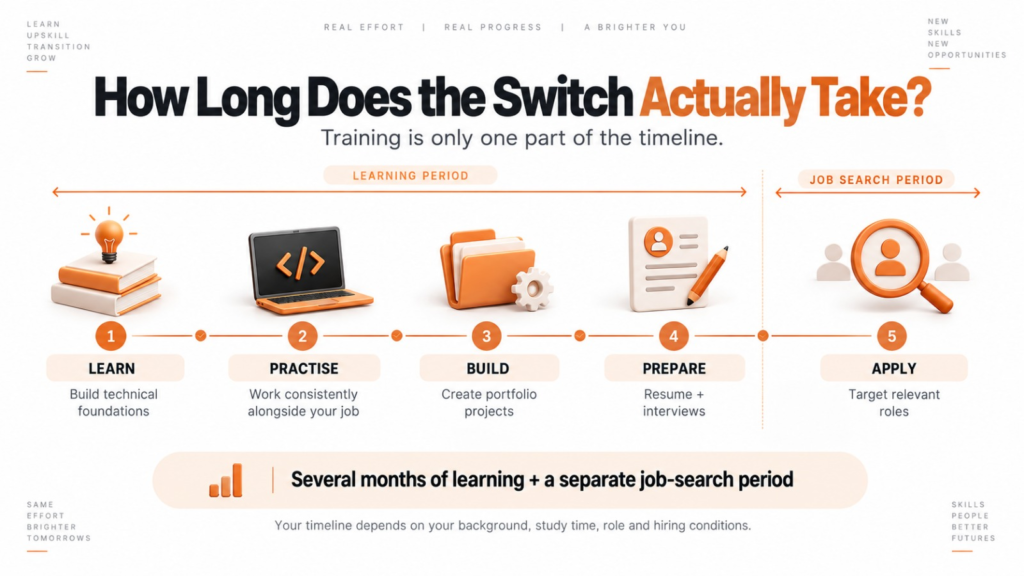
How long does the switch actually take?
You do not need to spend another four years earning a degree simply because you decided to move into IT after 30. At the same time, a three-month course does not mean you will automatically have a job three months later.
The training period
Teknowell currently has Data Analytics as a six-month programme, MERN/MEAN as three months, Python Full Stack as four months, and Java Full Stack as six months. It also has weekday and weekend options, along with online and classroom formats for learners who need flexibility.
Your learning schedule matters as much as the advertised duration. Someone attending weekend classes but practising for several hours during the week will progress differently from someone who only attends classes and does nothing between sessions.
The job search comes after the learning
Give yourself time for the job search rather than treating it as the final week of the course. Your resume needs to show relevant projects, your LinkedIn profile needs to support the new career direction, and you need enough interview practice to explain what you built and why you built it.
Teknowell’s current course includes interview preparation, resume support, mock interviews, project guidance, and placement assistance.
A realistic overall timeline
For many working professionals, a useful planning window is several months of training followed by a separate job-search period. An eight- to twelve-month plan can be reasonable for someone who needs to learn the skills, build a portfolio, prepare for interviews, and apply consistently.
The important part is not treating eight months as a guaranteed deadline. Your previous background, weekly study time, chosen role, portfolio quality, and hiring conditions can all change the timeline.
What companies in Pune actually think about hiring career switchers
The phrase “companies will not hire you after 30” is too broad to be useful. Different employers use different hiring processes, and some fresher programmes have eligibility rules that make them poor targets for older career switchers.
TCS iON’s current NQT information, for example, limits eligibility around graduation years, fresher experience, and age. The current criteria list candidates passing between 2022 and 2028, freshers with less than two years of experience, and a maximum age of 30 on the detailed eligibility page. That is a concrete example of why a 31-year-old career changer should read eligibility criteria carefully instead of assuming every fresher hiring route is available.
Other employers recruit for specific skills and experience rather than through one standard fresher examination. Pune also has a large mix of IT services companies, product businesses, startups, and global capability centres, so the hiring process can differ considerably from one employer to another.
The practical strategy is to search for roles where your new skill set and old experience can overlap. A banking professional with SQL and Power BI can look for analytics roles connected to BFSI. Someone from operations can explore reporting or business analysis. Someone committed to programming can build development projects and apply for junior developer roles.
BFSI can be particularly relevant for career switchers who already understand financial processes. Pune has technology and operations teams connected to companies such as Deutsche Bank, HSBC, and Barclays, but the exact role requirements still need to be checked against each current job posting rather than assumed from the company name.
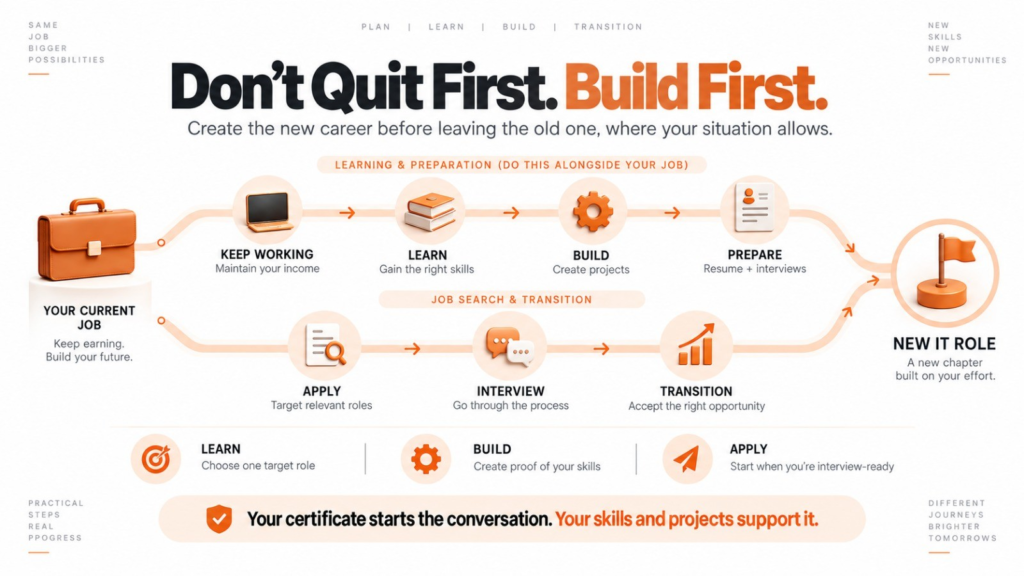
How to start the switch without resigning first
Quitting your current job before you have built the new skill set creates unnecessary financial pressure. Unless your personal situation requires a different approach, learning while employed gives you more room to make decisions carefully.
Start by choosing one target role instead of trying to learn everything. If you are working in accounts, for example, you could spend the first few weeks testing whether data analytics interests you. Learn basic Excel and SQL, create a small dashboard, and see whether you actually enjoy the work before committing to a longer programme.
A structured course can then give the learning process some consistency. Teknowell currently offers weekday and weekend batches, along with online and classroom options, which can make the transition easier to manage alongside existing employment. The other advantage of staying employed is psychological. You can apply for jobs because you want the right transition, not because you have no income left. That gives you more freedom to reject a poor role, wait for the right interview, or continue improving your portfolio when the first few applications do not work.
You can start applying before the course officially ends if your portfolio and technical preparation are ready. The goal is to reach the end of training with evidence of what you can do, not simply a certificate saying that you attended.
If Pune is where you want to build the next stage of your career, you can book a free demo class at Teknowell and ask the trainer which course fits your existing background, available study time, and target role.
The decision becomes clearer when you stop treating your age as the whole problem
The biggest mistake is thinking about a career switch to IT after 30 in India as if you are competing with every 21-year-old graduate for exactly the same job. You are not required to copy their path. Your previous experience, the role you target, the skills you build, and the evidence you can show in an interview all change the equation.
If you are from finance or operations, data analytics may give you a more natural bridge into technology. If you genuinely enjoy programming and want to build applications, full-stack development may be worth the steeper learning curve. Either way, the practical route is similar: keep your current income where possible, learn consistently, build projects, prepare for interviews, and target roles where your old experience still has some relevance.
The question is not whether turning 30 automatically closes the IT door. It does not. The more useful question is whether you can commit the next several months to learning a new skill set while being realistic about the first role, the salary range, and the companies you can actually apply to.
Book a free demo class at Teknowell, Pimpri Chinchwad, and discuss your current background, target role, and the course that fits your situation before making the switch.