

Over five lakh freshers appear for the TCS National Qualifier Test every year. One exam. Three possible outcomes. And a salary difference of almost ₹6 lakh per year between a Ninja and a Digital offer.
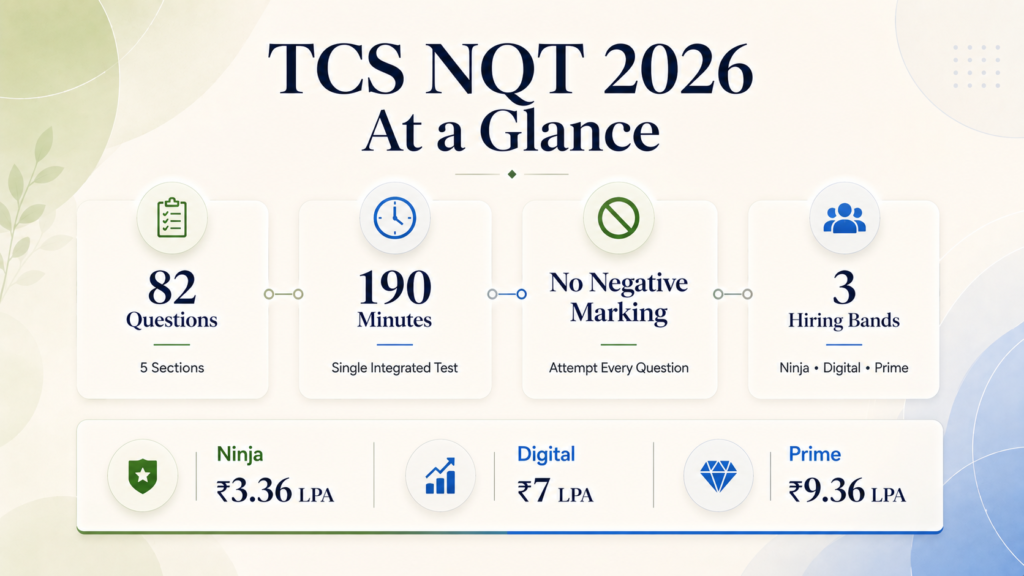
That is not a small gap. Ninja gets you ₹3.36 LPA. Digital gets you ₹7 LPA. Prime takes you to ₹9.36 LPA. The difference between those three outcomes is not luck or talent. It is preparation quality, and specifically, whether you prepared for the right things in the right order.
This guide breaks the TCS NQT down section by section, tells you exactly what gets tested and at what difficulty level, and gives you a realistic 30-day plan that works whether you have strong coding skills or not. No fluff. No generic tips. Just what you actually need to do.
Quick facts: TCS NQT 2026 has 82 questions across 5 sections, runs for 190 minutes, and uses an integrated single-test format. One exam determines your Ninja, Digital, or Prime band simultaneously. No negative marking in any section. Attempt every question.
What the TCS NQT actually tests in 2026
Before preparing for anything, understand the structure. The TCS NQT 2026 is divided into two parts: a Foundation Section and an Advanced Section. Both are mandatory for all candidates. For TCS NQT dates alongside Infosys, Wipro and Cognizant, keep our IT placement exam calendar for 2026-27 handy.
| Section | Part | Questions | Time |
|---|---|---|---|
| Numerical Ability | Foundation | 20 | 25 min |
| Verbal Ability | Foundation | 25 | 25 min |
| Reasoning Ability | Foundation | 20 | 25 min |
| Advanced Quantitative and Reasoning | Advanced | 15 | 25 min |
| Advanced Coding | Advanced | 2 | 90 min |
| Total | 82 | 190 min |
Quick answers
Is there negative marking in TCS NQT?
No. A wrong answer does not cost you marks, so attempt every question.
How many questions are there?
82 in total: 65 in the Foundation part and 17 in the Advanced part.
How long is the exam?
190 minutes.
Can you go back to an earlier section?
No. Each section locks when its timer ends.
What score do you need for Ninja?
Roughly 40 to 45 out of 65 in the Foundation part, based on past cutoffs.
Your Foundation performance determines Ninja eligibility. Your Advanced performance determines Digital and Prime eligibility. The cutoff for Ninja is roughly 40 to 45 out of 65 in the Foundation section. For Digital, you need 50-plus in Foundation, 10-plus MCQs in Advanced, and at least one coding problem fully solved. Prime requires 55-plus in Foundation and both coding problems solved correctly.
Section switching is not allowed. Once a section’s timer ends, it locks. You cannot go back. This is critical for preparation; the way you manage time within each 25-minute window is a separate skill from knowing the content.
For the full official syllabus breakdown, PrepInsta’s TCS NQT syllabus page is one of the most regularly updated resources available. The GeeksforGeeks TCS NQT guide also covers the post-NQT interview structure in useful detail.
Our courses come with placement support that keeps going after classes end, until you are placed.
- Classroom in Chinchwad or live online batches
- Technical and HR mock interviews
- Help with your resume and interview calls
The section most freshers underestimate: Verbal Ability
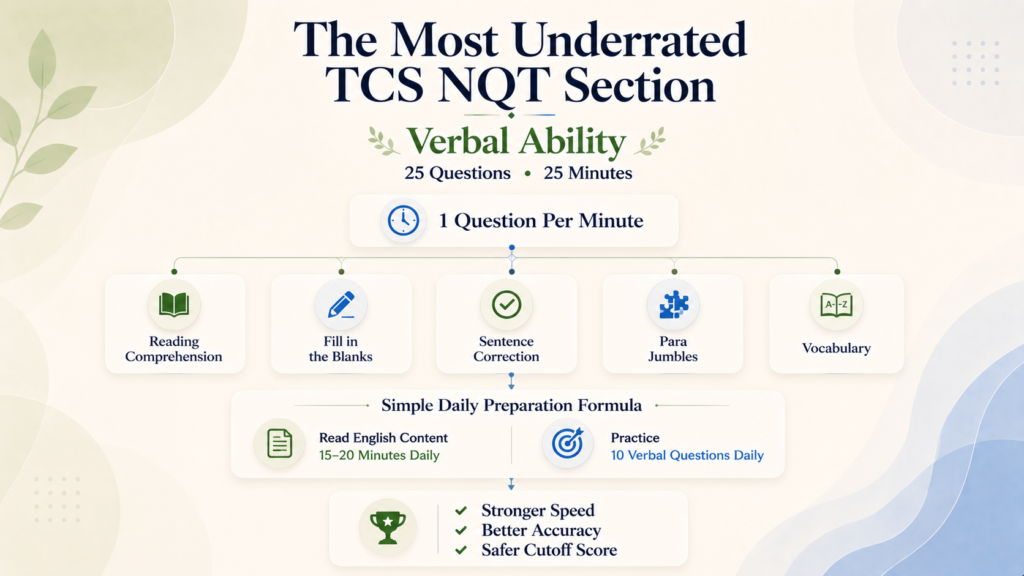
This is one of those things which will shock many of the candidates. Verbal Ability carries the highest number of questions in the Foundation Round, 25 in 25 minutes. In other words, one question per minute. And it is the section which CS and engineering students do the least preparation in.
The verbal section tests reading comprehension, fill-in-the-blanks, sentence correction, para-jumbles, and vocabulary. None of these things is very hard. But the thing is, they are fast, and if English is not your best subject, it might quietly kill your cutoff when you practice sorting algorithms all day.
The method of preparation is simple in this case: read 15 to 20 minutes of English every day. Not textbooks. Newspaper articles in English, news stories in English, tech blogs in English. It builds up speed and comprehension without any conscious effort. Add that to solving 10 verbal questions in a day from sources such as IndiaBix or PrepInsta, and your verbal section becomes safe within two weeks.
Numerical & Reasoning: What You Should Pay Attention To
Questions from the Numerical Ability section include topics which all engineering graduates would be aware of: percentages, profit and loss, time-speed-distance, ratios, averages, simple/compound interest, number system, and probability. Moderate level of difficulty, and definitely nothing at the level of CAT.
Topics included in the Reasoning section include: Logical Reasoning, Coding-Decoding, Blood Relations, Direction-Based Problems, Number Series, and Seating Arrangements. Difficulty Level: moderate. However, it is not the content, but the timing that sets the trap here.
It is important to note that speed is more valued than in-depth understanding in both sections. It would always be beneficial for a candidate to solve a profit and loss problem within 45 seconds rather than spending two minutes solving a more difficult one. This speed can only come through regular practice. It is important to solve 20 aptitude and 15 reasoning problems per day with a timer. Always timed!
Time-Speed-Distance and Percentages are two of the major topics from the Numerical Ability section. For the Reasoning Section, Number Series and Logical Arrangement are a few topics that come up with very high frequency.
The coding section: what level is actually asked
This is where most candidates either over-prepare or completely under-prepare. The TCS NQT Advanced Coding section has 2 problems and 90 minutes. The coding languages supported are C, C++, Java, Python, and Perl.
For the Ninja band, solving one problem completely is generally sufficient. For Digital, you need both problems solved or one completely solved with clear partial progress on the second. For Prime, both need to be solved, and the Advanced Aptitude MCQs also need to be strong.
The actual difficulty level of the coding problems sits between LeetCode Easy and LeetCode Medium. Topics that appear repeatedly across NQT cycles: array manipulation, string operations, basic sorting and searching, pattern-based loops, and occasionally basic recursion. Dynamic programming at a complex level is rarely asked for in the standard NQT. If you are targeting Digital, basic DP concepts like Fibonacci variations and simple subset problems are worth knowing. If you are targeting Ninja, arrays and strings are sufficient.
The biggest mistake in the coding section is spending 70 minutes on one problem, trying to get it perfect, when 45 minutes of correct code on one problem, plus partial logic on the second, gives a better score. Write clean, readable code. Comment on your logic. Even partial solutions that compile and pass some test cases count toward your score.
Python is now officially supported from the 2025 cycle onwards. For freshers who have just completed a data science or Python-based course, this is a genuine advantage. Python’s shorter syntax means you can write correct solutions faster than equivalent C++ or Java code.
Students who want to strengthen their coding fundamentals before placement season can also explore Teknowell’s software development training programmes, which combine coding practice, projects, and interview preparation.
The 30-day preparation plan
This plan assumes you are starting from a moderate foundation. Adjust based on your current level.
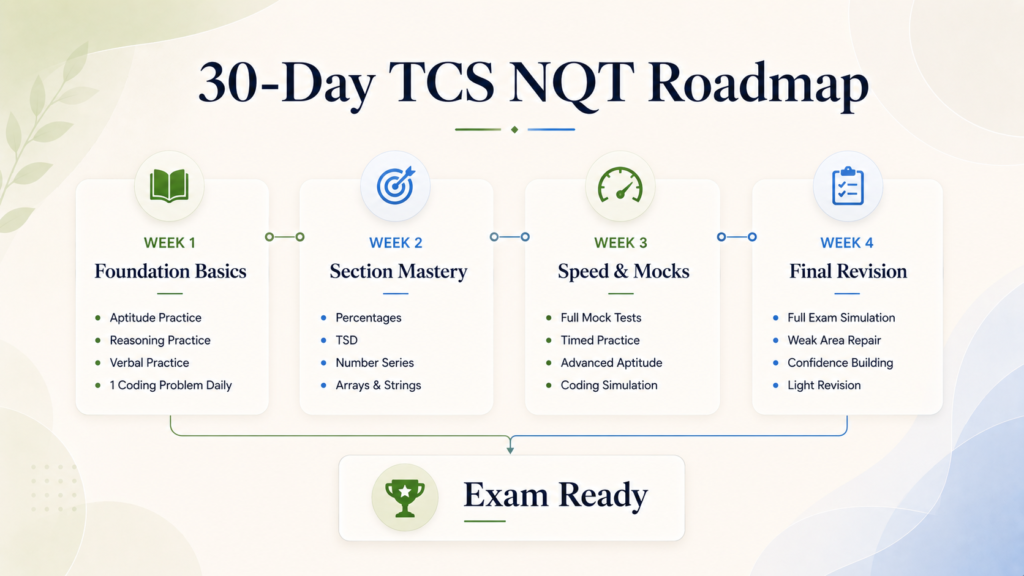
Week 1: Foundation basics
The goal this week is to understand your starting point and build consistent daily habits. Do not try to cover everything. Build the routine first.
Daily targets: 20 numerical aptitude questions (IndiaBix), 15 reasoning questions, 10 verbal questions. Timed. No exceptions. At the end of the week, take one full Foundation mock test and identify which section gave you the most trouble. That section gets 10 extra questions daily from Week 2 onwards.
Coding: Solve 1 LeetCode Easy problem daily in your preferred language. No pressure on difficulty this week. Focus on getting comfortable writing code under a timer.
Week 2: Section depth
This week goes deeper into the topics that carry the most weight.
Numerical: focus specifically on TSD, percentages, and profit-and-loss until you can solve standard questions in under a minute.
Reasoning: focus on number series and logical arrangements.
Verbal: Read one article daily and answer 5 comprehension questions about it before checking the text again.
Coding: move to LeetCode Easy problems involving arrays and strings. Solve 5 to 7 per week. Focus on understanding the problem before writing a single line. Most NQT coding failures happen because the candidate misread the problem statement, not because they lacked coding ability.
Week 3: Speed and mock tests
By Week 3, content knowledge should be in place. The focus shifts entirely to speed and accuracy under test conditions.
Take two full Foundation mock tests this week, timed exactly as the actual exam. Review every wrong answer. Not to memorise the answer, but to understand the mistake. Pattern recognition mistakes are different from formula mistakes and need different fixes. Take one partial Advanced mock (Aptitude MCQs only) and see where you stand against the Digital cutoff.
Coding: attempt 2 problems in a 90-minute session, exactly as the actual exam. Do not look at hints. Write the solution, test it mentally, then submit. Practice moving on from Problem 1 after 40 minutes, even if it is not perfect.
Week 4: Simulation and weak area repair
The final week is a full-length simulation. Take two complete NQT mock tests across both Foundation and Advanced sections. These should run for the full 190 minutes under exam conditions, with no phone, no breaks, no looking things up. After each, identify the three questions that cost you the most time and understand exactly why.
Spend the last two days before the exam on light revision only. No new topics. Review your strongest sections to build confidence. Sleep well the night before. The Verbal section suffers most from fatigue.
Need a Structured NQT Preparation Path?
If you’re preparing for TCS NQT alongside college, internships, or final-year projects, having a structured roadmap can save weeks of trial and error.
Teknowell combines aptitude preparation, coding practice, live projects, mock interviews, and placement assistance so students are ready not only for the NQT but also for the interview rounds that follow.
Book a Free Demo Class and see how the placement preparation programme works before making any commitment.
After the NQT: what happens next
Clearing the NQT is the start, not the finish. Once the results are declared, candidates who clear the cutoff are called for an interview round. The structure varies by band.
For Ninja, it is typically one technical round covering core CS fundamentals, OOP concepts, a basic SQL query or two, and a project discussion. For Digital and Prime, the technical round is more involved and includes DSA problem-solving and deeper project architecture questions.
This is where structured interview preparation becomes genuinely important. Many freshers clear the NQT and then underperform in the technical round because they prepared exclusively for the aptitude and coding exam. The interview is a different skill. If you want a round-by-round breakdown of what the TCS technical interview actually covers, the Software Developer Interview Preparation Guide covers it in detail.
The pattern across Ninja, Digital, and Prime technical rounds is consistent: the interviewer will ask about your final year project or training project in depth, will give you a basic coding problem to solve while explaining your reasoning, and will test one or two CS fundamentals. Communication matters as much as correctness at this stage.
The 5 mistakes that cost freshers the NQT cutoff
Understanding what goes wrong is as useful as knowing what to do right. These five mistakes appear across almost every NQT failure pattern.
1. Neglecting Verbal entirely. CS students consistently deprioritise the Verbal section. With 25 questions in 25 minutes, one bad section can pull the total below the Foundation cutoff even when Numerical and Reasoning are strong.
2. Practising untimed. Solving aptitude problems without a timer feels productive, but does not build the speed the actual exam requires. Everything in preparation should be timed from Week 2 onwards.
3. Over-preparing for coding at the expense of the Foundation. A perfect coding score does not matter if the Foundation section is not cleared. The foundation is evaluated first. Candidates who score below the Foundation threshold do not even have their Advanced section evaluated.
4. Attempting all coding questions before reading both. Read both coding problems before starting. The second problem is sometimes significantly easier than the first. Many candidates spend 80 minutes on Problem 1, realise it is hard, and do not attempt Problem 2 at all.
5. Leaving questions blank. There is no negative marking in the TCS NQT. Zero. Leaving a question blank and answering it incorrectly gives the exact same score. Attempt every single question, even if it is a guess.

How Teknowell’s programme prepares you for the NQT and beyond
The TCS NQT is not just an aptitude test. It is a filter for the technical interview that follows. Most training programmes prepare freshers for either the exam or the interview. Teknowell’s placement preparation covers both.
The structured mock interview sessions are modelled on actual TCS technical round formats. Students practise explaining projects, solving basic DSA problems while speaking through their reasoning, and answering OOP and database questions under interview conditions. The aptitude preparation built into the programme covers Numerical, Verbal, and Reasoning sections with timed practice sessions, not just content delivery.
More importantly, because the internship and live projects are completed alongside the course itself, students who sit for the NQT technical round already have real projects to discuss. That is a different experience from trying to explain a tutorial-based project to an interviewer who asks follow-up questions about why specific technical decisions were made.
If the NQT is coming up in the next 30 to 60 days and structured preparation with feedback would help, book a free demo class at Teknowell to see what the placement programme covers before making any decision.