

A fresher joining TCS or Infosys in Pune typically starts at ₹3.5 to ₹5 LPA. A fresher joining Deutsche Bank India Technology, HSBC Technology, or Barclays India in the same city typically starts at ₹8 to ₹14 LPA. Same city. Same graduation year. A very different salary. For a wider view of which roles pay the most in the city, see our list of the highest-paying IT jobs in Pune.
The difference is not the degree or the college. It is the type of company, and specifically, whether it is an IT services company or a Global Capability Centre. Pune now has over 350 GCCs operating across BFSI, automotive, enterprise tech, and industrial sectors, and that number is projected to cross 500 by 2030. The GCC jobs Pune freshers are targeting in 2026 are real, they are growing, and they are accessible, but the preparation strategy is completely different from what most students follow when applying to IT services companies.
This guide tells you what a GCC actually is, which ones are actively hiring freshers in Pune right now, how they find candidates, what skills they screen for, and how to prepare specifically for this track.
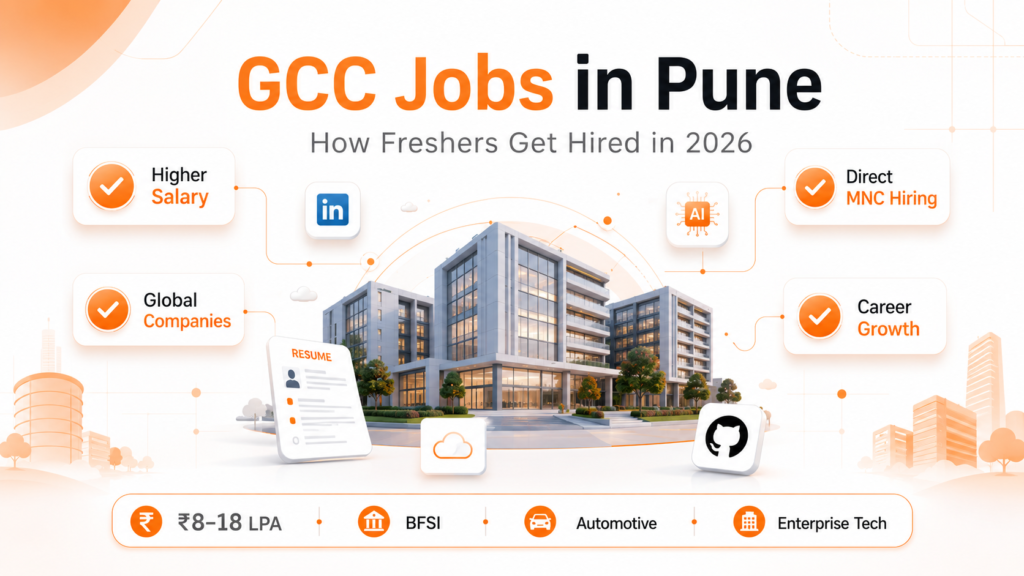
Quick facts before you read further: GCC jobs in Pune for freshers (2026): Salary ₹8–18 LPA, depending on company and role. Top sectors: BFSI, automotive, ER&D, enterprise tech. Key locations: Hinjewadi, Kharadi, Viman Nagar, Magarpatta, Yerwada. How they hire: LinkedIn outreach, referrals, campus partnerships, not mass drives. Core skills they look for: Python or Java, SQL, Git, DSA, communication, AI and cloud basics.
What is a GCC, and how is it different from an IT services company?
Most freshers know the acronym but are not entirely clear on what a Global Capability Centre actually is. The distinction matters a lot when you are deciding where to invest your preparation energy.
The core difference
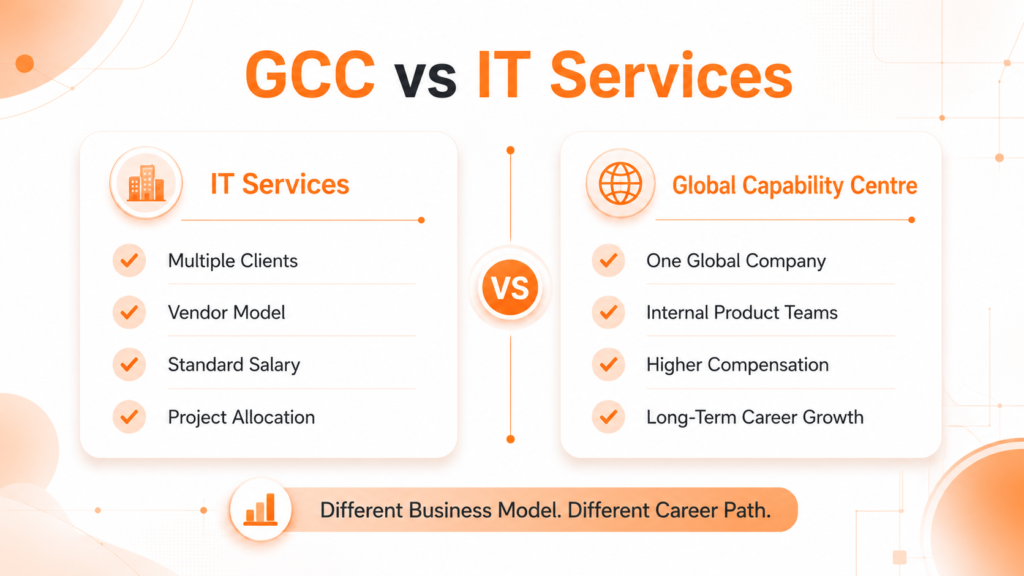
An IT services company like TCS, Infosys, or Wipro works for multiple clients. It is a vendor. When you join TCS, you work on client projects; you might be building software for a bank, a logistics company, or a healthcare platform, but the bank is the client, and TCS is the service provider.
A GCC is a wholly owned subsidiary of a single global parent company. Deutsche Bank’s India Technology Centre in Kharadi is not a vendor working for Deutsche Bank; it is Deutsche Bank, operating in India. HSBC Technology in Pune is not a contractor for HSBC; it is the bank’s own internal technology team, just based in Pune. When you join a GCC, you work directly for the global company, on their own products, with their internal compensation benchmarks and career paths.
That is the reason the salary is different. You are on an MNC payroll from day one, not an IT services payroll.
Why are GCCs in Pune specifically growing so fast?
Pune offers something very few cities can match simultaneously: deep engineering talent from institutions like COEP, PICT, Symbiosis, and VIT Pune; operating costs that are 10 to 20% lower than in Bangalore; a strong existing BFSI and automotive tech cluster; and infrastructure that keeps improving. Global companies setting up or expanding in India are increasingly choosing Pune because of this specific combination. For freshers, this means the number of GCC hiring opportunities in Pune’s Hinjewadi and Kharadi belt is growing every year, not flattening.
For the broader picture of India’s GCC landscape, NASSCOM’s GCC resource hub is the most authoritative reference.
Which GCCs are actively hiring freshers in Pune?
This is the question most freshers want answered first. Here is a sector-by-sector breakdown of the active GCC companies in Pune with a track record of fresher hiring.
BFSI GCCs in Pune (highest-paying for freshers)
The BFSI GCC belt in Pune is concentrated across Kharadi, Viman Nagar, and Yerwada, and it is where the highest fresher packages are available.
Deutsche Bank India Technology Centre (Kharadi, Pune) builds trading systems, financial analytics platforms, and enterprise banking infrastructure supporting Deutsche Bank’s global operations. Their Pune centre is one of the largest technology hubs that the bank operates outside Germany.
Barclays India (Pune) runs technology operations, compliance engineering, and risk systems from Pune. They have a consistent fresher hiring track and are one of the more accessible BFSI GCCs for well-prepared candidates.
HSBC Technology India (Pune) handles global banking platforms and risk systems. Their Pune presence spans both technology and operations, making it one of the larger GCC employers in the city.
Mastercard India Tech Hub (Pune) focuses specifically on AI-powered fraud detection, digital identity, and payments infrastructure. For freshers interested in BFSI GCC jobs Pune 2026 that directly involve applied AI, Mastercard is worth targeting.
Citi India (Pune) runs banking technology and data engineering from Pune, with a consistent presence in BFSI tech hiring across the city.
Automotive and engineering ER&D GCCs in Pune
Pune’s automotive GCC cluster is unlike anything in the rest of India. No other city has this density of automotive R&D from global names.
Mercedes-Benz Tech Innovation (Pune) designs automotive software, connected car platforms, and advanced engineering systems. Their Pune centre is central to Mercedes-Benz’s global vehicle innovation roadmap.
BMW Group India (Pune) focuses on electric mobility systems, autonomous driving research, and automotive software. The work here is genuine R&D, not support functions.
Siemens Digital Industries Software (Pune) builds industrial automation software, simulation tools, and digital twin platforms used across global manufacturing industries. One of the more technically demanding GCCs in Pune for freshers with an interest in embedded systems or industrial tech.
Bosch (Pune) operates one of its largest engineering centres in India from Pune, covering automotive electronics, embedded systems, and industrial technology. Engineering graduates with relevant domain interests have a realistic path here.
Enterprise tech and software GCCs
Workday India (Pune) develops cloud-based human capital management, financial management, and AI platform solutions. Their Pune centre has grown significantly and is active in fresher hiring.
Emerson (Pune) develops industrial automation systems and control technologies. Their Pune centre focuses on digital solutions for global energy and manufacturing sectors.
These companies are less talked about than the BFSI names but represent stable, well-paying Global Capability Centre jobs Pune 2026 that are more accessible than the top-tier investment bank GCCs.
How GCCs actually hire freshers, this part most guides skip
Understanding the hiring process matters as much as knowing which companies to target. GCCs do not recruit like IT services companies. There are no mass drives sending 10,000 offer letters. The pipeline is smaller, more selective, and often starts before a role is publicly posted.
LinkedIn is their primary hiring tool, not Naukri
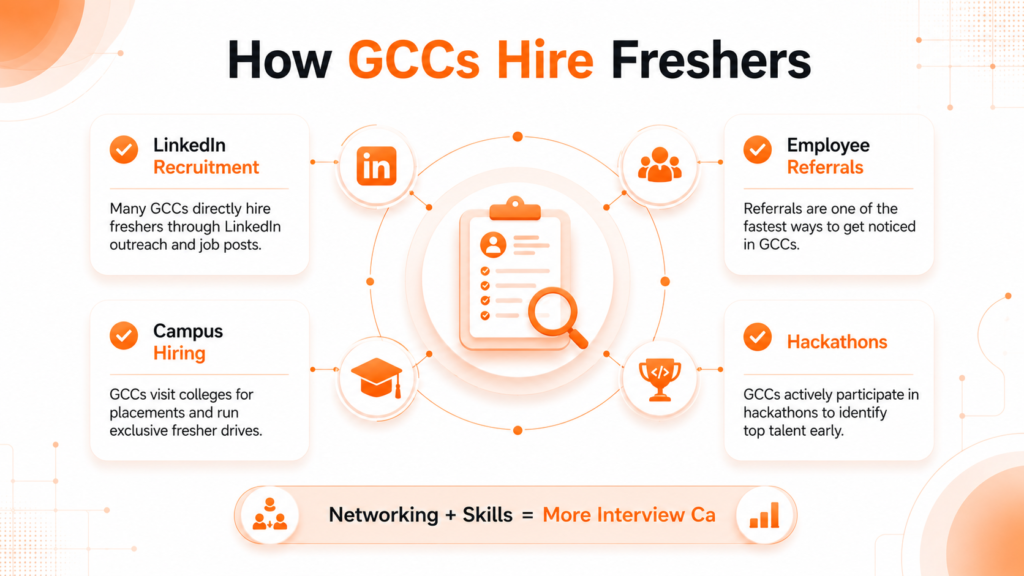
This is the single most important thing to understand about how to apply for GCC jobs in Pune. GCC talent acquisition teams actively search LinkedIn for candidates rather than waiting for applications to come in. A candidate with a complete, current LinkedIn profile, skills listed, projects described, certifications visible, and recent activity gets outreach from GCC recruiters without having applied anywhere.
This is not a theory. It is how a significant portion of GCC lateral and fresher hires actually happen. A warm message from a recruiter who found your profile is substantially more likely to convert to an interview than a cold application to a job posting. The practical implication: update your LinkedIn profile before you start applying anywhere. Search for active GCC roles on LinkedIn Jobs to see what is currently posted, but know that the deeper hiring pipeline operates before most posts go live publicly.
Referrals carry significantly more weight at GCCs
Because GCC’s parent company cultures place a high value on cultural and professional fit, an employee referral from someone currently working at the company carries far more weight than a direct application. One warm introduction from a current Deutsche Bank or HSBC employee in Pune moves a fresher profile from unread to shortlisted faster than almost anything else.
Start building genuine connections with people working at your target GCCs on LinkedIn while you are still in training. Not a generic connection request messages an actual note mentioning something specific about their work or the company. This is a medium-term strategy that pays off at the right moment.
Campus partnerships and hackathons
GCCs in Pune run dedicated fresher hiring through campus placement partnerships with specific colleges and through coding competitions and hackathons. These are announced on company LinkedIn pages and official career portals. Following the LinkedIn pages of your target GCC companies and turning on job alerts for their pages is the most reliable way to catch these opportunities early.
Official career portals
Deutsche Bank Careers, HSBC Careers, Barclays Jobs, and Mastercard Careers all have India-specific sections. Apply through official portals. Third-party job boards frequently list outdated or duplicate GCC postings that are no longer active.
Still trying to land your first tech role? Our guide on How to Get an IT Job Without Experience in Pune explains practical strategies to improve your resume, LinkedIn profile, portfolio, and job search before you start applying.
What skills GCCs look for in freshers in 2026
This is where the preparation difference between a TCS-ready candidate and a GCC-ready candidate becomes concrete. The skills required for GCC jobs in India are not entirely different, but the depth expected and a few specific additions change the equation significantly.
The non-negotiable foundation
Python or Java programming; not “familiar with.” GCCs want candidates who can build things. A GitHub profile with real deployed projects is the evidence. Knowing the syntax is the starting point, not the qualification.
SQL to intermediate level; joins, aggregations, window functions, subqueries. Not just SELECT and WHERE. BFSI GCCs, in particular, use SQL heavily in data engineering, risk modelling, and analytics functions. A candidate who can write a multi-table join with a window function immediately separates from one who knows only basic queries.
Git and GitHub: version control is baseline, not a differentiator. Every GCC expects it. The differentiator is whether your GitHub actually has well-documented, real projects that anyone can look at and understand.
REST API basics: understanding how data moves between systems, how to make API calls, and how to read API documentation. This underpins most modern development work at GCCs.
English communication: this is the one that consistently surprises freshers. GCCs require regular interaction with global teams in the US, UK, and Europe. Candidates who struggle to explain their project clearly in a mock interview, even technically strong ones, are regularly eliminated at GCCs. Communication is not evaluated only in the HR round. It is noted in every round.
The skills that put a fresher in the top 10% of applicants
Gen AI or LLM exposure: any demonstrable project that integrates AI. Prompt engineering basics, an application built with the OpenAI API, familiarity with vector databases or RAG architecture basics. Even one small project that uses AI meaningfully is a differentiator that most freshers do not have. BFSI GCC jobs Pune 2026 are actively screening for this awareness.
Cloud fundamentals certification: AWS Cloud Practitioner or Azure Fundamentals. These are the lowest-cost certifications available, and they signal seriousness and self-direction. A certified fresher demonstrates that they invested time preparing for the industry beyond what the college curriculum required.
Deployed portfolio, not tutorial projects. Real applications that are live have a URL and solve a problem. Describing a project is one thing. Showing a recruiter a live link that they can click and use is a different conversation entirely.
System design basics: freshers who can discuss scalability at a conceptual level stand out at product-focused and BFSI GCCs. Not a full system design interview, just awareness of concepts like load balancing, database selection trade-offs, and why you would use a microservices approach versus a monolith.
Domain awareness bonus for Pune’s specific GCC clusters
For BFSI GCCs, basic familiarity with how payment systems work, what fraud detection involves at a conceptual level, or how credit risk models are used adds visible value. None of this requires finance expertise. It signals that you have thought about the industry and not just the technology stack.
For automotive R&D GCCs, embedded systems basics, understanding of IoT, and awareness of automotive software development cycles. Again, not deep expertise. Just enough to have an informed conversation about the work the GCC actually does.
| Skill area | IT services expectation | GCC expectation |
| DSA depth | Basic aptitude level | LeetCode Easy to Medium |
| Coding projects | Tutorial projects acceptable | Deployed real projects are preferred |
| Communication | Functional | Strong global team interaction required |
| Domain awareness | Not required | Helpful for BFSI and ER&D GCCs |
| AI and cloud exposure | Not required | Strong positive differentiator |
| SQL depth | Basic queries | Intermediate joins, window functions |
| System design | Not asked for freshers | Basics expected at product-focused GCCs |
Essential skills required for GCC jobs in Pune for freshers including Java, Python, SQL and AI
GCC salary in Pune vs IT services: the actual numbers
The GCC vs IT services company India salary comparison is one of the most searched questions in this space. Here is what the market actually looks like for freshers in Pune in 2026.
| Company type | Fresher salary Pune | Notes |
| IT services (TCS, Infosys, Wipro) | ₹3.5–5 LPA | Standard SE/ASE track |
| IT services premium (TCS Digital, Infosys SP) | ₹7–9.36 LPA | Requires NQT Digital or InfyTQ Master |
| Product companies (Pune mid-size) | ₹5–9 LPA | Varies significantly by company |
| BFSI GCCs (Deutsche Bank, HSBC, Barclays) | ₹8–14 LPA | Strong project portfolio required |
| Top-tier GCCs (Goldman Sachs, Mastercard) | ₹12–18 LPA | High prep bar, limited fresher intake |
| Automotive ER&D GCCs (Mercedes, BMW, Siemens) | ₹6–12 LPA | Domain awareness preferred |
GCCs generally offer a 12 to 20% salary premium over IT services for comparable roles at the mid-level. At the fresher level, the gap is wider because GCC fresher packages are benchmarked against global compensation rather than Indian IT services norms. The salary premium is real. So, is the preparation bar required to access it? A fresher who targets a BFSI GCC without the right skill depth is unlikely to clear the technical interview, regardless of how well they perform on an aptitude test.
How to prepare specifically for a GCC job in Pune: step by step
GCC interview preparation for freshers requires a different strategy from standard IT services preparation. The skills overlap, but the depth and the specific additions are different.
Step 1: Build the right technical foundation first
Choose Python or Java as your primary language and go deep. Build three to four real projects that are deployed and accessible with a live URL and a GitHub repository. Cover SQL to an intermediate level, practice writing joins, group by aggregations, and window functions without looking things up. Add one cloud certification (AWS Cloud Practitioner is the most broadly applicable for the range of GCCs in Pune). Add one AI integration project, even something modest like a chatbot built with the OpenAI API or a recommendation system using a public dataset, to communicate the awareness GCCs are screening for in 2026.
Teknowell’s full-stack development course in Pune and data science and AI course in Pune are both structured around building exactly this kind of portfolio during training, with real deployed projects, Gen AI integration modules, and cloud preparation included in the curriculum. Students graduate with the portfolio already built, not with a certificate and nothing to show in an interview.
Step 2: Optimise your LinkedIn profile before you send a single application
This is the step most students skip or do last. For GCC hiring in Pune’s Hinjewadi and Kharadi belt, it should be done first. List every relevant skill, describe each project as an outcome rather than a list of tools used (not “built using React and Node.js” but “built a full-stack inventory management application deployed on AWS EC2 with JWT authentication and REST APIs”), and post or engage with content in your target domain at least once a week.
Follow the LinkedIn pages of every GCC you want to work at and turn on job alerts. Connect with people who currently work at your target companies. A genuine message that references something specific about their work or the company’s recent projects has a meaningful response rate. A copy-pasted template goes unread.
Step 3: Prepare for GCC interviews specifically, not generic IT interviews
The GCC technical interview is more rigorous than what IT services companies test at the entry level. DSA is expected at a real problem-solving level; you will be asked to solve a problem while speaking your reasoning aloud, not just to arrive at a correct answer. Project deep-dives are thorough interviews at BFSI GCCs that probe the business logic behind the project, not just the technology used. Communication is evaluated in each round, including technical.
Practice explaining your projects using the structure: what problem it solves, what technical decisions you made and why, what challenges you ran into, and what you would do differently now. Practice coding problems out loud. Mock interviews modelled on actual GCC formats are the most effective single preparation tool available. The software developer interview preparation guide breaks down every round, what each test tests, and how to prepare specifically in full detail.
If you’re serious about targeting GCCs instead of standard IT services roles, a structured roadmap can save months of trial and error. Book a free demo class at Teknowell to understand your current skill level, explore live projects built during training, and learn how our placement preparation is aligned with GCC hiring expectations in Pune.
Step 4: Time your applications around expansion announcements
GCC talent acquisition pipelines activate within weeks of a company announcing a new centre or expansion in Pune. Following target companies on LinkedIn and setting up Google Alerts for their name, combined with “Pune hiring” or “India expansion,” is a genuine job search strategy. Applying before a role is formally posted publicly removes most of the competition. The best time to reach out is right when the expansion is announced and the hiring team is building the pipeline.
How Teknowell prepares students for GCC-level roles in Pimpri Chinchwad, Pune
The gap between a TCS Ninja profile and a BFSI GCC-ready profile is not a talent gap. It is a preparation quality gap. Both candidates may have completed a full-stack or data science course. The difference is in whether the course produced real deployed projects, whether the student has practiced explaining those projects in an interview setting, and whether the training included the skills that GCCs specifically ask for: cloud, AI integration, intermediate SQL, and strong communication.
Teknowell’s training programmes in Pimpri Chinchwad are structured around exactly the profile that Hinjewadi and Kharadi GCC companies look for. Students build real projects during the course itself rather than theoretical exercises. The internship alongside training means students graduate with 4 to 6 months of documented real-world experience to discuss in interviews. Mock interviews are modelled on actual technical round formats, including GCC-specific patterns. Placement support covers LinkedIn profile optimisation, GitHub portfolio setup, and hiring connections with companies across Pune’s tech ecosystem. Trainers come from industry backgrounds in enterprise and BFSI technology, which shows in how they teach and what they prepare students for.
The salary difference between a standard IT services role and a BFSI GCC role in Pune starts at ₹3 to ₹9 LPA at the fresher level alone. That gap does not close by doing the same preparation everyone else does. It closes by building the specific skills, portfolio, and interview readiness that GCCs actually screen for.
The GCC track is real, and it is more accessible than most freshers think
The salary difference between a standard IT services role and a BFSI GCC role in Pune does not come from luck, college tier, or knowing the right people. It comes from preparation quality. The same graduation year, the same city, and a dramatically different outcome purely based on the depth of skills, the quality of the project portfolio, and the readiness of the interview performance.
Pune’s GCC ecosystem is growing. Hinjewadi and Kharadi GCC companies hiring in 2026 range from global banks to automotive R&D centres to enterprise software companies, and all of them are finding it harder to fill roles than to create them. The opportunity is genuine and widening.
The question is whether you are building toward the right target from the start of your training or whether you are preparing for the path of least resistance and hoping to move up later. The path up is harder after you have started. Building toward GCC-level readiness from day one of your preparation is significantly more efficient.
Book a free demo class at Teknowell, Pimpri Chinchwad, and see exactly how the full-stack and data science programmes are structured to build GCC-ready profiles with real projects, cloud and AI integration, mock technical interviews, and placement support that covers the whole preparation cycle. Speak to a trainer who has seen what GCC interviews actually test and how students who clear them are prepared. Then make your decision.