
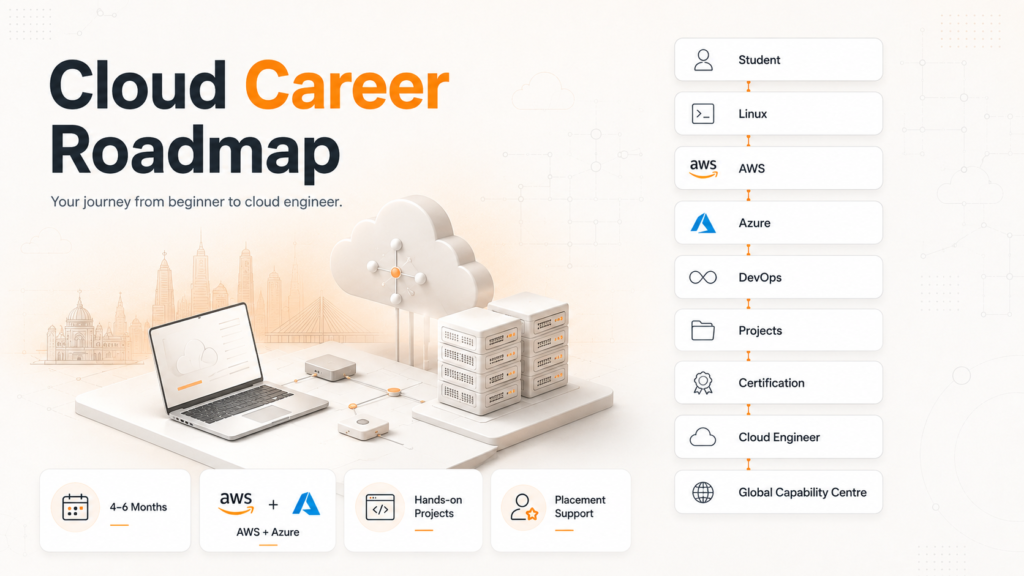
India will have 14 million cloud-related jobs by 2026, more than three times the number that existed just five years ago. Cloud job openings across the country grew 35% in a single year, and right now, there are over 100,000 active cloud vacancies sitting unfilled. Every GCC in Hinjewadi, every fintech startup in Baner, every enterprise running operations out of Kharadi is running on cloud infrastructure that needs people to manage it. [Source: Tagged]
The demand is real. What most students searching for a cloud computing course in Pune actually want to know is simpler: which platform between AWS and Azure actually gets you hired, how much does the course cost, and what salary can you realistically expect on day one? This guide answers all three without the usual marketing vagueness. Just numbers, comparisons, and a clear picture of what the career path looks like.
Quick facts: Duration: 4–6 months · Fresher salary: ₹3.5–8 LPA · Platforms: AWS + Azure · Certifications: AWS Cloud Practitioner, Azure Fundamentals (AZ-900) · Active cloud vacancies in India: 100,000+ (Taggd 2026) · Mode: Online + Offline at Teknowell, Pimpri Chinchwad.
Why cloud computing is one of the smartest career choices in Pune right now
The reason cloud engineering stands apart from most IT careers in 2026 is that it sits at the intersection of two things happening simultaneously: enterprise adoption and AI growth. Both are accelerating, and both directly increase demand for cloud professionals.
94% of Indian enterprises have already adopted cloud in some form. NASSCOM and Oliver Wyman project that the Indian cloud services market will reach $17 billion by 2027, growing at a 25% CAGR. That is not speculative growth; it is infrastructure spending that companies have already committed to. Every application migrating from an on-premises server to AWS or Azure creates roles for engineers who can configure, monitor, and maintain that environment.
The AI angle is worth understanding clearly because a lot of students ask whether AI threatens cloud jobs. It does the opposite. Every AI model a company deploys, every generative AI application running at scale, every machine learning pipeline, all of it runs on cloud infrastructure. GPU instances for training, inference endpoints for LLM APIs, managed ML platforms, vector databases. The AI boom has directly increased cloud infrastructure demand. Cloud engineers are not being replaced by AI. They are being hired to run the systems AI operates on.
Pune specifically sits in a strong position here. The GCC cluster in Hinjewadi and Kharadi: JPMorgan India, Goldman Sachs India, Deutsche Bank India Technology, HSBC Technology, and Walmart Global Tech all operate significant cloud engineering teams locally.
AWS vs Azure: which should you learn first?
This is the question every student asks, and it deserves an honest, direct answer rather than a “both are great” hedge.
AWS: highest job volume, best for freshers entering the market
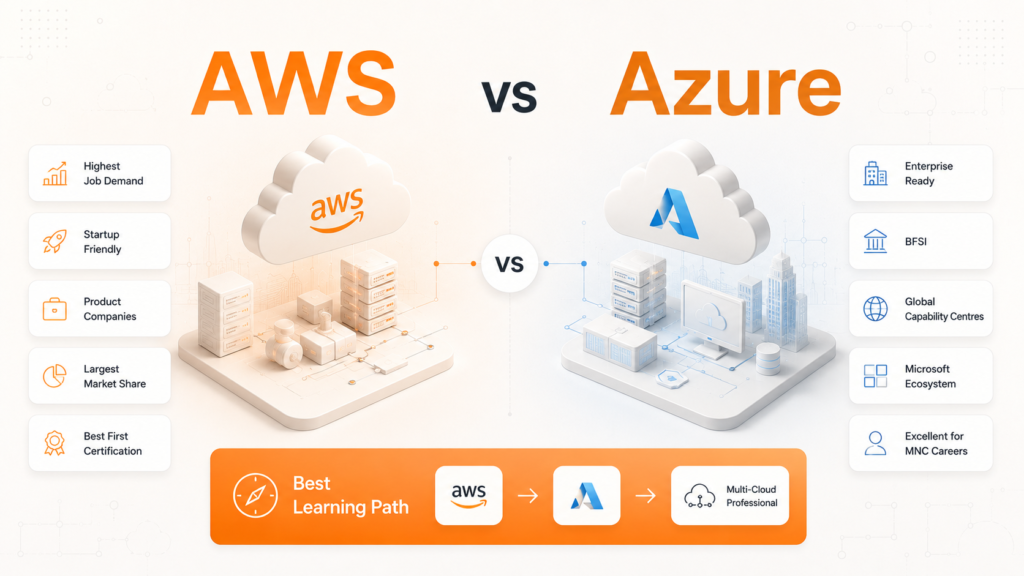
AWS holds approximately 31% of the global cloud market share. India has the highest absolute number of job postings across all cloud platforms. Startups, e-commerce companies, fintech firms, and product companies primarily run on AWS, and Pune’s startup ecosystem in Baner, Balewadi, and Wakad is no different. For a fresher who wants the widest pool of entry-level opportunities, AWS is the safer first choice.
The AWS Certified Cloud Practitioner is the most recognised entry-level cloud credential in India. HR teams actively filter for it on resumes, which immediately puts a certified fresher in a smaller, more visible candidate pool. At mid-level, AWS professionals earn 15–20% more than equivalent Azure professionals. Certification exam fee in India: approximately ₹20,000 for Cloud Practitioner and ₹30,000–₹40,000 for Solutions Architect Associate.
Azure: stronger for enterprise, BFSI, and Pune’s GCCs
Azure is the dominant cloud platform in enterprise environments, Microsoft-technology stacks, and the banking and financial services sector. BFSI companies prefer Azure because of its compliance capabilities and hybrid cloud architecture, and Pune has a dense BFSI tech presence through companies like Bajaj Finserv, Deutsche Bank India Technology, and HSBC Technology. For freshers specifically targeting MNCs and GCCs in Hinjewadi and Kharadi, Azure is the more relevant platform day-to-day.
Azure Fundamentals (AZ-900) certification costs approximately ₹4,500, making it the most affordable cloud certification available anywhere. It has no prerequisites, which makes it genuinely accessible for non-CS backgrounds. Azure Administrator (AZ-104) certification costs approximately ₹13,500 and opens mid-level roles at enterprise companies.
The practical answer: learn AWS first, Azure second
89% of Indian enterprises use multiple cloud platforms simultaneously. Most companies are not purely AWS or purely Azure; they are multi-cloud. Learning AWS fundamentals first gives the widest job access. Adding Azure basics in the second month of training adds the GCC and enterprise angle. By the end of a 4–6-month programme, a student is conversant in both platforms without being shallow in either.
| Factor | AWS | Azure |
| Global market share | 31% highest | 24% second |
| Best for | Startups, fintech, product companies | Enterprise, BFSI, MNCs, GCCs |
| Cert fees India | ₹20,000 (Practitioner), ₹30–40K (SAA) | ₹4,500 (AZ-900), ₹13,500 (AZ-104) |
| Fresher job openings | Highest absolute count in India | Strong in Pune BFSI + GCCs |
| Mid-level salary | 15–20% premium over Azure | Strong in enterprise verticals |
| Learn first? | Yes, maximum entry-level access | Second adds GCC and MNC edge |
What you actually learn in a cloud computing course
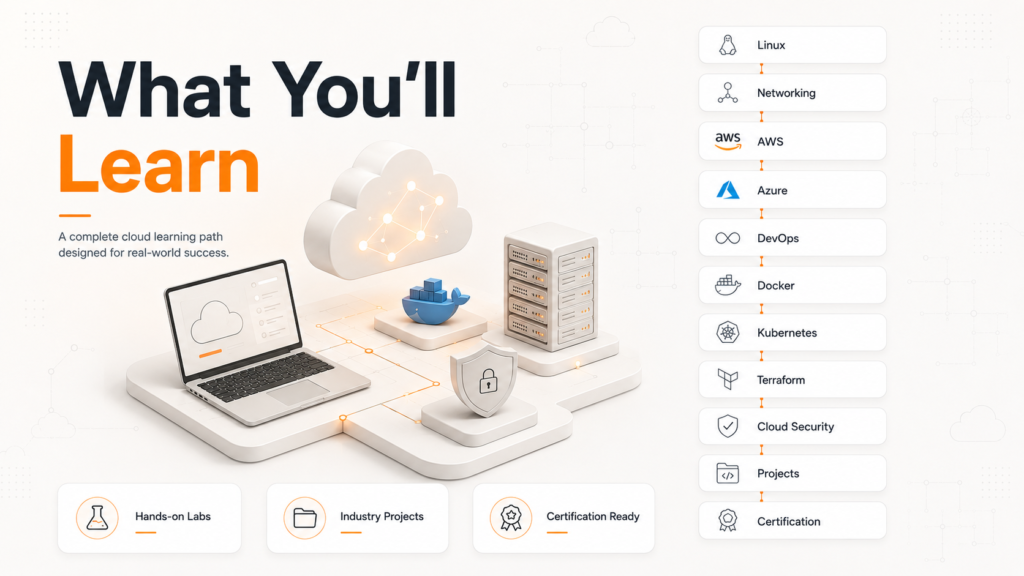
Most course pages list technology names without explaining what students do with them. Here is what a well-structured cloud programme actually covers, module by module.
Linux and cloud fundamentals
Before touching AWS or Azure, students learn how cloud infrastructure actually works, the three service models (IaaS, PaaS, SaaS), deployment models (public, private, hybrid), and Linux command-line basics. Linux is the operating system that most cloud servers run on. Knowing how to navigate directories, manage file permissions, monitor processes, and configure networking from the command line is a prerequisite for every cloud role at every level.
AWS core services
This is where hands-on learning begins. Students launch and configure real AWS infrastructure not by watching demonstrations, but by building. EC2 for virtual servers. S3 for scalable storage. VPC for network architecture. RDS for managed databases. IAM stands for identity and access management. Lambda for serverless functions. CloudFormation for infrastructure-as-code basics. The goal is not familiarity; it is the ability to set up a functional cloud environment from scratch and explain every decision made.
Microsoft Azure fundamentals
Azure Virtual Machines, Blob Storage, Azure Networking, Azure Active Directory, Azure Functions, and the basics of Azure DevOps. This module runs alongside preparation for the AZ-900 Azure Fundamentals certification. By the time it is complete, students are exam-ready without needing a separate study phase.
DevOps and CI/CD pipelines
This is where cloud training separates the candidates who get called back from those who do not. Git and GitHub for version control. Jenkins or GitHub Actions for automated CI/CD pipelines. Docker for containerising applications. Kubernetes fundamentals for orchestrating those containers at scale. DevOps skills add ₹2–4 LPA to a cloud fresher’s starting salary compared to cloud-only knowledge. Companies do not want engineers who can provision a server. They want engineers who can automate the entire deployment pipeline.
Infrastructure as Code and monitoring
Terraform for writing and deploying infrastructure programmatically. CloudWatch for AWS monitoring. Azure Monitor for Azure environments. Basic alerting, incident response workflows, and how to read logs when a production system starts behaving unexpectedly. These are skills used daily at every cloud-native company. Most fresher training programmes skip this module entirely, which is why students who know it stand out immediately in interviews.
Cloud security and cost management
Security groups, IAM policies, encryption at rest and in transit, compliance frameworks, and the basics of cloud cost optimisation a growing discipline called FinOps. Companies consistently report that freshers lack both security awareness and cost consciousness in cloud environments. Covering these in training translates directly to stronger interview performance.
If you want to understand where cloud training fits relative to other IT tracks, the best IT courses for freshers in 2026 guide has a side-by-side breakdown of duration, salary, and career scope across all major tracks.
Cloud computing course fees in Pune: what you actually pay
“Cloud computing course fees Pune” is one of the most-searched queries in this space, and most institutes dodge the question. Here is what the market actually looks like.
| Course type | Fee range | Duration | What is included |
| Self-paced online only | ₹5,000–₹15,000 | 3–6 months | Video content, no mentorship |
| Structured training (Teknowell) | ₹25,000–₹50,000 | 4–6 months | Live classes, labs, projects, placement support |
| Premium bootcamps | ₹60,000–₹1,20,000 | 6–12 months | ISA option, brand certifications |
One thing most students miss: certification exam fees are separate from training fees. AWS Cloud Practitioner costs approximately ₹20,000. AWS Solutions Architect Associate runs ₹30,000–₹40,000. Azure Fundamentals AZ-900 is ₹4,500, by far the most affordable cloud certification available. Azure Administrator AZ-104 is approximately ₹13,500. These fees are paid directly to AWS or Microsoft at the time of the exam.
Teknowell’s cloud programme includes certification preparation embedded in the curriculum, so students are exam-ready before the course ends without needing an additional study period or separate coaching.
The ROI framing is worth understanding clearly. A ₹40,000 course that leads to a ₹5 LPA first salary returns 12 times the investment in year one alone. With an AWS Solutions Architect Associate certification, the starting salary moves to ₹6–8 LPA, a 15–20x first-year return. Cloud certifications are not just credentials. They are the filter HR teams use to shortlist candidates. A certified fresher competes in a much smaller pool than a non-certified one.
Cloud engineer salary in Pune: fresher to senior
Salary questions are the ones most institutes answer vaguely. Here are the actual numbers for Pune specifically.
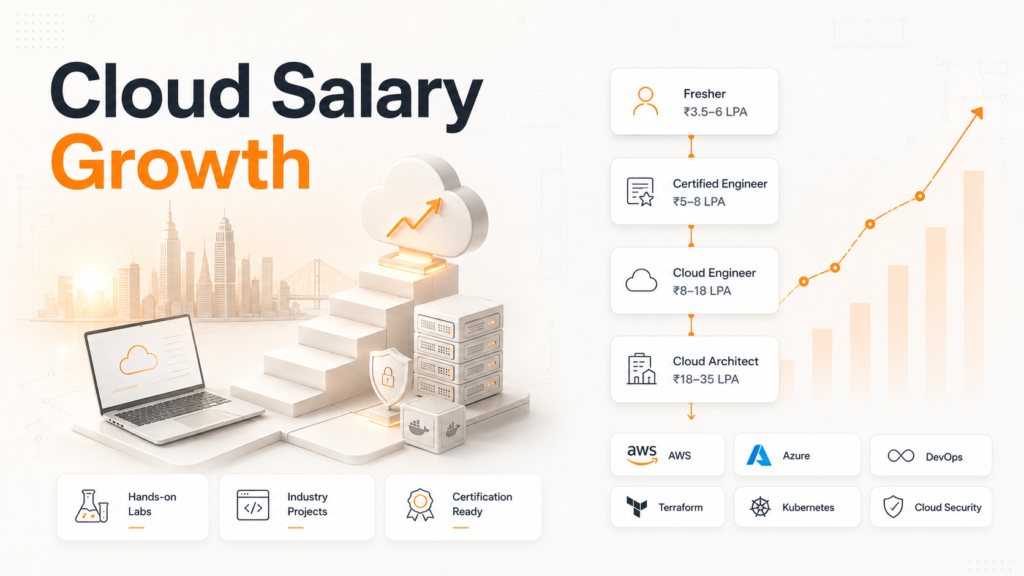
| Experience | Role | Salary in Pune | Key skills |
| Fresher (0–1 yr) | Cloud Support / Jr Cloud Engineer | ₹3.5–6 LPA | Key skills |
| Fresher with cert | Jr Cloud / DevOps Trainee | ₹5–8 LPA | AWS SAA or AZ-104 + projects |
| Mid-level (2–4 yrs) | Cloud Engineer / DevOps Engineer | ₹8–18 LPA | Terraform, Kubernetes, CI/CD |
| Senior (5+ yrs) | Cloud Architect / SRE | ₹18–35 LPA | Multi-cloud, security, architecture |
| GCC roles (any level) | Cloud + AI/ML roles | ₹8–20 LPA | Cloud + AI workload management |
Three skills add the most to salary at the fresher level, specifically. DevOps knowledge (Docker and Kubernetes basics) adds ₹2–4 LPA over cloud-only profiles. Cloud security awareness adds a 25–50% base salary premium at the mid-level. AI and ML integration knowledge, running ML workloads on AWS SageMaker or Azure ML, and understanding inference infrastructure command a premium, particularly at GCCs.
What the Pune market looks like right now
The IT services companies with large Pune presences TCS, Infosys, Wipro, HCL, Capgemini hire cloud trainees at structured ₹3.5–5 LPA packages as entry points into cloud teams. Mid-tier product companies in Pune offer ₹5–8 LPA for certified freshers with project portfolios. The GCCs in Hinjewadi and Kharadi offer the highest packages: ₹8–18 LPA for freshers with strong certification plus documented project work. JPMorgan India, Goldman Sachs India, Deutsche Bank India Technology, HSBC Technology, and Walmart Global Tech all operate cloud engineering teams in Pune and actively hire from structured training programmes. Our guide to the highest-paying IT jobs in Pune shows how cloud compares with other roles.
Who should do a cloud computing course?
Cloud is one of the more accessible IT tracks because it does not require deep programming knowledge at the entry level. Here is who it suits best.
CS and IT graduates
The strongest entry into all cloud tracks, including advanced DevOps, Kubernetes, and cloud security. CS graduates with networking and OS fundamentals already in place can progress to AWS Solutions Architect Associate directly rather than spending time on prerequisites. The target within 12–18 months post-placement is a GCC-level cloud or DevOps role.
Non-IT graduates (BCA, BCom, BBA, BSc)
Cloud Support and Cloud Operations roles do not require a programming background. The Azure Fundamentals AZ-900 certification has no prerequisites and is the natural entry point for non-CS students. Linux basics and one cloud platform are enough for entry-level cloud support roles. Python scripting helps, but is not mandatory to start. Students from commerce and science backgrounds regularly land cloud support and operations roles after a structured 4-month programme. If you are coming from a non-IT background and are unsure which track fits your background, the career change to IT after BCom or BBA guide covers the decision in detail.
Working professionals upskilling
Weekend batches make this practical alongside current employment. Cloud certification adds measurable salary leverage. Professionals moving from IT support, system administration, or non-cloud development roles report salary jumps of ₹2–5 LPA after AWS certification in India. The ROI is higher for working professionals than for freshers because they combine new cloud skills with existing domain knowledge that companies in their sector already value.
Cloud computing course at Teknowell, Pimpri Chinchwad
Teknowell’s cloud computing programme in Pimpri Chinchwad covers AWS and Azure across a 4–6-month curriculum with DevOps, Infrastructure as Code, and cloud security modules included. The programme is structured so certification preparation happens inside the course, not as a separate phase after it ends.
What makes the placement preparation different is the internship model. Students complete a real internship alongside the course rather than after it ends, which means by graduation, they have 4–6 months of documented real-world exposure to put on a resume and discuss in an interview. Most cloud interviews probe practical experience heavily. A student who has actually set up EC2 instances, configured VPCs, built a CI/CD pipeline, and deployed an application on AWS answers interview questions differently from someone who has only completed exercises.
Mock interviews are modelled on actual cloud engineering interview formats used at Pune IT services companies and GCCs, including the technical depth expected at Deutsche Bank India Technology and the infrastructure-focused questions typical of AWS-heavy startup interviews. Trainers are industry professionals with hands-on cloud backgrounds, not just educators.
If you want to see the curriculum in detail before committing to anything, book a free demo class at Teknowell Pimpri Chinchwad. The demo gives you a live session, access to the trainer, and a clear picture of the certification timeline, with no obligation and no pressure, just enough information to make a properly informed decision.
Ready to start with the cloud? Book a free demo at Teknowell
Every GCC in Hinjewadi, every startup scaling on AWS, every bank deploying AI on Azure needs engineers who can manage that infrastructure. The opportunity is concrete, the demand is growing, and the candidate shortage means a well-prepared fresher has less competition per application than in almost any other IT track.
Teknowell’s cloud computing course covers AWS, Azure, DevOps, and certification preparation in one structured programme. Students graduate with real project experience, certification readiness, and placement support that continues until they are hired.
Book a free demo class at Teknowell to see the curriculum live and speak to a trainer before making any decision.