

Java has been hiring developers for longer than many freshers have been alive. Python, on the other hand, went from being a useful scripting language to becoming the backbone of AI, machine learning, automation, and data science.
That creates a confusing situation for anyone entering the IT industry in 2026. One language powers banking systems, enterprise applications, and large corporations. The other powers AI tools, data platforms, and some of the fastest-growing technology jobs in the world.
Most comparison articles end with “both are good.” That is technically true, but not very helpful when someone has to choose one course, invest several months learning it, and build a career around it.
The better question is not which language is superior. The real question is which language creates the best opportunity for a fresher based on their background, career goals, and the kind of companies they want to work for.
Quick Verdict
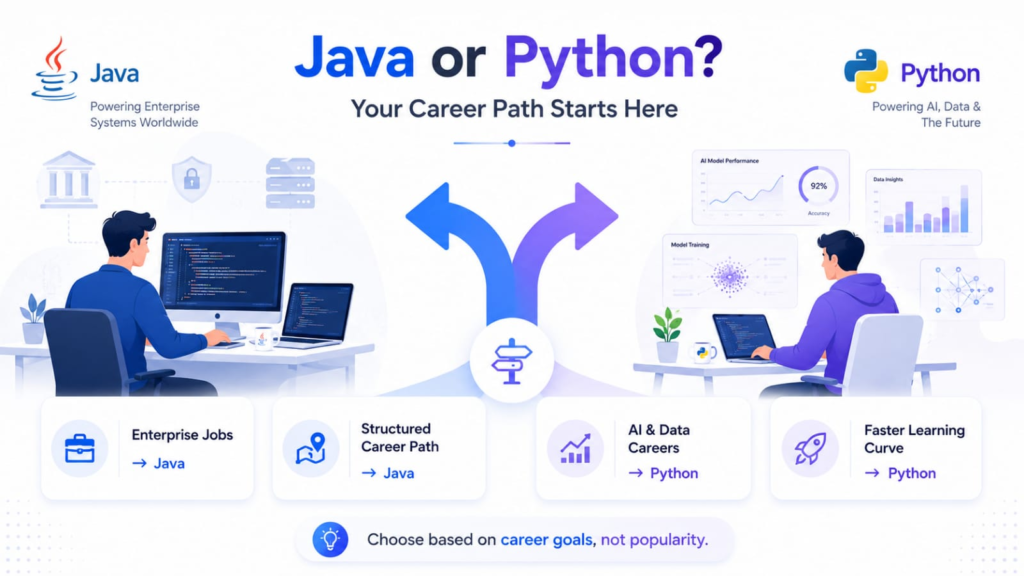
Short answer: Pick Java if you are aiming for MNCs, banks or IT service companies. Pick Python if you come from a non-IT background or want to work in data, AI or startups. Fresher pay starts in the same range for both (about ₹4 to 7 LPA), so choose by the kind of company you want to join, not by salary.
| Language | Best For | Fresher Salary |
| Java | MNCs, banking, enterprise software, backend development | ₹4–7 LPA |
| Python | AI, Data Science, automation, startups, product companies | ₹4–7 LPA |
| Python + AI Skills | Gen AI, Machine Learning, Data Science roles | ₹7–12 LPA |
Java offers higher job volume and a more predictable path into large organisations. Python offers faster-growing opportunities and a higher long-term earning ceiling, especially in AI-related fields.
Our Full Stack Developer course covers Java, Python and MERN full stack with live projects, so you finish with work you can show in interviews.
- Classroom in Chinchwad or live online batches
- Real projects and interview preparation
- Placement support after the course
Before Comparing Them, Let’s Understand What They Actually Do
Many beginners think programming languages compete with each other. In reality, companies often use both. The difference is the kind of problems each language is commonly used to solve.
What Java Is Used For
Java has been the backbone of enterprise software for decades.
Large organizations prefer Java because it is reliable, scalable, and easier to manage when hundreds of developers work on the same system.
Today, Java is heavily used for:
- Banking platforms
- Insurance systems
- Enterprise applications
- Backend APIs
- Microservices
- Full-stack web development
- Android development
Companies such as TCS, Infosys, Wipro, HCLTech, JPMorgan India, and many BFSI organizations continue to hire Java developers at scale.
In simple terms, Java powers many of the systems people use every day without even noticing.
What Python Is Used For
Python became famous because it removed much of the complexity beginners face while learning programming.
But simplicity is not the reason companies hire Python developers.
They hire them because Python dominates:
- Data Science
- Artificial Intelligence
- Machine Learning
- Automation
- Analytics
- Fintech modelling
- Backend development using Django and FastAPI
- Generative AI applications
Companies working on AI products, recommendation systems, predictive analytics, and automation frequently choose Python as their primary language.
When people hear about ChatGPT, machine learning, AI engineers, and data scientists, Python is usually involved somewhere behind the scenes.
With that context in place, the comparison becomes much easier.
Java vs Python: Which One Is Easier to Learn?
This is probably the most common question freshers ask.
The honest answer?
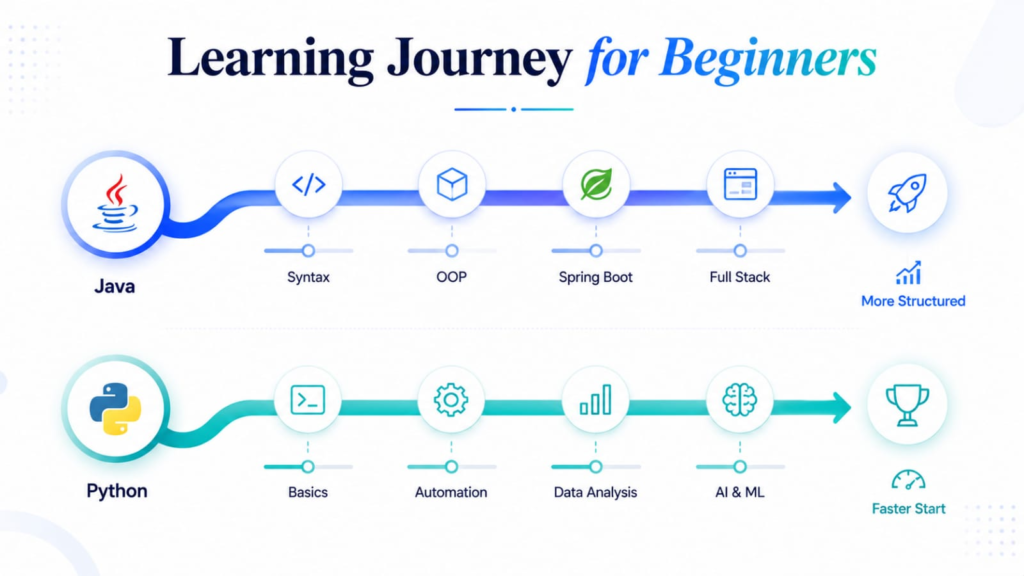
Python is easier.
But that doesn’t automatically make it the better choice.
Why Python Feels Easier
Python removes many things that frustrate beginners.
A simple program can be written in just a few lines. The syntax reads almost like English. There are fewer rules to remember during the early stages of learning.
Someone from a BCom, BBA, science, or non-technical background can usually start building basic Python programs within a few days.
That quick progress matters.
Many beginners quit coding because they feel overwhelmed. Python reduces that initial frustration significantly.
This is one reason most AI and Data Science programs start with Python.
Why Java Feels Harder
Java is stricter.
It introduces concepts like classes, objects, data types, and structure from the beginning.
At first, this feels unnecessary.
Many students wonder why they need ten lines of code to do something Python can do in three.
The reason becomes clear later.
Java forces developers to think about architecture, organization, and maintainability earlier than Python does.
A common observation among trainers is that students who learn Java well often develop stronger software engineering habits. They spend more time understanding how systems are built instead of only focusing on getting code to run.
The learning curve is steeper, but it teaches discipline.
Learning Curve Comparison
| Factor | Java | Python |
| First program complexity | More setup required | Extremely simple |
| Syntax difficulty | Higher | Lower |
| Time to learn basics | 4–6 months | 2–3 months |
| Non-IT beginner-friendly | Moderate | Very high |
| Coding discipline | High | Medium |
So, Which Is Better for Beginners?
For someone completely new to coding, Python is the easier starting point.
For someone from a Computer Science or IT background who already understands programming concepts, Java is much less intimidating than it first appears.
Ease of learning matters.
Career opportunities matter more.
Which brings us to the next comparison.
Java vs Python: Job Market and Demand in India in 2026
A programming language can be easy to learn and still struggle in the job market. Fortunately, that’s not the situation with either Java or Python. Both continue to be among the most sought-after programming languages in India. The difference is that they are being driven by different types of employers and different technology trends.
Java Still Wins on Job Volume
If the goal is to maximise the number of job opportunities available as a fresher, Java still has a clear advantage. A large part of India’s technology workforce is employed by enterprise IT services companies such as TCS, Infosys, Wipro, HCLTech, Capgemini, Cognizant, and Accenture. These organisations hire developers at scale every year and continue to build and maintain thousands of enterprise applications that rely heavily on Java.
Most of these projects involve technologies such as:
- Java
- Spring Boot
- Microservices
- Full Stack Java Development
This is one reason Java remains one of the most commonly requested skills in campus placements and mass hiring drives. A fresher searching for backend or full-stack opportunities is likely to encounter Java requirements repeatedly across job portals. While the language may not generate the same level of excitement as AI-related technologies, its hiring volume remains enormous and remarkably consistent.
Python Is Growing Faster
Where Java benefits from scale and stability, Python benefits from momentum. Over the last few years, it has become the default language for several of the fastest-growing areas in technology.
These include:
- Artificial Intelligence
- Machine Learning
- Generative AI
- Data Science
- Automation
- Analytics
What makes Python particularly interesting is that demand is no longer limited to technology companies. Banks use Python for predictive modelling, retailers use it for recommendation systems, healthcare organisations analyse patient data with it, and manufacturing companies rely on it for automation and reporting. As AI initiatives become a priority across industries, Python continues to move from a specialised skill to a mainstream requirement.
A few years ago, most Python openings were concentrated in data science teams. Today, recruiters in finance, consulting, healthcare, logistics, analytics, and product companies are actively looking for professionals who can work with Python. That shift is one of the biggest reasons many freshers are choosing it as their first programming language.
What the Pune Market Looks Like
Pune offers a useful snapshot of how both ecosystems coexist. The city has a strong presence of enterprise technology companies as well as rapidly growing GCCs and product firms, creating opportunities for both Java and Python professionals.
Areas such as Hinjewadi continue to generate significant demand for Java developers because many IT services companies and enterprise projects are based there. At the same time, locations like Kharadi and Baner have seen growing demand for Python skills due to the rise of analytics teams, AI initiatives, fintech companies, and global capability centres.
Many students attending interviews in Pune eventually realise that Java and Python are rarely competing for the exact same role. More often, they lead to different career tracks. Java typically opens doors into enterprise software development, while Python increasingly serves as an entry point into data, automation, analytics, and AI-focused positions.
That difference becomes even more important when salaries enter the conversation.
Java vs Python Salary for Freshers in India 2026
Salary is one of the biggest reasons students compare Java and Python in the first place. Unfortunately, it is also where some of the biggest misconceptions exist. Social media often creates the impression that learning Python automatically leads to a higher-paying job, but the reality is more nuanced.
At the Fresher Level, They Are Surprisingly Similar
For most entry-level software development roles, Java and Python start from a very similar salary range. Employers generally pay for problem-solving ability, technical fundamentals, and project experience rather than the language alone.
| Experience | Java Developer | Python Developer |
| Fresher (0–1 year) | ₹4–7 LPA | ₹4–7 LPA |
| 1–3 years | ₹6–10 LPA | ₹7–12 LPA |
| 3–6 years | ₹10–18 LPA | ₹10–20 LPA |
| 6+ years | ₹15–28 LPA | ₹18–30+ LPA |
This means a fresher joining a Java Full Stack team and another joining a Python development team often begin their careers at nearly identical salary levels. The difference usually becomes visible after the first switch or specialisation, not during the first job.
Where Java Has an Advantage
Java continues to perform exceptionally well in industries that value stability, scalability, and long-term software maintenance. Banking, insurance, financial services, and large enterprise organisations have invested in Java ecosystems for decades and continue to hire aggressively for those environments.
Freshers entering these organisations often benefit from:
- Predictable salary progression
- Structured promotion paths
- Large-scale enterprise projects
- Long-term career stability
For someone who wants a clear and well-defined career ladder, Java remains one of the safest bets in the Indian technology industry.
Where Python Pulls Ahead
Python’s salary advantage usually appears when developers move into specialised domains such as Data Science, Machine Learning, AI engineering, quantitative analytics, or Generative AI. These fields are experiencing rapid growth, and companies are often willing to pay a premium for professionals who can combine Python programming with domain-specific expertise.
A fresher with Python alone may earn a salary similar to a Java developer. A fresher with Python plus AI, machine learning, or Gen AI skills, however, can often access opportunities in the ₹7–12 LPA range, particularly within product companies and GCCs.
This is why the salary debate often becomes confusing. At the starting line, Java and Python are remarkably close. As careers progress, Python’s connection to AI and data-driven roles creates a higher earning ceiling for many professionals.
Java Full Stack vs Python Full Stack: Which Has Better Opportunities?
Many freshers are not choosing between Java and Python alone. They are choosing between Java Full Stack and Python Full Stack career paths. Whichever way you lean, this plan for learning full stack development from scratch shows what the first six months look like. If you are leaning towards Python, see how it compares with MERN in our MERN stack vs Python full stack guide.
Both can lead to developer roles, but they are popular in different parts of the market.
| Factor | Java Full Stack | Python Full Stack |
| Backend Framework | Spring Boot | Django / FastAPI |
| MNC Demand | Very High | Moderate |
| Startup Demand | Medium | High |
| Learning Curve | Steeper | Easier |
| AI Integration | Limited | Strong |
| Job Volume | Higher | Growing Rapidly |
Java Full Stack continues to dominate large enterprise projects. Many banks, insurance companies, and IT services firms use Spring Boot-based applications, creating a steady stream of opportunities for freshers.
Python Full Stack is more common in startups, product companies, SaaS businesses, and AI-focused organisations. The ecosystem is smaller than Java’s but growing quickly because many modern products combine web development with analytics and AI features.
For students primarily targeting MNC placements, Java Full Stack usually offers more opportunities. For students interested in startups, product development, and AI-adjacent work, Python Full Stack can be a strong alternative.
Teknowell teaches both tracks at its centre near Chinchwad Station. The Full Stack course page lists the Java and Python syllabus side by side, so you can see what each one covers before you decide.
Java vs Python: Career Paths and Job Roles in 2026
One mistake many freshers make is treating programming languages like permanent identities.
Someone learns Java and starts calling themselves a Java developer. Someone learns Python and thinks they must stay inside Python forever.
That is not how careers usually unfold.
The language is simply the door that gets opened first. What matters more is the room on the other side.
Where Java Usually Leads
Most Java developers begin their careers working on backend systems, APIs, enterprise applications, or full-stack projects. The work is often tied to large business systems that thousands or even millions of users rely on every day.
A fresher joining a Java team today is likely to encounter technologies such as Spring Boot, REST APIs, databases, cloud deployments, and microservices. It is not always glamorous work, but it teaches something many beginners underestimate: how large software systems are actually built and maintained.
Common career paths include:
- Java Full Stack Developer
- Backend Java Developer
- Spring Boot Developer
- Microservices Engineer
- Java Cloud Developer
- Android Developer (with Java/Kotlin)
The interesting thing about Java careers is that they often become more valuable with time. A senior Java architect working on banking systems or enterprise platforms may be managing software that handles transactions worth crores every day.
Where Python Usually Leads
Python careers tend to branch out much earlier.
One person may learn Python and become a backend developer. Another may move into analytics. Someone else may end up building machine learning models. A fourth person might spend most of their day automating business processes.
That flexibility is one reason Python has become so attractive to freshers.
A student who is not completely sure whether they enjoy software development, analytics, AI, automation, or data work often finds Python gives them room to explore.
Popular Python career paths include:
- Python Developer
- Data Analyst
- Data Scientist
- Machine Learning Engineer
- AI Engineer
- Automation Engineer
- Quantitative Analyst
The biggest shift over the last few years has been the rise of Generative AI. Many of the tools driving today’s AI ecosystem are built around Python. That does not guarantee success, but it does mean Python sits very close to where a lot of technology investment is currently happening.
Where Both Languages Meet
The internet often turns Java and Python into rivals, but real companies rarely see them that way.
A bank may use Java for its transaction systems and Python for analytics. A product company may use Java microservices in production while its data team works entirely in Python. Even individual developers frequently use both.
The biggest difference is that Python dominates AI and Machine Learning. There is no serious debate there. Anyone planning a future in data science, AI engineering, or Gen AI will eventually need Python.
Java’s strength lies elsewhere. It remains one of the most trusted languages for building large-scale business applications where reliability matters more than experimentation.
The Head-to-Head Verdict Across 7 Important Factors
After looking at salaries, demand, learning difficulty, and career growth, the comparison becomes
| Factor | Java | Python | Winner |
| Learning Curve | Steeper | Easier | Python |
| Job Volume | Very High | High | Java |
| Demand Growth | Stable | Faster | Python |
| Fresher Salary | ₹4–7 LPA | ₹4–7 LPA | Tie |
| Long-Term Ceiling | Strong | Higher in AI/Data | Python |
| MNC Opportunities | Excellent | Good | Java |
| AI & Machine Learning | Limited | Dominant | Python |
| Non-IT Friendly | Moderate | Very High | Python |
Looking at the table, Python appears to win more categories. That is true, but context matters.
A student targeting TCS, Infosys, Wipro, Capgemini, or enterprise backend development might genuinely be better served by Java. The number of available openings is still difficult to ignore.
At the same time, if a fresher has no fixed destination yet and wants access to the fastest-growing areas of technology, Python offers more flexibility and a larger upside.
The most honest verdict is this:
Java is the safer choice.
Python is the broader choice.
Should I Learn Java or Python First?
This question comes up surprisingly often, especially among students who eventually want to learn both.
The answer depends largely on background and career goals.
If someone comes from a non-technical background or has never written code before, Python is usually the better starting point. The syntax is easier to understand, progress feels faster, and beginners can start building small projects quickly.
For Computer Science and IT students who already understand programming basics, either language can work as a first choice. In that case, the decision should depend more on the type of role being targeted.
A simple way to think about it is:
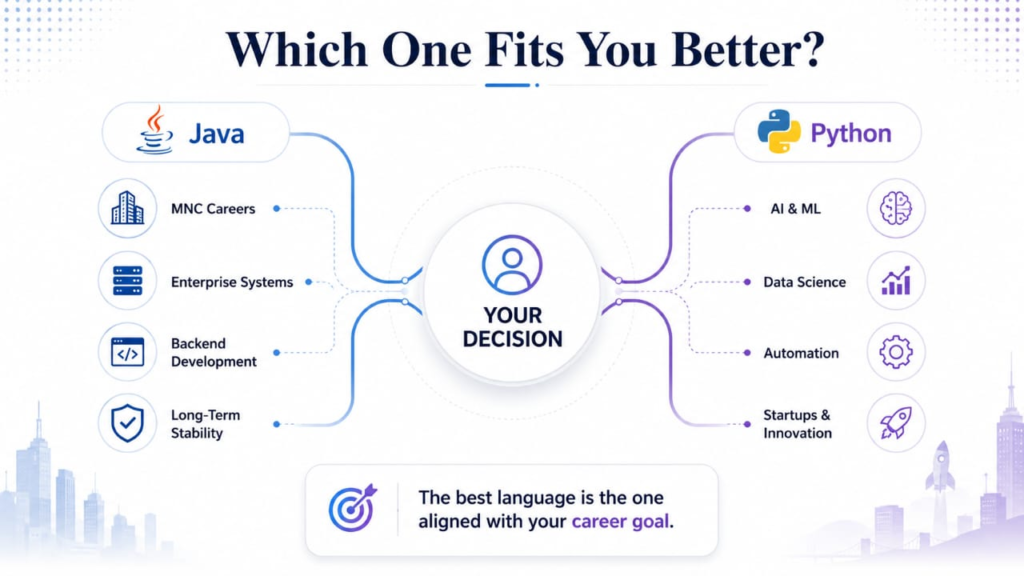
- Interested in AI, Data Science, Analytics, or Automation → Start with Python
- Interested in Backend Development, Enterprise Software, or MNC Placements → Start with Java
- Unsure about career direction → Python offers more flexibility
- Clear goal of becoming a Java Full Stack Developer → Start with Java
Learning one language properly is far more valuable than learning two languages halfway.
So, Which Should a Fresher Learn?
The answer depends less on the language and more on the person sitting in front of the screen.
Learn Java If…
Java makes sense for students who already have some exposure to programming concepts and enjoy understanding how software systems work under the hood.
It is particularly suitable for:
- B.Tech CS/IT students
- Freshers targeting MNC placements
- Students interested in backend development
- Candidates preparing for enterprise software roles
- Anyone seeking a structured career path
Students interested in enterprise development can explore the Java Full Stack Development Course in Pune offered by Teknowell, which covers Spring Boot, databases, APIs, frontend integration, and placement preparation.
Learn Python If…
Python is often the easier starting point for someone entering technology from a completely different background.
It works especially well for:
- Non-IT graduates
- Students interested in AI
- Future data analysts
- Future data scientists
- Automation enthusiasts
- Candidates looking for faster early progress
Many students who previously thought coding was too difficult discover that Python feels far more approachable than expected.
Those interested in AI and analytics can explore Teknowell’s Python-based Data Science and AI Course in Pune, which includes Data Science, Machine Learning, and Generative AI concepts.
What About Learning Both?
Eventually, many developers do.
But trying to master Java and Python at the same time is one of the fastest ways to become overwhelmed.
Most successful professionals start with one language, become comfortable solving problems with it, and then expand later.
A strong Python developer can learn Java.
A strong Java developer can learn Python.
The first language matters far less than most freshers think.
The bigger question is whether they stick with it long enough to become genuinely useful.
Because the industry does not reward people for learning programming languages.
It rewards people for solving problems with them.Still Deciding Between Java and Python? Talk to a Teknowell Trainer First