Everyone hears the same story in different versions. Data science is the future. Then data science is saturated. Then AI will take over everything anyway. All three statements are floating around at the same time, and most people trying to decide a career path in 2026 are stuck somewhere between excitement and confusion.
The reality is less dramatic but more important: the field hasn’t disappeared, it has matured. What has changed is not the demand for data science, but the type of people who succeed in it.
So the real question is not whether data science still exists as a career. It’s whether the version of data science most people are preparing for still exists. If you are still deciding between the two fields, our comparison of data analytics vs data science in Pune will help.
Quick Verdict: Is Data Science Still Worth It in 2026?
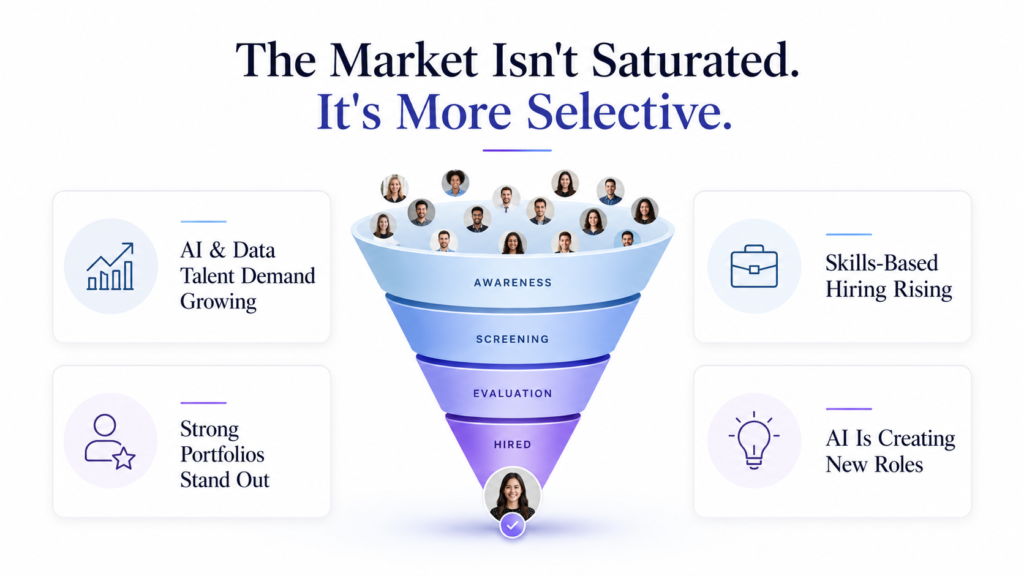
Yes, data science is still a good career in 2026, but only if the skill set matches what companies are actually hiring for now. According to NASSCOM’s State of Data Science & AI Skills in India report, India is expected to require more than 1 million AI and data professionals by 2026, while the current talent supply still falls significantly short. The field is not saturated at the top end. Generic profiles are struggling. Strong AI, ML, analytics, and domain-focused profiles are still getting hired aggressively.
What the data actually says: the data science job market in India in 2026
The conversation around data science often becomes emotional very quickly. One side says there are unlimited jobs. The other says nobody is hiring freshers anymore. Neither side is fully right.
The market is growing, but the hiring expectations are far higher than they were in 2020 or 2021.
Data science is no longer treated as an “extra tech skill” inside companies. It has become part of core business operations across banking, healthcare, logistics, e-commerce, manufacturing, insurance, and fintech. Businesses are making decisions around prediction systems, customer behaviour analysis, automation, and AI-assisted workflows.
What changed over the last few years is not demand, it’s the definition of a “hireable” candidate. Companies are moving away from generic certification-based hiring and looking more closely at applied skills, project quality, domain understanding, and AI readiness.
Another major shift is that companies are hiring fewer “general learners” and more specialised profiles. Businesses increasingly want people who understand machine learning, AI workflows, analytics, and business interpretation together.
The market did not disappear. It became stricter.
And that’s exactly why the field still has strong long-term potential for serious learners.
Will AI replace data scientists? The real answer (not the fear-based one)
This is the question behind almost every career doubt in 2026.
Students see ChatGPT writing SQL queries, AI tools building dashboards automatically, and platforms generating reports in seconds. Naturally, the next thought becomes: if AI can already do this, why would companies hire data scientists at all?
Because most real data science work was never just about writing queries.
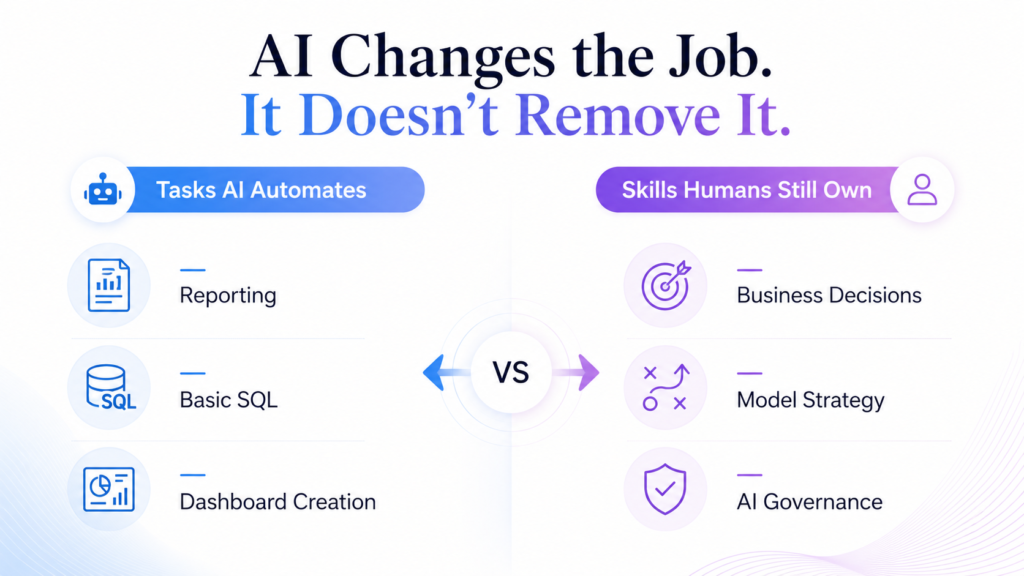
What AI is replacing
AI is definitely reducing repetitive and mechanical work:
- Basic reporting
- Simple dashboard generation
- Repetitive SQL writing
- Manual spreadsheet cleaning
- Copy-paste analytics work
Entry-level roles that depend only on these tasks are becoming weaker every year.
That part is real.
What AI is increasing the demand for
At the same time, AI is creating entirely new layers of demand:
- Machine learning engineering
- LLM integration
- AI workflow design
- Model monitoring
- AI governance
- Business-focused analytics
- Decision intelligence systems
Companies still need humans to decide:
- What problem matters?
- What data should be trusted?
- What a prediction actually means,
- And what business action should happen next?
AI can generate answers. It still cannot understand organisational context the way experienced professionals do.
The biggest misunderstanding is assuming AI replaces the entire profession because it automates one layer of the work.
It doesn’t.
It simply pushes the industry upward.
And that’s why the strongest professionals in 2026 are the ones learning how to work with AI instead of competing against it.
AI will not replace data scientists.
It will replace data scientists who refuse to use AI.
Is data science saturated in India? Separating fact from LinkedIn noise
The word “saturated” gets thrown around constantly online, but very few people explain what exactly it means.
The field itself is not overcrowded.
The entry-level clone profile is.
For years, thousands of learners followed almost identical paths:
- Python basics
- A few ML algorithms
- Titanic dataset projects
- One dashboard
- One certificate
Eventually, hiring managers started seeing the same resume repeatedly.
That created frustration on both sides. Students felt there were no jobs. Recruiters felt there were very few genuinely skilled applicants.
According to LinkedIn’s Economic Graph and workforce insights, AI Specialist, Data Analyst, and ML Engineer roles continue to remain among the fastest-growing job categories in India.
So the issue is not a lack of hiring.
The issue is a lack of differentiation.
The strongest candidates in 2026 are usually the ones who combine:
- Analytics with domain knowledge,
- AI tools with business thinking,
- and technical skills with communication ability.
That combination is still surprisingly rare.
Why do some data science students still struggle to get jobs
This is the part many institutes avoid saying openly.
A large number of learners still rely entirely on tutorial-based portfolios. Their resumes look polished, but the projects often solve no real business problem. Many candidates also jump directly toward “AI Engineer” titles without first building strong analyst fundamentals.
Communication becomes another major barrier. Some students can build models but cannot explain what the model actually means to a business stakeholder.
The industry is not rejecting data science.
It is rejecting interchangeable profiles.
Data science salary in India in 2026: What you can realistically earn
Salary expectations shape most career decisions, but the range in data science is unusually wide because skills matter more than titles.
Salary by experience level
| Experience | Role | Salary range (India) | Notes |
| 0–2 years | Data Analyst / Jr DS | ₹5–8 LPA | Strong portfolios reach ₹10 LPA |
| 2–5 years | Data Scientist / ML Engineer | ₹10–18 LPA | Gen AI adds 30–40% premium |
| 5–8 years | Senior Data Scientist | ₹18–28 LPA | Domain expertise critical |
| 8+ years | Lead / Principal | ₹25–50 LPA+ | Product companies exceed this |
| Remote global | Data roles (US/EU clients) | ₹25–45 LPA | Contract-based high upside |
What increases salary faster than experience
A pattern is becoming obvious in hiring data across India: Gen AI skills, MLOps exposure, and cloud deployment knowledge increase starting salaries more than just experience does.
A fresher with AI tooling and deployed projects often out-earns someone with 1–2 years of traditional analytics experience.
Pune as a hiring hub
Pune has quietly become one of India’s strongest data job markets alongside Bangalore and Hyderabad. GCCs in Hinjewadi and Kharadi are offering entry-level data roles in the ₹8–15 LPA range, especially in BFSI and fintech ecosystems like Bajaj Finserv, Deutsche Bank India Tech, and Persistent Systems.
Which industries are hiring data scientists in Pune in 2026?
Pune’s data science ecosystem is not built around one industry; it’s distributed across several.
BFSI dominates high-paying roles
Banks and financial firms use data for fraud detection, credit scoring, and risk modelling. These roles pay more because mistakes are expensive and models are critical. Companies like Bajaj Finserv and Deutsche Bank India Tech are expanding analytics teams aggressively.
GCCs are quietly becoming the biggest employers
Global Capability Centres are no longer support units. They are building core AI platforms. JPMorgan, Goldman Sachs, and Walmart Global Tech are developing India-based data systems that directly impact global operations.
Healthcare and logistics are the next wave
Regulations like India’s DPDP Act are forcing structured data governance. That is creating demand in healthcare, insurance, and logistics companies where data was previously underutilised.
What skills you actually need for a data science job in 2026
The biggest gap between expectation and reality shows up in skills.
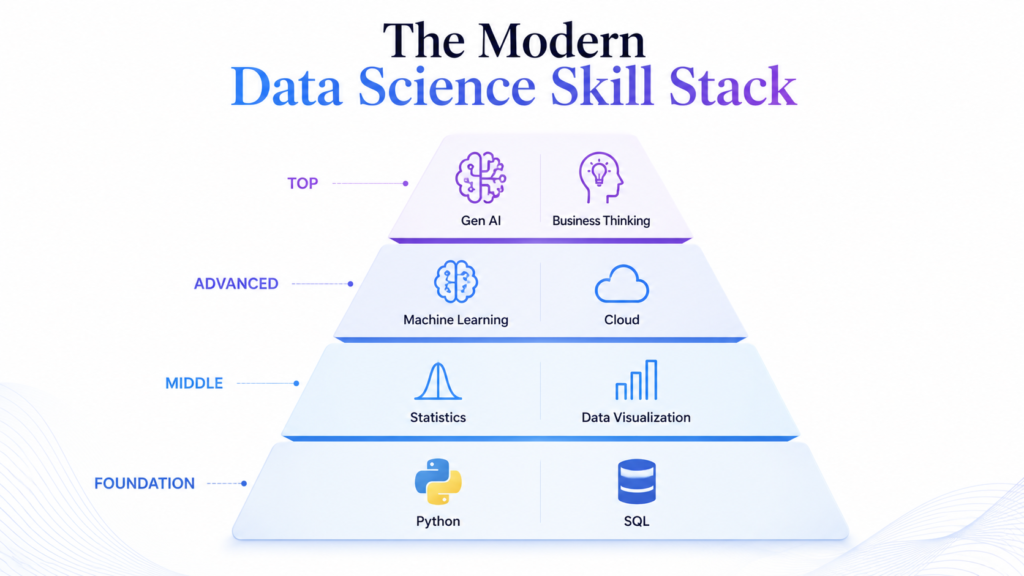
Non-negotiable core skills
Python, SQL, statistics, and visualization tools like Power BI remain the foundation. Without these, nothing else matters. If you are starting at this level, our roadmap for becoming a data analyst in Pune covers these tools in the right order.
Skills that decide hiring outcomes
Machine learning, cloud platforms, MLOps basics, and Gen AI integration now define employability. Companies expect candidates to understand how models move from notebook to production.
The skill almost everyone underestimates
Communication. Not the presentation’s actual translation of data into decisions. Many technically strong candidates fail here, and companies openly acknowledge this gap.
How long does it realistically take to become job-ready in data science?
One reason many students become frustrated with data science is unrealistic timelines. Social media often makes it sound like someone can learn Python for two months and immediately land an AI job. Real hiring rarely works like that.
For most learners, becoming employable in data science takes somewhere between 6 and 9 months of consistent learning and project work. The first stage is usually understanding Python, SQL, statistics, and data visualisation. After that comes machine learning, business case studies, and practical projects.
The difficult part is not learning syntax. It is learning how to think through problems.
This is why many students feel confident while watching tutorials but struggle during interviews. Companies increasingly ask candidates to explain why a certain model, approach, or business metric matters instead of only writing code.
The timeline also changes depending on the background:
- Engineering and maths students usually adapt faster
- Non-IT learners may take slightly longer initially
- Candidates already working in support or operations often transition well into analytics roles because they understand business workflows
The strongest portfolios usually come from students who spend less time collecting certificates and more time building practical projects.
In 2026, consistency matters more than speed.
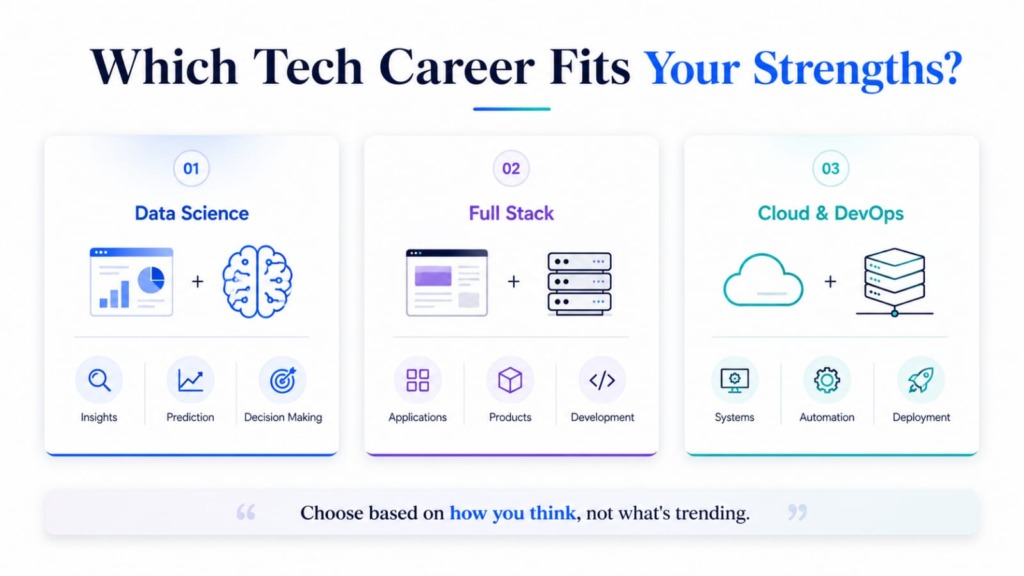
Data science vs full stack vs cloud: how it actually compares in 2026
This comparison matters because many students choosing data science are usually also considering full-stack development or cloud careers.
None of these fields is a bad choice. They simply reward different strengths.
| Factor | Data Science | Full Stack | Cloud/DevOps |
| Demand growth | Highest | High | High |
| Time to job-ready | 6–9 months | 4–6 months | 3–5 months |
| AI impact | Builds AI | Medium exposure | Low |
| Salary ceiling | ₹30–50 LPA+ | ₹20–35 LPA | ₹18–30 LPA |
Students who enjoy analysis, business logic, and pattern recognition usually perform better in data science.
Those who enjoy building interfaces, products, and applications often prefer development roles instead.
Cloud and DevOps generally attract people who like infrastructure, systems, and operational environments.
Someone exploring a full-stack developer course in Pune may reach employability slightly faster. Data science usually takes longer to become comfortable with, but it often has a higher long-term salary ceiling.
Who should choose data science in 2026 and who shouldn’t
Data science is a strong fit for people who:
- Enjoy analytical thinking,
- Can stay patient through longer learning curves,
- Like solving business problems,
- And are comfortable learning continuously.
It also works surprisingly well for many non-IT backgrounds, especially BCom, BBA, economics, mathematics, and science graduates moving toward analytics roles.
But it is not automatically the right choice for everyone.
Someone looking for the fastest possible entry into IT may find testing or development easier initially. People who strongly dislike statistics or logical problem-solving usually struggle after the beginner stage.
That’s why blindly joining a course because “AI is trending” often backfires.
The better approach is to actually see how the work feels before committing long-term.
A practical option is to book a free data science demo at Teknowell Pune, explore the curriculum, speak with trainers, and understand how modern data roles actually function before making a decision.
Because by 2026, the question is no longer: “Is data science a good career?”
The real question is: “Can the person learning it adapt fast enough to stay valuable while the industry keeps changing?”