

You have made up your mind to become a full-stack developer. And you are currently staring at 47 tabs in your browser window. One tab is called MERN, another Python, another React, one tells you to learn JavaScript first, and somebody on YouTube is discussing Docker.
This is the annoying part of the process of learning how to become a full-stack developer. Because the challenge is not that there aren’t enough resources out there. It is that there are too many of them, and hardly anybody tells you what to study first, what to skip, and when you are really ready to proceed. That’s why this six-month plan is very useful for you.
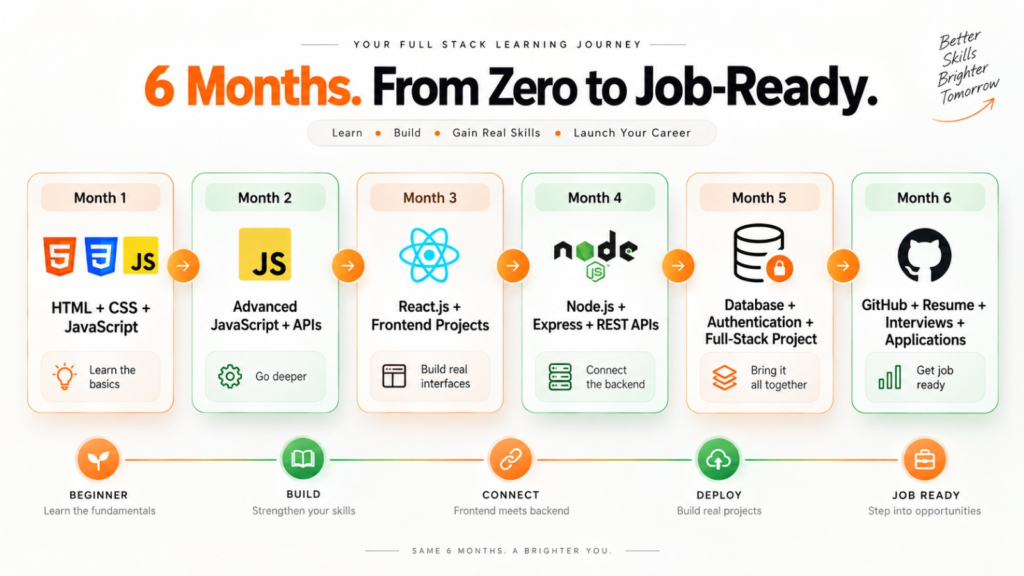
How to learn full stack development from scratch: realistic 6-month plan
Month 1: HTML, CSS, and JavaScript fundamentals. Build a static webpage and a small interactive app.
Month 2: Deeper JavaScript, including ES6, DOM, asynchronous JavaScript, and APIs. Build projects without a framework.
Month 3: React.js. Build two component-based frontend projects.
Month 4: Node.js, Express.js, and REST APIs. Connect a React frontend to a backend.
Month 5: MongoDB or MySQL, authentication, and one complete full-stack project. Deploy it online.
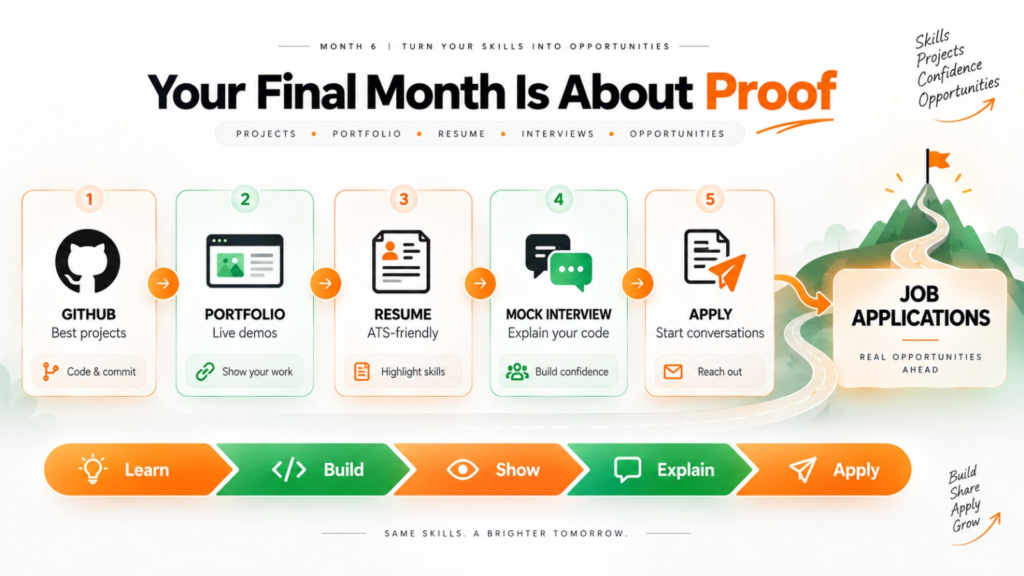
Month 6: Git, cloud basics, resume, portfolio, mock interviews, and job applications.
A realistic target is 5 to 8 months for someone studying consistently every day. Six months can be enough to become job-ready, but only if the time is spent writing code and building projects, not just watching tutorials.
Why full stack development in 2026, and why Pune specifically?
India’s demand for full stack developers has not disappeared just because AI tools can now generate code. In fact, the work is changing. Developers are expected to understand more of the application instead of being limited to one small part of it.
According to GUVI’s 2026 report, a current LinkedIn search shows 10,000+ full-stack developer openings across India. The report also cites a salary range from around ₹4 LPA for freshers to ₹30+ LPA for experienced professionals, although actual compensation varies by company, skills, experience, and portfolio quality.
Pune is particularly relevant for beginners because its technology market includes startups, SaaS businesses, IT services companies, and Global Capability Centres. Areas such as Hinjewadi, Baner, and Kharadi have a large concentration of technology employers, which gives freshers more than one type of company to target.
What “full stack” actually means for a beginner
A full-stack developer works across the parts of a web application that the user sees and the systems working behind it. The frontend handles the interface, buttons, forms, and screens. The backend handles application logic, APIs, and communication with the database.
Think about an online shopping website. The product page you see is the frontend. The system checking stock, processes your request, and retrieves product information from a database sits behind it. Full stack development means understanding how those pieces connect, rather than learning only one side.
That is also why the learning order matters. Trying to learn React, Node.js, databases, and deployment at the same time sounds ambitious, but usually creates confusion instead of progress.
Before you start: the two decisions you need to make
There are two choices worth settling before you start collecting courses and tutorials. First, decide which technology track you want to follow. Second, decide whether you are going to learn independently or follow a structured programme.
Getting these decisions right saves months later.
Decision 1: Which full stack track?
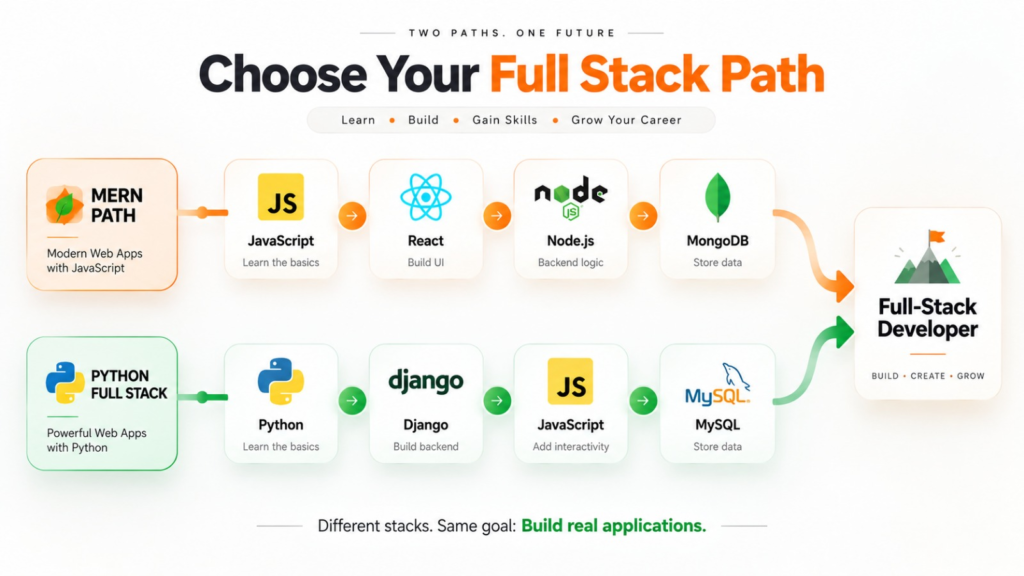
For beginners in Pune, two practical options are MERN and Python full-stack.
In MERN, there is usage of JavaScript in the entire stack with MongoDB, Express.js, React, and Node.js. In the case of Python full-stack, there is usually usage of Python in the backend along with Django, as well as a database like MySQL, whereas HTML, CSS, and JavaScript are used in the frontend.
Neither of the two assures a job automatically. Instead of the certificate name, your skill in building applications, your understanding of the code, and explaining the technical choices matter most.
JavaScript is a natural path for someone who is already familiar with the language, as you are going to use it for the entire stack. However, when learning from scratch, Python seems easier in the first weeks of study. It is better to choose what you will stick with until proficiency.
If you are still deciding, this MERN Stack vs Python Full Stack comparison for Pune can help you compare the two paths before committing.
This roadmap follows the MERN route because it gives beginners a straightforward progression from JavaScript to React and then Node.js. The equivalent Python path is included at each stage, so the roadmap still works if you choose Python Full Stack.
Decision 2: Self-study or structured course?
Self-learning can absolutely work. Plenty of developers have learned through documentation, YouTube, practice websites, and personal projects.
The problem is not whether self-study works. The real question is how long it takes you to reach the same level. Someone learning alone has to decide which JavaScript course to follow, which React version to use, which projects are worth building, how to debug problems, and when to stop learning and start applying for jobs.
A structured course removes some of that decision-making. A programme such as Teknowell’s full stack development training gives learners a fixed learning sequence, live instruction, project work, and placement assistance. The trade-off is cost and a less flexible schedule, so it makes more sense for someone who values structure and accountability.
Self-learning vs. a structured course for full stack is not really a question of which one is universally better. It is about whether you can create and follow your own curriculum without spending three weeks deciding which tutorial to watch next.
Month 1: HTML, CSS and JavaScript foundations
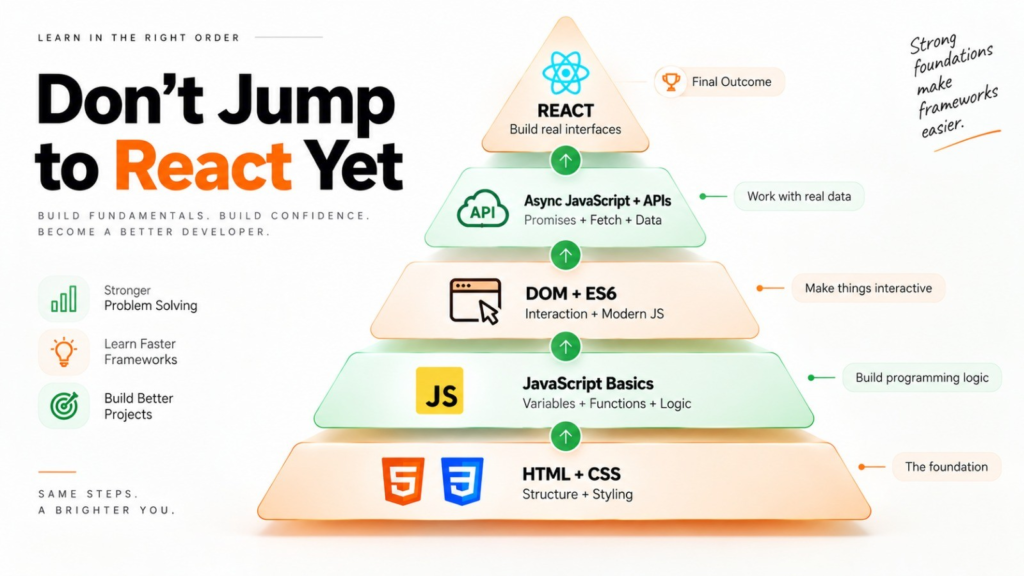
If you are wondering what to learn before full-stack development, start here. Do not open React documentation on day one.
HTML provides structure to a webpage. CSS manages the visual and behavioral appearance of the structure on varying devices. JavaScript enables interactivity. These are the basic components behind both MERN and Python Full Stack technology stacks; hence, missing out on them causes issues down the line.
Your first month should cover HTML5 semantic elements, forms, page structure, CSS Flexbox and Grid, followed by JavaScript fundamentals. That means variables, functions, loops, arrays, objects, DOM manipulation, event handling, and basic ES6 features such as let, const, arrow functions, and template literals.
Do not try to memorise everything. Write code.
Create your personal portfolio webpage using HTML & CSS by the end of the month. Also, create a small JavaScript application which takes answers from the user, calculates a score, and displays the output. There’s no need for anything fancy or looking like a startup app. The purpose of doing this is to demonstrate that you can create something without following any video step-by-step.
The reason for mentioning this is that completion of a tutorial might give a sense of accomplishment when nothing has been learned at all. If you cannot create something basic from scratch using a tutorial, then another 10 hours of video lessons will not solve this issue.
For Python Full Stack developers, Month 1 remains unchanged.
Month 2: JavaScript, going deeper before any framework
A common beginner mistake is spending three weeks learning basic JavaScript and immediately jumping into React. Then React starts throwing around props, state, hooks, components, and asynchronous requests, and suddenly none of it makes sense.
The problem is not React. The JavaScript foundation was too shallow.
Month 2 should therefore stay with JavaScript. Go deeper into promises, callbacks, async/await, the Fetch API, array methods such as map, filter, and reduce, destructuring, modules, imports, error handling, and local storage.
The projects should become slightly more useful too. Build a weather application that retrieves information from a public API and displays it on the page. Then build a to-do application that saves tasks in local storage so they remain after the browser is refreshed.
These projects teach something tutorials often hide: things go wrong. API requests fail. Data arrives later than expected. The user enters something you did not anticipate. Your code has to deal with those situations.
Before moving to Month 3, test yourself with three simple questions. Can you explain what a promise does? Can you fetch information from an API without copying the entire solution from a tutorial? Can you use map and filter on an array and explain why you chose them?
If the answer is yes, React will feel considerably less intimidating.
For Python Full Stack beginners, this month changes direction. Focus on Python fundamentals such as variables, functions, loops, lists, dictionaries, tuples, file handling, and basic object-oriented programming.
Month 3: React.js and your first serious frontend projects
React becomes much easier once JavaScript is no longer a mystery.
The Stack Overflow Developer Survey 2025 shows the continued strength of the JavaScript ecosystem, while its web technology data also highlights the close relationship between Node.js and React among developers looking to expand their skills.
For someone following a MERN path, React is the point where you stop building separate HTML pages and start thinking in reusable components.
Learn components and props first. Then move into state with useState, side effects with useEffect, React Router, form handling, API calls, and component composition. You do not need to master every React library in existence. You need to understand how a React application actually works.
Build two projects this month.
The first could be a movie search application that uses a public API and displays search results. The second could be a task management application where users can add, delete, and complete tasks. Make both applications component-based rather than putting the entire interface inside one enormous file.
This is also the month to make GitHub part of your routine. Every meaningful project should have its own repository, a readable README and clear instructions for running it. Your GitHub profile does not need 30 repositories. Three or four projects that you can explain properly are far more useful than 25 copied tutorial projects.
If you want to understand how all four parts fit together before starting the backend, the guide to what the MERN Stack is and how its technologies connect is a useful next read.
Python Full Stack learners can use this month for Django basics, including project setup, URL routing, views, templates, models, and the Django admin panel. By the end of the month, you should have a small working Django application rather than a collection of disconnected exercises.
Month 4: Node.js, Express.js and REST APIs
This is usually the month when full-stack development finally clicks.
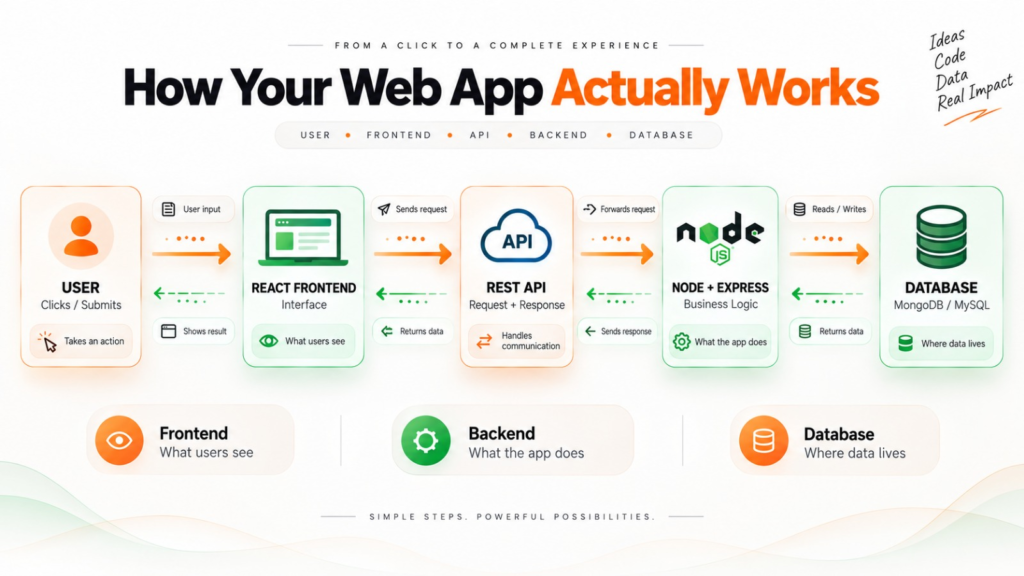
So far, you have been developing the front-end part of your app. Now that you are working with Node.js and Express.js, you get to develop the server side. The React frontend makes a request; the backend receives it, processes it, and sends back data.
First, learn about the basics of Node.js and what it means to execute JavaScript on the server side. Next up, learn Express.js, routing, middleware, GET and POST requests, JSON, status codes, and RESTful APIs.
There is no way to leave out authentication. Of course, you don’t have to become an expert in everything security-related within a month, but you should at least grasp the concepts of registration, login, and JWT authentication.
Create a simple blog app. React will provide the user interface, and Express will provide the API. A user should be able to receive posts and add a new one via a form.
One common source of confusion is seeing the React application and Express server running on different ports. That is normal. The two applications communicate through API requests. React asks the backend for information, Express processes the request and returns JSON, and React uses that response to update the screen.
Once that request-response cycle makes sense, the jump from frontend developer to full-stack developer starts feeling much smaller.
Python Full Stack learners can use this month to go deeper into Django. Focus on models, forms, authentication, CRUD operations, and how Django connects application logic to a database.
Month 5: Databases and your first complete full stack project
Knowing how to build a frontend and an API is useful. Knowing how to store and retrieve real application data is what makes the project complete.
MERN learners should work with MongoDB and Mongoose. Learn schemas, models, CRUD operations, and how the database connects to the Express application. Python Full Stack learners can work with MySQL through Django’s ORM, including models, relationships, migrations, and queries.
The technology matters, but the underlying idea matters more. A user submits information through the frontend. The request reaches the API. The backend validates and processes it. The database stores the information. Later, another request retrieves it and sends it back to the frontend.
Month 5 is also when you should build one serious project for your resume.
Choose something that solves a problem rather than another basic calculator or to-do list. An expense tracker, job application tracker, or personal library manager would work. The project should include user registration and login, CRUD functionality, a connected database, and a live deployment.
Deployment does not have to mean becoming an AWS expert overnight. You can learn basic hosting with options such as Render or Railway for the backend and Vercel or Netlify for the frontend. AWS EC2 and S3 can be introduced as cloud concepts, but the first priority is getting one application live.
A recruiter should be able to open a URL and use your project.
That changes the conversation in an interview. Instead of saying, “I learned React and Node.js,” you can say, “I built this application, deployed it, used JWT authentication, connected it to MongoDB, and handled these specific problems.” The second answer gives the interviewer something concrete to ask about.
And they will ask.
A Pune startup interview might move quickly from “Tell me about your project” to “Why did you use MongoDB?” or “What happens if the API request fails?” or “How did you protect authenticated routes?” You need to have actually built the application to answer those questions comfortably.
Month 6: Git, cloud basics, interviews and the job search
Month 6 is where your learning starts turning into a job search.
The first step is to clean up GitHub. Each repository that you consider as an example of good work must describe the functionality of the project, technologies used, ways to run the project, and ideally contain some images and a live demo link. Instead of presenting everything that you have ever done, pin only your best projects.
Your cloud skills will remain practical here. Find out what services like AWS EC2 and S3 are all about, the basics of deploying your apps, and how your application is deployed from your local machine to a public link. There is no need to earn numerous certifications to become a developer.
Build an ATS-friendly fresher resume
Your resume should fit on one page. Use a simple layout, list specific technologies rather than vague categories, and give your projects enough space to explain what you actually built.
For example, “Built an expense tracker using React” tells a recruiter very little. “Built a React and Node.js expense tracker with JWT authentication, MongoDB CRUD operations, and deployed frontend and backend” gives them several technical points to discuss.
Put live project links beside the relevant projects. If a recruiter cannot find the application in a few seconds, the portfolio loses some of its value.
Start mock interviews before you feel ready
Technical interviews are not just about knowing the answer. You also need to explain your reasoning while someone is asking follow-up questions.
A fresher interview for a full-stack developer role may include JavaScript fundamentals, React concepts, APIs, databases, basic coding problems, and questions about your projects. You should be able to explain why you made specific technical choices rather than repeating definitions you memorised the night before.
Aim for at least five realistic mock interviews during this month. Say your answers out loud. Ask someone to interrupt you with follow-up questions. That discomfort is useful because the real interview will not wait patiently while you search your memory for the perfect definition.
You can also use this IT interview questions guide for freshers in Pune to identify the technical areas worth practising.
Start applying before you feel 100% ready
Do not wait until every technology on a full-stack developer job description is familiar.
Create a LinkedIn profile with relevant skills, keep your Naukri profile aligned with the same keywords as your resume, and apply directly through company websites. Start looking at startups and technology companies around Hinjewadi, Baner, Balewadi, and Kharadi rather than restricting yourself to one neighbourhood.
Networking can help too, but keep it human. One thoughtful message to a developer whose work you genuinely found interesting is more useful than sending the same “Please refer me for a job” message to 100 people.
The goal of Month 6 is not to become an expert. It is to reach the point where your skills, projects, and communication are strong enough to enter the interview process.
Self-study vs structured course: which route makes more sense?
Both routes can produce a developer. The difference is how much of the learning process you have to design and manage yourself.
| Factor | Self-study | Structured course at Teknowell |
| Learning timeline | Often depends heavily on personal consistency and resource selection | Follows a defined 3- 4 month programme |
| Project work | Depends on the learner’s own discipline and project choices | Includes live project work as part of the programme |
| Interview preparation | Must be arranged independently | Placement assistance and preparation are part of the structured route |
| Accountability | Completely self-managed | Regular learning structure and instructor support |
| Flexibility | Completely self-managed | Lower, but the fixed structure can make progress easier to maintain |
| Cost | Completely self-managed | Higher upfront cost, with a structured learning path |
Self-learning is appropriate for an individual who has the skills to work independently and be consistent without any external supervision. In addition, it is the most economical option, but “free” education costs time when considering the amount of time spent searching through various materials and redoing everything on one’s own.
A full-stack development course for a beginner would be more appropriate for someone with no experience whatsoever aiming to secure a job within a particular period of time. The course by Teknowell gives a learner structure, live projects, and placement assistance as opposed to self-learning and deciding what to do in the future oneself.
It all comes down to a personal preference, the time you have at your disposal, and your budget. Taking a course is not going to help you magically, and self-learning does not always make one worse off than the other. What counts is whether you reach the stage of building and explaining projects yourself.
Salary expectations after learning full stack development
Salary is worth discussing, but it should not be the first thing you use to choose a course.
According to GUVI’s 2026 report, full stack developer salaries in India can range from approximately ₹4 LPA for freshers to ₹30+ LPA for experienced professionals. These are market figures rather than guaranteed salaries, and actual compensation varies by company, skills, experience, and portfolio quality.
A fresher in Pune would do well to expect to apply for jobs in startups, IT services firms, and product companies, instead of expecting that all first jobs will be high-paying. A portfolio of two or three good projects, strong basics in JavaScript, and the ability to explain one’s code could make a lot of difference in competition with other freshers.
Experience will make a difference to all this. An individual who devotes a period between one year and three years to gaining experience on real-world projects, sharpening his/her problem-solving skills, and becoming at home with databases, API’s and deployments will be a totally different prospect compared to an individual who has just done a course for six months.
Salary figures should therefore be treated as a range in the market, not as guarantees. The first objective should be to become employable. The second should be to become irreplaceable.
Your six-month roadmap is achievable, but consistency matters more than speed
If you are still wondering how to learn full stack development from scratch, do not make the mistake of trying to learn everything at once. Start with HTML, CSS, and JavaScript, strengthen JavaScript before React, learn backend development after you understand the frontend, then connect the database and deploy one complete application.
Six months is enough to build that foundation if you actually write code throughout the six months. The learners who struggle are often not the ones who find programming impossible. They are the ones who spend too long watching tutorials, keep changing stacks, or get stuck on a backend problem in Month 4 and quietly stop practising.
A structured path can help with that, but the work still has to be yours. If you are based in Pimpri Chinchwad or Pune and want to compare the curriculum before deciding, explore Teknowell’s full-stack development courses or book a free demo class to see how the programme is structured.