
Selecting data analytics or data science may seem like an easy thing to do until one starts reviewing course offerings. Both include topics on data, programming in Python, career options, and high salaries; however, the kind of preparation each field requires is different. In one case, you will be able to begin working with dashboards, SQL, and business reports soon, while the other way will involve going deep into Python, statistics, machine learning, and AI.
Thus, asking the question of which is better, data analytics vs data science, is not enough on its own. What matters more is which option suits you in terms of your background, the speed of learning, and the nature of the work you will enjoy doing.
Data Analytics vs Data Science: which should you choose in Pune?
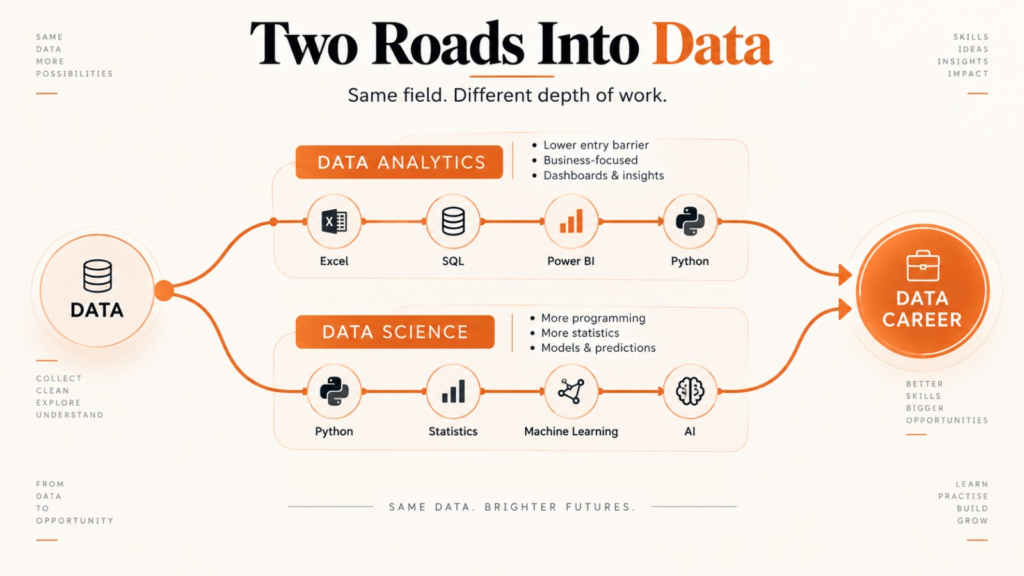
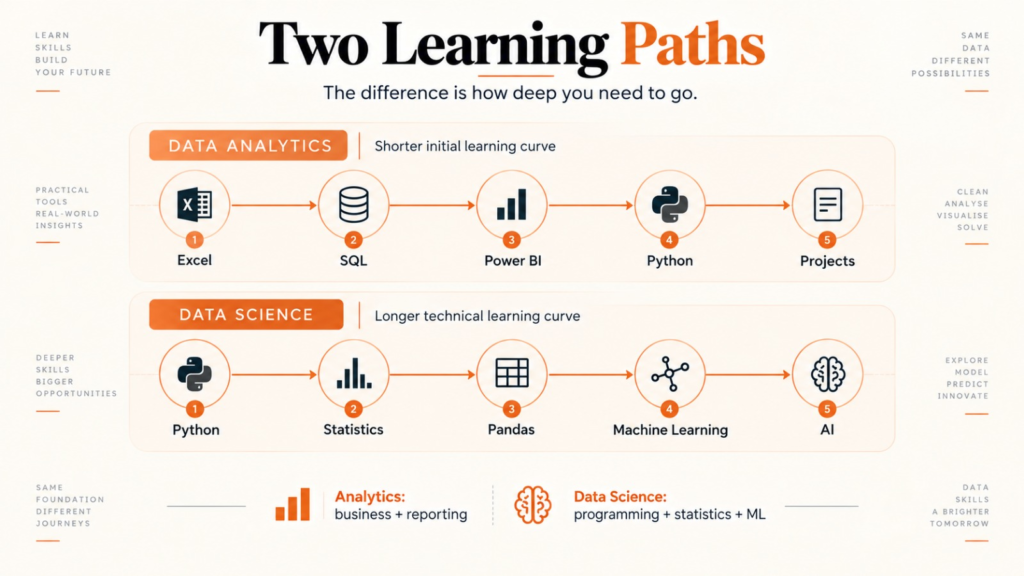
- Start with your entry barrier. Data Analytics is generally the easier starting point for beginners and non-technical students. At Teknowell, the Applied Diploma in Data Analytics runs for 6 months and covers Excel, Power BI, Python, databases, data handling, visualization, and practical projects.
- Data Science is a longer, more technical path. Teknowell’s Data Science course runs for 9 months and covers Python, Pandas, NumPy, Machine Learning, Deep Learning, AI basics, data visualization, and predictive modeling.
- Current salary data also shows a gap, although the numbers vary widely by company, skills, and experience. Naukri Campus lists entry-level data analyst salaries around ₹3 to ₹6 LPA and entry-level data scientist salaries around ₹5 to ₹10 LPA.
- Analytics makes sense if you want an accessible entry into the field. If you are comfortable with programming, statistics, and a longer learning curve, data science opens a more technical path.
What Data Analytics Actually Is, and What the Daily Work Looks Like
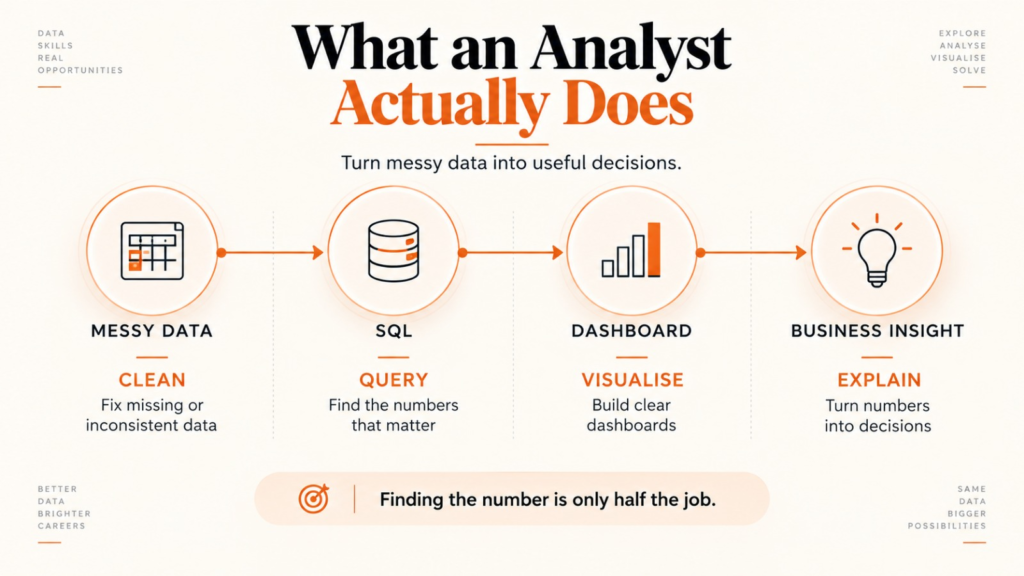
Picture a Tuesday morning in a Kharadi office. The sales manager walks into a meeting saying, “Revenue dropped last quarter. What happened?” Nobody expects you to deploy a neural network to answer that question. You grab the raw transactional logs, clean up missing values, compare sales across regions or products, and pinpoint where the drop came from.
Your entire day revolves around SQL queries, Excel sheets, interactive dashboards, and talking to team leads. You might spend two hours fixing a broken SQL join, build a Power BI dashboard before lunch, and then present those numbers to someone from sales or operations before heading home. Finding a number is useless if you cannot explain what it means for the business.
The tools are approachable
Excel handles small datasets quickly. Power BI turns those raw rows into visual dashboards, while database tools like PostgreSQL help analysts pull exact records instead of fighting with massive spreadheets.
Skip the fear of needing to code like a software engineer on day one. SQL uses straightforward English syntax, and Python only becomes necessary as your analysis deepens.
Teknowell’s current 6-month Applied Diploma in Data Analytics includes Excel, Power BI, Python, databases, data handling, cleaning, exploratory analysis and practical projects, along with interview preparation.
Who gets into analyst roles?
Non-technical graduates switch into this field constantly. A BCom or BBA graduate who already understands sales, finance, or operations can pick up data tools and become useful immediately.
If you are coming from a non-IT background and wondering whether getting an IT job without previous experience is realistic, this guide on how to get an IT job without experience in Pune covers the entry-level routes in more detail.
Pune is packed with companies that rely on reporting and business intelligence, especially around Kharadi, Viman Nagar, and Hinjewadi. You do not need to rewrite software architectures. Taking messy operational data and turning it into clear decisions is what actually gets you hired.
What Data Science Actually Is, and Where It Differs
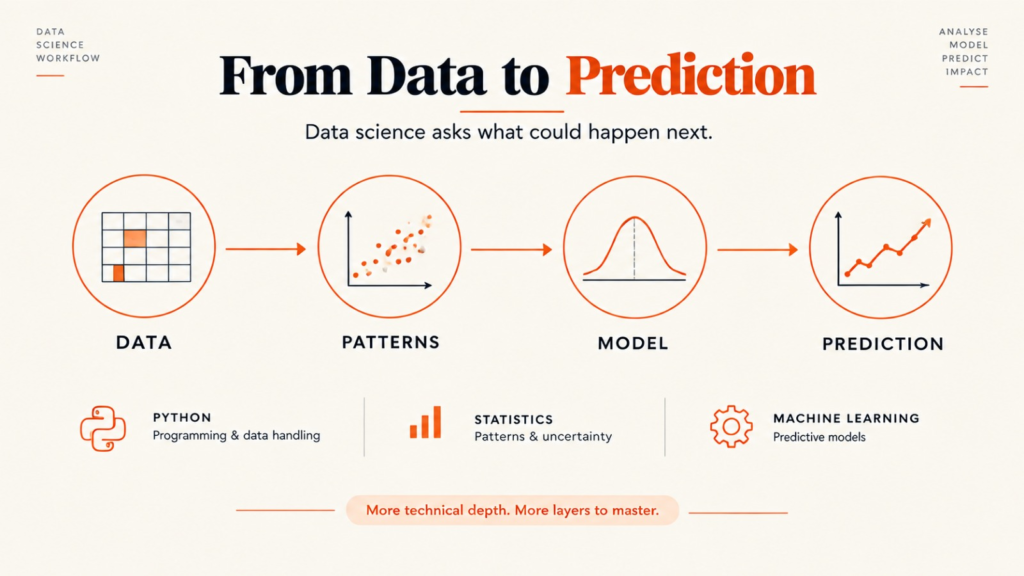
Take that exact same messy dataset, but hand it to a data scientist. They do not stop at why customers left last quarter. They ask which active customers will drop out in the next 90 days and whether a predictive model can catch them first.
Predictive questions change your daily workflow completely. Python dominates your screen as you focus on data preparation, statistical formulas, machine learning algorithms, and model evaluation. A data scientist might spend three straight days tuning hyper-parameters, testing train-test splits, and checking if their model is overfitting.
The programming reality
Writing code is non-negotiable here. You must get comfortable writing, debugging, and refactoring Python scripts that leverage libraries like Pandas, NumPy, and Scikit-learn.
Math stops being optional very quickly. No computer science degree is required, but you cannot dodge probability distributions, linear algebra, and statistical hypothesis testing when evaluating why a model fails.
Teknowell’s current 9-month Data Science course covers Python, Pandas, NumPy, Machine Learning, Deep Learning, AI basics, data visualization and predictive modeling, with practical work using real datasets.
What jobs can come after it?
Completing this training opens up technical roles like Junior Data Scientist, Machine Learning Associate, AI Analyst, Data Science Associate, and Predictive Analytics Associate.
If you want a closer look at what companies are actually expecting from data science candidates, this guide on whether data science is still a good career in 2026 breaks down the current job market, skills and hiring expectations.
Signing up for a course does not automatically transform you into a senior scientist overnight. Your final designation depends on your portfolio, past education, and interview performance. How you prepare determines the market value you command.
The Salary Difference: What Verified Data Actually Says
Ignore the hype on social media. Real salary offers are never as clean as marketing brochures make them look.
Naukri Campus released data in February 2026 showing entry-level data analysts in India earn around ₹3 to ₹6 LPA, while entry-level data scientists start around ₹5 to ₹10 LPA. They also report that data science roles generally carry a 20% to 30% pay premium over traditional analytics roles.
Glassdoor India reports a similar baseline. Current submissions show data analyst base pay ranging from ₹5 to ₹10 LPA, averaging roughly ₹6 LPA. Market figures fluctuate based on employer size and specific candidate skill sets.
| Experience | Data Analyst | Data Scientist |
| Fresher, 0 to 2 years | ₹3 to ₹6 LPA | ₹5 to ₹10 LPA |
| Mid-level, 3 to 5 years | ₹6 to ₹12 LPA | ₹10 to ₹18 LPA |
| Senior, 6+ years | ₹12 to ₹20+ LPA | ₹18 to ₹30+ LPA |
These ranges reflect broader Indian market trends reported by Naukri Campus and Glassdoor India. Actual offers vary depending on the hiring company, candidate background, and specific domain experience.
When the salary gap is misleading
High averages do not guarantee every data scientist beats every analyst. An analyst who masters SQL queries, designs complex Power BI dashboards, and understands healthcare or retail operations often earns more than a mid-level data scientist stuck writing basic Python scripts.
A starting job title never locks your lifelong income trajectory. Specialized industry expertise and practical problem-solving dictate long-term growth far more than an initial title.
Learning Curve Comparison: Which One Is Actually Harder?
Look at the technical stack you must master before working independently. That is the real distinction between these two tracks.
Data Analytics learning curve
Analytics gets you building real projects fast. You start with Excel spreadsheets, learn SQL queries to pull data, construct Power BI dashboards, and practice presenting those insights to peers.
The initial hurdle hits when you first see SQL logic. Writing your first complex nested SELECT statement feels strange, but consistent practice makes query syntax second nature within a few weeks.
A structured three-to-six-month course gives you job-ready fundamentals, though landing a role still requires portfolio projects, resume preparation, and interview practice.
Data Science learning curve
Data science piles multiple complex disciplines on top of each other. You must learn Python programming, statistics, data manipulation, and machine learning, where every new layer relies heavily on the previous one.
Understanding Python syntax is one thing, but figuring out why your random forest classification model is overfitting requires a whole different level of debugging. Knowing what precision and recall mean is useless if you pick the wrong metric for a fraud detection problem.
Teknowell’s 9-month Data Science course reflects that deeper learning path. Its curriculum starts with foundations and mathematics before moving into Python, SQL, analytics, machine learning, AI and project work.
What about maths?
Basic numerical literacy is all you need to start. You do not need top-tier competitive math scores, but you must be comfortable reading statistical trends.
Finding patterns in numbers makes the mathematical side engaging. If you dislike statistics and logical problem-solving, forcing yourself through machine learning algorithms will feel exhausting.
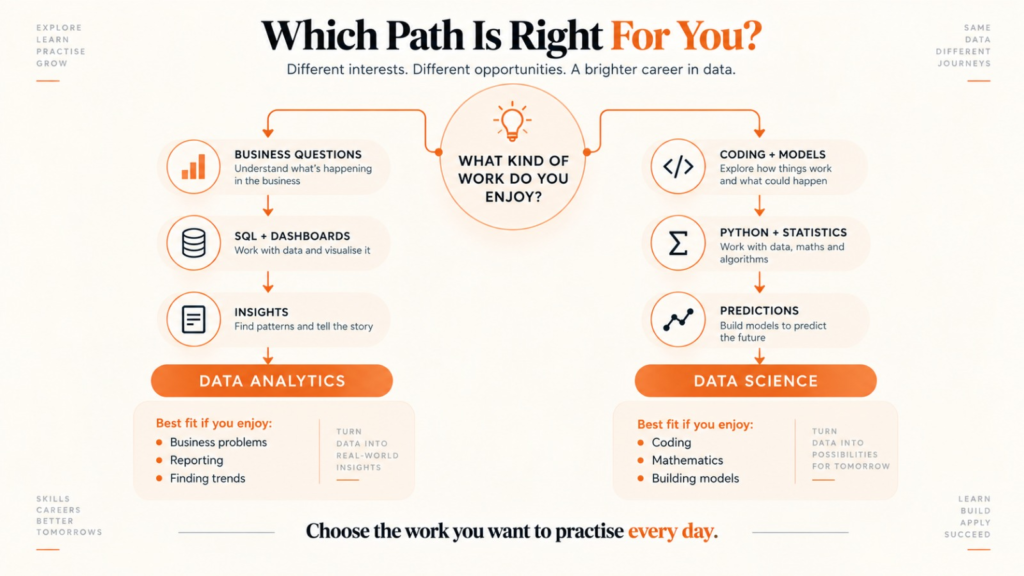
Data Analytics vs Data Science: Side-by-Side Comparison
Compare what you will actually spend hours learning every day rather than focusing on course titles.
| Factor | Data Analytics | Data Science AI/ML/DL |
| Course duration at Teknowell | 6 months | 9 months |
| Main tools | Excel, Power BI, Python, databases, data analysis tools | Python, Pandas, NumPy, Machine Learning, Deep Learning, AI |
| Programming required | Some Python is included, but the entry barrier is lower | Yes, Python is central |
| Maths requirement | Basic analytical thinking | Statistics, probability and mathematical foundations |
| Fresher salary in India | ₹3 to ₹6 LPA | ₹5 to ₹10 LPA |
| Learning timeline | Around 3 to 6 months for foundational job readiness | Around 7 to 12 months depending on background and practice |
| Best suited to | Beginners, business-focused learners and non-technical backgrounds | Programming-focused learners and people targeting AI/ML |
| Typical outcomes | Data Analyst, Business Analyst, Reporting Analyst, Power BI Developer | Junior Data Scientist, ML Associate, AI Analyst, Data Science Associate |
Neither track is objectively superior. Analytics provides a fast, practical entrance into business operations. Data science requires deeper technical investment upfront, which unlocks machine learning and AI careers later.
Check module details before enrolling anywhere. Institutes label courses differently, but Teknowell aligns both tracks around core Python and database fundamentals before branching the Data Science track into deep learning and neural networks.
Both courses run out of Teknowell’s Pimpri Chinchwad campus. You can attend a free demo class at Teknowell to evaluate the teaching methodology before making a commitment.
Data Analytics vs Data Science: Which Should You Choose?
Forget about starting salaries for a moment. Ask yourself what you can realistically commit to studying every single day for the next six to nine months.
Choose Data Analytics if:
Non-technical graduates from BCom, BBA, or BSc backgrounds often prefer this entry point. If analyzing business trends sounds interesting, but spending six months writing Python functions and reading statistical papers sounds tedious, pick analytics.
Dashboards, reporting, and presenting insights to managers form the core of this path. You can build these capabilities immediately without learning advanced software engineering first.
Teknowell’s 6-month analytics programme is built around data handling, Excel, Power BI, Python, databases and practical work, with interview preparation included.
Choose Data Science if:
Pick this path if you already enjoy coding or want to master it. Writing Python scripts, building predictive models, and analyzing algorithmic behavior should genuinely excite you.
Commitment to a longer timeline is required here. Teknowell’s 9-month Data Science programme goes through Python, Pandas, NumPy, machine learning, deep learning, AI basics and predictive modelling.
High salary ceilings are attractive, but choosing a technical track purely for money usually leads to burnout. You must enjoy the daily work of debugging models and processing data.
If neither feels obvious yet
Step back and evaluate your core interest in technology. Do you actually like working with datasets?
If writing SQL queries, building Power BI dashboards, and analyzing spreadsheets sounds boring, step back. Pune offers alternative tech tracks like full stack web development, where the focus shifts entirely to building software and web applications.
Starting with analytics does not trap you there forever. SQL, data cleaning, and exploratory data analysis build a strong foundation if you decide to jump into machine learning later.
Can You Switch From Data Analytics to Data Science Later?
Shifting from analytics into data science is completely viable. It is not an automatic promotion, though. You must still master Python libraries, study statistics, build machine learning models, and create original portfolio projects.
Working as an analyst speeds up this transition. You already know how to handle dirty data, run SQL queries, and answer real business questions, which saves time when you begin learning predictive modeling.
This career pivot happens naturally over time. Many professionals start as Data Analysts, master Python automation, build predictive models on the side, and then move into formal Data Scientist roles. You do not need to figure out your entire twenty-year career on day one.
Python acts as the connective tissue between these disciplines. Exploring how Python operates across tech domains helps clarify its role in data engineering and web development.
What If You Are Not Sure Data Is Even the Right Direction?
Building software is fundamentally different from analyzing data. Not everyone belongs in a data-focused role just because AI dominates current news cycles.
If writing code to build web applications, interactive tools, and user features sounds exciting, software engineering fits better. If investigating numbers, spotting trends, and explaining business operations sounds appealing, analytics is the right match.
Decide on your preferred daily work first. Selecting between analytics and science becomes simple once that choice is clear.
Still unsure which path fits you? Book a free demo class at Teknowell and talk to a trainer about the courses, curriculum, and type of work involved before you decide.