Here’s an uncomfortable truth nobody tells freshers before they start applying: most IT resumes in India get rejected before a human being ever lays eyes on them. Over 80% of large employers, TCS and Infosys included, along with pretty much every fast-growing Pune startup, run applications through ATS software first. If the formatting trips up the system, or the right keywords just aren’t there, your resume is gone before anyone reads a word of it. Doesn’t matter how good you actually are.
So let’s fix that. This guide covers the exact software developer resume format that’s working right now, what to actually write in each section, and how to write projects in a fresher resume in a way that doesn’t scream “tutorial project.” That last part, honestly, is where most people lose the game without realising it.
Quick answer: One page. That’s it, one page. Section order: Header, Summary (2 lines), Skills, Projects, Education, Certifications, Extras. Skip the photo, skip the DOB, skip marital status. Save it as .docx for ATS portals; keep a .pdf version ready for direct email applications. Font: Arial or Calibri, 10 to 11pt, single column, nothing fancy. Recruiters give a fresher resume 6 to 10 seconds before deciding. That’s roughly the time it took you to read this box.
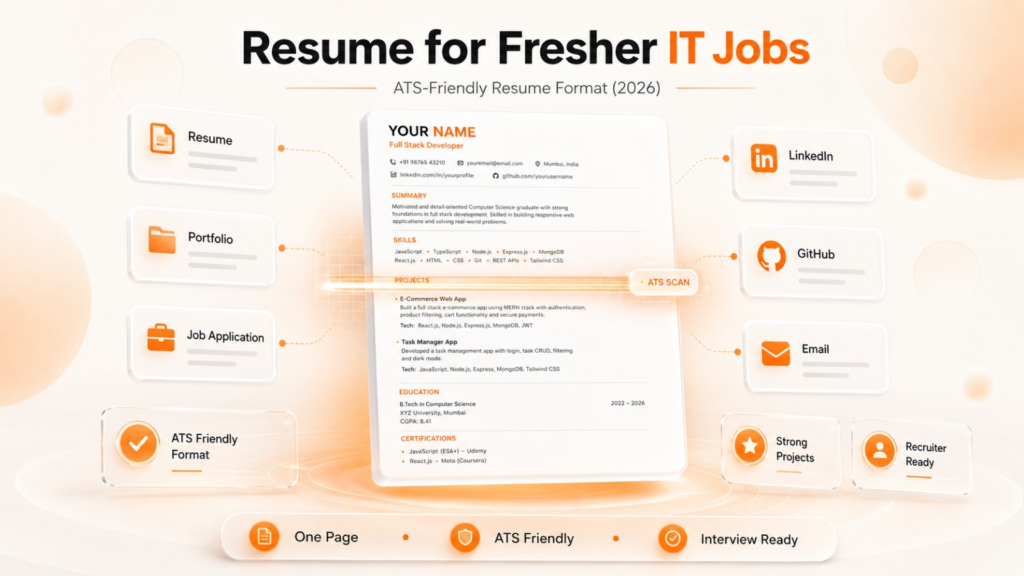
What ATS actually is, and why it matters more than your CGPA right now
Before jumping into formatting, you need to know what you’re up against, because this changes almost every decision you’ll make on the resume. Building an ATS-friendly resume for freshers in India isn’t about picking a pretty template. It’s about understanding how the system reads you.
What ATS does
ATS, or Applicant Tracking System, is software companies use to scan and rank resumes before a recruiter ever opens one. It looks for keywords, checks your section headings, and scores your resume against the job description. Use tables, columns, or graphics, and the system can misread the whole thing, sometimes turning it into a jumbled mess of text even if you’re genuinely a great fit. Over 80% of large Indian employers, TCS and Infosys among them, use ATS somewhere in their hiring pipeline.
What that means if you’re a fresher
About 1.5 million engineering graduates enter India’s job market every year. A single IT opening can pull in hundreds of applications. ATS isn’t out to get you; it’s just neutral software doing its job. A properly formatted resume gets through it fine. The problem is that a lot of the “attractive” fresher resume templates floating around online, the ones with icons and multi-column layouts, fail parsing badly. You send off something that looks great on your screen, and the recruiter opens a broken mess. Single column. Standard headings. No tables, no graphics. That’s the whole trick.
.docx or .pdf, which one?
Go with .docx for job portals and most company career pages; that’s where ATS parsing happens. .pdf works fine when you’re emailing a startup directly and know a real person will open it. Not sure which one applies? Default to .docx and keep a clean .pdf on hand just in case.
A well-formatted resume gets you past the ATS, but recruiters still shortlist candidates based on relevant technical skills and projects. If you’re still deciding which IT career path to pursue, our guide on the Best IT Courses for Freshers in 2026 explains which skills employers are hiring for today.
The exact one-page format that works for IT freshers in 2026
This is the part people bookmark and come back to, so here it is, no fluff. Whether you’re aiming for a fresher resume one page India recruiters won’t skip past, or something built specifically for campus placement, this order works.
Section order (don’t skip this)
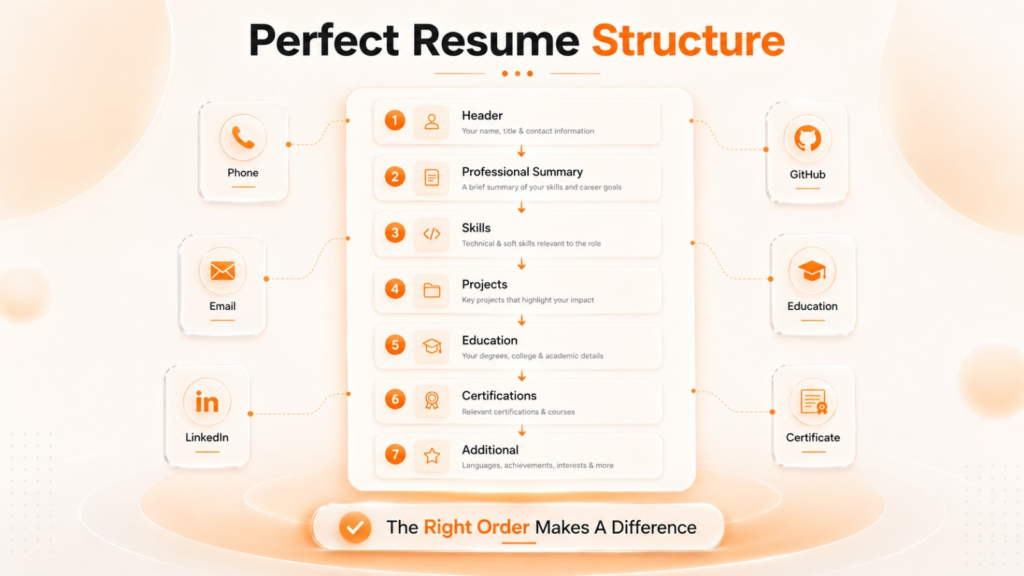
Header, Professional Summary, Skills, Projects, Education, Certifications, and Additional if there’s anything worth adding. Most students still put Education at the very top out of old habit, probably because that’s what their seniors did. For a fresher, though, Skills and Projects belong before Education. Why? Because the recruiter reading your resume wants to know what you can actually build before they care which college you’re from. This holds whether you’re going through campus placement or applying directly to product companies and startups around Pune.
Header
Name in bold, phone number, a proper email address (firstname.lastname@gmail.com, please, not the nickname you made in 2016), your city, LinkedIn URL, GitHub URL. No photo. No date of birth. No marital status, no gender. These are leftover conventions from a different era of hiring, and honestly, they can invite bias into a process that should be about your skills. Your header should take under three seconds to scan.
Professional summary
Two lines. That’s the ceiling. And this is not an objective statement; please retire “seeking a challenging role to utilise my skills”; it’s on a few hundred thousand resumes already and says nothing about you. Say what you are, what you can build, what you’re targeting instead. Something like: “Full-stack developer fresher with hands-on experience in MERN stack, REST APIs, and AWS deployment. Built 3 production-grade projects during training at Teknowell, Pune. Targeting developer roles at product companies and GCCs in Pune.” That’s the shape a strong full-stack developer resume fresher India recruiters respond to actually takes.
Your summary should also reflect the type of developer role you’re targeting. If you’re still choosing between Java and Python, read our comparison of Java vs Python: Which Career Is Better for Freshers in 2026? before tailoring your resume.
Education
Degree, college, graduation year, CGPA. Include the CGPA if it’s 7.0 or above. Below that, drop the number entirely and let your projects carry the weight instead. Some companies use CGPA as a hard filter at campus level, so it’s worth checking that cutoff early rather than finding out the hard way. Adding 10th and 12th marks is optional; only bother if the rest of the resume feels thin.
Certifications and extras
AWS Cloud Practitioner, Azure Fundamentals, Google Data Analytics, HackerRank badges; list them with the platform and year. Under extras, mention hackathons, open source work, anything that shows you go beyond the syllabus. Keep this section short, three or four lines, no more.
Section order to follow exactly
- Header (name, phone, email, city, LinkedIn, GitHub)
- Professional Summary (2 lines, not an objective)
- Skills (technical and tools, no soft skills)
- Projects (2 to 3 projects, strongest first)
- Education (degree, college, year, CGPA if above 7.0)
- Certifications
- Additional (hackathons, contributions, optional)
How to write the skills section without it looking like everyone else’s
The skills section in an IT resume fresher profile is where most people either say too little or pad it out with things that don’t belong. Here’s the fix.
Be specific, not broad
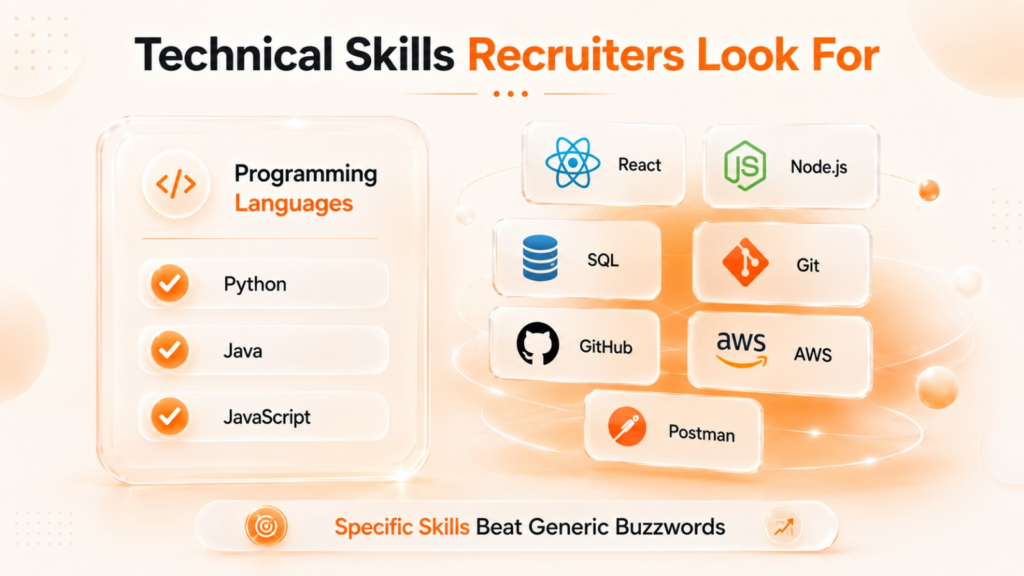
Don’t just write “programming languages”; that heading tells a recruiter nothing on its own. Write “Python (Django, Pandas), JavaScript (React.js, Node.js), SQL, Git” instead. That’s what both a human and the ATS need. And only list what you can actually talk about in an interview. Put Docker on there and can’t explain what a container even does? That gap shows up fast in the technical round, and it’s an awkward one to sit through.
Tools and platforms
GitHub, VS Code, Postman, Figma if relevant, AWS EC2 and S3, Tableau or Power BI for data roles. List these separately from your programming languages so the ATS can categorise them cleanly, and so a recruiter skimming quickly can see your real, practical exposure at a glance.
What to leave out
Soft skills, communication, teamwork, leadership they simply don’t belong in a technical skills section. Recruiters already assume you have some of these. Listing them just eats up space you could use for something that actually differentiates you. Drop MS Word and MS Excel too, unless you’re going for a data or analytics role where Excel genuinely matters. Same with anything that’s really a prerequisite rather than a qualification, “internet browsing” being the classic offender.
Before Skills: Programming, Problem Solving, Communication, Teamwork, MS Office, HTML, CSS, JavaScript, Leadership, Time Management
After Languages: Python, JavaScript, Java Frameworks: React.js, Django, Express.js, Databases: MySQL, MongoDB, Tools: Git, GitHub, Postman, VS Code, Cloud: AWS EC2, S3 (Cloud Practitioner certified)
Notice what changed. The “after” version tells you exactly what this person can build. The “before” version could belong to literally anyone.
The projects section: where most freshers lose the plot
If you only read one section of this guide properly, make it this one. It’s also, frankly, the weakest part of most fresher resumes that come across a recruiter’s desk.
Why it matters more than anything else on the page
With roughly 1.5 million engineering graduates entering the job market each year, most resumes look nearly identical: similar degree, similar CGPA, similar college tier. Projects are where actual difference shows up. It’s consistently the biggest factor recruiters and ATS both weigh when there’s no work history to look at. Which, for a fresher, is always.
Context, technology, outcome, in that order
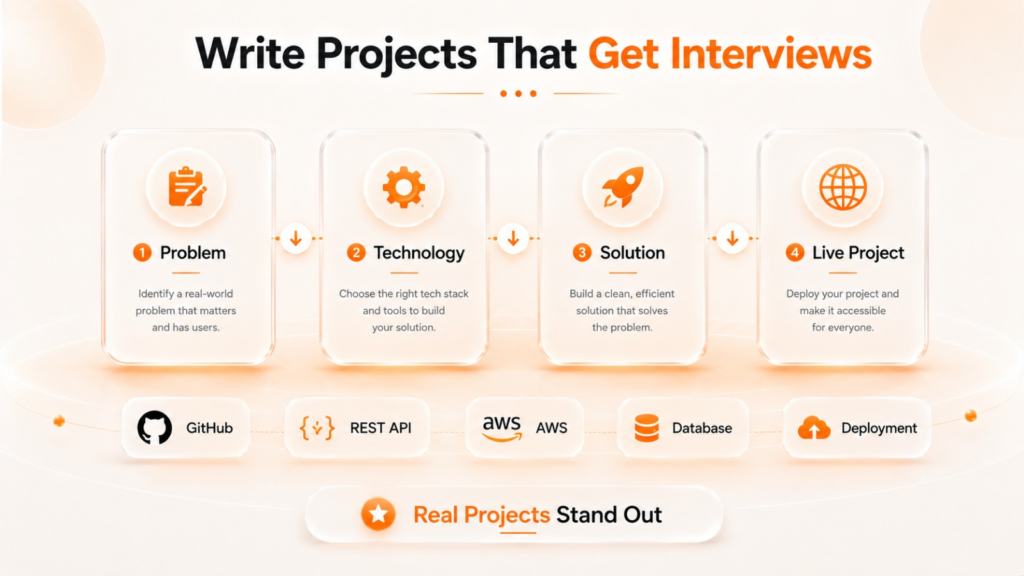
Every project bullet needs three things working together: what the project does, what you built it with, and what the measurable result or standout feature was. Not a vague description. Not just a technology list sitting there by itself. One sentence, all three woven in.
Before, how most freshers write it: Project: E-commerce Website Technologies: HTML, CSS, JavaScript, React, Node.js, MongoDB Description: Built a website where users can browse and buy products.
After, what actually gets you shortlisted: E-Commerce Web Application | React.js, Node.js, MongoDB, AWS EC2. Built a full-stack e-commerce platform with cart management, JWT-based authentication, Razorpay payment integration, and REST API backend. Deployed on AWS EC2 with a live URL. GitHub: [link]
See the difference? The first one could be describing a class assignment. The second one sounds like something a company would actually pay you to build.
For data science freshers
Same principle, different flavour. Skip “built a machine learning model to predict house prices,” that tells a recruiter nothing specific. Instead: “Trained a gradient boosting regression model on the Boston Housing dataset, achieving 87% accuracy. Deployed as a Flask API and visualised results in a Power BI dashboard. GitHub: [link]” The accuracy number and the deployment detail are what separate a real project from a rerun of someone’s tutorial video.
How many projects, really?
Two to three, for a one-page resume. Go past three, and it starts to feel padded. Under two and it feels thin, like you’re hiding something. Got only one genuinely strong project? Describe it in depth across four or five bullets rather than stretching to fill space with weaker ones. Got four? Cut your weakest and keep the top three. It’s genuinely that simple.
What separates a real project from a copy-paste job
A real project has a live URL you can click. It solves something, even something small. And somewhere in there, you made an actual technical call: MySQL over MongoDB, React over plain JS, JWT over session-based auth, and you can explain why. A tutorial replica usually has none of that going for it. If the exact same code sits on GitHub under the exact same project name as some YouTube tutorial, it’s not really yours to claim on a resume. The best projects are the ones you can confidently explain during an interview. Focus on solving a real problem, deploy your application, and include both the GitHub repository and live demo on your resume. If you want hands-on experience building production-style applications with mentor guidance, explore Teknowell’s Full Stack Development Course in Pune.
LinkedIn and GitHub matter just as much as the resume itself
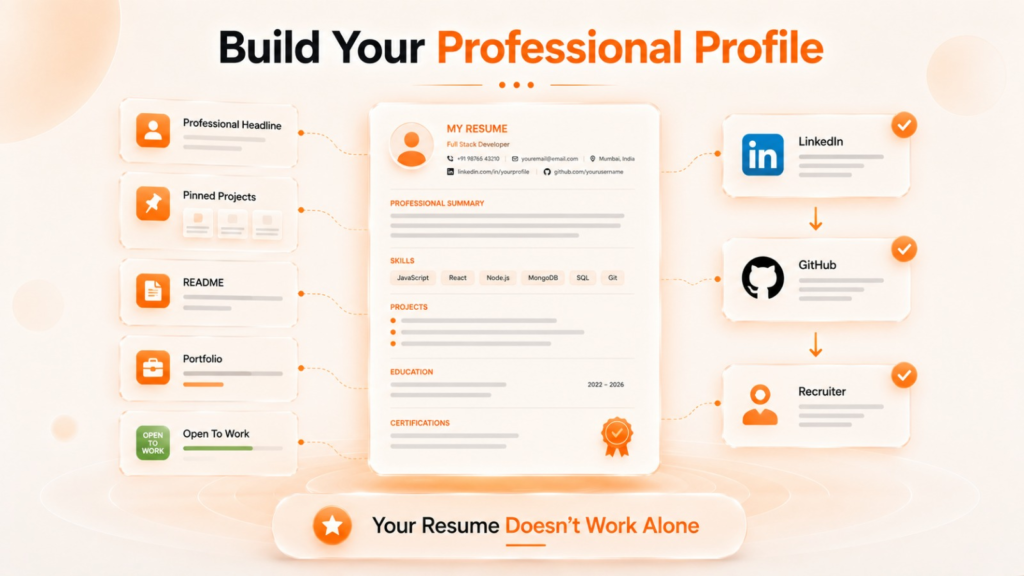
Here’s the thing nobody quite tells you: the resume alone doesn’t cut it anymore in 2026. Recruiters check both these platforms before they even think about calling you, so these GitHub and LinkedIn resume tips for freshers deserve just as much attention.
GitHub
Recruiters at product companies, GCCs, and Pune startups check this before shortlisting, more often than you’d think. A profile with real repositories, proper README files, and actual commit history tells them you code outside of assignments too, not just when a professor asks. Pin your three strongest projects to the top. Write a README for each explaining what it does and how to run it. An empty profile, or one stuffed with forked repos and nothing original, is a missed opportunity sitting right there.
Update your LinkedIn profile so it matches your resume: same skills, same projects, same summary, no contradictions. GCC recruiters actively search LinkedIn to find people before roles even go public. Add your Teknowell training and internship under Experience. List every certification. Switch on “Open to Work.” A complete profile keeps surfacing you in recruiter searches quietly, even while you’re out there applying elsewhere.
Across both platforms, three things carry the most weight: a proper professional photo (LinkedIn only, resumes stay photo-free), project links with live URLs, and a headline that says what you actually do. “Full Stack Developer | MERN Stack | Teknowell Pune | Open to Work” beats “Engineering Graduate 2025” every single time.
A strong GitHub profile can make your resume far more convincing. If you’re starting from scratch, read our complete guide on building a GitHub portfolio for IT freshers before you begin applying.
Where to actually upload and apply
Naukri and LinkedIn
Most IT fresher hiring in India runs through these two. Upload your resume on Naukri using the same keyword-rich content you’d use anywhere else. Naukri’s internal search ranks by keyword relevance and how complete your profile is, so a half-filled profile ranks lower even if your actual skills match perfectly. Keep LinkedIn content consistent with this too; don’t let the two drift apart.
Customise for each job description; seriously, do this
ATS scores your resume against the specific job description it’s matched to. Match the language it uses and your score goes up. Before applying anywhere, read the JD and add in any relevant skill or technology it mentions that you genuinely have. This isn’t lying, to be clear; it’s precision. If the JD says “REST APIs” and yours says “API development,” change the wording. Same skill, tighter match, better odds.
Off-campus applications in Pune
For startups around Baner, Balewadi, and Hinjewadi, a direct email to the hiring manager or CTO often beats going through a portal entirely. A short, specific email with a portfolio link and one clear ask tends to land better than yet another Naukri application buried under three hundred others.
Next Step: Once your resume is ready, prepare for technical interviews, coding questions, and project discussions. Read our Software Developer Interview Preparation Guide to understand what recruiters typically ask freshers during the hiring process.
If you’d like expert feedback on your resume, GitHub profile, or projects before you start applying, book a free counselling session with Teknowell and get personalised guidance
7 resume mistakes that get freshers rejected before anyone reads a word
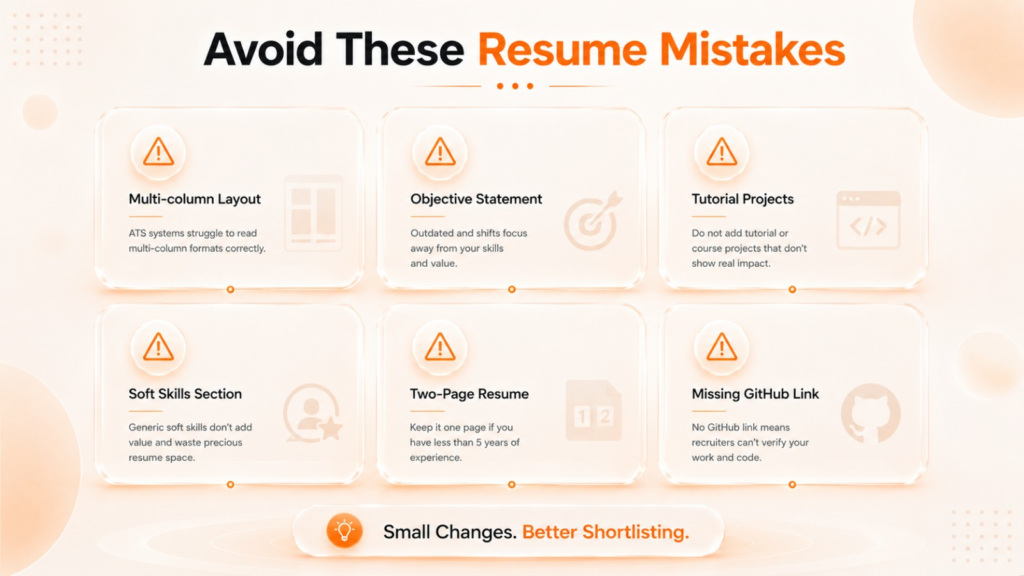
- Multi-column design. Looks sharp on your screen. Fails ATS parsing almost every time, and the recruiter ends up staring at a garbled mess instead of your carefully designed layout. Single column, always.
- Photo on the resume. Not required, not expected, at any major IT company in India. Can trigger bias without anyone even meaning it to, and eats up space your projects should be using instead.
- Objective statement instead of an actual summary. “Seeking a challenging role to utilise my skills in a reputed organisation” is sitting on thousands of resumes right now and telling recruiters nothing new. Two lines about what you build, what you’re aiming for, that’s it.
- Passing off tutorial projects as your own original work. Interviewers ask follow-up questions on every project listed. Can’t explain a decision you supposedly made? That’s the moment it becomes obvious the project wasn’t really yours.
- Soft skills sitting in the skills section. Communication, teamwork, leadership, save these for your interview answers. In the skills section, they just take up space and hint that there isn’t enough technical substance to fill the page otherwise.
- Going past one page. Recruiters give a fresher resume 6 to 10 seconds. A second page doesn’t say “thorough,” it says “couldn’t prioritise.” One page, full stop, until you’ve got three or more years of actual work experience behind you.
- No GitHub link anywhere. At IT companies, that link is basically an open invitation for a recruiter to verify what you’ve claimed in the projects section. Leave it out, and it raises questions: either the projects don’t exist, or they’re not worth showing. Include it; keep the repos public and documented.
Ready to Start Applying?
A well-written resume helps you get shortlisted, but recruiters also expect you to explain your projects, solve coding problems, and demonstrate practical development skills during interviews.
At Teknowell, students build real-world applications, create professional GitHub portfolios, prepare for technical interviews, and receive placement support designed for today’s IT hiring process.
Whether you’re targeting product companies, service-based firms, or GCCs, having practical experience alongside a strong resume can significantly improve your chances of getting hired.
Book a Free Demo Class
Attend a live session, explore the curriculum, and see how our project-based training prepares students for software developer roles.