So you have picked Python. Good call. Now comes the part nobody prepares you for.
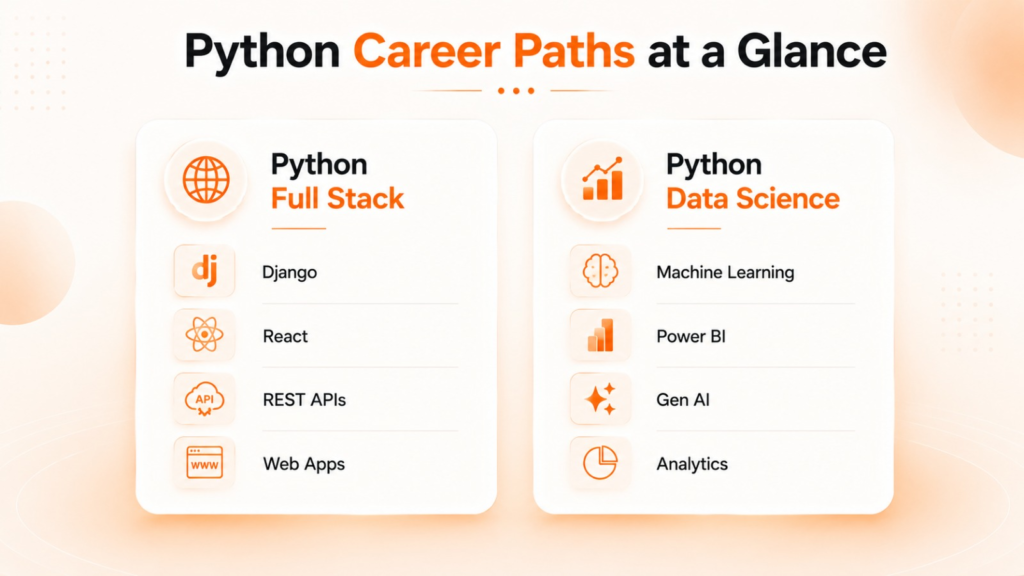
Python does not lead to one career. It leads to at least two, and they look nothing like each other once you are actually in them. One path takes you into Python Full Stack Development, where you build web applications using Python frameworks like Django for the backend, modern frontend technologies, databases, and REST APIs. The other takes you into data science, where you analyse data, train machine learning models, and in 2026, build Gen AI features using tools like LangChain and the OpenAI API.
When people search “Python for data science vs web development,” what they are really asking is which of these two directions makes more sense for them. This blog answers that directly. Not with a “follow your passion” non-answer, but with the actual differences in daily work, salary, learning time, and who each path suits.
Short on time? Here is the quick version:
Python Full Stack Development: You build web applications using Django on the backend, React on the frontend, and databases and APIs connecting everything. The course at Teknowell runs 4 to 6 months. Freshers in Pune typically start at ₹3.5 to 6 LPA.
Python Data Science: You work with data, build ML models, and use Gen AI tools. Course runs 6 to 9 months. Freshers start at ₹5 to 8 LPA. Higher ceiling, longer road. Both are strong careers. The right one depends on your timeline, background, and what kind of problem-solving you enjoy.
What Python is actually doing in each path
Walk into a Python Full Stack Development team and walk into a Python Data Science team on the same day, and you will think you are watching two different professions. Because in a meaningful sense, you are.
The Full Stack Development path
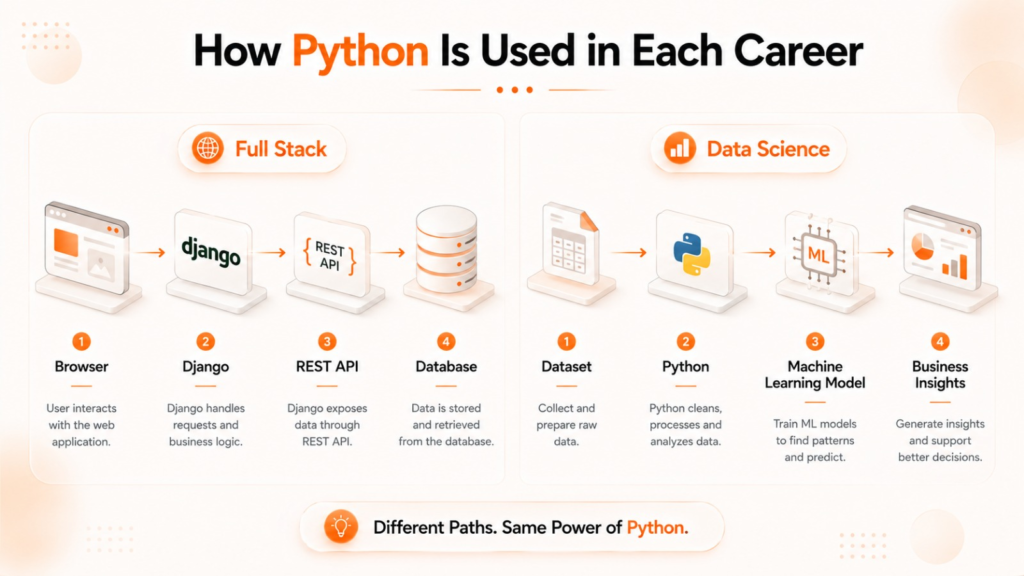
On this path, Python is most commonly used with frameworks like Django, and sometimes Flask or FastAPI depending on the company’s needs. Your job is the backend: the server logic, the database connections, the API endpoints that connect the frontend to the data. You write code that handles authentication, processes requests, stores information, and sends it back in the right format for the interface to display.
A Python Full Stack Developer does not just write backend code. “Full stack” means working across the application, building the server-side with Python and Django while also understanding the frontend, databases, APIs, and how everything connects. In many real-world projects, Django is commonly paired with frontend technologies such as React, where Django exposes APIs, and the frontend consumes them to create the user experience. This combination helps developers build complete, end-to-end web applications rather than only the backend.
The Python Django web development career is satisfying if you like building functional things and seeing them work. You push a feature, it goes live, users interact with it. That feedback loop is fast and concrete. Job titles at the end of this path are Python Full Stack Developer, Python Django Developer, or Software Developer.
The Data Science path
Python here is a completely different tool in a completely different context. You are using Pandas, NumPy, Scikit-learn, and in 2026, LangChain and the OpenAI API. Your job is not building products users interact with. It is answering questions the business cannot answer by looking at a spreadsheet. Why are users dropping off at this step? Which customers are about to churn? How do you build a fraud detection model that catches bad transactions without blocking legitimate ones?
The output of your work is a model, a dashboard in Power BI, or a Gen AI feature that gets handed off to a development team to integrate. And then you have to explain what it means to a product manager or an executive who does not know what a confusion matrix is. That part surprises most freshers. Data science is code plus statistical reasoning plus making someone who does not write Python understand why they should trust what the model is recommending.
Python data science scope in India is expanding significantly because of Gen AI. Companies are no longer just looking for classical ML skills. They want data professionals who understand prompt engineering, RAG pipelines, and how to use LLM APIs in production. Job titles here are Data Scientist, ML Engineer, Data Analyst, or increasingly, Gen AI Engineer. If the analyst route sounds right for you, here is how to become a data analyst in Pune, step by step.
Salary: what each path actually pays
According to Glassdoor, the average Python developer salary in India sits around ₹5.8 LPA, with entry-level roles ranging from ₹3 LPA to ₹10 LPA depending on specialisation. That range is wide because specialisation matters enormously here. These are market averages and actual packages vary based on company type, city, skills, project portfolio, and whether the student completed an internship before applying.
Machine learning engineer and junior data scientist roles offer the highest starting packages among Python developer jobs in India, typically ₹5 LPA to ₹9 LPA for freshers, because the candidate pool is narrower and companies pay a premium to access it.
| Experience | Python Full Stack Developer | Python Data Scientist | What drives the gap |
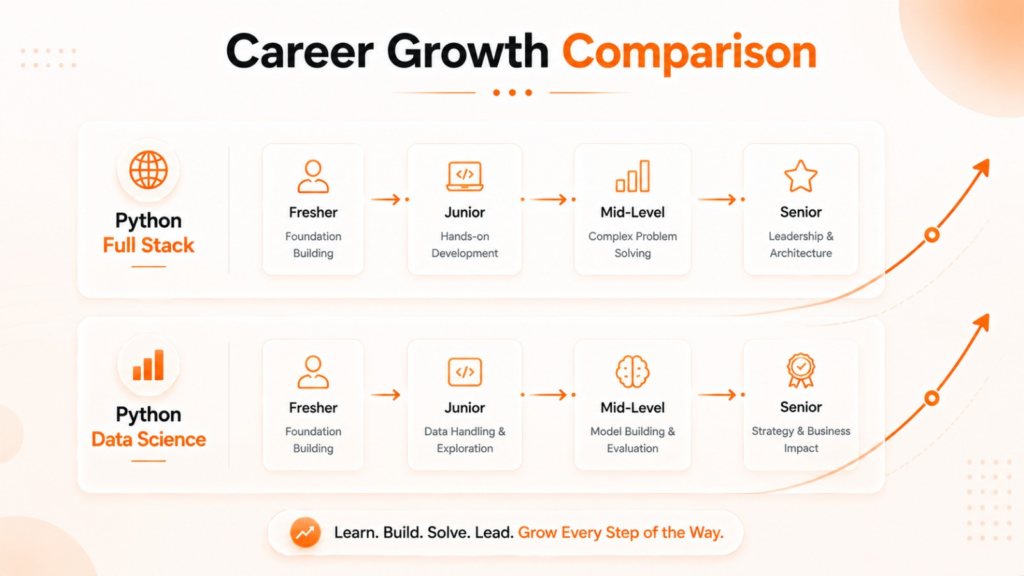
| Fresher (0 to 1 yr) | ₹3.5 to 6 LPA | ₹5 to 8 LPA | Smaller DS talent pool at entry |
| Junior (1 to 3 yrs) | ₹6 to 10 LPA | ₹8 to 14 LPA | Gap widens at first job switch |
| Mid-level (3 to 5 yrs) | ₹10 to 18 LPA | ₹15 to 24 LPA | Premium grows with experience |
| Senior (5 plus yrs) | ₹18 to 30 LPA | ₹24 to 40 LPA | Paths start to converge here |
These figures are indicative and sourced from publicly available market data on Glassdoor India, Naukri, and AmbitionBox. They represent ranges, not guarantees.
The premium for data science exists for one reason: fewer people can do it well. Building a machine learning pipeline that actually works on real, messy data is harder to learn than building a Django backend. Not impossible, just harder. Fewer qualified candidates means companies pay more to find the ones who exist.
And then there is the Python web dev vs AI ML premium, which is reshaping both paths. Full stack developers who can build applications on top of LLM APIs are commanding packages that pure backend developers are not. Data scientists who can fine-tune models and design Gen AI pipelines are in even higher demand. Both tracks reward this skill addition in 2026 the difference is only in how naturally it extends from the existing work.
In Pune specifically
Python Full Stack Developer roles at product companies and startups in Hinjewadi, Baner, and Balewadi start at ₹4 to 7 LPA for freshers with strong portfolios. Python data science roles at BFSI GCCs in Kharadi and Viman Nagar start at ₹6 to 12 LPA. The GCC cluster in Pune pays significantly more for data talent than most other hiring channels in the city. The GCC jobs Pune guide covers which specific companies are hiring and what they screen for.
Learning curve: what each path actually asks of you
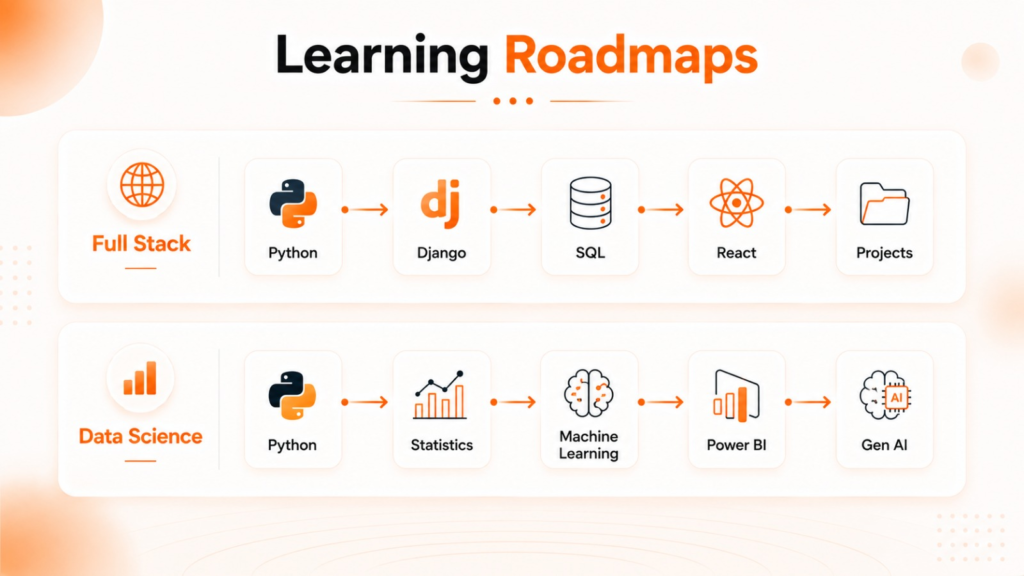
Python Full Stack Development: 4 to 6 months
The course structure at Teknowell moves from Python and Django on the backend through frontend development, database connectivity, REST API design, Git, and basic cloud deployment. Students gradually build complete web applications while learning how each part of the stack works together. Each module connects to the next in a logical sequence, and students work on real deployed projects throughout rather than exercises completed in isolation.
Most students find the first month the steepest and the rest more predictable as the pieces start connecting. By the end of the programme, the goal is not just course completion; it is being interview-ready. That means real projects on GitHub, a structured resume, and mock interview practice that mirrors what Pune companies actually ask.
Python Data Science: 6 to 9 months
The extra months are not padding. Python fundamentals, statistics, Pandas, machine learning algorithms, model evaluation, deep learning basics, data visualisation with Power BI, and now Gen AI integration with LangChain and the OpenAI API that is a lot of genuine ground to cover. Students who try to rush this track consistently show gaps in interviews. The structure is deliberate.
Statistics is where students either settle into data science or start struggling. Probability distributions, hypothesis testing, precision and recall, gradient descent these come up in the first two months and keep coming up throughout. A good trainer makes them accessible rather than abstract, but the underlying comfort with numerical reasoning needs to already be there.
The maths question answered plainly
You do not need a maths degree. But you need to be the kind of person who finds a statistical puzzle interesting rather than draining. Can you sit with an ambiguous numbers-based problem and feel curious rather than panicked? That is the real question. If yes, data science will suit you. If no, Python Full Stack Development will suit you better, and honestly, you will be more productive and more satisfied in it.
Which Python track has more jobs in 2026
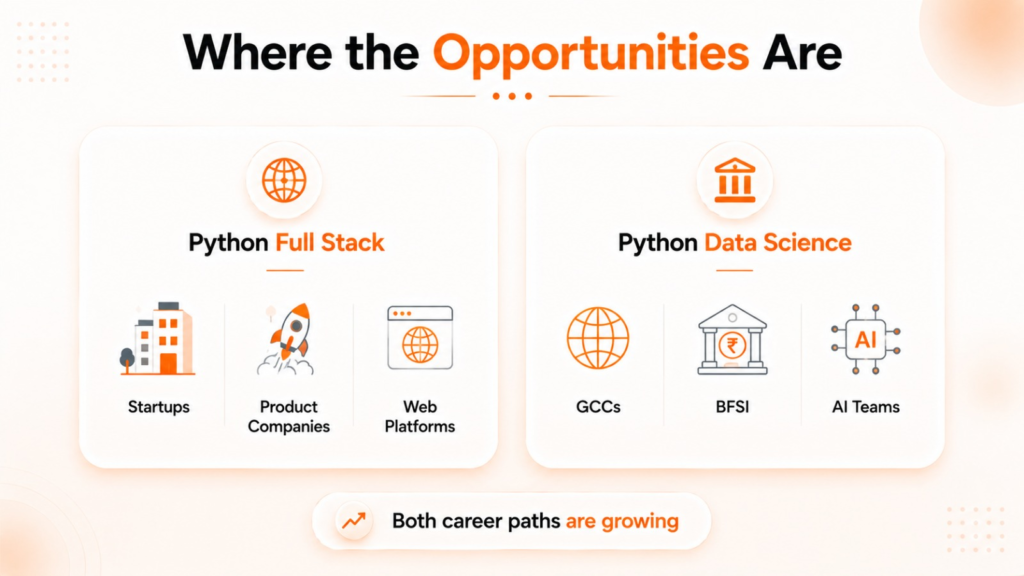
Full stack development wins on volume. More Python Full Stack Developer job postings exist across India than data science postings. Every startup, every fintech company, every product business needs backend developers, and Django holds a solid position in that market. Pune’s startup belt in Baner and Balewadi generates consistent hiring.
But which Python track has more jobs in India is actually the wrong framing when you are making this decision. Job volume and jobs-per-qualified-candidate are two different numbers, and the second one is more useful. The data science talent gap means fewer applicants per opening at the companies that are hiring. And those companies in Pune, the BFSI GCCs in Kharadi and Viman Nagar, pay at the top of the market.
The smarter question is: where do you want to be in three years, and which path gets you there given your current situation?
The actual comparison across what matters
| Factor | Python Data Science | Python Full Stack Development |
| Course length | 6 to 9 months | 4 to 6 months |
| Fresher salary in Pune | ₹5 to 8 LPA | ₹3.5 to 6 LPA |
| Mid-level salary | ₹15 to 24 LPA | ₹10 to 18 LPA |
| Core skills | Python, statistics, ML, Gen AI, Power BI | Django, React, SQL, REST APIs, AWS |
| Maths comfort needed | Yes, genuinely | Minimal |
| Where Pune demand is strongest | GCCs and BFSI in Kharadi and Viman Nagar | Startups and product companies in Hinjewadi and Baner |
| Time to first job offer | Longer | Shorter |
Which one should you actually choose?
Here is the honest version.
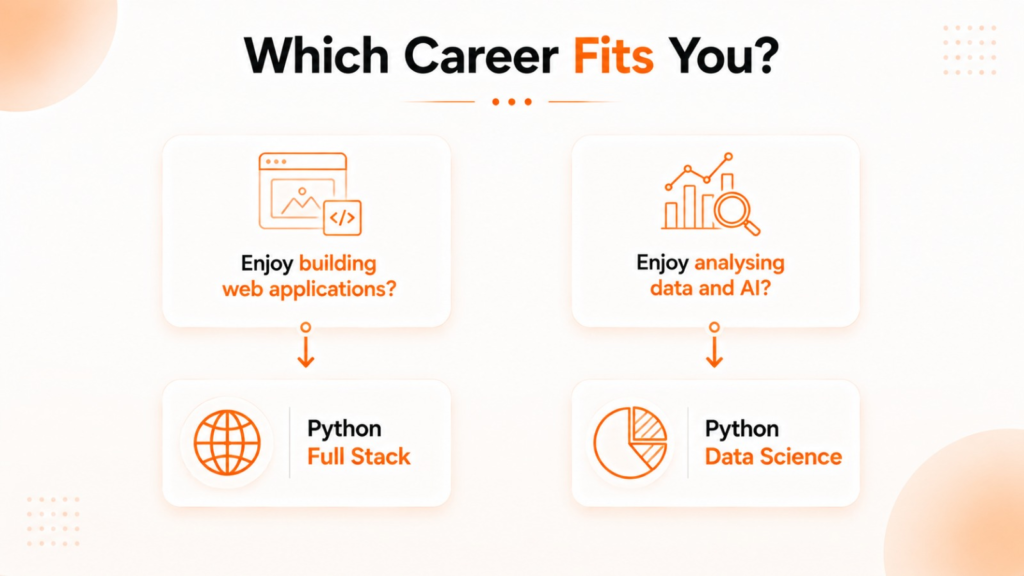
If you find yourself more drawn to questions like “why are users behaving this way in this data” or “how do I build a model that predicts this outcome,” pick data science. If you are more drawn to “how do I build a feature that does this” or “how do I make this backend talk to that frontend,” pick full stack. Both are equally valid ways of thinking. They just reflect different types of problem-solving that different people enjoy.
If that self-reflection is not giving you a clear answer, use the practical factors.
Pick Python Data Science if you can commit to 6 to 9 months, have genuine comfort with numbers and statistics, are targeting the higher-paying BFSI GCC roles in Pune, and can wait a bit longer for your first offer in exchange for a meaningfully higher salary ceiling. The data science and AI course covers Python, ML, deep learning, Power BI, and Gen AI with real dataset projects and placement support across the full duration.
Pick Python Full Stack Development if you want the fastest path to a first offer, prefer building products over analysing data, are from a non-IT background where a 6-month timeline is more realistic than 9, or are targeting Pune’s startup and product company ecosystem. Teknowell offers separate Full Stack Development tracks in Python (Django), MERN, Java, PHP, and .NET. The Python Full Stack programme focuses on Django, frontend development, databases, REST APIs, cloud fundamentals, and live projects, giving students practical experience in building complete web applications.
If you spent time on the Java versus Python debate before landing here, the Java vs Python career comparison gives useful context on the broader language question.
Still unsure which curriculum suits you? Compare both programmes side by side or attend a free demo; it is genuinely easier to decide after sitting in one live session than after reading five more articles.
And there is a third option worth mentioning. Start with Python Full Stack Development, get your first job, then add data science skills from a position of employment. Less glamorous than “follow your passion,” but for freshers who are split and need income within a realistic timeframe, it works well. The Python foundation transfers completely. What you add later are the libraries and the statistical thinking layer, and both come faster when you already have real engineering experience behind you.
Can you switch paths later?
Yes, and more easily than most people expect.
A Python Full Stack Developer who wants to move into data science already has the hardest part done: real Python proficiency and an understanding of how data moves through systems. Adding statistics, Pandas, and ML libraries on top of that takes 3 to 4 months of focused effort rather than starting from scratch. This transition is common enough in Pune’s tech community that it is a normal career move, not an exception.
The reverse also works. A data scientist who picks up Django and REST API basics can build complete ML-powered web applications model and product layer in one person. That combination is rarer and commands a premium at both startups and GCCs. Companies building AI products increasingly want someone who can do both. Both paths grow toward each other at the senior level, which means today’s choice is about the next two or three years, not the rest of your career.
The right Python path is the one you’ll enjoy building
Choosing between Python Data Science and Python Full Stack Development isn’t really about chasing the highest salary. It’s about choosing the kind of problems you want to solve every day. Data science rewards people who enjoy analysing data and building intelligent systems. Full stack development suits those who enjoy creating applications, solving technical challenges, and seeing their work come to life.
The good news is that both careers start with the same foundation: strong Python skills. As your experience grows, moving between web development, AI, and data science becomes much easier than most beginners expect.
If you’re still weighing your options, take some time to compare the curriculum, career outcomes, and projects for each path. Understanding what you’ll actually learn is often the easiest way to decide which direction feels right for your goals.
Explore Teknowell’s Python learning paths: