According to the Naukri JobSpeak Index (Feb 2026), fresher hiring in India grew by 8% in January 2026 alone, and Pune recorded one of the highest hiring surges among major metro cities at 23% YoY. That sounds encouraging until someone actually starts applying and realises something has changed. Companies are no longer hiring based on college names, percentages, or whether someone has “experience” on paper. They want proof that a person can do the work from day one.
That shift is exactly why many freshers with average marks are getting interviews, while others with degrees and certifications are still stuck applying endlessly. The hiring market now rewards skills, portfolios, communication, and practical problem-solving. Someone who can show two working projects on GitHub often gets shortlisted faster than someone with five certificates and no live work.
For anyone wondering how to get an IT job without experience in Pune, the roadmap is clearer now than it was a few years ago. Build the right skills, create proof of work, learn how hiring actually works in 2026, and the first job becomes much more realistic within 4 to 6 months.
Quick facts before starting
| Factor | Reality in 2026 |
| Who this is for | Fresh graduates, career switchers, non-IT students |
| What matters most | Skills + portfolio + interview preparation |
| Typical timeline | 4–6 months with structured training |
| Fresher IT salary Pune 2026 | ₹3.5–8 LPA depending on role |
| Biggest hiring trend | Skills-based hiring over degree-based hiring |
| Most accessible roles | Full Stack, Testing, Data Analytics, Cloud Support |
The biggest mistake freshers still make is assuming companies care mainly about certificates. They do not. Recruiters now want evidence.
The truth about IT hiring in 2026 and why freshers are getting hired differently
A few years ago, most companies filtered candidates by CGPA, degree, and college tier before even looking at skills. That model is fading fast because the industry simply cannot hire enough skilled people through traditional campus filters anymore.
The NASSCOM India AI Skills Report confirmed that India will need nearly1.2 million AI professionals by 2027, while the current supply is estimated at around 420,000. That gap is too large for companies to keep depending only on engineering colleges.
Degrees are no longer the only entry ticket
Large IT companies like Tata Consultancy Services, Infosys, and Wipro have all moved toward skills-based hiring models. Many fresher job postings now mention certifications, coding assessments, or project portfolios instead of rigid academic filters.
Recruiters have also realised something uncomfortable. A student with high marks is not automatically job-ready. Someone who has deployed projects, solved coding problems consistently, and understands real workflows often performs better inside teams.
That is why “portfolio required” appears more frequently in entry-level IT jobs in Pune, no experience listings now.
AI and cloud hiring changed the rules completely
AI, automation, and cloud technologies created a strange hiring situation. Companies need talent urgently, but experienced professionals are expensive and limited. So businesses started training freshers faster and hiring people based on adaptability instead of only experience. If you are a working professional thinking about this, our guide on switching to IT after 30 in Pune is worth a read.
According to the NASSCOM report, cloud technologies could contribute nearly 8% of India’s GDP by 2026, highlighting how aggressively businesses are investing in digital infrastructure and cloud talent. This growing demand for cloud, automation, and AI-related technologies explains why freshers with skills like Python, SQL, GitHub projects, and cloud basics are getting interview calls much faster than before.
Pune became one of the strongest fresher markets
Pune’s IT ecosystem quietly expanded beyond traditional service companies. Areas like Hinjewadi, Kharadi, Baner, and Magarpatta now have GCCs, SaaS startups, fintech firms, AI teams, and product companies hiring aggressively.
According to the Naukri JobSpeak Report, Pune hiring activity jumped 23% YoY. That matters because fresher demand usually follows expansion hiring. When companies build new teams, they hire junior talent first to scale faster.
That is also why searches like “IT jobs for freshers in Pune 2026” have exploded recently.
Our Full Stack Developer course covers Java, Python and MERN full stack with live projects, so you finish with work you can show in interviews.
- Classroom in Chinchwad or live online batches
- Real projects and interview preparation
- Placement support after the course
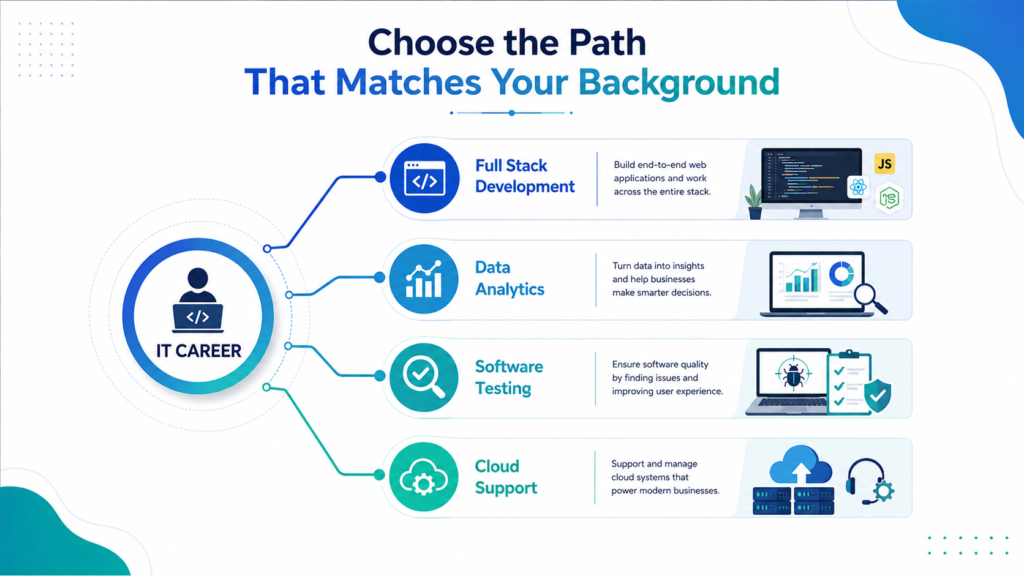
Step 1: Pick the right IT role instead of blindly following trends
Most beginners choose Full Stack Development because everyone around them talks about it. Then six months later, they realise they never actually enjoyed coding deeply enough to survive interviews.
Choosing the right role matters more than choosing the most popular role.
If someone already has a CS or IT degree
The easiest entry paths are usually:
- Full Stack Development
- Automation Testing
- Cloud & DevOps support roles
These domains have structured hiring pipelines and a large number of freshers in demand in Pune. Someone asking how to become a full-stack developer fresher usually has the highest chance of getting interviews if they focus on one stack properly instead of learning 10 technologies badly.
A practical MERN stack portfolio with GitHub projects still performs extremely well in Pune’s startup market.
Natural internal progression also matters here. A fresher developer can move toward backend engineering, DevOps, AI integration, or architecture later.
For students exploring this route, a structured full-stack developer course in Pune usually shortens the learning curve significantly because the roadmap is already organised.
If someone comes from a non-IT background
This is where most people underestimate themselves. If your degree is BCom or BBA, our guide on switching to IT after BCom or BBA shows which roles fit best.
BCom, BBA, BA, and science graduates are getting hired into IT roles regularly now, especially in:
- Data Analytics
- Manual & Automation Testing
- Cloud Support
- Technical Support
Data Analytics is particularly beginner-friendly because it combines business thinking with tools like Excel, SQL, Power BI, and Python. Our guide on how to become a data analyst in Pune lays out the skills and a realistic roadmap.
Testing is another underrated path. Many people searching “Is an IT job possible without coding?” do not realise that manual testing still exists as an entry route. Coding becomes important later for automation growth, but the initial barrier is lower.
Students from non-CS backgrounds often perform surprisingly well in analytics because they already understand reporting, operations, or business processes.
Those interested in analytics can explore data science training in Pune for freshers to transition faster into analyst or AI-adjacent roles.
If someone is switching careers after working elsewhere
Career switchers usually need speed and stability more than experimentation.
Software Testing remains one of the fastest transitions because companies value process understanding and communication. Someone from customer support, operations, banking, or sales often adapts well to QA roles.
Data Science and AI have higher long-term ROI but require more patience. Full Stack Development has the widest market, though it usually takes longer to become genuinely interview-ready.
The truth most institutes avoid saying openly is this: people fail interviews not because they are weak technically, but because they learn too many random things without depth.
Which IT role suits different backgrounds?
| Background | Recommended Role | Time to Become Job-Ready | Avg Starting Salary Pune |
| CS/IT Graduate | Full Stack Development | 4–5 months | ₹4.5–8 LPA |
| Non-IT Graduate | Data Analytics | 3–4 months | ₹3.5–6 LPA |
| Working Professional | Software Testing | 4 months | ₹4–7 LPA |
| Any Background | Cloud Support | 3–4 months | ₹4–6 LPA |
Step 2: Build job-ready skills instead of collecting certificates
One uncomfortable truth about the IT industry is that nobody gets hired because they completed a course alone. A certificate only proves attendance. Companies care about whether someone can solve problems independently.
That difference becomes obvious during technical interviews.
What “job-ready” actually means now
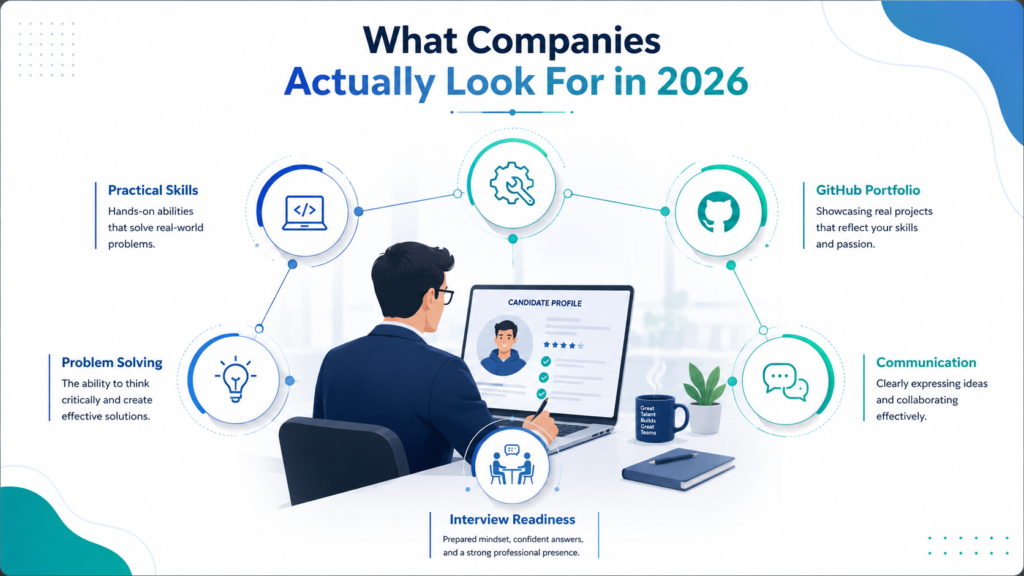
In 2026, freshers usually go through four filters:
- ATS resume screening
- Online coding or aptitude assessments
- Portfolio or GitHub review
- Communication and interview evaluation
Being “job-ready” means clearing all four.
A candidate might know React well but fail because their resume is unreadable. Another candidate may clear coding rounds but fail because they cannot explain their own project confidently.
That is why random YouTube learning often stalls after a few months. Skills grow, but structure never develops.
Technical skills that actually get interview calls
Most freshers overload their resumes with tools they barely know. Recruiters notice that immediately.
A stronger strategy is depth over quantity.
For Full Stack Development:
- JavaScript
- React
- Node.js
- Git & GitHub
- MongoDB
- Basic AWS deployment
- TypeScript
For Data Analytics:
- Excel
- SQL
- Power BI
- Python basics
- Pandas
- One ML project
For Testing:
- Selenium
- API Testing
- JIRA
- Test case writing
- Bug tracking
For Cloud Support:
- AWS Fundamentals
- Linux basics
- Networking
- Scripting fundamentals
Git and GitHub are now baseline expectations. Recruiters increasingly assume every fresher knows version control already.
The skill most freshers ignore completely
Communication.
Not “spoken English” in the traditional sense. Real workplace communication.
Explaining code clearly. Giving updates during standups. Asking good technical questions. Writing proper documentation. Handling feedback without freezing.
The Deloitte Global Gen Z & Millennial Report 2026 found that career mobility among Gen Z professionals is extremely high. The people who grow fastest inside teams are usually not the smartest coders. They are the ones others enjoy collaborating with.
That is why mock interviews and group discussions matter much more than freshers realise initially.
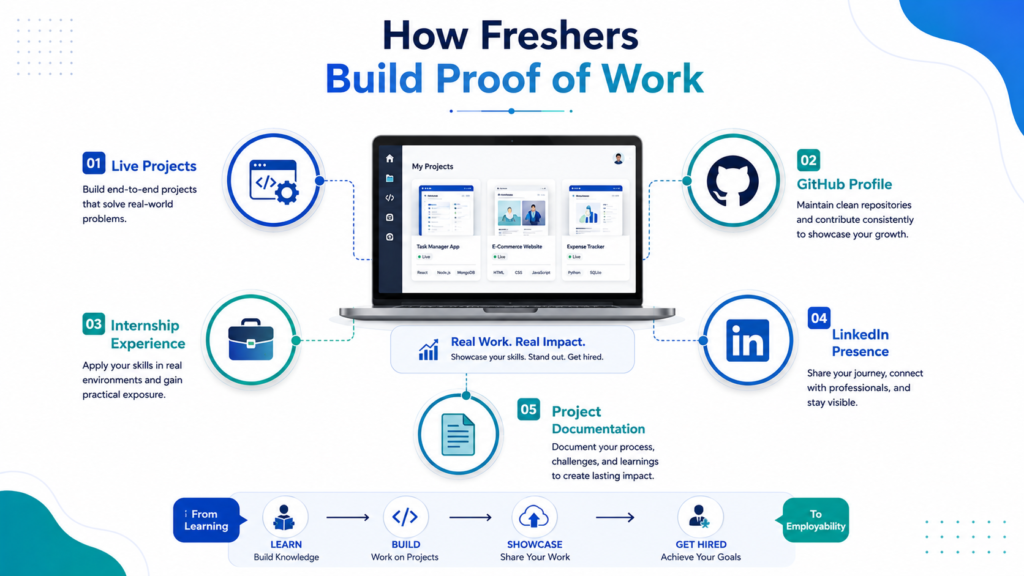
Step 3: Build a portfolio that replaces experience
This is the part that changes everything.
Most recruiters understand that freshers do not have corporate experience. What they want instead is evidence that someone can learn independently and finish real work.
That evidence is called a portfolio.
Why portfolios outperform certificates every time
A GitHub repository reveals more about a candidate than a certificate ever can.
Recruiters can instantly see:
- Code quality
- Consistency
- Project complexity
- Documentation style
- Problem-solving ability
Someone with two strong deployed projects usually outperforms candidates holding multiple certifications without live work.
That is especially true for startups and product companies hiring in Pune.
What freshers should actually build
The best beginner projects solve ordinary problems properly.
Strong portfolio examples:
- E-commerce website with authentication
- Expense tracker dashboard
- Weather application with APIs
- Blog CMS with an admin panel
- Sales analytics dashboard
- Student management system
The important part is not originality. It is execution.
One detail experienced recruiters notice immediately is whether a project was actually completed. Many freshers leave projects half-finished once tutorials end. Even a simple project with proper deployment, documentation, responsive UI, and clean Git commits creates a stronger impression than an advanced, incomplete one.
That small difference changes interview outcomes constantly.
GitHub and LinkedIn are now part of your resume
A strong GitHub portfolio for IT jobs in India matters now because recruiters actively review profiles before interviews.
LinkedIn matters for visibility. GitHub matters for proof.
Students should:
- Add project descriptions properly
- Upload clean README files
- Keep LinkedIn active weekly
- Mention internship projects
- Connect with recruiters strategically
- Post project updates occasionally
This is exactly why Teknowell integrates live projects and internships into training itself. By the time students finish the course, they already have practical work to showcase instead of starting from zero afterwards.
Step 4: Where freshers should actually apply in 2026
The “apply everywhere” strategy barely works anymore because fresher applications are overwhelming.
Smarter application channels matter more than higher application volume.
IT service companies work differently from startups
Large service companies prefer official hiring systems.
Examples:
- TCS hires freshers through the TCS National Qualifier Test (NQT), registered on TCS iON
- Infosys lists fresher roles on its careers page
- Wipro hires through its Elite National Talent Hunt (NTH)
Applying through official portals gives fresher resumes better ATS visibility than random LinkedIn applications.
Startups care more about proof than pedigree
Platforms like:
- Instahyre
- Wellfound
- Cutshort
They are heavily portfolio-driven.
A strong GitHub profile plus deployed projects can bypass traditional filters entirely. This is where candidates without CS degrees often succeed faster because startups prioritise output over academic background.
GCCs pay more but expect stronger preparation
Pune’s GCC ecosystem expanded aggressively.
Companies like:
- JPMorgan Chase
- Goldman Sachs
- HSBC
- Walmart
Hire freshers through skill assessments and placement pipelines.
These roles often offer ₹12–35 LPA packages, but competition is tougher. Structured preparation becomes critical here.
Best fresher application channels in Pune
| Company Type | Best Place to Apply | What They Prioritise | Fresher Salary Pune |
| IT Services | Official company portals | Assessments + communication | ₹3.5–6 LPA |
| Startups | Instahyre, Wellfound, GitHub | Projects + adaptability | ₹5–10 LPA |
| Product Companies | LinkedIn + referrals | Strong technical depth | ₹8–15 LPA |
| GCCs | Placement cells + assessments | Problem-solving + portfolio | ₹12–35 LPA |
One strategy that still works surprisingly well is personalised cold emailing.
Generic job applications often disappear into ATS systems. A short email referencing a specific project or company product sometimes gets more responses than 100 mass applications combined.
Step 5: What freshers actually face during interviews now
Many students still prepare for interviews as if companies only ask theory questions.
That approach collapses quickly during real interviews.
The three rounds almost every fresher faces
Round 1: Online Assessment
Usually includes aptitude, logical reasoning, SQL, coding, or debugging questions.
Platforms like HackerRank and LeetCode help significantly here.
Round 2: Technical Interview
Interviewers focus heavily on projects now. They ask:
- Why was this approach used?
- What problem did the project solve?
- What broke during development?
- What would improve next?
Candidates who memorise theory but cannot explain their own code struggle badly here.
Round 3: HR & Communication Round
This round checks clarity, confidence, consistency, and professionalism.
The project presentation mistake most freshers make
Freshers often explain projects like technology shopping lists.
“We used React, Node.js, MongoDB…”
Interviewers already saw that on the resume.
What they actually want:
- What was the real problem?
- What challenge happened during development?
- How was it solved?
- What was learned?
The strongest project explanations follow:
Problem → Solution → Challenge → Improvement
That structure immediately sounds more practical and mature.
Mock interviews matter more now because AI screening exists
Many mid-to-large companies now use AI-powered video screening before live interviews. Communication pacing, confidence, eye contact, and response clarity are increasingly analysed automatically.
That means interview preparation is no longer just technical preparation.
This is one area where structured training environments genuinely help because students practice repeatedly before facing actual recruiters.
How Teknowell helps freshers get IT jobs in Pune without experience
Most students do not fail because they are incapable. They fail because the path becomes chaotic. Too many tutorials, too many conflicting roadmaps, and no feedback loop.
Teknowell’s model is built around solving that exact problem step by step.
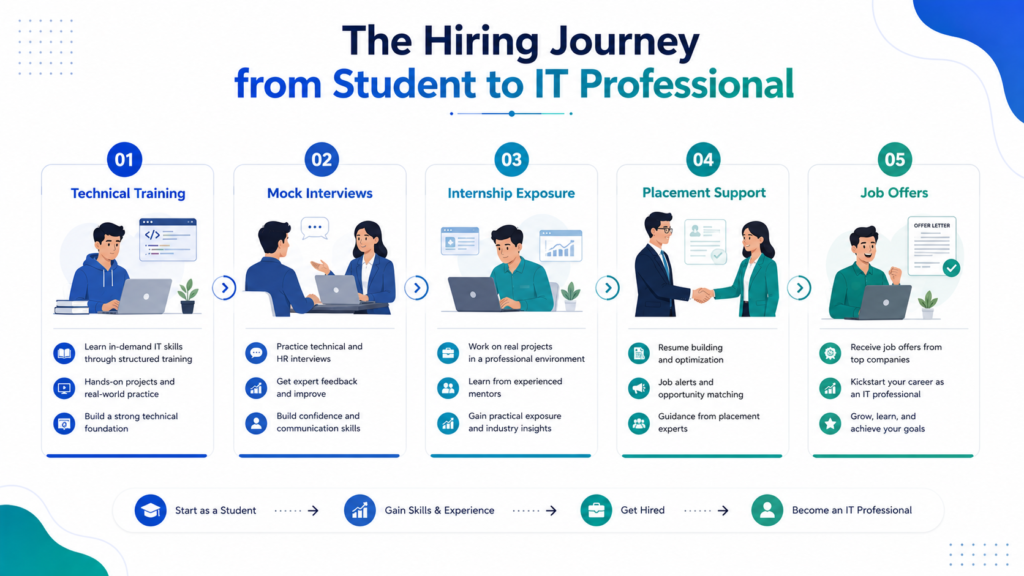
Students first receive structured technical training based on current hiring demand instead of outdated syllabus content. Then live projects and internships run alongside the course itself, which means students graduate with practical exposure already documented.
That internship layer matters more than people realise because recruiters want proof of consistency. A portfolio built over several months always looks stronger than rushed projects built one week before interviews.
Mock interviews, GD rounds, resume reviews, and communication training are also integrated into the placement process instead of being treated as optional extras.
Teknowell also provides continuous job assistance, placement support, and regular interview opportunities to help students stay active in the hiring process. That support matters because most freshers improve significantly after their first few interviews and become more confident with each attempt.
The trainers include experienced industry professionals from companies such as Tata Consultancy Services and Persistent Systems, which adds practical insight beyond textbook teaching.
Students exploring placements can check Teknowell’s placement to understand the type of companies and roles students are entering after training.
Your first IT job starts with proof, not permission
The hardest part about getting into IT is not learning technology. It is reaching the point where someone trusts you enough to give you the first opportunity.
That trust comes from visible work.
A degree helps. Certifications help. But recruiters remember candidates who can explain a real project, solve problems confidently, and show practical skills through GitHub, internships, or live work. That is what separates students who keep applying from students who start getting interview calls.
Teknowell works with freshers from CS, BCom, BBA, and non-IT backgrounds who are trying to break into the IT industry for the first time. The focus is simple: structured training, live projects, internship experience, mock interviews, and placement preparation that actually matches how companies hire in 2026.
The first IT job usually goes to the person who started building before they felt fully ready.
Book a Free Demoat Teknowell Pune