

This buzzword keeps popping up wherever you go. Recruitment ads include it as part of their job description. You see it in YouTube thumbnails offering tutorials. Your college buddy has recently signed up for a MERN stack course. And here you are wondering: what actually is it?
MERN stack is the integration of four different JavaScript frameworks that help build today’s web apps. MongoDB stores the data. Express.js deals with backend functions and APIs. React.js builds the user interface. And then comes Node.js, which gives JavaScript the ability to execute in server-side environments.
Together, they form the core tools required to build a full-fledged web app using JavaScript.
That is the brief explanation. Here is a more detailed version of this in the blog: What do the individual frameworks do? How do they integrate with each other? The role of a MERN developer, the salary range, the learning curve, and whether it makes sense to become a MERN developer for a fresher in Pune 2026. If you already know the basics and want to see who is hiring, read our guide to MERN stack jobs in Pune for freshers.
Quick answer: What is the MERN stack?
MERN stands for:
M: MongoDB: The database that stores your application’s data
E: Express.js: The backend framework that handles server logic and APIs
R: React.js: The frontend library used to build the user interface
N: Node.js: The JavaScript runtime that runs backend code
Together, these technologies can be used to build full-stack web applications with JavaScript across the frontend and backend.
At Teknowell in Pimpri Chinchwad, the MERN/MEAN Stack Development course runs for 3 months and covers MongoDB, Express.js, React.js, Node.js, JavaScript, and REST APIs, along with Angular as an additional frontend technology.
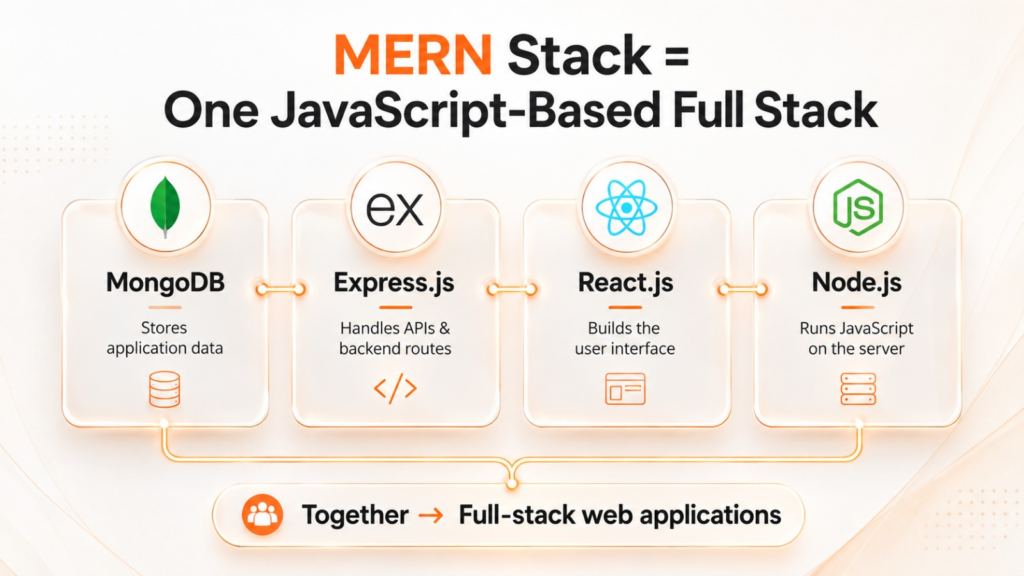
MERN Stack Full Form: What Each Technology Does
MERN is not one programming language or one software product. It is a stack made up of four different technologies, each with a specific job.
The easiest way to understand it is to imagine an online shopping application.
You need somewhere to store customer and product data. You need a server to process requests. You need a user interface that customers can interact with. And you need an environment where the backend JavaScript code can run.
That is where the four parts of MERN come in.
| MERN technology | What it does | Where it works |
| MongoDB | Stores application data | Database |
| Express.js | Handles APIs, routes, and backend logic | Backend |
| React.js | Builds the user interface | Frontend |
| Node.js | Runs JavaScript on the server | Backend runtime |
M: MongoDB
MongoDB is the database. It is the place where an application keeps its data, such as user records, product data, orders, messages, and any other data related to the application.
Traditionally, relational databases store information in tables with rows and columns. In MongoDB, information is kept in documents that look like JavaScript objects.
For example, the user record may include the user’s name, email, account information, and an array of orders previously placed by the user in a single document.
The document-based approach may be quite convenient in applications where flexibility in storing information is required as the application grows. For beginners, the easiest way to remember MongoDB is:
MongoDB = where the application keeps its data.
E: Express.js
Express.js is a backend framework that runs on Node.js.
It helps developers build the server-side part of an application. That includes receiving requests, defining routes, processing data, running middleware, and creating API endpoints.
Imagine a customer clicking “Add to Cart.”
The browser needs to send that request somewhere. The server needs to receive it, check the product, update the cart, and send a response back.
Express.js helps organise that process.
Think of Express.js as the coordinator between the frontend, backend logic, and database.
R: React.js
React.js is a JavaScript library that is used to develop the user interface.
Components such as buttons, forms, navigation menus, product cards, dashboard, search results page, and profile page can all be developed using React. The greatest advantage of React is that it enables the creation of components. In this way, developers can build reusable parts of an interface, and there is no need to duplicate the same element multiple times.
For example, in an e-commerce web application, a product card component can be used that will render products based on data received.
React allows modification of only selected parts of an interface based on application data and therefore enables developers to create interactive applications without a full page reload.
In other words: React = what the user sees and interacts with.
N: Node.js
Node.js is a JavaScript runtime. JavaScript originally became popular as a browser language, where it could make web pages interactive. Node.js made it possible to run JavaScript outside the browser, including on servers.
This is important because Express.js runs on Node.js.
So when you see: React → Express → MongoDB
Node.js is part of the environment that makes the backend JavaScript code run. The simple version:
Node.js = the environment that runs JavaScript on the server.
How Does MERN Stack Work Together?
This is where MERN starts making sense.
Rather than consider each technology: MongoDB, Express, React, and Node.js individually, take into consideration what happens when somebody logs into a website.
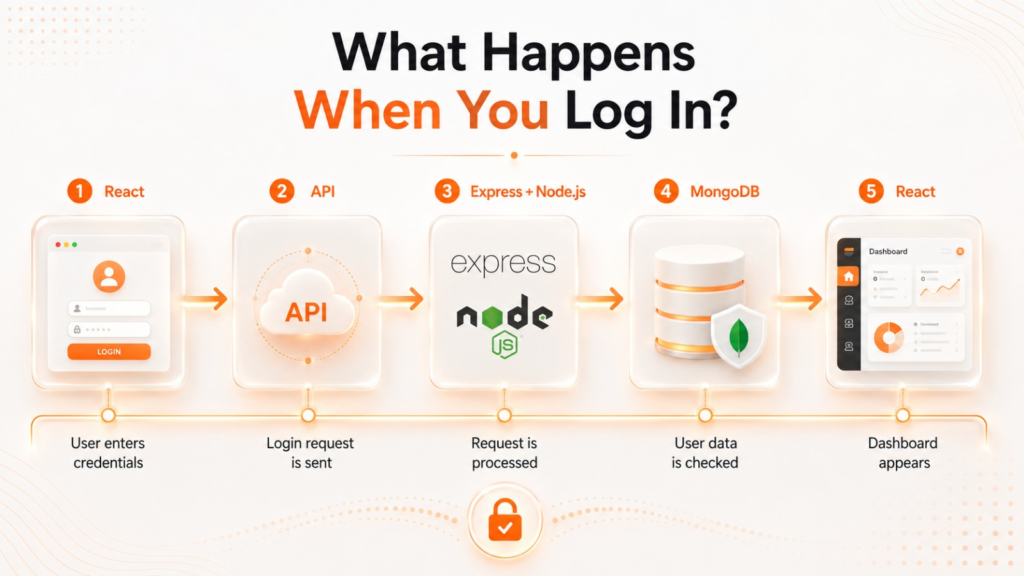
Firstly, the user goes onto the login page. React.js displays the fields for email address, password, and the login button on the webpage.
Then the user logs in. React.js sends an API call to the backend.
Express.js will receive the API call and identify the appropriate route. It may also be responsible for any middleware operations, for instance, authentication, validation, logging, or rate limiting. Next, the backend system will check the user’s information against the information stored in MongoDB.
Finally, if the credentials provided are valid, then the backend generates an authenticated session or token and provides a response back to the browser.
React then processes this response and modifies the application such that the user can access the dashboard.
The process roughly follows this pathway:
User → React → API → Express/Node.js → MongoDB → Express/Node.js → React → User
What this means is that JavaScript can be used both on the frontend and backend.
This does not necessarily mean that MERN is easier than any other stack but rather that developers can work within one.
Why Is MERN Stack Popular?
MERN became popular because its individual technologies solve different parts of web development and work well together.
React gives developers a component-based way to build interfaces.
Node.js allows JavaScript to be used on the backend.
Express provides a lightweight framework for building APIs and server-side applications.
MongoDB provides a document-oriented database that works naturally with JavaScript-based applications.
There is also a large ecosystem around JavaScript, React, and Node.js, which gives developers access to libraries, tools, documentation, and community support.
The 2025 Stack Overflow Developer Survey continues to show strong interest in the JavaScript ecosystem. The survey specifically notes that Node.js users commonly want to add technologies such as React, Next.js, and Vue.js, reflecting interest in developers who can work across more parts of an application.
That is one reason full stack JavaScript remains a practical skill set rather than simply a buzzword.
It is also important not to treat MERN as the only modern option. Python, Java, .NET, and other technologies remain widely used. The right stack depends on the type of work you want to do.
MERN vs MEAN Stack: What Is the Difference?
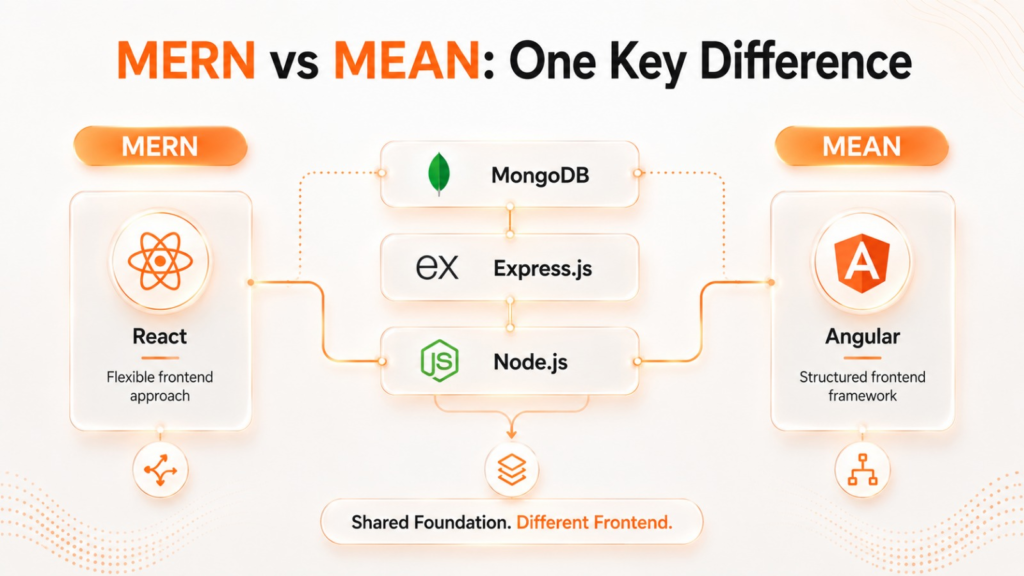
People often talk about MERN and MEAN in such similar terms that everyone thinks the two are more or less the same thing. They’re not. There is, however, much DNA to be found between these two.
For starters, the two use the exact same three technologies in the backend:
- MongoDB
- Express.js
- Node.js
The difference is seen in the frontend.
For MERN, you get MongoDB, Express.js, React, and Node.js, while for MEAN, React is replaced by Angular. That might sound like a small change, but that’s far from the case since the two have almost opposite approaches to solving the “build me a frontend” question.
React is a library and not a framework. React operates on the interface only, and frameworks are chosen based on project needs. Angular is a framework altogether, with its own set of structure and ideology.
It is important to note the following information about AngularJS: it is not the same as Angular. Even though these two technologies are almost similar in terms of naming, they are completely different from one another. On the website of the Angular framework, the versions of Angular that are now deprecated can be found. Therefore, it is important to remember what exactly is meant by the name “AngularJS” when it appears in the names of courses or required skills for job positions.
In the course provided by Teknowell, Angular appears alongside the MERN stack technologies.
So, How Does a MERN Stack Developer Spend Their Time?
Knowing your MERN Stack is obviously the simple part. It’s the application of this knowledge that’s going to be the more important topic for you. Imagine that your client asks for the addition of a product filter in their online store. Then, here’s what the development is going to look like:
- Develop the filter interface in React
- Pass the selected filters to the backend using an API
- Create and adjust an Express.js route
- Process the backend logic in Node.js
- Find matching products in MongoDB
- Return the results to the frontend
- Show the new products in React
- Check the application and fix whatever is broken.
Your next assignment may have absolutely nothing to do with the above. Maybe there’s a bug in the login process. Or maybe it’s a slow page. Maybe it’s time for a new API, or maybe you need to rewrite a database query or integrate something third-party. This is exactly why the constant switching between various layers is what differentiates a full-stack developer from someone working on the front-end or back-end side exclusively.
What Skills Does a MERN Stack Developer Actually Need?
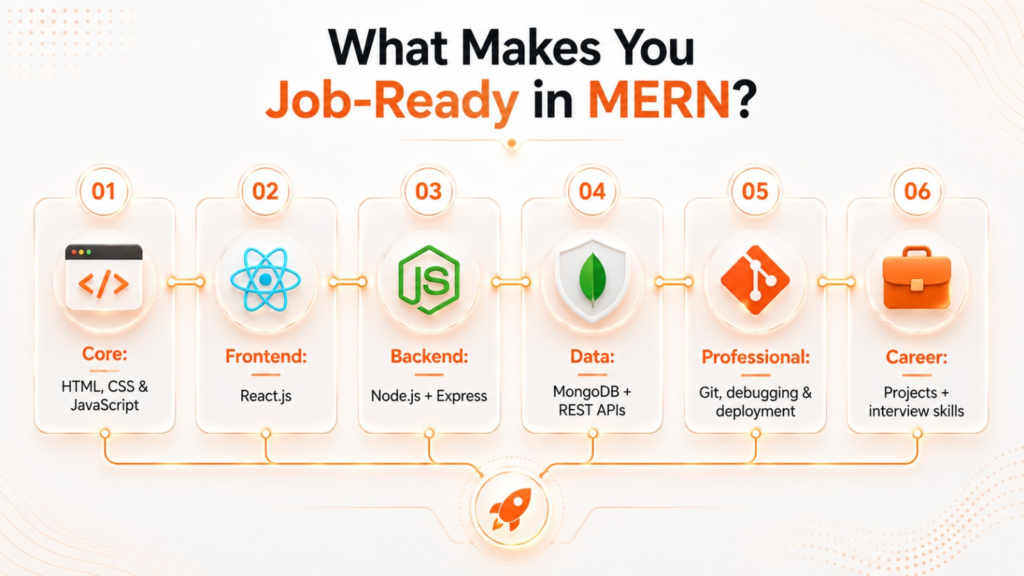
The four core technologies get you partway there. Job-ready needs a bit more around the edges, and this is the part a lot of beginners skip.
You’ll want to be building skills in:
- HTML and CSS
- JavaScript fundamentals
- React.js
- Node.js
- Express.js
- MongoDB
- REST APIs
- Git and GitHub
- Basic authentication
- Debugging
- Deployment basics
- Problem-solving
- Technical interview prep
You don’t need all of this on day one. Trying to will just slow you down. A more realistic order looks like this:
HTML/CSS → JavaScript → React → Node.js → Express → MongoDB → APIs → full stack projects.
What Should You Know Before You Even Start?
You don’t need professional coding experience walking in. A decent handle on JavaScript basics will save you a lot of headaches later, though.
Before going deep into MERN, get comfortable with:
- Variables and data types
- Functions
- Arrays and objects
- Loops and conditions
- Basic DOM concepts
- Events
- Array methods
- Asynchronous JavaScript
- Promises and async/await
- Basic HTTP and API concepts
No advanced math required either. This is a logic and problem-solving stack far more than a math one.
If you’re starting from absolute zero, the JavaScript stage will eat up more time than you expect. That’s normal. Push through it, because once it clicks, the rest of the stack connects surprisingly fast.
Where Does MERN Actually Get Used?
Pretty much everywhere web development happens:
- E-commerce websites
- SaaS applications
- Admin dashboards
- Booking platforms
- Education platforms
- Social and community apps
- Customer portals
- Business management tools
- Content platforms
- Internal company tools
What any one company uses depends on their product, their existing codebase, their team, and whatever their technical requirements happen to be. So think of MERN as one strong path into full-stack work, not the assumption that every company runs the exact same four technologies you learned.
MERN Stack Developer Salary in India in 2026
Salaries swing quite a bit here, based on experience, location, the company, your actual skill level, and how you handle interviews.
Glassdoor’s current India salary page puts MERN Stack Developer base pay at around ₹4 lakh per year on average, with a displayed range of roughly ₹3 lakh to ₹7 lakh. It also shows recent individual salary submissions, including some from Pune, and those vary a lot depending on experience and location.
Which is exactly why one single number for “MERN developer salary” doesn’t tell you much on its own.
For a fresher, these things move the needle more than any headline figure:
| Factor | Why it matters |
| Projects | Proves you can actually build, not just follow along |
| JavaScript fundamentals | Shows up constantly in coding rounds |
| React skills | Central to most frontend roles |
| Backend knowledge | Decides whether you qualify for full stack roles |
| Git/GitHub | Signals real development habits |
| Problem-solving | Gets tested directly in technical rounds |
| Communication | Matters when you have to explain your thinking out loud |
Chase becoming someone who can build something, explain it, and troubleshoot it live. That matters more than any salary figure you find online.
How Long Does Learning MERN Actually Take?
Depends entirely on where you’re starting from. Someone who already knows JavaScript moves noticeably faster than someone writing their first line of code.
Teknowell’s structured route: 3 months
Teknowell’s MERN/MEAN Stack Development course runs for three months and covers JavaScript, MongoDB, Express.js, React.js, Node.js, REST APIs, and Angular. Live project work is built in, with classroom and online formats, and weekday or weekend batches.
A structured programme isn’t just about checking off four technologies one by one. It’s meant to give you real practice putting them together on actual projects, and to get you ready for entry-level roles.
Learning on your own
Will normally take more time. You are designing your own study program, selecting your own projects, debugging on your own, and preparing for an interview without a curriculum that dictates what to do.
Five to eight months is a fair estimate for many beginners to be able to build and explain full-stack projects independently. There will be a lot of variation depending on the amount of studying time spent, previous programming experience, and the depth of your projects.
The number of months does not matter here. Are you able to build projects without having a tutorial open in another tab? This is what really matters.
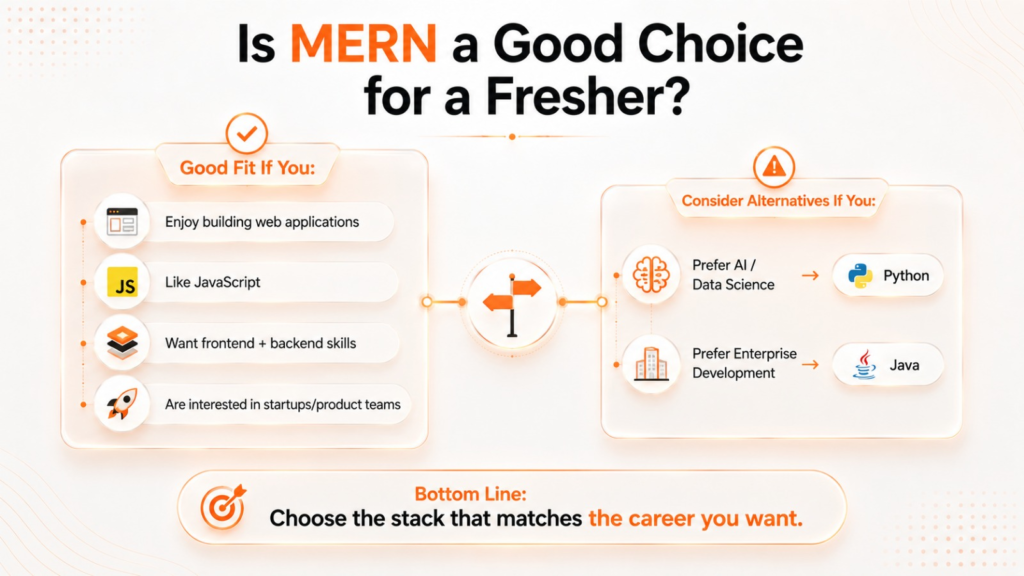
Is MERN Stack Good for Freshers in India?
Yes, for a lot of people it is, especially if web development genuinely interests you and you don’t mind putting real hours into JavaScript.
You get exposure to both frontend and backend, so you’re not boxed into applying for just one kind of role.
It tends to fit well if you:
- Like building things you can actually see in a browser
- Enjoy working in JavaScript
- Want to work on web applications
- Are drawn to startups or product teams
- Want to understand both frontend and backend
- Would rather work in one main language across the whole stack
It’s not automatically the right pick for everyone, though. If data science or AI interests you more, Python is probably the more natural starting point. If enterprise development and Java roles are the goal, Java Full Stack likely fits better. Our guide on MERN Stack vs Python Full Stack in Pune goes deeper into that comparison if you want to weigh it properly.
Is MERN Hard to Learn?
It might be overwhelming at first. You’re dealing with multiple tools and trying to make sense of how they interact with one another.
Try not to overwhelm yourself right off the bat. Learn the basics of JavaScript. Learn React next. Node.js and Express for the backend. And then finally MongoDB, integrated with your application. Do full projects. If you want this broken down month by month, follow our 6-month plan to learn full stack development from scratch.
Those first weeks where you’re just confused? It happens to everyone. And in truth, the purpose isn’t to just memorize syntax, but to understand how each layer works and how data gets from point A to B.
MERN Stack Course in Pimpri Chinchwad, Pune
Looking for a structured MERN course in Pune? Teknowell’s MERN/MEAN Stack Development course in Pimpri Chinchwad is worth checking out.
What’s currently included:
- Duration: 3 months
- Technologies: MongoDB, Express.js, React.js, Node.js, JavaScript, REST APIs, and Angular
- Training format: Online and classroom
- Batch options: Weekday and weekend
- Practical work: Live, project-based
There’s also placement assistance, resume prep, mock interviews, portfolio guidance, and interview prep included.
One thing worth being upfront about: placement assistance is not a job guarantee. Your outcome still comes down to your own skills, your projects, how interviews go, and what’s actually open when you apply.
Sitting in on a free demo class is a low-pressure way to see the teaching style before you commit to anything.
Book a free demo class at Teknowell
What Jobs Can You Actually Get After Learning MERN?
Quite a few entry-level roles open up, including:
- MERN Stack Developer
- Full Stack JavaScript Developer
- React Developer
- Frontend Developer
- Node.js Developer
- Junior Full Stack Developer
- Web Developer
The title varies wildly from one company to the next. A “React Developer” posting might be almost entirely frontend. A “Full Stack Developer” posting might expect React, Node.js, APIs, and database work all at once. Read the actual job description instead of judging by the title alone. It’ll save you some confusion later.
Prepping for interviews? Our guide to IT interview questions for freshers in Pune is worth a look.
MERN Stack vs Other Full Stack Options
MERN is one road into full stack development. Not the only one.
| Stack | Main frontend | Main backend language | Often suits |
| MERN | React | JavaScript/Node.js | Modern web apps, startups, product teams |
| MEAN | Angular | JavaScript/Node.js | Structured, Angular-based applications |
| Python Full Stack | React/Angular or other frontend | Python | Web development, Python-focused careers |
| Java Full Stack | React/Angular or other frontend | Java | Enterprise and large-scale application environments |
Which one fits you depends on your goals, what skills you already have, and the kind of companies you’re aiming for. Still deciding? Our MERN vs Python Full Stack in Pune comparison digs into this before you commit to a course.
The MERN Stack, In One Breath
Four technologies. One JavaScript ecosystem. A practical path from database to user interface.
MongoDB stores the data. Express.js handles backend routes and APIs. React builds the interface. Node.js runs the server-side JavaScript. That’s the whole stack.
It’s not the only road into full stack development, and it won’t hand you a job by itself. But if you want to build real applications and work in JavaScript across both ends of the stack, it’s a genuinely solid one to learn.
Already know MERN is the direction you want? Explore Teknowell’s full stack development courses, or just book a free demo class before deciding.