

Completing a MERN course is like accomplishing a huge milestone. But then, when you check LinkedIn or Naukri for MERN Stack jobs in Pune for freshers, all of a sudden your confidence takes a slight dip. Most of the positions appear to require experience, internships, project work, or skill sets that are never mentioned anywhere in the syllabus of your course.
This doesn’t mean that you are not job-ready. Rather, this indicates that you have come to the second stage of learning where just knowledge of React, Node.js, Express, and MongoDB is no longer sufficient. At this stage, you have to be able to communicate your knowledge in such a way that it becomes easy for the recruiter to verify and evaluate it in an interview.
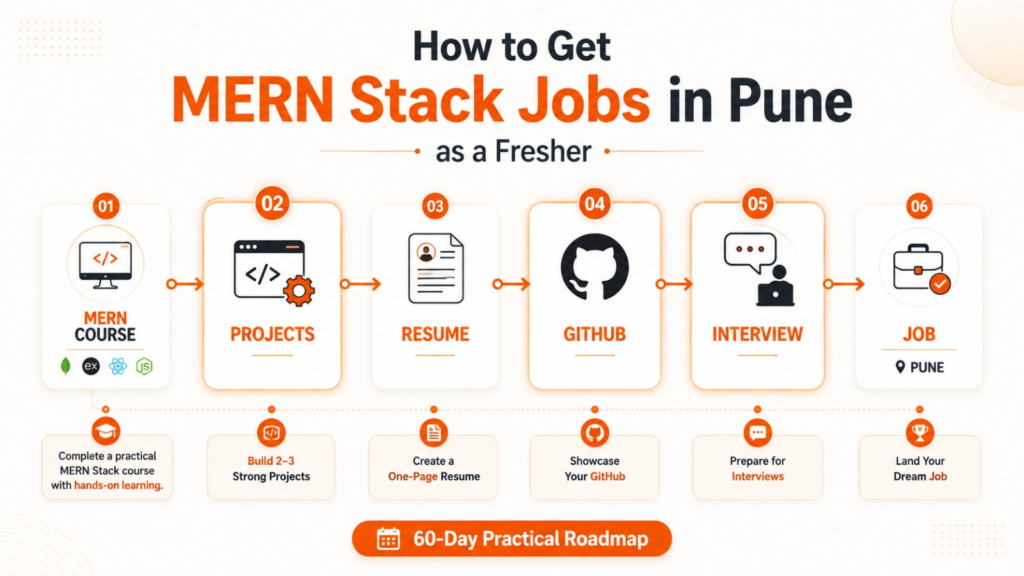
The upside is that this process is more practical than ever before. All you need is a small portfolio showcasing your skills in building applications, a resume reflecting your skills correctly, a GitHub profile that is not neglected, and adequate interview practice to demonstrate the skills. An ideal way of approaching all of this within 60 days would do well. Not sure MERN is the right stack for you? Compare it with Python in our MERN stack vs Python full stack guide.
How do I find MERN Stack jobs in Pune for freshers?
- Work on 2 to 3 major MERN projects, not small tutorial projects.
- Craft a one-page resume emphasizing JavaScript, React, Node.js, MongoDB, APIs, and projects.
- Keep your GitHub profile clean, public, and professional, showing off your best projects.
- Get ready to answer questions about JavaScript, React, Node.js, MongoDB, REST API, and projects.
- Stick to a 60-day plan involving portfolio building, job applications, and interviews.
As far as salaries are concerned, according to Glassdoor, the MERN Stack Developer base pay in Pune at present is between ₹4 lakh and ₹8 lakh per annum, with the average base pay being ₹4 lakh.
What Do MERN Stack Jobs in Pune for Freshers Actually Require?
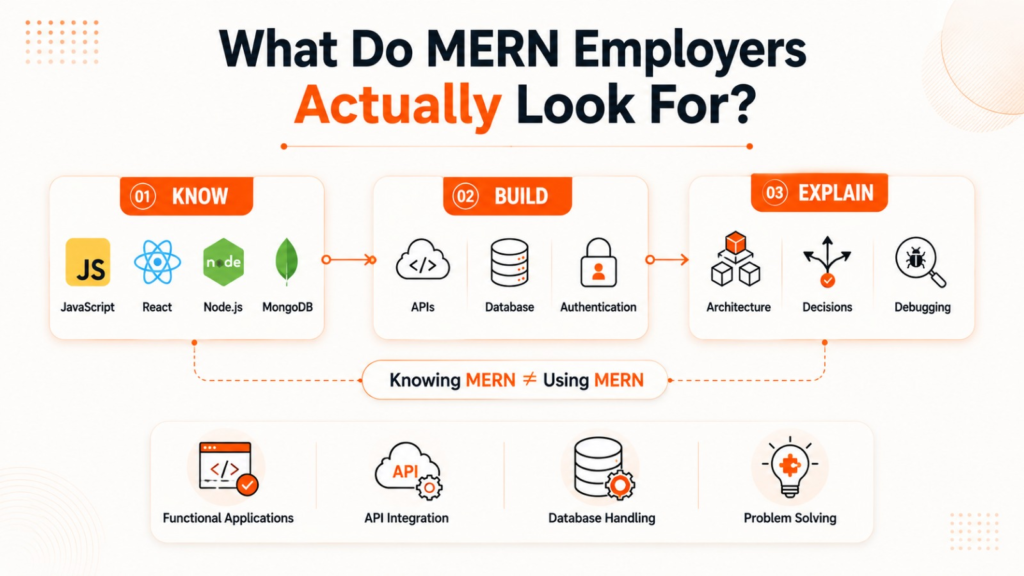
The fresh recruiter checking your MERN developer resume would expect something different from the one having some experience. But still, he would want you to say something more than “I know React and Node.js”. You should be able to develop a functional application, connect the front-end and API, handle the database and errors, and know why you chose that or another way to write the code.
The point is that freshers usually get ready for interviews by studying technologies. They write JavaScript, React, Node.js, Express, MongoDB, Git, and REST API in their resume, but when it comes to explaining how the authentication works in their project, they cannot provide a proper answer. Knowing a tech stack and using it are two different matters.
In the case of a fresher, the basic requirement is quite simple. You must have a good working knowledge of modern JavaScript, React.js, Node.js, Express.js, MongoDB, REST API, and Git/GitHub. In the current MERN/MEAN program being followed at Teknowell, MongoDB, Express.js, React.js/AngularJS, Node.js, JavaScript, and REST APIs are some of the technologies included in the curriculum.
Pune has a very diverse range of employers. Therefore, you might not find “MERN Developer” written on many job postings. Instead, you would come across jobs as React Developer, Node.js Developer, Full Stack Developer, JavaScript Developer, and even Software Developer. The little variation in your search parameters can make a world of difference to your job search process.
How to Build a MERN Portfolio That Looks Job-Ready
Here is where many freshers lose time. They build five or six projects, usually by following tutorials, add them all to their resume, and assume the number of projects will impress recruiters.
Usually, it does not.
A portfolio is useful when each project gives the recruiter evidence of a particular skill. A basic to-do application proves that you can follow instructions and work with simple state. A complete application with authentication, database operations, API integration, validation, error handling, and deployment tells a much stronger story because there is more for you to explain.
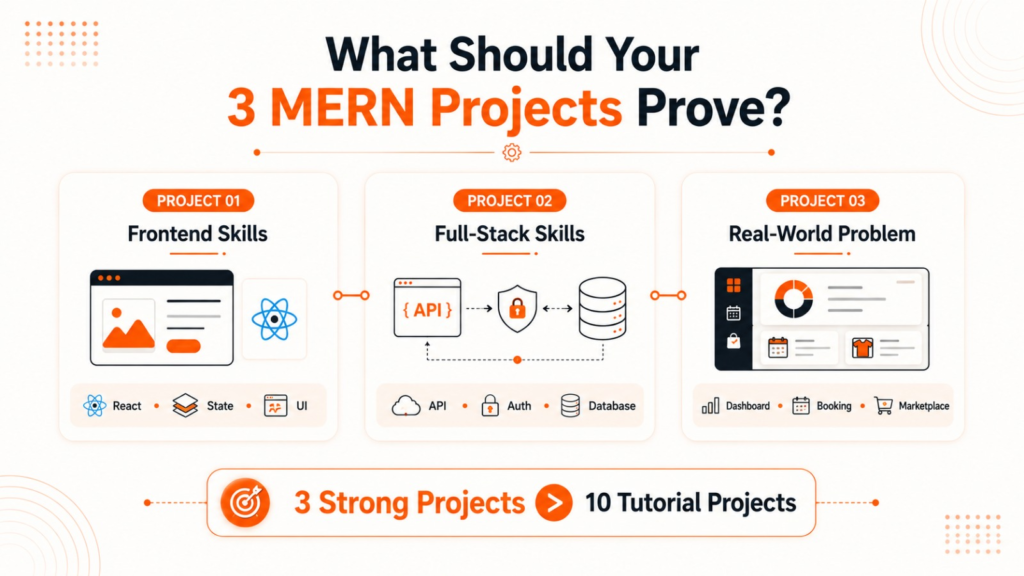
For a MERN portfolio for freshers in India, two or three serious projects are enough to start with. You do not need ten applications sitting on GitHub. You need a few projects that you genuinely understand from the first component to the database query.
What should your 3 projects prove?
Think about your projects as three interview conversations rather than three items on a checklist.
Your first project could demonstrate strong frontend work. Your second should show complete full-stack development, including the backend, database, and authentication. A third can solve a more realistic business problem, such as an admin dashboard, booking system, learning platform, inventory application or service marketplace.
The project itself does not have to be revolutionary. Recruiters are not expecting a fresher to invent the next Amazon. They are looking for signs that you can take a problem, break it into smaller pieces, build the application, and fix things when they stop working.
A useful project should ideally include features such as:
- User authentication, protected routes and sensible handling of login or session-related errors.
- REST APIs that connect the React frontend with a Node.js and Express.js backend.
- MongoDB operations that demonstrate creating, reading, updating and deleting meaningful application data.
- Form validation, error handling, responsive design, and a deployed version that someone can actually open.
- A README explaining the problem, features, technology choices, setup process, and important implementation decisions.
That last part is often ignored. A recruiter should not have to open five folders and read your source code just to figure out what your project does.
If your GitHub currently contains several unfinished tutorial repositories, it is better to archive or clean up the weak ones and make your best projects easy to find. A smaller portfolio that you can confidently defend in an interview is much stronger than a large portfolio you barely remember building.
For a deeper step-by-step approach, you can read Teknowell’s guide on how to build a GitHub portfolio that gets you hired after you finish this section.
What Should a Fresher MERN Developer Resume Look Like?
The only reason your resume will be helpful at this stage is to help the recruiter comprehend your skills.
It should not be made in such a way that it looks like your autobiography. There is no need to write an extensive history of how enthusiastic you are regarding the technology. A fresher resume for a MERN developer has to emphasize your technical skills, best project(s), education, and experience.
The resume can be written in a single page. It should begin with your contact details, LinkedIn and GitHub, followed by a technical summary, your skills, projects, education, and experience.
The project descriptions need to have your undivided attention, as you may not have any professional development experience up till now. You can’t simply mention something like “Created an e-commerce website using MERN Stack.” Instead, try to tell what you built. Mention anything from authentication, product API’s, search and filtering capabilities, shopping cart, payment integration, etc. that you have actually created.
For instance, “Developed a full-stack e-commerce application using React, Node.js, Express, and MongoDB with JWT Authentication, Filtering of products, and Role-based Access” would definitely tell the recruiter more than “Participated in the e-commerce project.”
There is a slight change you would make in your resume according to the requirements of different companies. For instance, if a job description talks extensively about React and TypeScript, then it would be easier for you to find those technologies in your resume as you actually know those.
If your resume needs a complete rebuild, Teknowell’s guide to creating an ATS-friendly resume for fresher IT jobs is a useful next step.
How to Build a GitHub Profile That Recruiters Can Understand
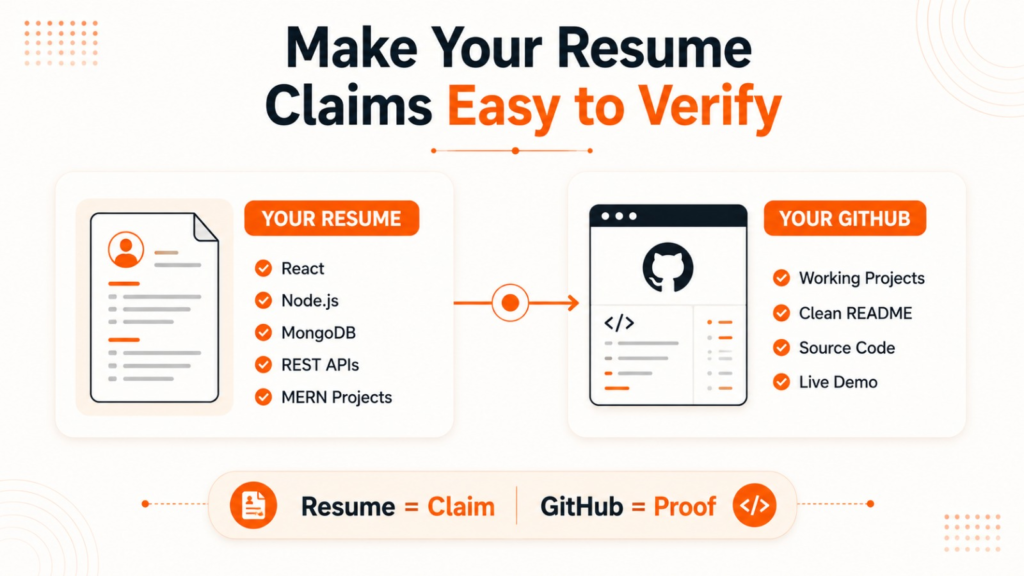
Think of your GitHub profile as the place where your resume claims can be checked.
You have written “React developer” on your resume. GitHub gives the recruiter a chance to see whether you have actually built React applications. You have mentioned REST APIs. Your repositories should give them something concrete to inspect.
GitHub itself recommends using your profile to showcase your skills and projects during a job search. Its official guidance suggests creating a professional bio, adding a profile README, showcasing strong projects, and improving the repositories you want hiring managers to see.
Your profile does not need to look like a developer influencer’s page. It just needs to be organised. Your name should be clear, your bio should say what kind of developer you are, and your strongest repositories should be easy to find.
What should each MERN repository contain?
Start with a useful README. Give the project a short description, explain the main features, mention the technology stack, and include setup instructions. Add screenshots where they genuinely help, along with the live demo if the application is deployed.
Then look at the code itself. Repository names such as project-final-final2 do not help anyone. Neither does a repository filled with dozens of meaningless commits, unused files, and commented-out code from an old tutorial.
GitHub recommends pinning 3 to 5 projects that are relevant to the type of work you want, and it specifically advises making projects easy for hiring managers to understand quickly.
You do not have to pin five projects just because GitHub says you can. For a fresher with three genuinely good MERN applications, three strong repositories are enough. The goal is not to make the profile look busy. The goal is to make the right work impossible to miss.
What Do Pune Startups and Product Companies Ask in MERN Interviews?
A startup interview can feel very different from an exam.
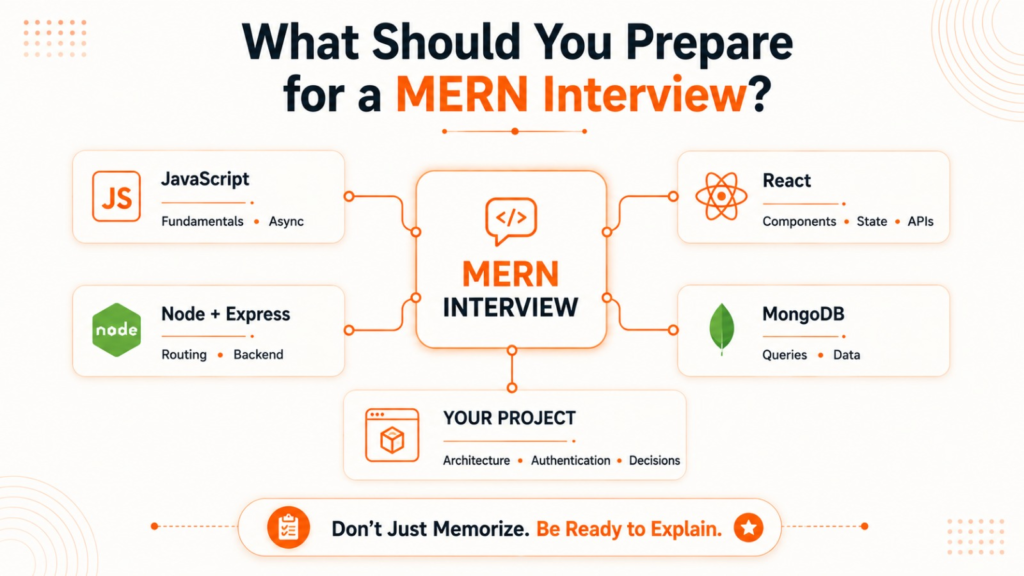
You might begin with a JavaScript question, move into React, then suddenly hear, “Show me how you handled authentication in your project.” That is why memorising 100 MERN interview questions is not a great preparation strategy by itself.
For freshers, the technical conversation commonly moves around JavaScript fundamentals, React, Node.js, Express, MongoDB, REST APIs, Git, and the projects on the resume. You may also face debugging questions or small coding problems where the interviewer is more interested in how you think than whether you remember a particular syntax pattern.
Project questions deserve special attention. If you built an application with JWT authentication, be ready to explain where the token is created, where it is stored, how protected routes work, and what happens when the token is invalid. If you used MongoDB, understand the collections and the queries you wrote. If you deployed the application, know what you deployed and where.
Pune’s hiring market also gives you a reason to search beyond one job title. Current job listings include React, Node.js and MERN-related roles across Pune, while some positions ask for additional skills such as TypeScript, testing, accessibility, security or cloud exposure.
The locations matter too. If you are searching only for “MERN jobs near me,” you may miss relevant roles in Hinjewadi, Kharadi, Baner, Magarpatta, Talawade and Pimpri Chinchwad. Search by technology and role, then filter by location rather than assuming every employer will use the exact phrase “MERN Stack Developer. “
Need Help Preparing for MERN Interviews?
If you want help with projects, resume preparation, and mock interviews before you start applying, contact Teknowell and speak with the team about your MERN job preparation.
What Salary Can You Expect From MERN Stack Jobs in Pune?
Salary discussions can get confusing because websites often mix freshers with developers who already have one, three or five years of experience.
Glassdoor’s current Pune data shows a ₹4 lakh to ₹8 lakh per year base-pay range, with an average base pay of ₹4 lakh for MERN Stack Developers. Recent entries on the same page include a Pune MERN developer with 1 to 3 years of experience reporting ₹8 lakh to ₹9 lakh, which is another reason not to treat the overall market figure as a fresher guarantee.
For a fresher, the useful takeaway is not “I will get ₹4 lakh.” It is that salary can vary considerably depending on the company, technical ability, interview performance, internship exposure, and portfolio quality. Market data gives you a reference point, but your first offer is still an individual outcome.
| Experience | Pune market context | What can influence the offer |
| Fresher, 0 to 1 year | Often below or around broader entry-level market benchmarks | Projects, fundamentals, communication, and interview performance |
| 1 to 3 years | Market data can show a wider range as production experience increases | Job changes, product experience, and greater technical skills |
| 3+ year | Compensation varies substantially by company and specialisation | Architecture, cloud, system design, and leadership skills |
The same candidate can receive very different offers from two companies. A small product company may care heavily about React and Node.js skills, while another employer may place more weight on JavaScript fundamentals, testing or backend depth.
So do not choose your first job entirely around a salary number. Your first year should also build experience that makes your second job easier to get.
If you can build the projects but still struggle to explain them in interviews, the next step is practice, not another certificate. Teknowell’s Full Stack programme includes practical training, live projects, resume building, mock interviews and placement assistance, giving learners a structured way to work on the gap between learning the stack and facing actual hiring rounds.
MERN Stack Job Search in Pune: Where Should Freshers Actually Apply?
Applying to 100 jobs appears productive. It is often the case that it may be a means of avoiding the improvement of your resume.
You should start by making a list of positions that fit you according to your existing skill set. The keywords that you need to look for include MERN Developer, React Developer, Node.js Developer, Full Stack Developer, React and Node Developer, JavaScript Developer, and Software Developer.
Your location search needs to be equally flexible. Search for Hinjewadi and Wakad for the western part of Pune. Consider searching for Kharadi, Viman Nagar, and Magarpatta for the eastern part of Pune. Pimpri Chinchwad and Talawade could also come in handy for entry-level technology positions.
However, do not apply blindly in all cases. Look at the opening paragraphs of the job description and think about your abilities to fulfill most of the duties mentioned. If a job requires knowledge of React, Node.js, MongoDB, and REST API, but you have already built something similar, and there is only one skill mentioned that you are yet learning, then go ahead and apply for the job.
Keep a simple application tracker. Record the company, role, date applied, job link, technologies requested, and interview status. After 20 or 30 applications, patterns start appearing. If nobody is calling, your resume or project presentation may need work. If you are getting interviews but failing technical rounds, your preparation needs attention.
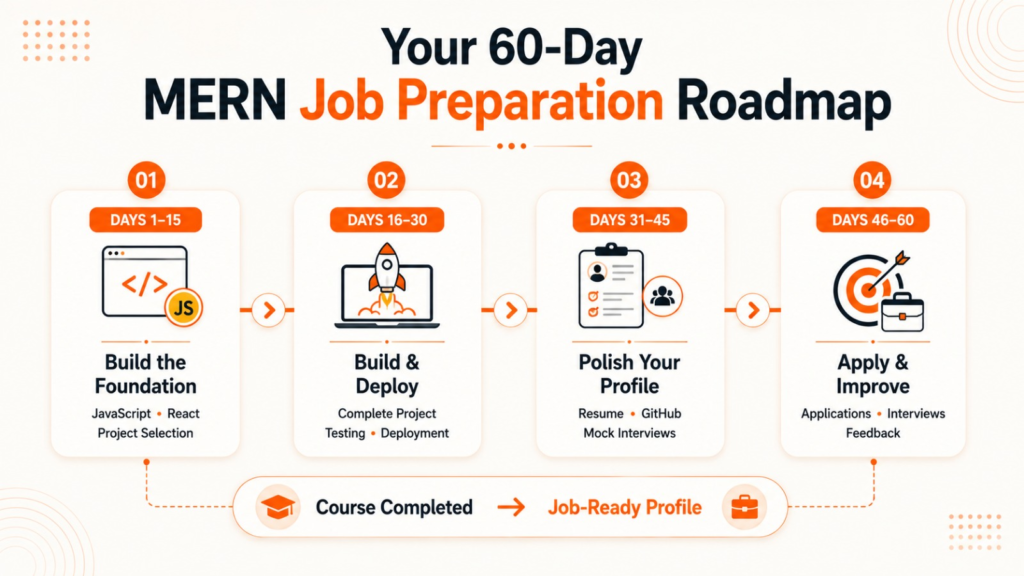
Your 60-Day Roadmap From MERN Course Completion to First Offer
Sixty days is not a promise that you will have a job by day 60. That would be dishonest. It is a practical window for getting your portfolio, resume, GitHub profile, and interview preparation into a much stronger state while you start applying.
Days 1 to 15: Fix the foundation and choose your projects
Do not start by building a new project immediately. First, revisit the areas where you cannot explain what you are doing without looking at a tutorial. JavaScript fundamentals, asynchronous programming, React state, API calls, and backend routing are common places where gaps become obvious.
Then choose two or three projects that you can realistically finish and explain. If you already have a decent project, improve it instead of throwing it away because it is not new.
By the end of these two weeks, you should know exactly which projects will appear on your resume and which technologies each project demonstrates.
Days 16 to 30: Build and deploy
This is where you stop polishing ideas and start finishing applications.
Complete the strongest project first. Add the features that make it feel like an actual application, then test the flows yourself. Try logging in with incorrect credentials. Submit empty forms. Break an API request. Delete something you should not be able to delete. These small tests expose weaknesses that screenshots hide.
Get at least one project deployed. A recruiter being able to open your application and use it is much more convincing than a folder of screenshots.
Days 31 to 45: Resume, GitHub and interview preparation
Your resume should now reflect finished work rather than planned projects. Rewrite your project bullets around what you actually implemented and remove technologies you cannot confidently discuss.
Clean your GitHub profile at the same time. Pin the strongest repositories, improve the READMEs, and make sure the links on your resume actually work.
Then start mock interviews. Practise answering questions out loud because reading an answer and explaining an answer are completely different skills. If you cannot explain why you chose a particular approach in your project, that is exactly the gap you should fix.
Days 46 to 60: Apply, interview and improve
Start applying consistently rather than waiting until your portfolio feels perfect. Apply to roles where your skills are reasonably close to the requirements and adjust your resume when a particular type of role repeatedly appears in your search.
At this point, interview feedback becomes extremely valuable. If you keep getting stuck on JavaScript questions, spend two days fixing JavaScript. If recruiters ask about deployment and you cannot explain it, learn that part properly. Your job search should tell you what to improve next.
That is a much better cycle than spending two months watching more tutorials and only starting applications after you feel “fully ready.”
What Should You Do After Completing a MERN Stack Course?
You do not necessarily need another course.
If you have completed MERN training, the next question should be whether you can prove what you learned. Can someone open your GitHub and understand your projects? Can your resume explain your technical work in one page? Can you walk through your application’s architecture without opening a tutorial? Can you solve basic JavaScript and React problems without searching for every answer?
If the answer to those questions is mostly yes, start applying while continuing to improve. Waiting until you know every possible React or Node.js topic will only delay the process because there will always be another technology to learn.
If the answer is no, structured practice can make sense. Teknowell currently lists its MERN/MEAN Stack Development course in Pune as a 3-month programme covering MongoDB, Express.js, React.js or AngularJS, Node.js, JavaScript and REST APIs. The course page also highlights practical application development, real project implementation, live projects, resume building, mock interviews, and placement assistance.
The useful part is not the certificate at the end. It is whether the training helps you reach the point where you can sit across from an interviewer and confidently explain the work sitting on your resume.
Finishing a course is only the halfway point. To get MERN Stack jobs in Pune for freshers, you need to show employers that you can build, explain, debug, and improve real applications, then keep applying while you strengthen those skills.
If you want structured project work, resume guidance, mock interviews, and placement assistance while preparing for the market, you can explore Teknowell’s Full Stack Development course or book a free demo.