
So you have already heard about TCS NQT and InfyTQ. Maybe you have even started preparing for one of them. But here is something a lot of freshers miss: Wipro and Cognizant are running two of the biggest fresher hiring programmes in India right now, and most students are not preparing specifically for either one.
Wipro is targeting 7,500 to 8,000 freshers in FY26 through its Elite NTH programme. Cognizant is targeting 25,000 graduates globally in its FY26 to 27 cycle through the GenC programme. Both are open to engineering freshers from any branch. Both test skills that overlap significantly with each other and with TCS NQT prep. And both have a premium salary track that most students do not even know exists because nobody told them to aim for it.
This guide covers everything you need to know about both exams: the actual pattern, what each section tests, the salary bands, a four-week preparation plan, and the mistakes that quietly cost freshers their shortlist.
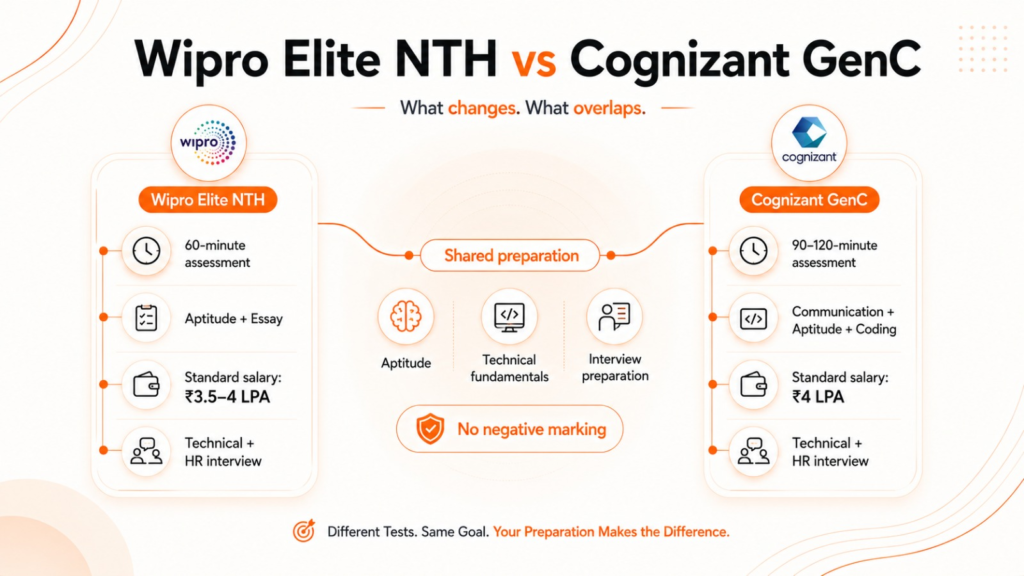
Wipro Elite NTH vs Cognizant GenC: Quick Comparison
| Factor | Wipro Elite NTH | Cognizant GenC |
| Test duration | 60 minutes | 90 to 120 minutes |
| Sections | Aptitude + Essay Writing | Communication + Aptitude + Coding (GenC Next) |
| Negative marking | None | None |
| Standard salary | ₹3.5 to 4 LPA | ₹4 LPA |
| Premium track salary | CoE track (undisclosed premium) | ₹6.5 LPA (GenC Next |
| Assessment platform | AMCAT/SHL | AMCAT |
| Rounds after online test | Technical + HR Interview | Technical + HR Interview |
Wipro Elite NTH 2026: Eligibility, Salary and Exam Overview
A lot of freshers call it the Wipro NTH; some call it the NLTH, some call it Wipro Elite. These are all the same programme. The full name is the National Level Talent Hunt, and it is how Wipro hires engineering freshers through its off-campus and drive-based recruitment process.
Before getting into the exam pattern, there is something about Wipro’s hiring structure that most students do not know, and it matters for salary.
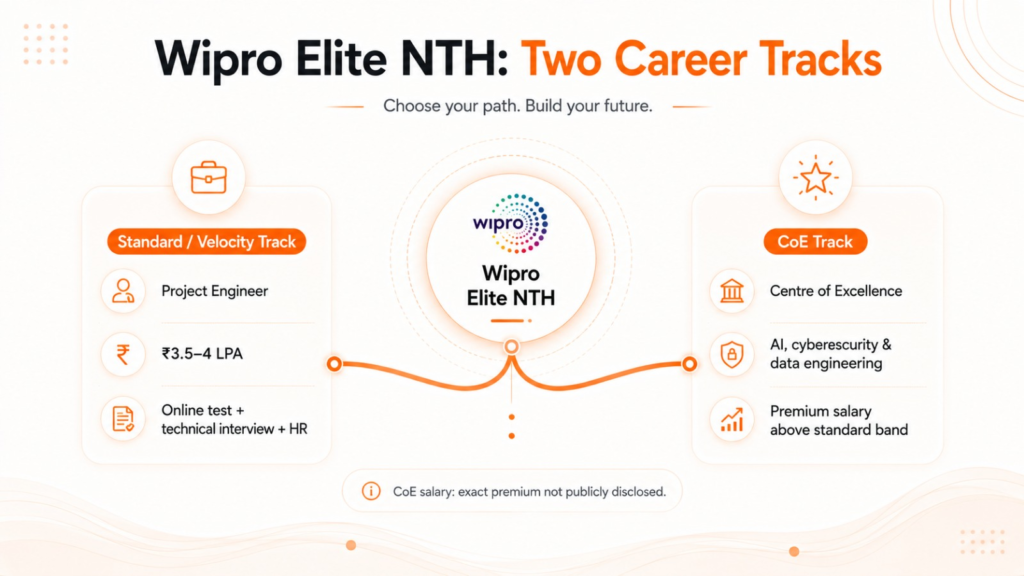
Wipro Elite NTH Salary 2026: Standard vs CoE Track
When people say “I am preparing for Wipro,” they almost always mean the Standard track, which is also called the Velocity track. You clear the NTH online test, go through a technical interview, clear an HR interview, and join as a Project Engineer at ₹3.5 to 4 LPA. This is Wipro’s main fresher intake route.
But Wipro also runs a CoE (Centre of Excellence) track. Wipro has partnered with 50 universities in India to co-develop curriculum specifically in AI, cybersecurity, and data engineering. Students from those partner institutions go through a differentiated interview process and receive a pay premium above the standard band. Wipro has not publicly disclosed the exact CoE salary, but the CHRO confirmed at Q3 FY26 earnings that premiums are paid to candidates with prior client or project experience in AI.
If your college has a Wipro CoE partnership, that is worth knowing about specifically before you apply.
Wipro Elite NTH Eligibility Criteria 2026
Wipro requires a minimum of 60% across your 10th, 12th, and degree, but not as an average. Each level has to independently clear 60%. So if you scored 72% in 10th, 57% in 12th, and 80% in your degree, you do not qualify. The 12th board percentage is below the cutoff, and that alone rules you out.
This trips up a surprising number of applicants. Check your individual percentage at each level before applying, not the combined average.
Also, no active backlogs at the time of application. Cleared backlogs with mark sheets are allowed. Any uncleared backlog at the time of joining leads to offer cancellation.
Wipro Elite NTH exam pattern 2026
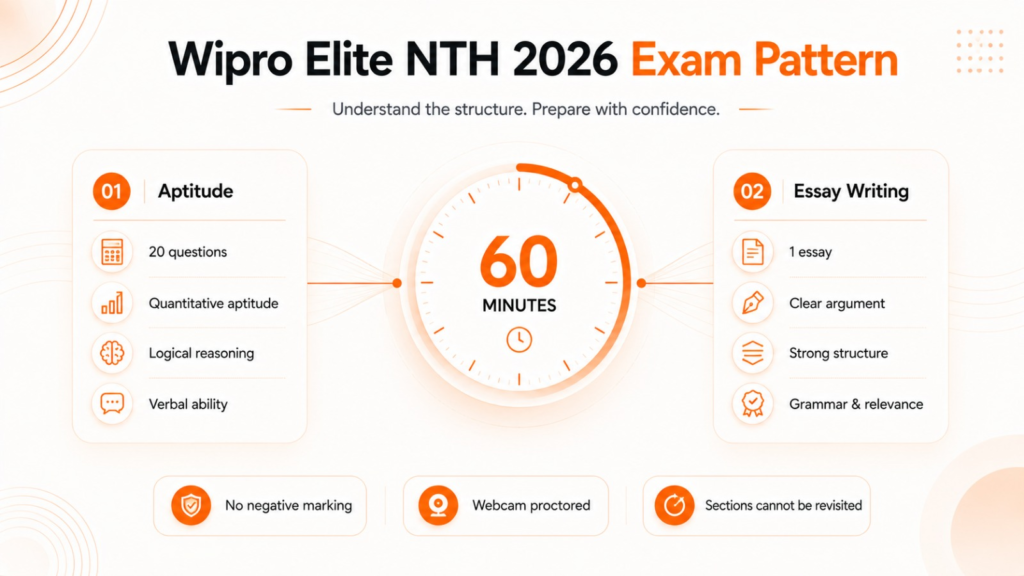
| Section | Questions | Duration | Negative Marking |
| Aptitude | 20 | Part of 60 minutes | No |
| Essay Writing | 1 | Part of 60 minutes | No |
| Total | 21 tasks | 60 minutes | No |
The online test is 60 minutes, administered through AMCAT or SHL India, and webcam-proctored. There are two sections: Aptitude and Essay Writing. No negative marking. Once you move to the next section, you cannot go back to the previous one. Plan your time accordingly before the test starts.
For the full official syllabus breakdown and FY26 eligibility details, the FacePrep Wipro NLTH 2026 guide is one of the most current and accurate resources available.
Option 1: Wipro Elite NTH Aptitude Section: Syllabus and Preparation
The aptitude section covers three sub-areas, and all 20 questions are drawn from them combined.
Quantitative Aptitude: Percentages, profit and loss, time and work, time-speed-distance, ratios and proportions, averages, simple and compound interest, permutations and combinations, probability. Wipro drives lean toward two-step word problems in this area. Algebra-heavy topics appear less frequently than proportion and percentage problems.
Logical Reasoning: Number series, letter series, coding-decoding, blood relations, seating arrangements, syllogisms, direction sense, clocks and calendars. Series-continuation and coding-decoding show up consistently across Wipro drives. Practising these two types specifically gives better returns per hour than spreading across the full list.
Verbal Ability: Reading comprehension passages (150 to 250 words typically), sentence correction and error detection, fill in the blanks, synonyms and antonyms, para-jumbles.
No negative marking means no reason to leave any question blank. Attempt every question.
Section 2: Wipro Elite NTH Essay Writing: Tips and Format
One topic is given, and you write a response within the time remaining in the window. Wipro does not publish topics in advance. Past cycles have covered technology trends, workplace ethics, and open-ended opinion prompts on current events.
What the section actually evaluates: clarity of argument, paragraph structure, grammar accuracy, and relevance to the prompt. The assessment runs through AMCAT’s written-English scoring engine, which weighs structure and grammar over vocabulary range.
Aim for 200 to 250 words. A focused three-paragraph structure, with your position clearly stated in the opening, two or three supporting points in the body, a tight conclusion consistently outperforms longer rambling attempts. More words with less structure score lower than fewer words with a clear argument.
How to practice: Write two timed essays per week in the month before your drive. Give yourself 10 minutes each. Pick current-affairs topics, enforce the time limit, and review the output for sentence-level grammar. Reading newspaper editorials from The Hindu or Business Standard regularly builds the sentence construction reflex more efficiently than vocabulary drills.
Wipro Elite NTH Technical and HR Interview
Clearing the NTH moves you to interviews. The technical round is 30 to 45 minutes with a Wipro engineer. Expect OOP concepts including inheritance, polymorphism, and encapsulation with code examples, data structures like linked lists, stacks, queues, and trees, basic algorithms, and your final year or training project in depth. Know every technical decision in your project. Why did you use MySQL and not MongoDB? Why that framework? If you cannot answer the “why” behind every major decision in your project, that is the preparation gap to fix before the interview.
HR round is 15 to 20 minutes. Standard questions cover your background, communication, willingness to relocate, and the service bond. Wipro requires a 12-month service agreement with a bond amount that varies by batch. Confirm you are comfortable with this before the interview. Being unprepared for that question specifically reads poorly.
For a full round-by-round technical interview breakdown, the software developer interview preparation guide covers what IT services interviewers actually look for and how to prepare for project discussions specifically.
Cognizant GenC 2026: Eligibility, Tracks and Salary
GenC stands for Generation Cognizant. It is Cognizant’s flagship fresher hiring programme, and in FY26 to 27, Cognizant is planning to bring in around 25,000 graduates globally through it. The India cycle covers engineering freshers from 2024 to 2026 graduating batches.
Here is the part most students do not know.
GenC vs GenC Next vs GenC Elevate: salary difference
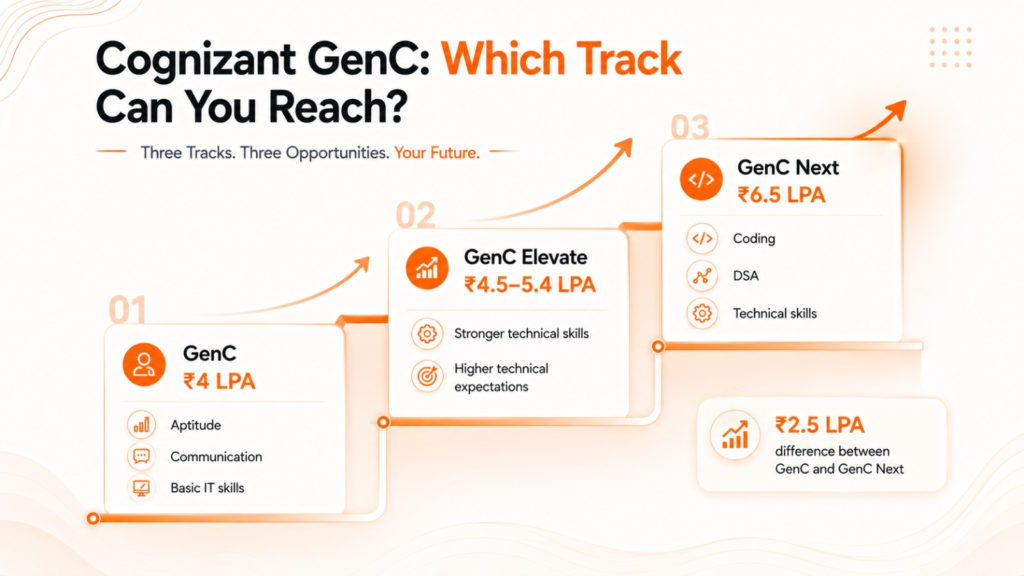
Cognizant runs three tracks, and which one you get depends on how you perform in the assessment, not which one you “apply” for. The three tracks are:
| Track | Typical Salary | Main Focus |
| GenC | ₹4 LPA | Aptitude, communication, and basic IT |
| GenC Elevate | ₹4.5–5.4 LPA | Stronger technical skills |
| GenC Next | ₹6.5 LPA | Coding, DSA, and technical skills |
GenC is the standard track. You join as a Programmer Analyst Trainee at ₹4 LPA. No heavy coding required. The focus is aptitude, verbal, and basic IT skills.
GenC Elevate sits in the middle at ₹4.5 to 5.4 LPA. Higher than GenC, lower than GenC Next.
GenC Next is the developer and technical track. You join as a Programmer Analyst at ₹6.5 LPA. This requires strong coding and DSA skills. The coding section is mandatory and scored if you are targeting this track.
The ₹2.5 LPA difference between GenC and GenC Next is ₹20,833 per month. That is not a small gap. If you can solve basic LeetCode problems, always aim for GenC Next from the start of your preparation.
For the official programme structure and registration details, Cognizant’s GenC programme page has the current information.
Cognizant GenC Eligibility Criteria 2026
B.E./B.Tech/MCA from 2024 to 2026 graduating batches. Minimum 60% marks with no active backlogs. Three-year degree graduates (BCA, BSc, BCom, BBA, BVoc, BMS) are eligible for non-technical GenC tracks. Registration happens through the Superset platform using either a link your college shares for a campus drive or through an open registration link. Registration is free. Registration windows open at different times, so keep an eye on our placement exam calendar for 2026-27.
Cognizant GenC exam pattern 2026
| Round | What It Tests | Applies |
| Communication Assessment | Speaking, listening, reading, writing, and grammar | GenC |
| Aptitude | Quantitative, logical, and verbal ability | GenC |
| Coding | Programming and problem-solving | GenC Next |
| Technical + HR Interview | Technical knowledge and communication | Shortlisted candidates |
The full GenC selection process has four rounds: Communication Assessment, Aptitude, Coding (for GenC Next), and then Technical plus HR interviews.
Round 1: Cognizant GenC Communication Assessment
This is the section that eliminates a larger number of candidates than the aptitude test does. It is an elimination round. Not a tie-breaker, not a supplementary section, but a full elimination gate. Candidates who do not clear this round do not reach the aptitude test, regardless of how strong their quantitative or logical skills are.
The assessment has five components: speaking, listening, reading, writing, and grammar. Each is evaluated separately. The speaking component is what surprises most freshers because the other IT hiring programmes they have prepared for do not include it.
How to prepare: Practice reading English newspaper articles and summarising them aloud in 60 to 90 seconds. Do 10 grammar exercises daily. Work on listening comprehension through any structured English listening resource. This is not a section where two days of cramming before the exam works. Three to four weeks of light daily practice is what moves the needle.
Round 2: Cognizant GenC Aptitude Test: Syllabus and Preparation
Same core areas as the Wipro NTH and very similar to TCS NQT Foundation:
Quantitative covers percentages, ratios, profit and loss, time and work, and algebra. Logical Reasoning covers data interpretation, number series, syllogisms, and puzzles. Verbal Ability covers sentence correction, reading comprehension, synonyms and antonyms, and fill in the blanks. No negative marking. Attempt every question.
If you have been preparing for Wipro NTH or TCS NQT aptitude, your preparation transfers directly here. The topics are the same. The difficulty is comparable.
Round 3: Cognizant GenC Coding Section: How to Prepare for GenC Next
DSA problems in Java, Python, or C++. Difficulty sits between LeetCode Easy and Medium. Arrays, strings, basic sorting, and recursion cover the majority of what appears. For GenC Next, this round is mandatory and scored.
One fully solved problem with clean, readable code is generally enough for shortlisting. Attempting both problems and partially solving the second is better than spending the full time on one and not touching the other. Write clean code. Comment your logic. Even partial solutions that compile and pass some test cases count.
Round 4: Cognizant GenC Technical and HR Interview
Very similar structure to Wipro’s interview rounds. OOP, basic DSA, projects, SQL if listed on the resume. HR covers background, motivation, communication, and relocation. The same preparation applies to both companies’ interview rounds.
Wipro Elite NTH vs Cognizant GenC: Which Is Easier to Crack?
The honest answer here is that preparing for both at the same time is genuinely practical because the overlap is so large.
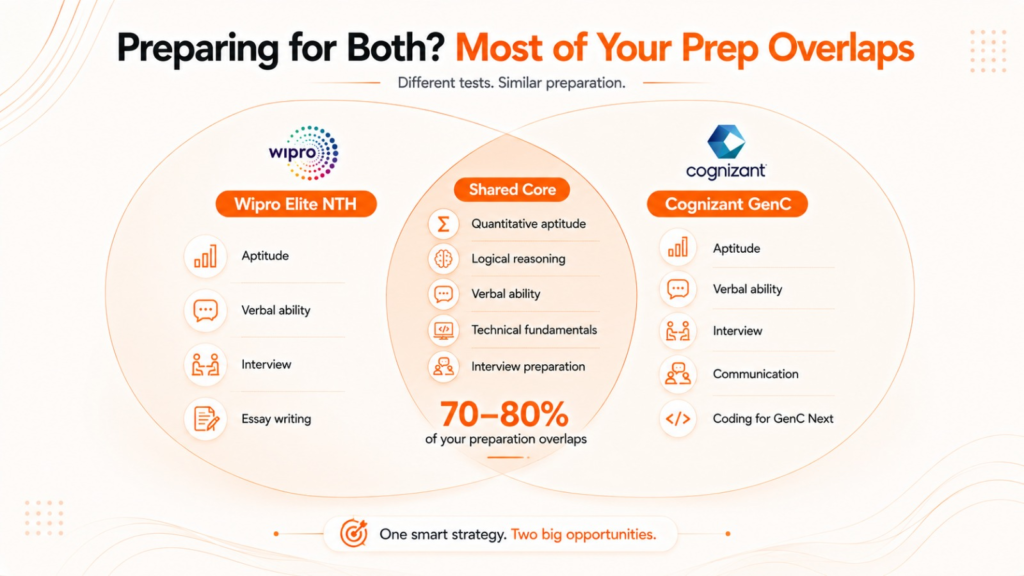
About 70 to 80% of the preparation is shared: quantitative aptitude, logical reasoning, verbal ability, and coding fundamentals all apply to both exams. The areas that differ are Wipro’s essay writing section (which Cognizant does not have) and Cognizant’s communication assessment (which Wipro does not have). If you are preparing for both, the most efficient approach is to build the shared foundation first and then spend one focused week on each of the differentiating sections.
If your Cognizant GenC exam is coming first, treat the communication assessment as the priority because it is the elimination round. Failing there means the aptitude prep does not even get evaluated.
If your Wipro NTH is coming first, treat essay writing as the priority alongside aptitude, because it is the only other section in the 60-minute test.
If you have already prepared for TCS NQT or InfyTQ, your aptitude and coding preparation transfers directly. The TCS NQT preparation guide and the InfyTQ vs TCS NQT comparison both cover the aptitude prep approach in detail; the same strategy applies here.
Wipro Elite NTH and Cognizant GenC: 4-Week Preparation Plan
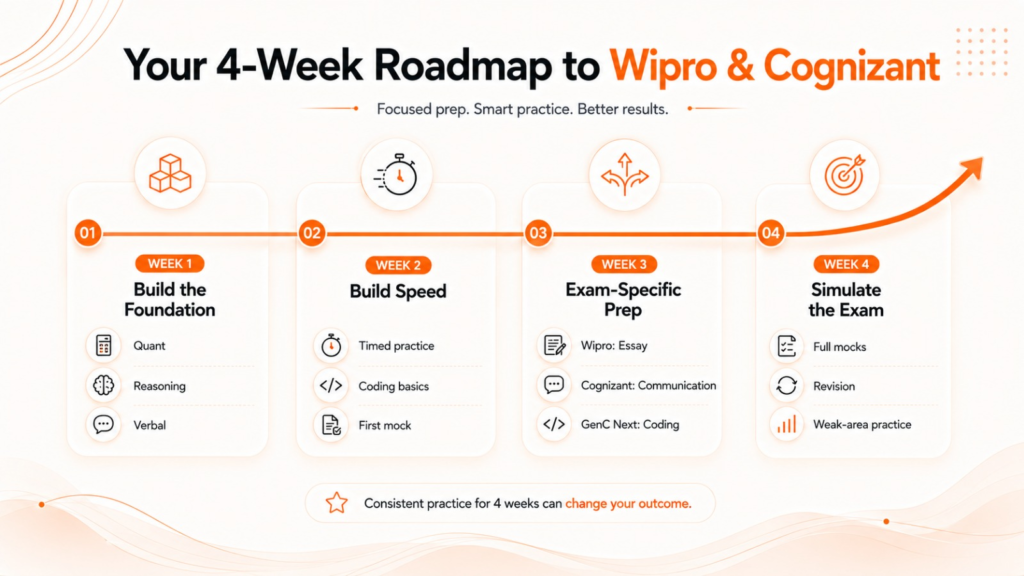
| Week | Main Focus | Wipro | Cognizant |
| Week 1 | Aptitude foundation | Quant + reasoning + verbal | Quant + reasoning + verbal |
| Week 2 | Speed + coding | Aptitude mock + coding basics | Aptitude mock + coding |
| Week 3 | Exam-specific preparation | Essay writing | Communication + coding |
| Week 4 | Full mocks + revision | Wipro mock + revision | GenC mock + revision |
Week 1: Build the aptitude foundation (shared prep for both)
Every day: 20 quantitative questions, 15 logical reasoning questions, 10 verbal questions. All timed. No exceptions.
Quantitative focus this week: percentages, time and work, and time-speed-distance. These appear consistently across both Wipro and Cognizant drives and between them account for a significant portion of the quantitative section. Logical focus: number series and coding-decoding. Verbal focus: reading comprehension and sentence correction.
No essay writing and no coding this week. Build the aptitude base first.
Week 2: Go deeper and run your first mock
Move to the next tier of topics. Quantitative: profit and loss, probability, and data interpretation. Logical: seating arrangements and syllogisms. Verbal: para-jumbles and error detection. Coding: one LeetCode Easy problem daily in Python or Java.
At the end of Week 2, take one full timed aptitude mock (45 questions, 45 minutes). Review every wrong answer not to memorise the correct answer but to understand why you got it wrong. Pattern recognition mistakes need different fixes than formula application mistakes.
Week 3: Split prep for each exam’s unique sections
This week you add the differentiated preparation on top of the shared base.
For Wipro: Write two timed essays per week. 10 minutes each. Pick opinion-based topics, write your position clearly in the first paragraph, support it in two to three body sentences, close in one sentence. Review your own grammar. Do this even if it feels uncomfortable. The discomfort is where the improvement is.
For Cognizant GenC Next: Increase coding to two LeetCode Easy to Medium problems per week. Time yourself on both to build the stamina for a 90-minute coding session. Focus on arrays, strings, and basic recursion.
For Cognizant communication assessment: Practice speaking aloud for 5 to 10 minutes daily. Read a newspaper article and summarise it aloud. Do 10 grammar exercises daily. Listen to English podcasts or news during commute.
Week 4: Full simulation and final preparation
Run one complete timed mock for each exam. Wipro: 60 minutes, aptitude plus essay, no breaks, webcam on. Cognizant: communication plus aptitude in sequence, timed. Identify the three question types that cost you the most time in each and spend two days specifically on those.
The last two days before each exam are for light revision only. No new topics. Review what you already know and strengthen your confidence in your strongest areas. Sleep well the night before. Verbal ability and the communication sections suffer noticeably from fatigue.
Need Help Preparing for Wipro or Cognizant Placements?
Preparing for aptitude, coding, communication, and technical interviews separately can become difficult, especially when you are also managing college or a technical course.
At Teknowell EduTech, Pimpri Chinchwad, placement-focused training helps freshers prepare for the different stages of IT hiring in one structured program.
Want to see how the placement preparation works before enrolling?
Book a free demo with Teknowell today.
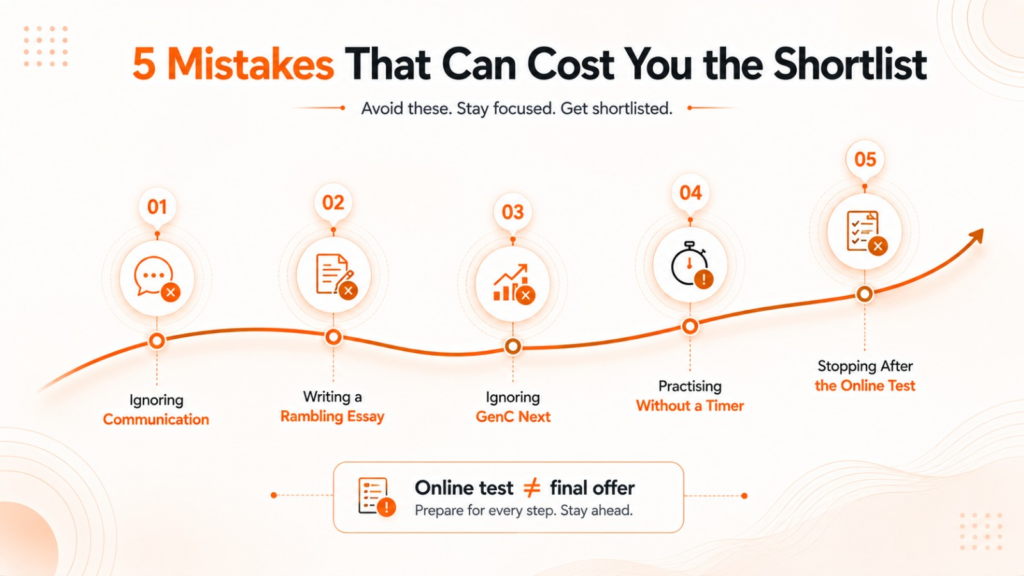
5 Mistakes That Can Cost You a Wipro or Cognizant Shortlist
1. Not preparing specifically for the Cognizant Communication Assessment
This is the most common reason Cognizant GenC applicants do not make it through the first round. The communication assessment eliminates candidates before the aptitude test is even reached. Most freshers spend weeks on quantitative and reasoning practice and almost no time on communication preparation. Reverse that ratio. The aptitude section is predictable and learnable in two weeks. The communication section takes consistent daily practice over three to four weeks to improve meaningfully.
2. Writing a long essay for Wipro without a clear structure.
AMCAT’s scoring engine weighs structure and grammar. A 350-word essay with a rambling argument scores lower than a 220-word essay with a clear position and clean grammar. Freshers who have not practised timed essay writing before the exam often run out of ideas by paragraph two and fill the remaining space with repetition. The fix is straightforward: practise at least six timed essays before the exam date.
3. Not targeting Cognizant GenC Next when the coding ability is there.
The ₹6.5 LPA GenC Next track is not a separate application. It is a performance threshold. Most students who could qualify for it default to the standard GenC track simply because they have not prepared specifically for the coding section. If you can solve LeetCode Easy problems reliably, the extra two to three weeks of coding preparation for GenC Next is worth ₹2.5 LPA per year from your first day of employment.
4. Practising aptitude without a timer.
Both exams run under time pressure. Solving a percentage problem correctly in three minutes when untimed does not mean you can solve it in 90 seconds under exam conditions. Every aptitude practice session from Week 2 onwards should have a timer running. The accuracy is already there for most students who have done basic preparation. What is missing is the speed.
5. Stopping preparation after the online test.
Clearing the Wipro NTH or Cognizant GenC online assessment gets you to the interview. It does not get you the offer. The technical interview is a separate evaluation, and it has caught many freshers off guard. Projects are probed in depth in both Wipro and Cognizant technical rounds. If a project is on the resume and the candidate cannot explain the technical decisions behind it, that is typically the point where the interview goes poorly. Prepare for the interview the same week you prepare for the online test, not after you clear it.
Wipro and Cognizant Technical Interview: What to Expect
The online assessment opens the door. The technical interview determines whether you walk through it.
Both Wipro and Cognizant technical rounds follow a similar structure. OOP concepts, including inheritance, polymorphism, encapsulation, and abstraction, come up in both, specifically with code examples, not just definitions. Data structures at a working level: linked lists, stacks, queues, trees. Basic algorithms: sorting, searching, time complexity awareness. Your final year project or training project in full depth.
The project discussion is where most freshers underperform. Interviewers at both companies ask follow-up questions: why did you choose this database? How did you handle authentication? What would you change if you built it again? These questions have no standard answer. They can only be answered well by candidates who genuinely built the project and understood every decision along the way.
Cognizant’s technical round also includes a communication evaluation embedded in the technical conversation itself, which is why the communication assessment earlier in the process is not a standalone step but a preview of what the interview expects.
For a complete round-by-round guide on what IT services technical interviews cover and how to prepare for each stage, the software developer interview preparation guide covers this in full.
Clear the Exam. Be Ready for the Interview
Clearing the Wipro Elite NTH or the Cognizant GenC online assessment is a real milestone. It puts you in a much smaller candidate pool. But the offer is decided in the interview, and the interview is won by candidates who prepared for it with the same seriousness they brought to the online test.
Both Wipro and Cognizant technical rounds test the same things: OOP with examples, basic DSA, and your project in depth. If your preparation stops at aptitude and coding and does not include at least five mock technical interview sessions before the real one, the online test shortlist converts to an offer at a lower rate than it should.
Start Your Placement Preparation Before the Exam Date
You don’t need to wait until Wipro or Cognizant announces the next assessment to start preparing.
Build your aptitude, coding, communication, and interview skills now so that when the test arrives, you’re prepared to perform rather than starting from zero.
Teknowell EduTech helps freshers in Pimpri Chinchwad prepare for IT placement assessments and interviews through structured training, practice tests, coding preparation and mock interviews.
Ready to see if it’s right for you?
Start preparing before the shortlist, not after it.