

Before enrolling in a software testing course, most people ask the same thing.
Not “what tools will I learn?” Not “how long does the course take?” The real question is simpler than that: is the salary actually worth it?
That is a completely fair thing to ask. Switching careers or learning a new skill takes months of effort and real money. Knowing what you can actually earn at the end of it is not greed, it is just good planning.
So this guide gives you exactly that. Real salary numbers at every stage, from fresher to senior. Broken down by role type, city, and skill set. No inflated best-case figures. No vague ranges that could mean anything.
If you are in Pune or anywhere in Maharashtra and considering a career in software testing, this is the data you need before making that call.
Quick answer: What is the salary of a software testing engineer in India?
According to Glassdoor India, the average salary for a software test engineer in India is around ₹5.5 LPA. Most professionals fall between ₹3.77 LPA at the entry level and ₹8.7 LPA with experience. Top earners in automation and SDET roles can reach ₹13 LPA and above.
| Experience | Salary range |
|---|---|
| Fresher (0 to 1 year) | ₹3 to 7 LPA |
| 2 to 4 years | ₹5 to 14 LPA |
| 5+ years | ₹10 to 22 LPA |
| QA Lead / Manager | ₹14 to 28 LPA |
The lower end is manual testing and the higher end is automation. The full breakdown is below.
Why Two Testers With the Same Experience Can Earn Very Different Salaries
Here is something that confuses a lot of people: two QA engineers, both with 3 years of experience, can be earning salaries that are ₹4 to 5 LPA apart. Same years. Same city. Very different paychecks.
That gap comes down to four things.
Manual vs automation skills. This is the biggest one. A tester who only does manual testing earns less than a tester who can write automation scripts, even with identical years of experience. The skill set is different, and the market pays for that difference at every level. If you are deciding where to start, our guide to manual vs automation testing explains which to learn first.
The type of company. A QA engineer at TCS or Infosys earns a predictable, structured salary. A QA engineer at a funded SaaS startup in Hinjewadi doing the same work can earn 25 to 40 percent more. The company type matters as much as the role title.
The tools you know. A tester who knows Selenium is employable. A tester who knows Selenium plus API testing plus CI/CD pipelines is in a different salary conversation entirely. Each additional skill layer adds real money, not just better resume bullet points.
Location. Bangalore pays the most on average. Pune and Hyderabad are close behind. Delhi/NCR is comparable. Tier 2 cities are typically 20 to 30 percent lower, although remote automation roles are starting to close that gap for experienced professionals.
Keep these four levers in mind as you look at the numbers below. They explain why the ranges are wide and which end of the range you can realistically aim for.
Software Testing Salary in India 2026: Role-by-Role Breakdown
Let’s get into the actual data. These figures are drawn from Glassdoor India and AmbitionBox, two of the most reliable crowdsourced salary platforms in India.
By experience level
| Experience | Manual Tester | Automation Tester |
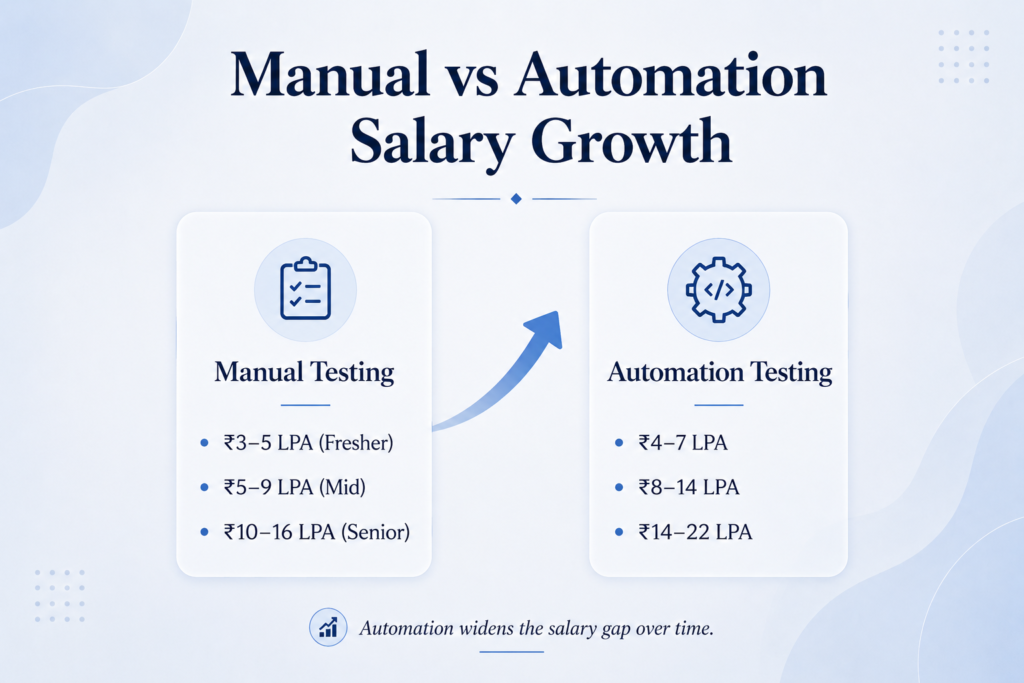
| Fresher (0–1 year) | ₹3 to 5 LPA | ₹4 to 7 LPA |
| Mid-level (2–4 years) | ₹5 to 9 LPA | ₹8 to 14 LPA |
| Senior (5+ years) | ₹10 to 16 LPA | ₹14 to 22 LPA |
| QA Lead / Manager | ₹14 to 20 LPA | ₹18 to 28 LPA |
By role type
| Role | Entry Level | Experienced |
| Manual QA Analyst | ₹3 to 5 LPA | ₹6 to 10 LPA |
| Automation Test Engineer | ₹4 to 7 LPA | ₹9 to 16 LPA |
| API Test Engineer | ₹4.5 to 7.5 LPA | ₹10 to 18 LPA |
| QA Lead | ₹10 to 14 LPA | ₹14 to 20 LPA |
| QA Manager | ₹14 to 18 LPA | ₹18 to 25 LPA |
| SDET | ₹6 to 9 LPA | ₹16 to 28 LPA |
| Performance Test Engineer | ₹5 to 8 LPA | ₹12 to 20 LPA |
By city (mid-level QA engineer, automation capable)
| City | Typical Salary Range |
| Bangalore | ₹9 to 16 LPA |
| Pune | ₹8 to 14 LPA |
| Hyderabad | ₹8 to 13 LPA |
| Chennai | ₹7 to 12 LPA |
| Delhi / NCR | ₹8 to 13 LPA |
The single most important takeaway from all three tables is this: the difference between manual-only and automation-capable testers grows larger at every experience level. At the fresher stage, the gap is roughly ₹1 to 2 LPA. By year 4, that same gap is often ₹4 to 6 LPA for the same number of years in the industry.
That is not a small difference. Over a 5-year career, a tester who invests in automation skills can earn ₹15 to 25 LPA more in total compensation compared to someone who stays manual-only.
Not sure which path makes sense for your background? The guide on Software Testing Course in Pune: Manual vs Automation breaks down exactly which track to choose based on where you are starting from.
5 Skills That Push Your Salary Up Faster Than Experience Alone
Years at a company give you increments. Skills give you salary jumps. These are the five that move the needle the fastest in India’s QA job market right now.
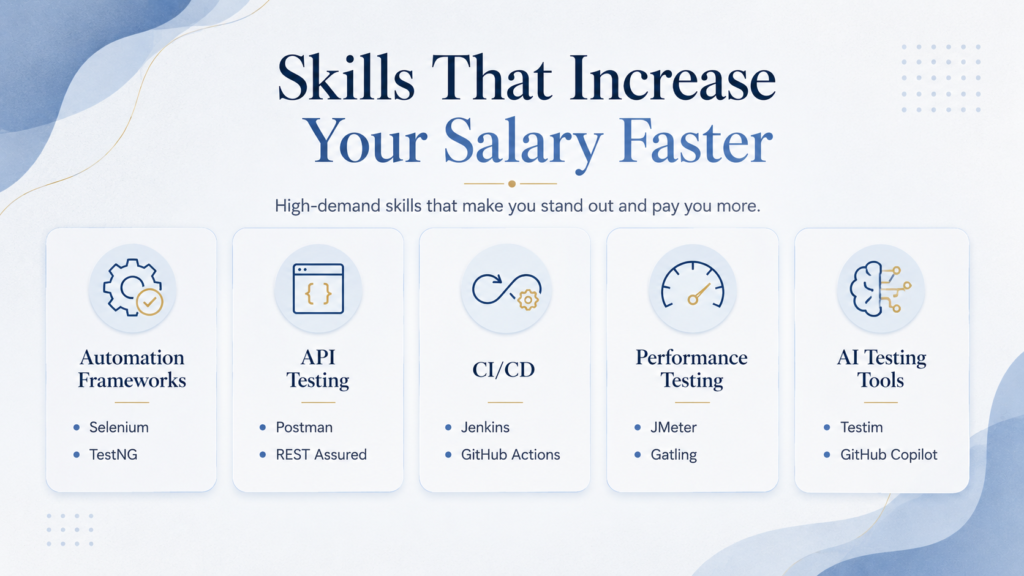
1. Automation framework proficiency (Selenium + TestNG + Page Object Model)
This is the foundational upgrade. Moving from manual testing to structured automation testing is the single biggest salary lever available to a QA professional in the first 2 years of their career.
The gap it creates: ₹1.5 to 3 LPA above manual-only peers at the same experience level, consistently across companies in Pune, Bangalore, and Hyderabad.
2. API testing (Postman and REST Assured)
In 2026, most job descriptions for automation testers in India will list API testing as a required skill, not a nice-to-have. If your automation skills stop at UI testing with Selenium and you have not touched API automation, you are essentially missing half the role.
The gap it creates: ₹1 to 2.5 LPA above testers who only know UI automation. Companies are specifically filtering for this in technical interviews.
3. CI/CD integration (Jenkins and GitHub Actions)
Testers who can set up and maintain CI/CD pipelines are treated as DevOps-adjacent contributors, not just QA support. This skill is rarer than Selenium knowledge and pays accordingly.
The gap it creates: ₹2 to 4 LPA premium at the mid level. Senior testers with CI/CD experience are among the most in-demand QA professionals in Pune’s product company ecosystem right now.
4. Performance testing (JMeter or Gatling)
This is a niche, but a high-paying one. Performance engineers who can run load tests, interpret results, and work with development teams to fix bottlenecks are genuinely hard to find. Companies pay a meaningful premium for this.
Performance testers in Pune with 4 to 5 years of experience earn ₹12 to 18 LPA, significantly more than general automation testers at the same stage.
5. AI-assisted testing tools
This is the emerging skill of 2026. Tools like Testim and Copilot for test generation are being adopted by forward-thinking QA teams. Testers who are comfortable with AI-powered test generation are being positioned as senior contributors earlier than the traditional career ladder allows.
This skill does not replace the fundamentals; it accelerates them. But learning it alongside your core automation skills puts you in a premium category that most QA job seekers are not yet competing in.
The sequence that works for most people: automation first, then API testing, then CI/CD, then performance and AI tools as the career matures. Most testers who follow this ladder seriously double their starting salary within 3 years.
If you are still figuring out where to start, book a free session with Teknowell’s QA mentors and get a specific plan mapped to your background and target salary. It is a 30-minute conversation, not a sales call.
Where You Work Matters as Much as What You Know
The same automation tester can earn ₹7 LPA at one company and ₹11 LPA at another. The skill set is identical. The difference is the company type.
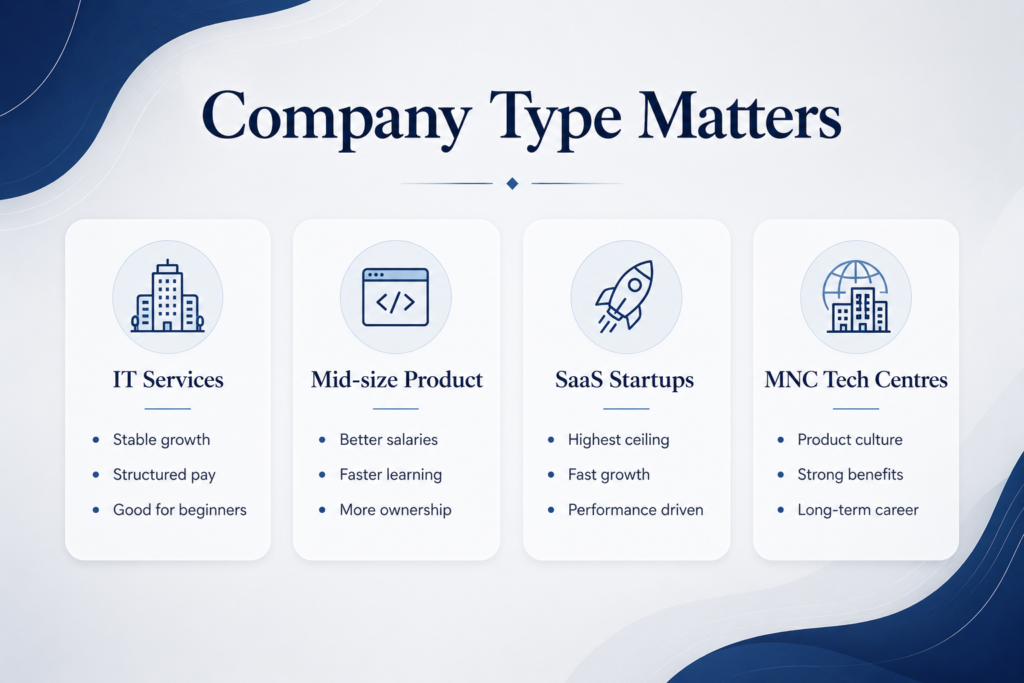
Large IT service companies (TCS, Infosys, Wipro, Cognizant)
These are structured environments with defined pay bands. Increments are predictable. Salaries are conservative compared to the market but stable. For freshers, this is often where the first job comes from, and that is fine. The learning environment is solid, and the brand name helps for future switches.
Fresher QA salary range: ₹3.5 to 5 LPA. Mid-level automation: ₹7 to 10 LPA.
Mid-size product and IT companies (Persistent Systems, Zensar, KPIT, Cybage)
These are among the biggest employers in Pune and Pimpri Chinchwad’s IT corridor. They pay better than large service companies and give engineers more ownership of their work. Job switches here come faster because the experience is more varied.
Fresher range: ₹4 to 6 LPA. Mid-level automation: ₹9 to 14 LPA. This is the sweet spot for most career switchers entering QA.
Funded SaaS startups and product companies (many in Hinjewadi and Kharadi, Pune)
Highest pay ceiling. Less structure. More risk, more reward. A strong automation candidate can walk into a startup and earn ₹6 to 9 LPA as a fresher if the skill demonstration is solid. Senior SDETs at funded startups earn ₹18 to 28 LPA regularly. To compare testing with other fields, see the highest-paying IT jobs in Pune in 2026.
MNC tech centres (Barclays Technology Centre, Cummins, Volkswagen Digital Solutions)
These are underrated options for QA professionals in Pune. They combine the stability of a large company with product-grade engineering practices. Automation engineers here earn ₹8 to 15 LPA at the mid level, with structured growth paths.
For most people entering software testing, the practical advice is this: aim for a mid-size product company or MNC tech centre as the first role. The pay is significantly better than at large service companies, the learning is faster, and it positions you better for your second move.
You can see how Teknowell supports students through this process on our placements page.
What a Software Tester’s Career Really Looks Like Over 10 Years
Salary data in a table is useful. But what does the actual journey look like, year by year? Here is a realistic picture.
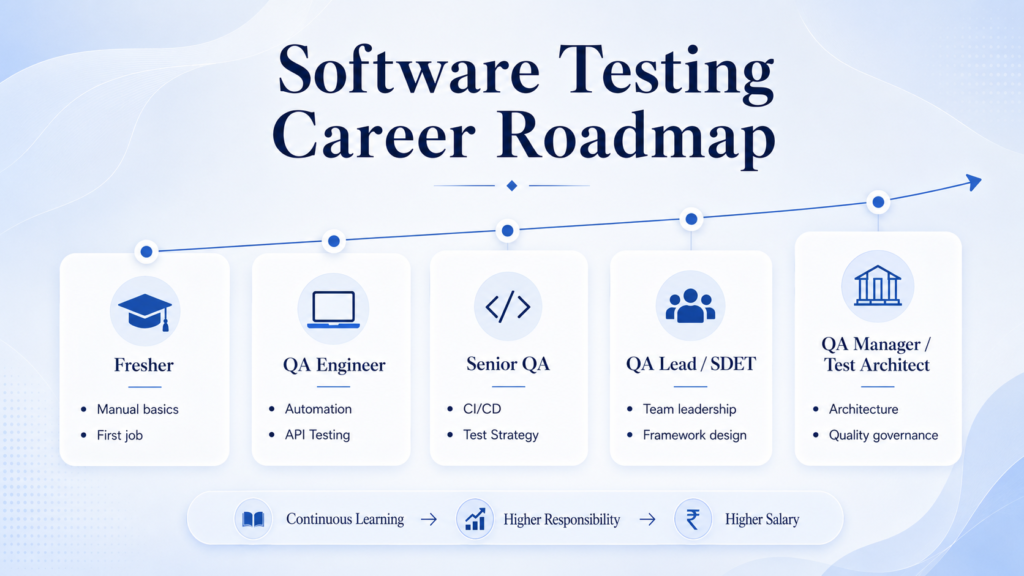
Year 0 to 1: The foundation stage
Most people start with manual testing roles or entry-level automation positions. Salary: ₹3.5 to 6 LPA. This year is about learning the actual job: writing test cases, reporting bugs clearly, understanding Agile workflow, and getting comfortable with JIRA, Postman, and basic Selenium. The pay is modest. The learning is not. If you have no coding background, this is how non-IT graduates get QA jobs in Pune.
Year 2 to 3: The first inflection point
This is when automation confidence starts building, and the first strategic job switch usually happens. Salary before the switch: ₹5 to 8 LPA. Salary after: ₹8 to 12 LPA. A 30 to 50 percent jump in one move is common at this stage for testers who have built real skills and a portfolio to show for it.
This is also when the decision to add API testing and CI/CD knowledge starts paying off visibly.
Year 4 to 5: The senior tester stage
QA engineers who have stacked manual, automation, API, and CI/CD skills are now genuinely senior contributors. ₹10 to 16 LPA is the realistic range. QA Lead responsibilities start with leading a small team, designing test strategies, and reviewing others’ work. Some move into SDET roles here.
Year 6 to 8: Senior SDET or QA Lead
₹15 to 22 LPA. Engineering-level credibility. Working directly with DevOps and product teams on release quality. Some professionals branch into performance testing or move into QA management at this stage.
Years 9 to 12: QA Manager or Test Architect
₹22 to 30 LPA and above. Managing QA teams, setting organisational testing standards, contributing to product-level decisions. The ceiling is high for people who have kept building skills consistently.
One thing worth saying directly: the biggest salary jumps in software testing careers almost always come from strategic job switches, not annual increments. People who stay at their first company for 5 or 6 years often find that peers who switched once or twice are earning significantly more for the same skills. The market values demonstrated skill more than loyalty.
For interview preparation specific to QA roles, the software developer interview preparation guide on Teknowell’s blog covers technical rounds, aptitude sections, and communication rounds in detail; most of it applies directly to QA interviews too.
Is Software Testing a Good Career in 2026?
This question deserves a straight answer, not a diplomatic one.
Yes, with one condition. The answer depends entirely on which direction you take it.
Manual-only testing has a real ceiling. Companies are hiring fewer pure manual testers and expecting more from the ones they do hire. If you stop learning after getting comfortable with test cases and JIRA, the career path will feel increasingly limited by year 4 or 5.
Manual plus automation, with API and CI/CD skills added over time, is a different story. That path has strong demand, meaningful salary growth, and clear senior roles to progress into.
What about AI replacing testers? This is the question everyone is worried about, and it is worth addressing honestly. AI tools are being used to generate test cases faster and to flag potential issues earlier in development. But someone still has to design the testing strategy, maintain the automation framework, interpret results, and catch the things AI tools miss. If anything, testers who learn how to work alongside AI tools using them rather than being replaced by them are positioning themselves as premium contributors.
Compared to full-stack development, software testing has a shorter time-to-first-job for most freshers. The ceiling is lower than full stack at the senior level, but the entry barrier is also meaningfully lower. For career switchers who need to get into IT quickly while building toward a long-term role, testing is one of the most practical entry points available.
If you are coming from a commerce background and wondering whether testing is the right switch for you, the guide on switching to IT after BCom or BBA covers exactly that, including how testing compares to other non-engineering IT paths.
The Salary Is There. But Only If You Build the Right Skills.
Here is the honest summary.
Software testing starts at ₹3.5 to 7 LPA, depending on your skills coming out of training. It scales to ₹10 to 16 LPA by years 4 to 5 for people who invest in automation and API skills. And it reaches ₹20 to 30 LPA and above for QA leads, managers, and SDETs who have stayed committed to growing technically.
The path is real. The numbers are real. But the trajectory only holds for testers who keep building skills rather than staying comfortable with what they already know.
Manual testing gets you in the door. Automation, API testing, and CI/CD knowledge are what take you to the upper half of the salary range. That is not just a suggestion; it is what the market data actually shows.
Not sure testing is the right fit? Many people who start in QA move into development within a year or two, and a developer who understands testing is valued in any team. If you would rather build software than test it, have a look at the Full Stack course.
Want to Know Exactly What the Path Looks Like for Your Background?
At Teknowell EduTech, the QA curriculum is built to take you from manual testing fundamentals all the way to automation-ready in a single structured program. Live projects from day one. Trainers with real industry experience. And placement support that does not stop after 90 days.
Book a free demo session here and talk to a mentor about what a realistic salary timeline looks like for someone with your specific background. No pressure, no pitch, just a clear picture of where you can go and how long it realistically takes to get there.