
You have got an interview lined up. It may be for TCS or Infosys or even a start-up from Hinjewadi. You are aware of all OOP concepts and definitions, and you have revised your SQL. What you really want to know is what the interviewer is going to ask you and what a good answer would look like.
Generic preparation guides give you categories. This blog gives you the actual questions pulled from verified 2026 interview experiences across TCS, Infosys, and Pune startups organised by company, by round, and by role. Read through the section for your target company before your interview. Bookmark the ones you cannot answer yet. Those are your preparation gaps.
The short version: what each company actually asks freshers in 2026:
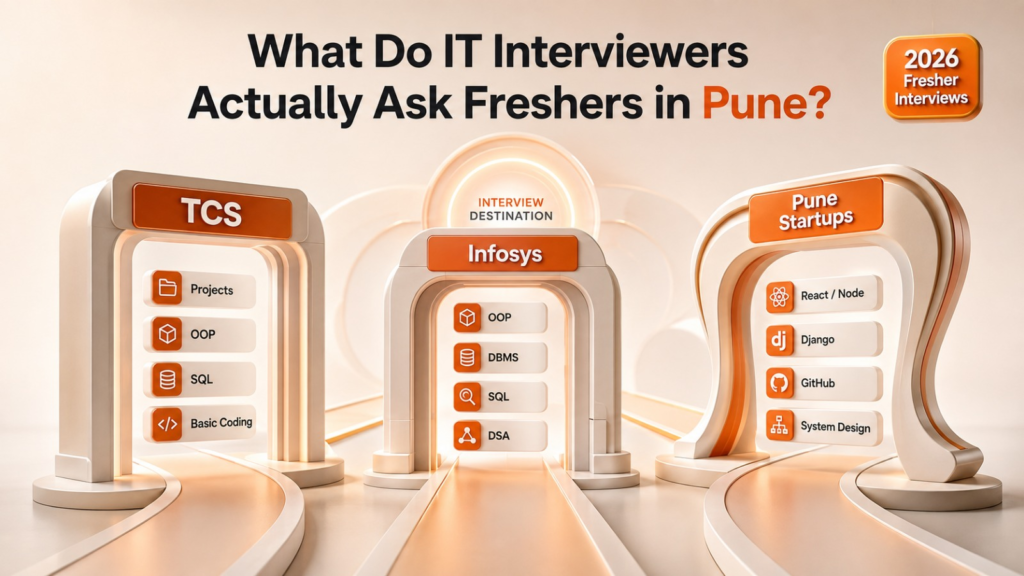
TCS Technical Round: Your project in depth, OOP with real-world examples, SQL queries (joins, GROUP BY, EXISTS, UNION), one basic coding problem, and a new 2026 question about AI vs traditional software systems.
Infosys SE Round: Which programming language are you comfortable with (sets the direction of everything after), OOP pillars with examples, DBMS normalisation from 1NF to BCNF, SQL triggers. SP and PP rounds add live DSA coding on linked lists, trees, and sorting.
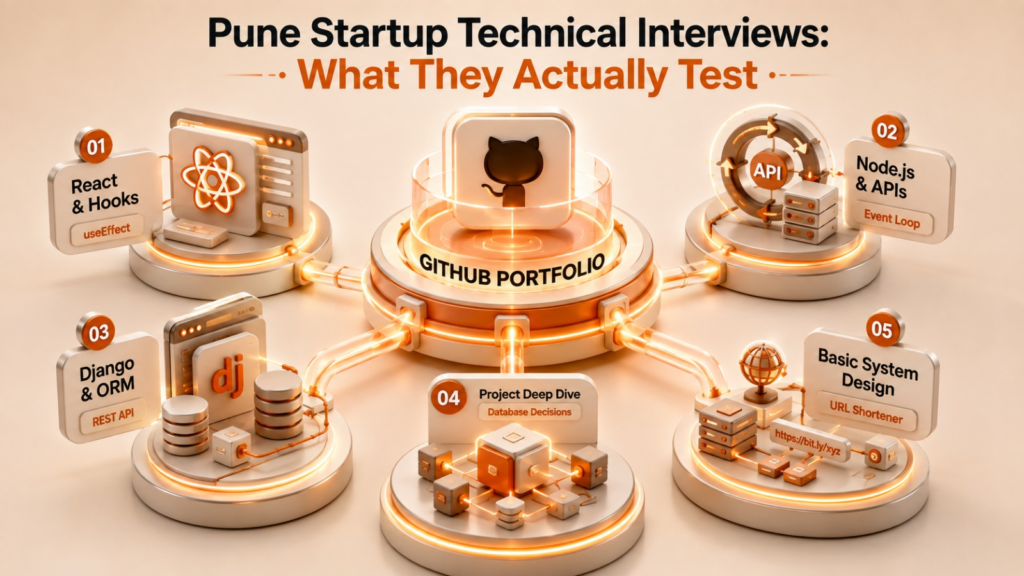
Pune Startup Technical Round: React hooks and component architecture, Node.js event loop, REST API design, Django ORM, and a GitHub portfolio walkthrough. System design basics even for freshers at product companies.
TCS technical interview: real questions freshers are being asked in 2026
Based on Glassdoor’s TCS interview database updated June 2026 across 25,558 submitted reviews, the average interview difficulty is rated 2.7 out of 5, and 72.7% of candidates rate the experience as positive. The technical round stays close to your resume. TCS technical interviews mostly stay close to your resume and project work; they rarely go into deep DSA or system design for freshers. That is genuinely good news if you actually built the project on your resume.
The project questions where every TCS interview actually begins
Before any OOP question, before any SQL query, the interviewer will ask about your project. This is not a warm-up. It is where TCS interviewers spend the most time, and it is where most freshers either win or lose the round.
These are the actual questions reported from TCS technical interviews in 2026:
“Tell me about your final year project.”
“What problem does your project solve?”
“Which technology did you use and why did you choose it over alternatives?”
“How does the backend of your project work?”
“What was the most difficult part of building this?”
“What would you change if you rebuilt it today?”
“What happens when a user clicks the submit button? Walk me through the full flow.”
Interviewers ask follow-up questions from whatever is written on the resume, especially about project tools and technologies. If Django is listed on the resume, the interviewer will ask about Django views. If MySQL is listed, they will ask about the database schema. If React is listed, they will ask about component structure. Every skill on the resume is fair game for a follow-up question.
The students who struggle in this section are the ones who followed a tutorial and listed the tutorial’s technology as their own skills. The ones who do well are the ones who made at least one genuine technical decision during the project and can explain why.
OOP questions TCS freshers are actually asked
“What is object-oriented programming? Name the four pillars.”
“Give me a real-world example of inheritance, not just a definition.”
“What is the difference between method overloading and method overriding?”
“Explain polymorphism with a code example or a real-world scenario.”
“What is encapsulation and why would you use it?”
“What is abstraction? How is it different from encapsulation?”
“What is a constructor? Can it be overloaded?”
“What is the difference between an abstract class and an interface?”
The pattern across these is consistent. Interviewers at TCS do not want dictionary definitions. Saying “polymorphism means many forms” gets a follow-up that most candidates cannot answer. A simple code example, or a real-world analogy that demonstrates you actually understand the concept, is what earns positive feedback in this round.
A useful way to prepare: for each OOP pillar, write one sentence definition and one concrete real-world example that is not the textbook Animal-Dog example everyone uses. Use something from your actual project.
SQL questions: asked in almost every TCS technical round
SQL is asked in almost every TCS technical interview. Joins, subqueries, indexing, EXISTS, NOT EXISTS, IN, NOT IN, GROUP BY, HAVING, UNION, UNION ALL, INTERSECT, and MINUS are all commonly tested.
Real SQL questions from TCS interviews in 2026:
“Write a query to find the second highest salary in a table.”
“What is the difference between WHERE and HAVING? When do you use each?”
“Explain INNER JOIN versus LEFT JOIN with a practical example.”
“What is a primary key? Can it be null?”
“What is normalisation? Walk me through 1NF and 2NF.”
“What is the difference between DELETE, TRUNCATE, and DROP?”
“Write a query to count employees in each department.”
“What is a subquery? Write one.”
Prepare to write these queries on paper or a whiteboard, not just talk about them. TCS interviewers frequently ask candidates to write out the query rather than describe it.
Coding questions: one problem, basic to medium difficulty
The technical round conducted by TCS usually consists of one basic question. Examples include the second largest number, reverse string, palindrome, Fibonacci series, or a factorial. It’s all about the logic and good code, rather than DSA.
Practice writing such questions manually rather than coding them on an IDE. If you are being interviewed by TCS, there is a chance that you will have to write code manually as well. The logic will carry weightage, but still, you need to be sure about the correctness of your code.
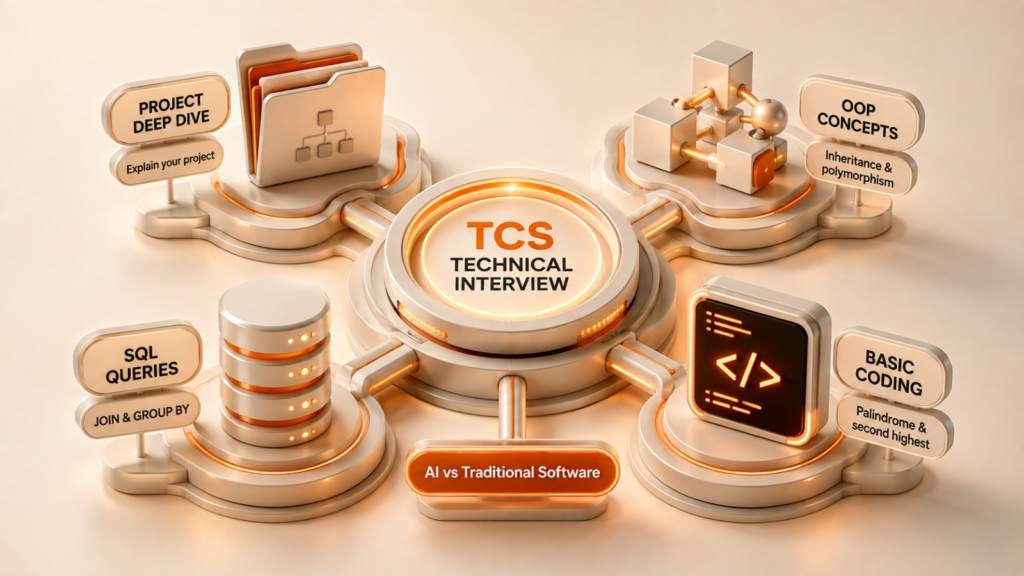
The new question in 2026: AI versus traditional software
A June 2026 Glassdoor interview submission for TCS contains this verbatim: “What is the difference between a traditional software system and an AI-based system?”
This is something new that needs to be prepared for. In a conventional software system, the software follows rules set by the programmer. The output will always be the same for any given input. But in an AI system, learning is done from data. Behavior gets better and better without the need for reprogramming. The same input can give out different results.
Even a two-sentence answer like that is enough for a TCS fresher round. Do not skip this.
TCS HR round questions
“Tell me about yourself.” Prepare a 60 to 90 second version. Name, degree, most relevant technical skills, one project in one sentence, why this role. Practice it until it sounds like a conversation, not a script.
“Why do you want to join TCS?”
“Are you willing to relocate?”
“What is your greatest strength?”
“Where do you see yourself in five years?”
“Are you comfortable with the service bond terms?” Know the answer before you walk in.
“Do you have any backlogs?” Be honest. TCS verifies academic records.
“Do you have any questions for us?” Always have two ready. This signals professional curiosity, and almost no fresher does it.
For a complete guide on how to prepare for every stage of the IT services technical interview, including how to structure the self-introduction and how to handle the project discussion, the software developer interview preparation guide covers each round specifically.
Infosys technical interview: the questions change based on your track
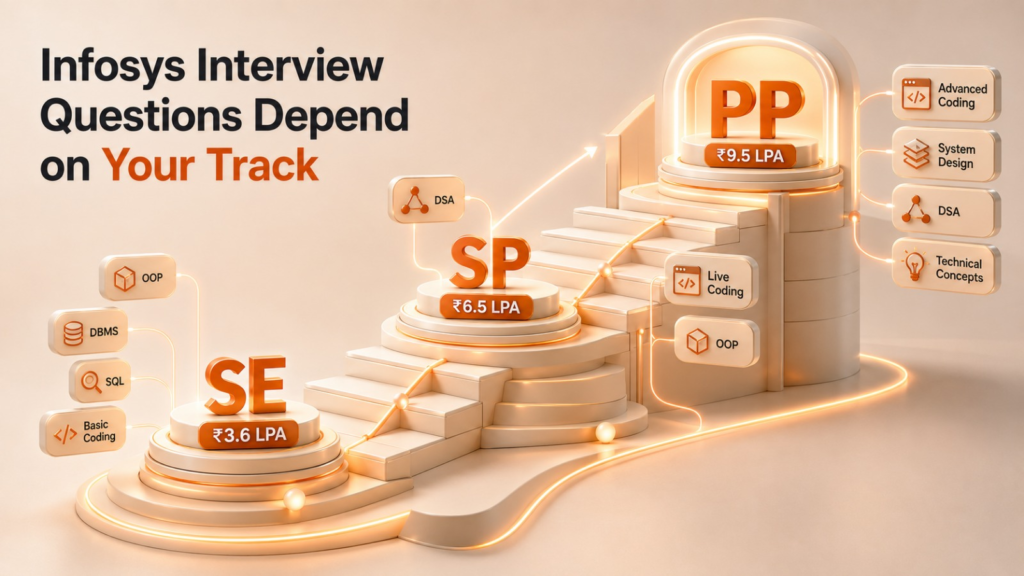
The most important thing to understand before preparing for an Infosys interview is which track you are being evaluated for. Three Infosys tracks: SE at ₹3.6 LPA, SP at ₹6.5 LPA, and PP at ₹9.5 LPA probe the same topics at different depths in the technical interview.
If you are in the SE track, the interview focuses on OOP fundamentals, DBMS, and one coding question. If you are in the SP track, the interview includes live DSA coding. If you are in the PP track, system design concepts and harder coding problems come into play. Know which track you cleared before preparing.
For the full question bank with worked answers across all three tracks, FacePrep’s Infosys Technical Interview Questions 2026 is the most current and detailed resource verified for this year.
The question that sets the direction of everything
Every Infosys technical interview opens with: “Which programming language are you most comfortable with?” Your answer sets the direction for the next 20 minutes. C, C++, and Java are the common choices.
This is not a small question. Once you name a language, the interviewer will ask OOP questions anchored to that language, coding questions in that language, and will probe how well you actually know it. Name the language you can code in most fluently, not the one that sounds most impressive. Java is fine. Python is increasingly acceptable for SP and PP tracks. Whatever you choose, be ready to write real code in it.
OOP questions Infosys freshers are actually asked
Four OOP concepts: inheritance, polymorphism, encapsulation, and abstraction are present in all interviews. Questions require giving practical examples rather than defining terms.
“What is the difference between abstraction and encapsulation?” The question arises time and again. Encapsulation involves bundling data and methods that operate on it into a single entity, limiting external access by making fields private and providing public getters and setters. Abstraction is concerned with hiding the implementation and exposing only the behaviour. An abstracted system, ATM, is a good example; you just call withdraw() without any knowledge about the mechanism of dispensing the money.
“Give an example of inheritance using code.” The example could be the Dog class inheriting the Animal class, including breathe() and eat() methods without duplicating their definitions.
“What is polymorphism?” Compile-time polymorphism is about overloading methods having the same names but differing in parameters. Runtime polymorphism involves overriding methods defined in the parent class and implemented differently in a child class at runtime.
“What is an abstract class and when do you need it?” You cannot create an instance of this class directly. It can include abstract methods that should be overridden by the child classes, together with concrete methods.
DBMS questions: standard for SE track
DBMS normalisation from 1NF through BCNF and SQL triggers are standard SE-track technical questions.
“Walk me through normalisation up to 3NF.” 1NF: each column holds atomic values, every row is unique. 2NF: satisfies 1NF; every non-key attribute is fully dependent on the entire primary key. 3NF: satisfies 2NF, no transitive dependencies; non-key attributes depend only on the primary key, not on other non-key attributes.
“What is the difference between a primary key and a unique key?” Both enforce uniqueness. A primary key cannot be null, and a table can only have one. A unique key allows one null value, and a table can have multiple unique keys.
“What is a SQL trigger?” A stored procedure that fires automatically when an INSERT, UPDATE, or DELETE event occurs on a specified table. The database executes it without an explicit call.
“What is a foreign key?” A column in one table referencing the primary key of another, enforcing referential integrity. You cannot insert a foreign key value that does not exist in the referenced table.
DSA and coding questions: specific to SP and PP tracks
SP and PP rounds include live coding on DSA: linked lists, trees, time-complexity analysis, and sorting algorithms.
Questions from Infosys SP rounds in 2026:
“Reverse a linked list.”
“Write a function to check if a binary tree is balanced.”
“Implement binary search.”
“What is the time complexity of merge sort?”
“Find the intersection of two arrays.”
“Detect a cycle in a linked list.”
“What is the difference between a stack and a queue? When would you use each?”
These are written live during the interview, not multiple choice. Write clean, readable code and explain your thinking while you write. An interviewer watching a candidate think through a linked list reversal and explain each step is more impressed than by a candidate who produces the final solution silently in 30 seconds.
Infosys HR round questions
“Walk me through your background.” Different from TCS’s “tell me about yourself”; be more conversational, less scripted.
“Why do you want to join Infosys specifically?”
“What is your long-term career goal?”
“Tell me about a challenge you faced and how you handled it.”
“Are you comfortable with the service agreement terms?”
“What questions do you have for us?” This matters at Infosys. Asking “what does the onboarding and training programme look like for freshers in the SP track?” signals you did your research and know which track you are in.
If you are preparing for the InfyTQ certification exam alongside the interview, the InfyTQ vs TCS NQT comparison covers both the exam structure and how InfyTQ certification influences which track you interview for.
Pune startup technical interview: what they actually ask
Startup interviews in Pune work differently. No aptitude test first. Often straight into a technical call or a 45-minute coding and discussion session. The interviewer is usually a senior developer, sometimes the CTO. They want to know whether you can build something real.
The questions are more practical. The OOP definitions matter less. The GitHub profile matters a lot.
Full stack developer questions: MERN profiles
These appear consistently in Pune startup technical rounds for MERN stack candidates:
“What is the difference between props and state in React?”
“How does the virtual DOM work?”
“What is useEffect and when would you use it instead of useState?”
“What are React hooks? Which ones have you actually used?”
“Explain the event loop in Node.js. Why does it matter for a backend?”
“What is middleware in Express.js and how does it work?”
“Walk me through how a REST API handles a POST request from a React frontend.”
“What is async/await and how is it different from using callbacks?”
“Show me your GitHub. Tell me about this repository specifically.”
That last one is specific to startups. At product companies and startups in Hinjewadi and Baner, interviewers frequently ask to look at GitHub mid-interview. A repository with a real deployed application, a proper README explaining the project and how to run it, and a commit history that shows ongoing work is the best possible answer. An empty profile or one with only forked repositories communicates nothing useful.
Python Full Stack questions: Django profiles
“What is Django’s ORM and how does it work?”
“Explain the difference between a function-based view and a class-based view in Django.”
“What is the difference between GET and POST in REST APIs?”
“How does Django handle authentication and sessions?”
“What is a migration in Django, and when do you run makemigrations versus migrate?”
“Explain the MTV architecture in Django.”
“How do you connect a Django backend to a React frontend? Walk me through the flow.”
“What is the difference between a ForeignKey and a ManyToManyField in Django models?”
The project discussion at startups: much deeper than IT services
Startup interviewers in Pune probe project decisions at a depth that surprises freshers who only prepared for TCS-style interviews. These questions have no textbook answers. They can only be answered well by someone who actually built the project.
“Why did you use MySQL and not MongoDB for this project?”
“How did you handle authentication? Walk me through the full flow.”
“What happens if the database connection fails? How does your application respond?”
“How would you scale this application if it suddenly got ten times the traffic?”
“What is the biggest bug you fixed during the build?”
“What would you add to this project if you had another two weeks?”
“What part of the codebase are you least happy with and why?”
If any of those questions produces a blank look, the interviewer knows the project was not really yours.
The system design question for freshers at product companies
This is newer in Pune’s startup interview market and comes up even for freshers at mid-size product companies:
“How would you design a URL shortener?”
“What database would you use for a real-time chat application and why?”
“How would you build a notification system that sends emails to users?”
“What is the difference between SQL and NoSQL databases? Which would you use for a social media feed?”
These are not expecting production-ready system design answers. They are checking whether you understand the trade-offs. Knowing that SQL handles structured data with complex queries well, that NoSQL scales horizontally more easily for certain workloads, and that a notification system needs a queue mechanism, that level of awareness is enough to answer these at a fresher level.
HR questions at startups: quick and direct
Startup HR rounds are usually 10 to 15 minutes and very direct:
“Why do you want to work at a startup rather than TCS or Infosys?”
“How do you learn something you do not know?”
“Tell me about a time you were stuck on a technical problem. What did you do?”
“Are you comfortable with a fast-changing environment?”
“Where do you want to be in two years?”
The startup HR question that trips most freshers: “Why a startup?” Saying “for growth” is not enough. A better answer references something specific about that company’s product, the pace of ownership you get early in your career, or the type of work that appeals to you. Generic answers at startups read the same way a tutorial project reads in a technical round
If the project deep-dive section above revealed a gap if your current projects could not hold up to those follow-up questions, that is actually the most useful thing this blog can do. The fix is building real projects with genuine technical decisions before the interview, not after.
Teknowell’s training in Pimpri Chinchwad is built around this specifically. Every course includes live project work on real applications during the training period, not tutorial-style exercises. Students finish with projects they can actually discuss in any of the interviews above because they made the technical decisions themselves.
Book a free demo class at Teknowell to see how the course structure and placement preparation is organised before enrolling in anything.
Questions that come up in every interview: regardless of company
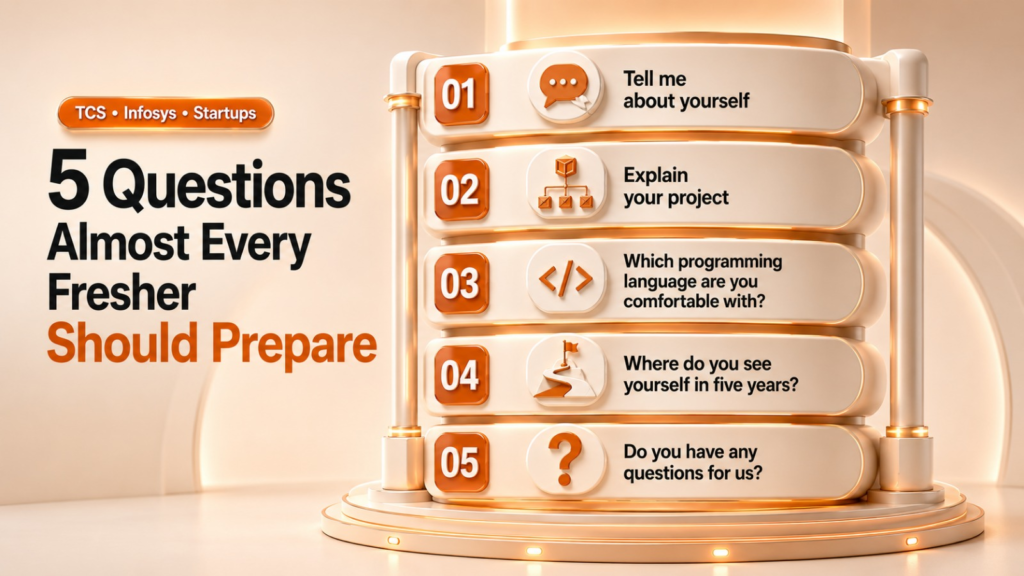
Five questions pop up at TCS, Infosys, and all startups. They cannot be avoided at all. Get ready for these answers till you know them by heart.
“Tell me about yourself.” Not an educational background starting from 10th grade. Your skills, your most significant project, and what you are looking for. Less than 90 seconds. You will practice this question out loud because you will sound like a robot otherwise.
“Explain your project.” Use four parts: what problem it solves, which technologies you chose and why, one challenge you ran into during the build, and what you learned or would do differently. Do not describe features. Describe decisions.
“Which is your favourite programming language and why?” Choose one. Be specific about why, not “because it is versatile” but a concrete reason related to something you have actually built with it.
“Where do you see yourself in five years?” Ambitious and realistic at the same time. “Contributing as a senior developer with strong system design skills, ideally in a product-focused team” is better than “I want to be a manager” (too soon) or “I am not sure” (reads as lack of direction).
“Do you have any questions for us?” Always yes. Two questions minimum. “What does the first six months look like for a fresher in this role?” and “What technology decisions are the team currently debating?” are good starting points. This question is the difference between a candidate who seems genuinely interested and one who is just looking for any offer.
The one thing that costs more interviews than any wrong answer
It is not getting an OOP question wrong. It is the project discussion.
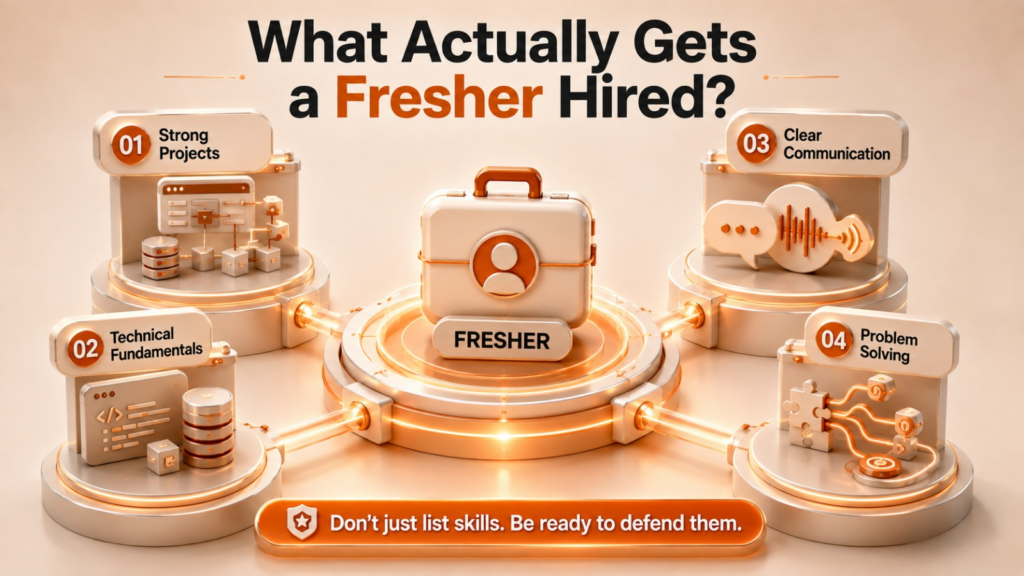
Across TCS, Infosys, and Pune startups, the most consistent reason freshers leave interviews without offers is a project they cannot defend. They listed technologies they watched someone else use. They followed a YouTube tutorial and described it as their own work. They added Django to the resume after a two-day workshop and put it in the skills section. And then the interviewer asks one follow-up question about the database schema and the conversation falls apart.
The fix is not complicated. Build one real project during your training period. Make at least five genuine technical decisions in it: what database to use, how to structure the authentication, why you chose a particular framework. Be able to explain every one of them. That project, discussed confidently in an interview, is more valuable than a resume full of skills that cannot be defended.
Teknowell’s full stack development courses are structured around exactly this. Students build and deploy real applications during the course itself, not as a separate portfolio project afterward. By the time they reach the mock interview stage, the projects are already real enough to withstand the follow-up questions above.
The interview is a conversation, not an exam
Most of the questions in this blog have a right answer. But what interviewers are actually tracking is whether you think clearly, communicate honestly, and can admit when you do not know something while still trying to reason through it.
“I have not worked with that specific tool, but based on how REST APIs work in general, I would approach it like this” is a better answer than a confident wrong answer. The former shows problem-solving instinct. The latter shows overconfidence.
Prepare the questions above. Practice your project explanation until it sounds natural. And walk into the interview knowing that the bar for a TCS or Infosys SE fresher offer is genuinely not as high as it looks from the outside; the data from Glassdoor says 2.7 out of 5 difficulty and 72.7% positive experience. The ones who do not get through are largely the ones who listed skills they cannot back up.
If you want structured mock interview practice before the real thing, book a free demo at Teknowell, and see what the placement preparation programme covers.