

If you are going to begin a career in information technology (IT), there is no doubt that you must have come across two very lucrative professions: cloud engineer and data engineer. There is nothing in common but the use of technology, scope for development, and high pay. How can one choose between the two?
The thing about choosing a profession based on the amount of salary it promises is the difficulty of knowing exactly what one does in that profession, what skills are required, and how easy or hard it is to secure a job in that field. Let’s explore cloud engineer vs data engineer in India so you can choose your profession based on something other than salary.
Cloud Engineer vs Data Engineer: Quick Comparison
| Factor | Cloud Engineer | Data Engineer |
| Main responsibility | Build and manage cloud infrastructure | Build and maintain data pipelines |
| Core skills | AWS, Azure, Linux, networking, Docker | Python, SQL, Spark, data pipelines |
| Entry-level salary estimate | ₹6 to ₹12 LPA | ₹4 to ₹7 LPA |
| Learning focus | Systems, infrastructure and deployment | Programming, databases and data processing |
| Certification route | AWS and Azure certifications | Cloud data and data engineering certifications |
| Best suited for | People who enjoy systems and troubleshooting | People who enjoy coding and working with data |
Salary levels presented above are indicative only and taken from different market resources. They do not guarantee any specific starting compensation package. The offer you will actually receive will depend on your qualifications, the projects you work on, your location, the company you are working for and your performance during the interview process.
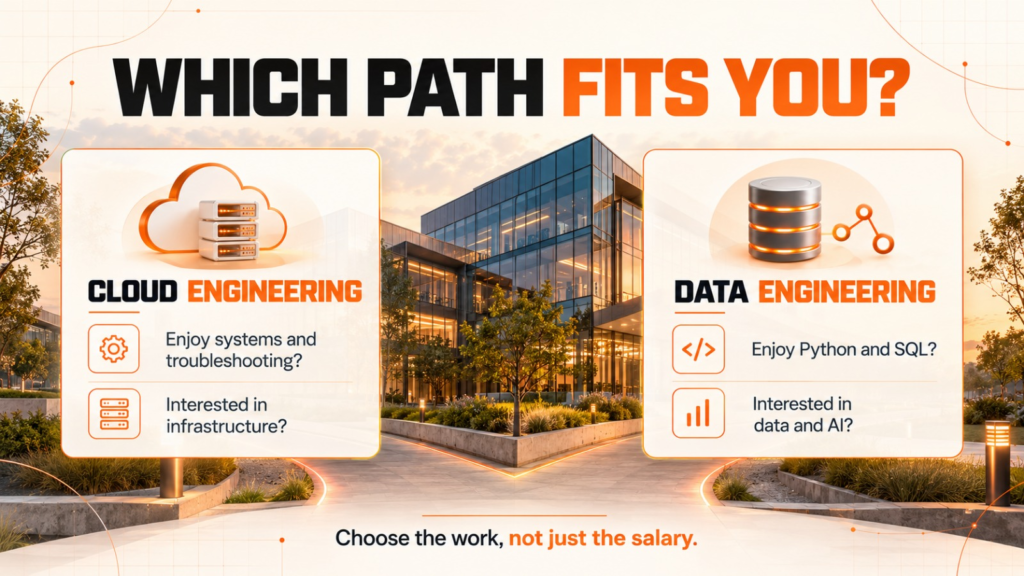
To sum up the whole issue in one sentence, you should choose cloud engineering if you are passionate about infrastructure, networking and maintaining reliable application performance. You should choose data engineering if you enjoy working with Python and SQL and building systems for moving and organizing data.
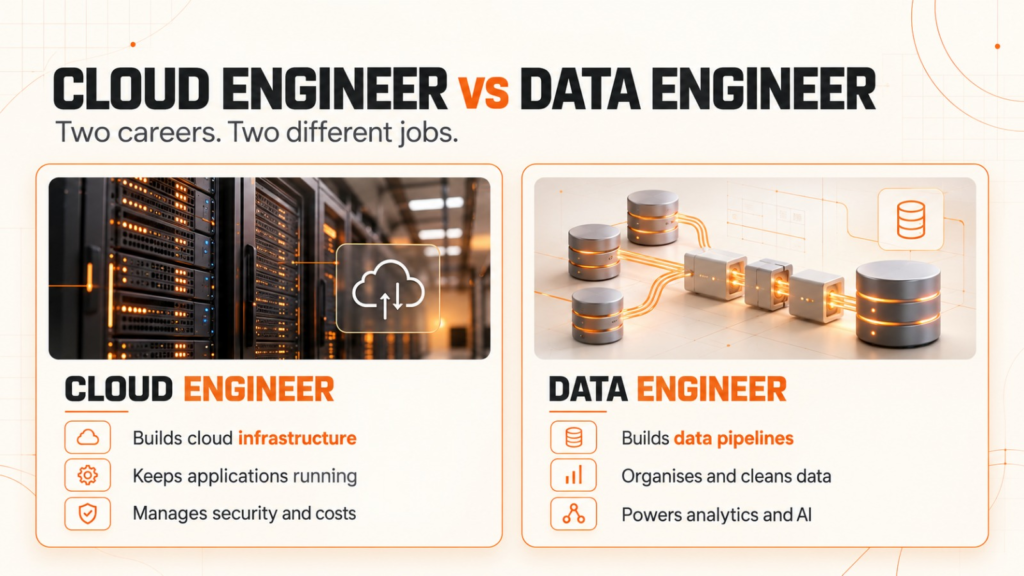
What Does a Cloud Engineer Actually Do?
Think about an app you use every day. It needs servers, storage, networking and security to work properly. Someone has to set up those systems, keep them running and make sure they can handle more users as the business grows.
That is where a cloud engineer comes in.
What a typical working day looks like
The day may begin for the cloud engineer by working on configuring the infrastructure using Amazon Web Services (AWS) or Microsoft Azure. They will be troubleshooting any issue that causes an application to run slowly or they may be automating deployment using CI/CD pipeline and creating infrastructure with the help of Terraform, which doesn’t require configuration of everything manually.
They work on the following tools as well: Docker and Kubernetes.
In simple terms, a cloud engineer makes sure the technology a company depends on has a reliable place to run.

Who hires cloud engineers in Pune?
Cloud engineers can be found in IT services, product companies, financial services and Global Capability Centres (GCCs). In Pune the tech scene has names like Siemens, Persistent Systems and Mercedes-Benz’s technology operations.
However not every firm is looking for freshers, in cloud engineering all the time. Entry‑level jobs might be posted as cloud support engineer, infrastructure engineer, junior DevOps engineer or technical operations engineer.
If you love solving tech puzzles and want to know how systems run behind the curtain, cloud engineering might suit you.
What Does a Data Engineer Actually Do?
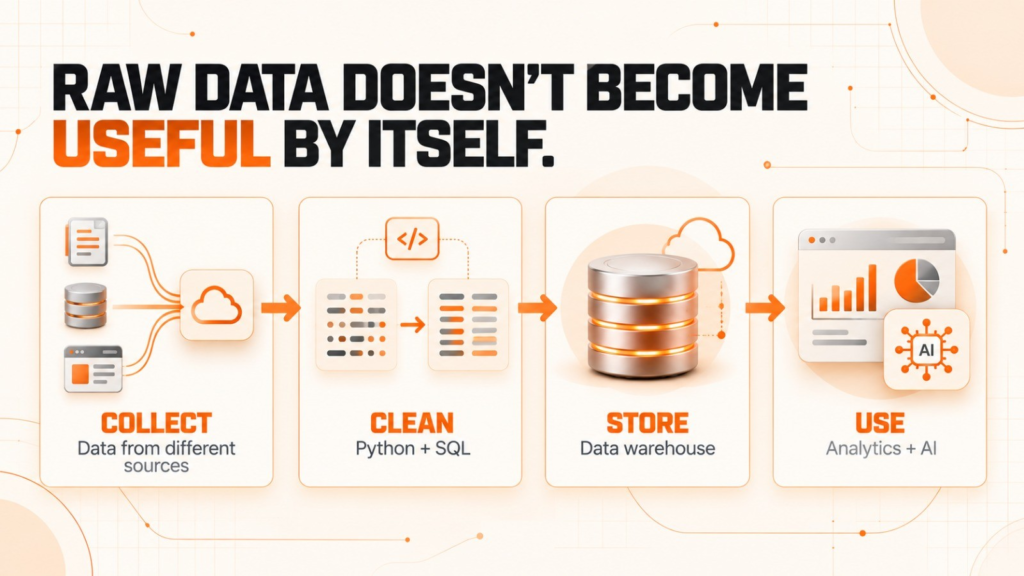
Now imagine a company that gets thousands of orders each day. The details come from its website, payment systems, warehouses and customer database.
Before the company can look at sales or create an AI model that data needs to be gathered, fixed, arranged and sent to the place.
A data engineer creates the systems that make this possible.
What a typical working day looks like
A data engineer might write Python scripts to collect information from sources. They use SQL to query databases and build automated pipelines that move data into a warehouse. For datasets they may use Apache Spark or Kafka. They also set up checks to catch incorrect data. They use orchestration tools such as Airflow to schedule pipelines.
Why does this matter? A dashboard can only show information if the underlying data is reliable. Similarly an AI model cannot produce results when the data feeding it is incomplete or poorly organised.
A data engineer builds the data foundation that analysts, data scientists and AI systems depend on.
Who hires data engineers in Pune?
Banks, financial services companies, technology firms and GCCs all need people who can handle amounts of data. In Pune employers with technology operations include Deutsche Bank, HSBC, Barclays and Siemens.
The responsibilities can differ depending on the team. One role might focus on SQL and data warehouses. Another could require Python, Spark and real-time streaming.
If you like coding, if you enjoy solving data problems and if you want to understand how information flows through a business then data engineering might be the path for you.
Cloud Engineer vs Data Engineer Salary in India
Let’s look at the numbers, because earning potential is an important part of this decision.
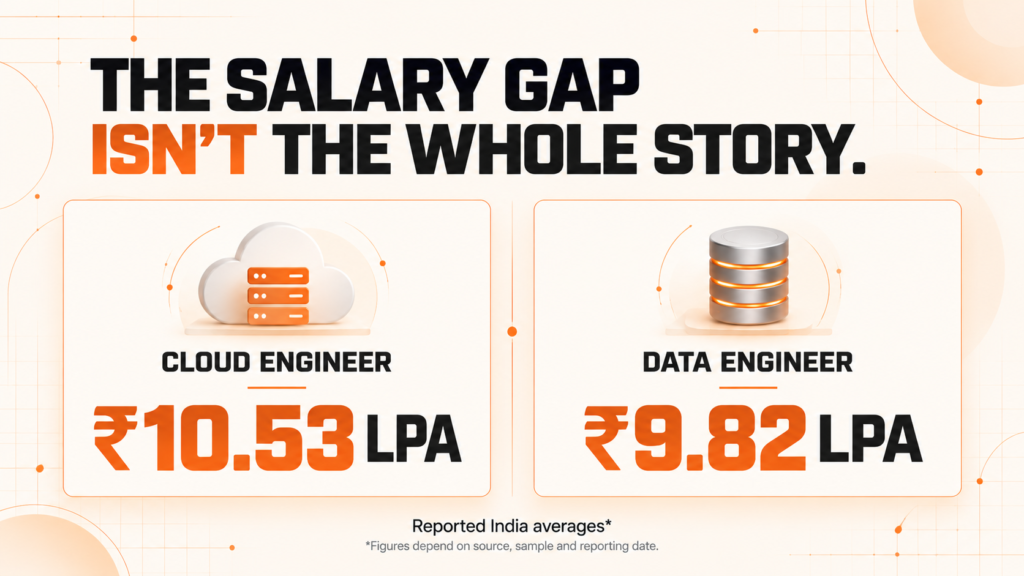
According to Indeed India’s cloud engineer salary data, its reported average was approximately ₹10.53 lakh per year in the July 2026 figures used for this comparison. Indeed updates its estimates as salary submissions and job-posting data change.
For data engineering, see Indeed India’s data engineer salary data. The reported average used in this comparison is ₹9.82 lakh per year. Treat both averages as snapshots, not fixed salary benchmarks.
Salary by experience
| Experience | Cloud Engineer | Data Engineer |
| Fresher or early career | ₹6 to ₹12 LPA | ₹4 to ₹7 LPA |
| Mid-level | ₹14 to ₹24 LPA | ₹8.5 to ₹12 LPA |
| Senior | ₹26 to ₹42 LPA | ₹25 to ₹40 LPA |
These are indicative ranges compiled from multiple salary guides, including OwnYourCareer and other salary aggregators. They are not a like-for-like survey, so the differences should not be interpreted as proof that cloud engineers always earn more at each experience level.
For example, the OwnYourCareer cloud engineer salary guide provides experience-based estimates and a separate Pune salary range. The DataVidhya data engineer salary guide offers another reference for data engineering.
Which role pays more?
In the early stage of your career, some cloud jobs may have a better package compared to entry-level data engineering jobs. But this is very much dependent on the employer and the nature of the position itself.
Both cloud engineering and data engineering professions provide for good remuneration for professionals at a more senior level. More so, specialization in terms of technical skills, production capability, designing capabilities, and the scope of responsibilities may have more value than just the position.
Cloud engineers can specialize in multi-cloud architecture, security, FinOps, and infrastructure for AI applications. Data engineers can specialize in real-time data streaming, batch processing, data platforms, and machine learning infrastructure.
These are some possible directions for professional growth but not necessarily higher remuneration.
What about Pune salaries?
Pune has opportunities across Hinjewadi, Kharadi, Viman Nagar and other technology hubs. GCCs and product companies can offer competitive packages, but salaries vary by employer and experience.
For a broader comparison, see Teknowell’s guide to highest paying IT jobs in Pune right now. If you want to target multinational companies with in-house technology teams, our guide on how to get a GCC job in Pune can help you understand that hiring route.
One thing to remember: Do not choose a course simply because a salary table shows a higher number. First, find out what the actual entry-level jobs require and whether you enjoy the work involved.
Ready to explore your options?
Both paths can lead to rewarding IT careers, but they require different preparation. Before paying for a course, compare the syllabus with the job descriptions you want to apply for.
You can explore Teknowell’s IT training programmes and book a free demo session to understand the teaching approach and curriculum before deciding.
Cloud Engineer vs Data Engineer Skills: What Do You Need to Learn?
You do not need to master every tool before applying for your first job. What matters is building the right foundation and then practising the tools relevant to your target role.
Skills required for cloud engineering
Start with these:
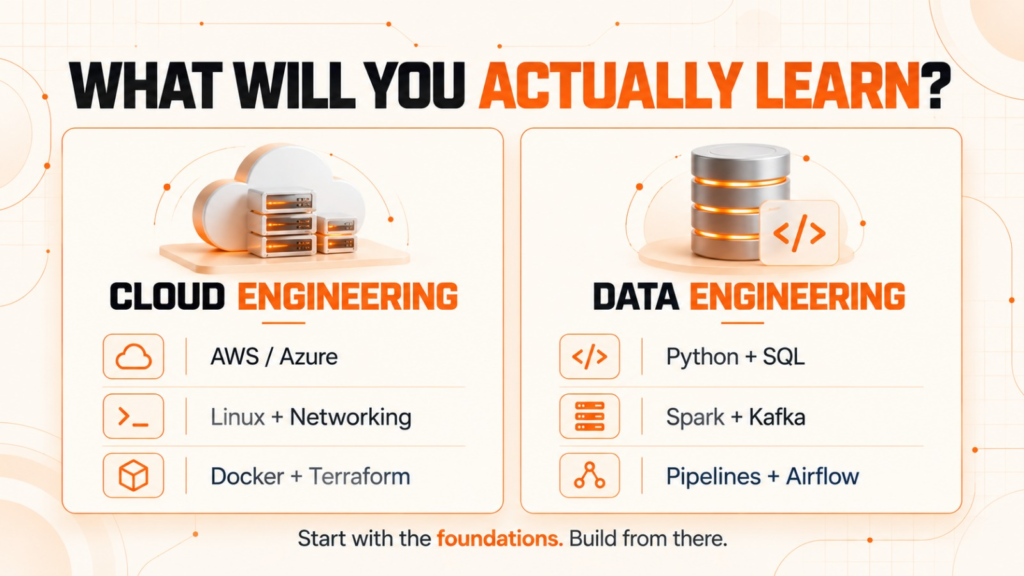
- Cloud fundamentals: Understand AWS or Azure, including compute, storage, identity and access management.
- Linux and networking: Learn command-line basics, IP addresses, subnets, DNS and security groups.
- Containers: Understand Docker and the basics of Kubernetes.
- Automation: Learn Terraform and how infrastructure can be managed through code.
- Deployment and monitoring: Get familiar with CI/CD pipelines, logging and troubleshooting.
Certifications can help show what you know. AWS Certified Cloud Practitioner is a starting point and AWS Solutions Architect Associate and Azure Administrator Associate are advanced choices.
A certificate by itself will not get you a job. Work on projects, like putting an app on the cloud, setting up access controls and creating monitoring systems.
Skills required for data engineering
The learning priorities are different:
- Python: Write scripts, process data and automate repetitive tasks.
- SQL: Query databases, join tables, use window functions and improve query performance.
- Data pipelines: Learn how information is extracted, transformed and loaded into a destination.
- Data processing: Progress to tools such as Apache Spark and Kafka as your foundation improves.
- Cloud data services: Explore services such as AWS Glue, Azure Data Factory or Google Cloud Dataflow.
- Workflow management: Learn how tools such as Airflow schedule and monitor data pipelines.
You can also explore dbt, Snowflake and BigQuery as you progress. Certifications such as AWS Certified Data Engineer Associate or Google Professional Data Engineer may help, depending on your experience and target jobs.
For beginners, Python and SQL deserve particular attention. They provide a foundation for data engineering and also transfer to analytics, data science and other technical roles.
Which Career Is Easier for Freshers to Learn?
Neither career is easy. The hard parts are different.
Cloud engineering may feel more organized at first because you can follow a learning path. You start with networking and Linux. Then you study one cloud platform. After that you practice deployments. Then you move to containers and infrastructure automation.
Teknowells cloud computing course in Pune covers AWS, Azure, Docker, Kubernetes, Terraform and DevOps fundamentals. This course runs for four to six months according to the details provided.
Data engineering usually requires programming and database skills. You need to know Python and SQL before creating pipelines with advanced tools.
Teknowells data science course in Pimpri Chinchwad covers Python, machine learning, deep learning and generative AI. These skills can give a base for working with data. However if your main goal is to become a data engineer make sure your learning plan also includes SQL, ETL pipelines, Spark orchestration and cloud data platforms.
The key difference is that a course title is not the same, as a job skill set. Look at the projects you will create. Look at the tools you will use. Look at the types of jobs those skills help you get.
Which Should You Choose: Cloud Engineering or Data Engineering?
Here is a straightforward way to decide.
Choose cloud engineering if:
- You like understanding how computers, servers and networks work.
- Troubleshooting technical issues sounds interesting rather than frustrating.
- You want to learn infrastructure, deployment, security and automation.
- You prefer a learning path built around cloud platforms and practical certifications.
- You want to explore cloud operations, DevOps, platform engineering or cloud security later.
Start with one cloud platform and build a working project before jumping into multiple platforms. A strong foundation in AWS or Azure is more useful than a long list of tools you have only seen in tutorials.
Choose data engineering if:
- You enjoy programming and solving logical problems.
- You are interested in how businesses collect, store and use data.
- You are willing to spend time improving your Python and SQL skills.
- You want to build the pipelines and platforms that support analytics and AI.
- You may eventually want to explore data platforms, streaming systems or ML infrastructure.
Start with Python, SQL and databases. Then build a small pipeline that takes raw data, cleans it and stores the results somewhere useful.
Can you switch from cloud engineering to data engineering later?
Absolutely. The skills sets have a lot in common, particularly when it comes to cloud platforms, automation, and infrastructure.
A cloud engineer who acquires skills like SQL, data warehouses, and pipelines design can become a cloud data engineer. In turn, a data engineer who acquires more expertise in terms of networking, infrastructure automation, and deployment can become a platform or cloud architect.
However, it would require developing the skill set that is missing in your present role.
Conclusion: Choose the Path That Works For You
Cloud engineer and data engineer are both excellent careers to choose from. However, you do not need to choose the path that pays more than the other based on the salary figures. Think about what kind of work you would like to do every day, the required skills for the role and conduct a small experiment before making your choice.
If you are not yet convinced, schedule a demo class for yourself at Teknowell EduTech in Pimpri Chinchwad, Pune. You will be able to check out the curriculum, practical experience, and preparations for the chosen role. Then you will be able to make an informed decision.