

You’ve decided software testing sounds like a solid career move. Good instinct. Pune is full of IT companies hiring QA professionals, and the entry barrier is genuinely lower than most other IT roles.
Then you start researching. And suddenly, there are two different things staring back at you: manual testing and automation testing. One seems simpler. One seems more technical. Both seem necessary. And nobody is clearly explaining which one you should actually focus on first.
You end up with 12 browser tabs open, a list of tools you’ve never heard of, Selenium, TestNG, JIRA, Postman, Maven, Cucumber, and somehow even more confused than when you started.
That’s exactly what this guide is going to fix.
By the end of this, you’ll understand what each type of testing actually involves, which one makes sense for your background, what the salaries look like in Pune right now, and what to look for before enrolling in any course.
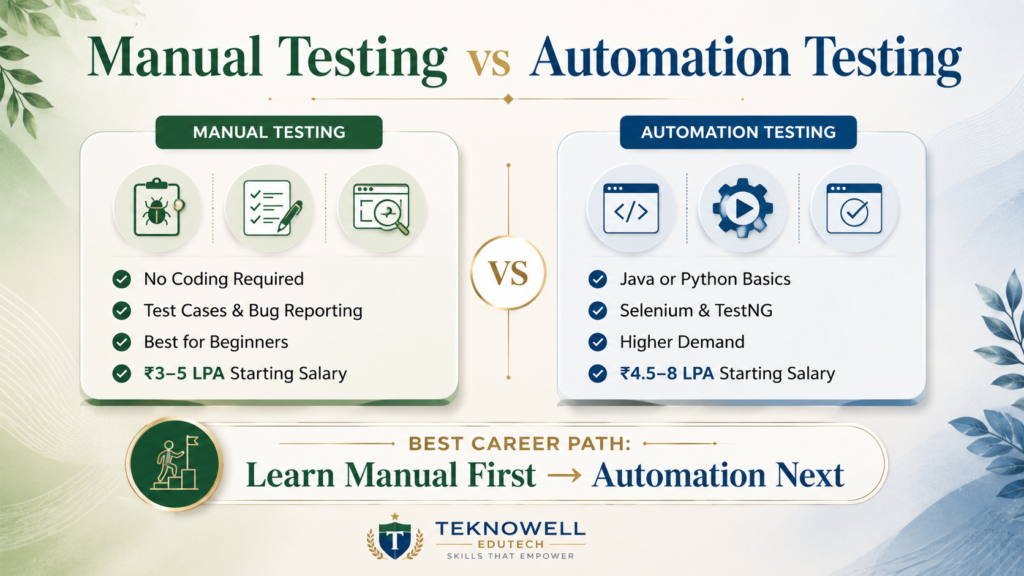
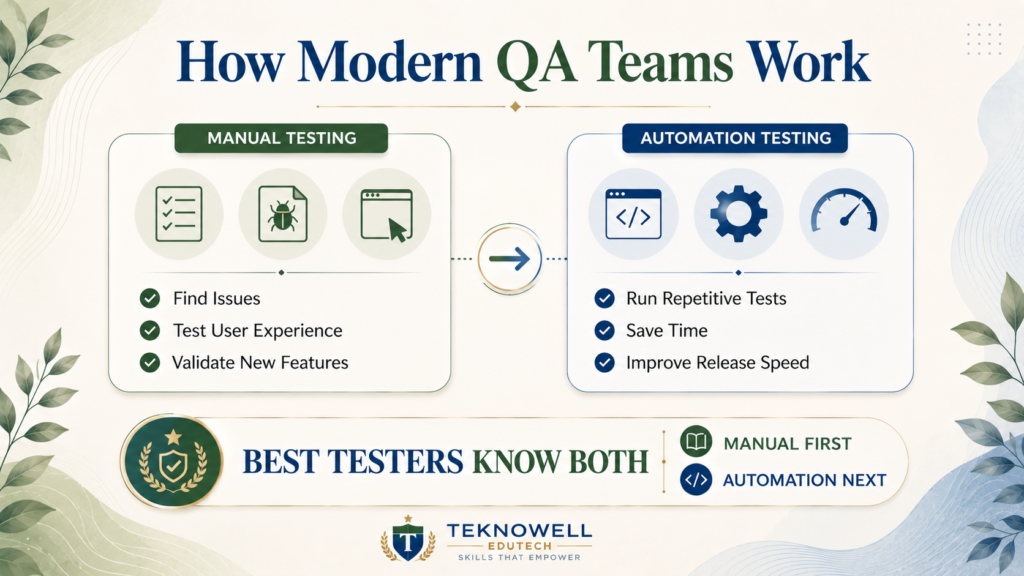
Quick answer: What’s the difference between manual and automation testing? Manual testing is when a human tester goes through the software step by step to find bugs, no coding needed. Automation testing is when scripts (small programs) run tests automatically, faster, and at scale. Manual is the foundation. Automation is where salaries go up. Most good courses teach both, in that order. If coding is what worries you, read how non-IT graduates get QA jobs in Pune without coding.
What Is Software Testing and Why Is Pune Hiring for It Right Now?
The most basic understanding of software testing comes down to checking whether an application, website, or any banking system works before launching it to its end user. The person who does it is called a software tester.
Everything from buttons and forms to every single payment procedure and login process must go through thorough testing before being launched. As soon as something breaks while working in production and real users start to suffer, companies experience heavy losses. That is why QA teams operate in order to prevent such losses. Every IT company needs a team like this.
It is especially true about Pune, where there are many MNCs, product startups, and SaaS companies located in various IT parks like Hinjewadi, Kharadi, Baner, and Magarpatta. Those companies release new versions of their services twice a month, so they constantly need QA specialists. Some of those companies include TCS, Persistent Systems, Zensar Technologies, Infosys, KPIT, Barclays Technology Centre, and others.
Software testing provides one of the most accessible entry points into IT for freshers. In fact, it consistently ranks among the best IT courses for freshers because of its shorter learning curve and strong placement opportunities. You do not have to be a graduate of the computer science discipline. Neither should you have many years of programming experience behind your back. All you need are logical and analytical skills coupled with proper training.
Once you get into this field, it is a complete career path and not a dead end. Manual Tester moves to Automation Tester, then QA Lead, QA Manager, and eventually becomes Test Architect or SDET (Software Development Engineer in Test). People holding senior positions in the QA field in Pune earn anywhere between ₹15 and 25 LPA. That’s the destination. But what about the point of departure?
What Is Manual Testing? What Does a Manual Tester Actually Do?
Manual testing means exactly what it says. It involves a person going through the software manually and checking if it behaves according to expectations.
There is no coding involved. There are no scripts executed. Only a person methodically goes through a set of tests and notes down what works and what does not work.
This is what a day at the job of a manual tester looks like:
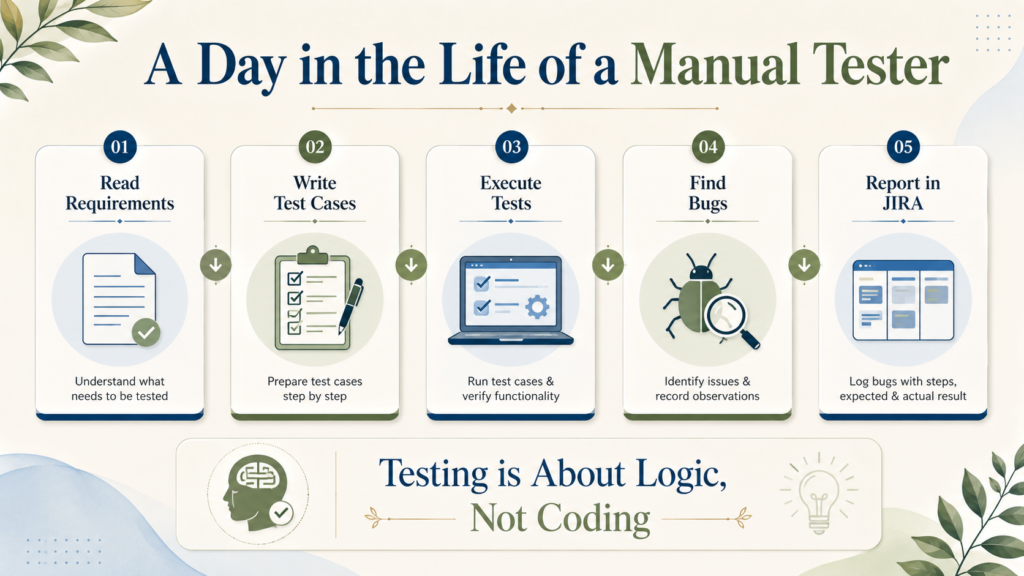
The tester begins the day by going through the requirements of a new feature that has been coded. He writes down a set of test cases that involve listing out a series of steps to be checked. These test cases are then executed against the software, and whatever passes or fails is noted. If a problem is detected, the tester makes a bug report in JIRA detailing all information, such as what he did, what was expected, and what happened instead.
This is what manual testing involves. It’s all about systematic and meticulous tasks. And it’s really important work.
The tools a manual tester uses regularly:
JIRA (for bug tracking), TestRail or Excel (for test case management), Postman (for simple API tests), and browser developer tools (for front-end testing). None of these requires any coding skills to be used effectively.
What you learn in a manual testing course:
SDLC (Software Development Life Cycle), STLC (Software Testing Life Cycle), different testing types (functional testing, regression testing, smoke testing, and user acceptance testing (UAT)), writing good test cases, writing a proper bug report, and an explanation of Agile/Scrum methodologies in practice.
Manual testing is the right start for newcomers with no programming experience, for those with BCom or BBA degrees transitioning to the IT field, and everyone who wishes to become a tester.
One honest thing worth saying, though:
Roles purely for manual testing are difficult to come by these days as firms move towards automation. The manual is where everything starts, and it is perfectly fine to be doing. However, nowadays most firms need testers who will eventually be able to do automation. That is why the manual is just the beginning for you.
Salary for manual testing in Pune: ₹3 to 5 LPA for freshers. After 2 to 3 years of experience and some automation knowledge, it would be ₹6 to 9 LPA.
What Is Automation Testing? And Do You Really Need to Code?
Automation testing occurs when we write scripts, which are small programs, that will perform tests on our software automatically, rather than being done manually by a human tester.
Imagine yourself as a representative of a corporation that releases an update for your application once every two weeks. At every release, there is always somebody who needs to ensure that all functionalities have not been disturbed at each of them. This task is really time-consuming and takes days. However, if we automate our tests through scripting, the process takes just 20 minutes.
This is the reason why automation is so much needed. Speed, consistency, and scalability, that’s what automation gives us. Of course, it doesn’t substitute manual testing; rather, it helps to perform repetitive tasks.
Now, the question everyone asks: do you need to code?
Yes. But not at the level of a software developer.
Learning to automate testing involves learning how to code in a single programming language. Many students choose automation testing because it combines testing fundamentals with programming skills, making it a strong alternative to traditional software development careers. Java or Python are the most popular at the beginner to intermediate level. You do not have to develop applications; you will be developing test scripts that will work with the browser or APIs. As soon as you learn loops, conditional statements, methods, and basic object orientation, you can start developing your own test scripts.
Automated Testing Tools used by automation testers in the Pune job market:
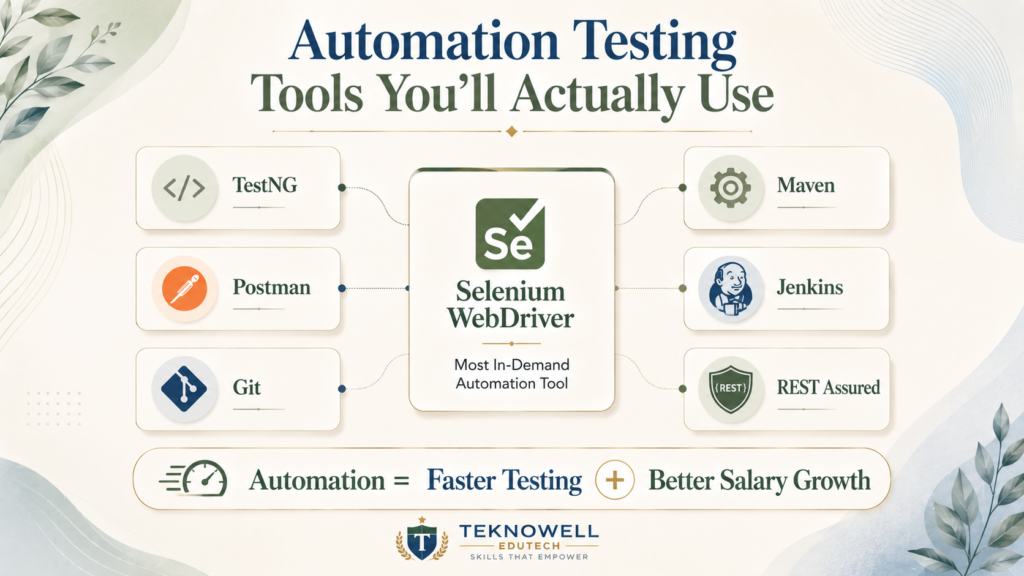
Selenium WebDriver (most in demand), TestNG/JUnit (testing frameworks), Maven (project management), Postman/REST Assured (API Testing), Cucumber (behavior-driven development/BDD), Git (version control), and Jenkins/GitHub Actions for CI/CD basics. These CI/CD concepts overlap heavily with modern DevOps workflows, which is why many automation testers eventually expand their skills into cloud and DevOps engineering.
Topics covered in the automation testing module:
Basics of core Java /Python, setup and usage of Selenium WebDriver, page object model(POM design pattern), creation and structuring of test suites using TestNG, test execution using Maven, API test automation using REST Assured, and how to integrate tests in a CI/CD pipeline.
Automation testing is good for individuals who are comfortable with writing some basic code, manual testers who want to enhance their skills, CS or IT grads who want to be in QA, but starting with a better pay package.
Pay scale of an automation tester in Pune: ₹4.5 to 8 LPA at the entry level. ₹9 to 15 LPA with 2 to 3 years of experience. There is actually a difference in the pay scale of a manual tester vs an automation tester of the same experience years.
Manual vs Automation Testing: Side-by-Side Comparison
Here’s a clean comparison so both paths are visible at once.
| Parameter | Manual Testing | Automation Testing |
| What it is | Human tester checks software manually | Scripts run tests automatically |
| Coding required | No | Yes, Java or Python basics |
| Learning curve | Shorter | Longer |
| Main tools | JIRA, TestRail, Postman, Excel | Selenium, TestNG, Maven, REST Assured, Jenkins |
| Best suited for | Non-tech freshers, career switchers | CS grads, people with basic coding knowledge |
| Entry salary in Pune | ₹3 to 5 LPA | ₹4.5 to 8 LPA |
| Mid-level salary in Pune | ₹5 to 9 LPA | ₹9 to 15 LPA |
| Job demand | Moderate and declining slightly | High and growing |
| Career ceiling | QA Lead, Test Manager | SDET, QA Architect, ₹20+ LPA |
Three things worth noting after looking at that table:
First, the salary difference is significant at every stage. Second, manual demand is softening as companies move toward Agile and CI/CD workflows that rely on automation. Third, and this is important, most companies today don’t want someone who only knows one type. They want testers who understand testing deeply and can do both.
Which is exactly why a good course teaches manual first, automation second. In sequence.
Which One Should You Learn First? Honest Answer Based on Your Background
“It depends” is the laziest answer to this question. Here’s the actual breakdown based on three different profiles.
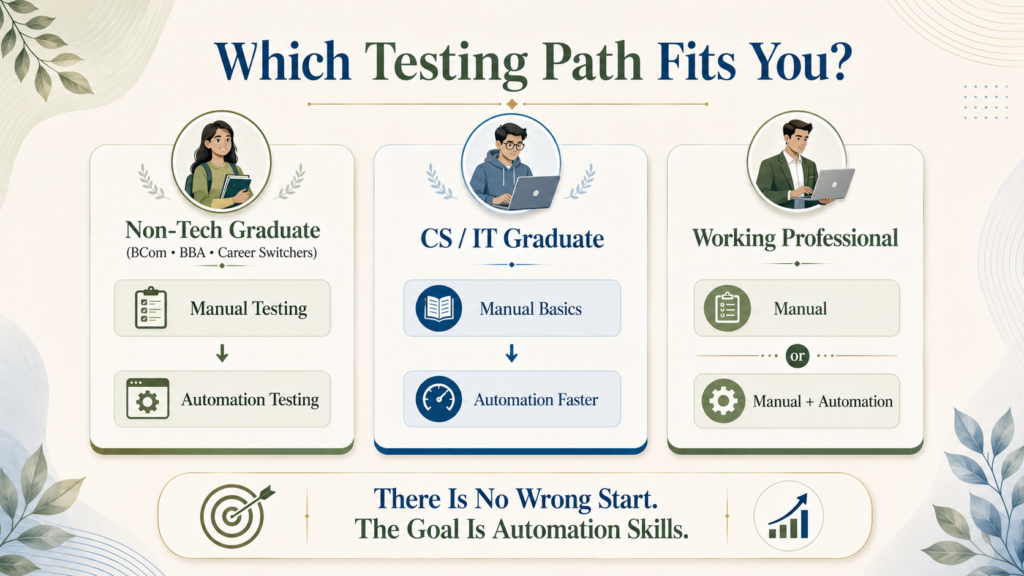
If you’re a complete fresher with no tech background (BCom, BBA, Arts, Commerce)
Start with the manual. Spend the first 6 to 8 weeks building your testing fundamentals: SDLC, STLC, test case writing, bug reporting, JIRA, Agile basics. Once that’s solid, move into automation from week 9 or 10 onward.
The reason is simple. Automation without testing fundamentals produces bad automation. You can learn to write Selenium scripts in 3 weeks, but if you don’t understand what you’re testing and why, the scripts won’t cover the right scenarios. Manual teaches you how to think like a tester first.
If you’re a CS or IT graduate, or someone who already knows basic Java or Python
You can move faster. Manual concepts still come first about 2 to 3 weeks, because understanding testing logic and methodology is non-negotiable, regardless of your coding ability. Then you move into automation earlier, around week 4 or 5.
Your advantage is that the Java or Python learning inside an automation course will feel familiar. The framework concepts on top of it are where your focus goes.
If you’re comparing this against other IT paths, the best IT courses for freshers guide covers how software testing stacks up against full stack, data science, and cloud in terms of fees, duration, and placement outcomes.
If you’re a working professional switching careers
Your decision depends on two things: how much time you have and how quickly you need to start earning in IT.
If you have 6 months and your goal is the highest possible salary at the end, aim for both manual and automation in a structured course. That’s the path with the best outcome.
If you have 3 to 4 months and need to enter the job market fast, start with manual, get placed, and upskill into automation from there. Many QA professionals do exactly this; they enter at a manual role and pick up automation on the job or through a short upskilling course within a year.
Not sure which of these profiles fits your situation? Book a free session with Teknowell’s mentors and get a specific plan mapped out for your background. No enrollment pressure, just an honest conversation about what makes sense for you.
What a Good Software Testing Course in Pune Should Actually Include
There are a lot of institutes offering software testing courses in Pune. The curriculum names look similar. The marketing looks similar. But what’s actually inside varies a lot.
Before enrolling anywhere, check for these 8 things specifically.
1. Both manual and automation, in sequence. Any course that teaches only manual or jumps straight to Selenium without building manual foundations first is not structured correctly. The sequence matters. Always manual first, automation second.
2. Live project work, not just theory. By week 3 or 4, you should be testing a real application, writing actual test cases, executing them, and logging real bugs. Not watching someone else’s demo. Hands-on. If the course has no live project, that’s a red flag.
3. Tool coverage that matches the actual job market. At minimum: JIRA, Selenium WebDriver, TestNG, Postman, Git, and Maven. If a course doesn’t cover these, you’ll enter interviews underprepared for what companies are actually asking about.
4. Trainers with real QA industry experience. Teaching experience is not the same as industry experience. Ask directly: how many years did the trainer spend working as a QA professional before teaching? Five years minimum is a reasonable bar. Someone who went from student to trainer with no industry time in between won’t prepare you for the real job.
5. Placement support that doesn’t have an expiry date: “3 months of placement assistance post-course” is a common offer that sounds fine until you realize some career switchers take 5 or 6 months to land the right role. Ask specifically: what happens if you’re not placed after 3 months? Is there a cutoff, or is support ongoing?
6. Interview preparation is built into the curriculum. Mock interviews, aptitude rounds, HR coaching, QA-specific technical questions, these should be part of the program, not an afterthought. The gap between knowing the content and performing in an interview is real, and a good course closes that gap.
7. Reasonable batch size: A batch of 40 students with one trainer means you are unlikely to get individual attention when you’re stuck. Ask the batch size before enrolling. Smaller batches cost the institute more but produce better outcomes for students.
8. Internship or live project certification. Employers in Pune’s IT corridor increasingly want to see evidence of real testing experience on your resume, not just a course completion certificate. A course that runs a simultaneous internship or provides a live project certification gives you something concrete to show.
At Teknowell, the QA and upskilling curriculum covers manual and automation in the right sequence, runs live projects alongside the training so you’re building experience from day one, and provides placement support without a cutoff date. You can explore what’s covered in our upskilling courses here.
Software Testing Salary in Pune 2026: Real Numbers
Let’s look at actual salary ranges, not the best-case-scenario numbers that show up in course marketing.
| Experience Level | Job Role | Average Salary (₹ LPA) |
| Entry Level (0–1 Year) | Manual Tester | ₹3 – 5 LPA |
| Automation Tester | ₹4.5 – 7 LPA | |
| QA Analyst (Manual + Some Automation | ₹3.5 – 6 LPA | |
| Mid-Level (2–4 Years) | QA Engineer (Manual + Automation) | ₹7 – 12 LPA |
| API Test Engineer | ₹8 – 13 LPA | |
| QA Lead | ₹10 – 15 LPA | |
| Senior Level (5+ Years) | QA Manager | ₹15 – 22 LPA |
| SDET (Software Development Engineer in Test) | ₹16 – 25 LPA | |
| Test Architect | ₹18 – 28 LPA |
These ranges are based on data from AmbitionBox and Glassdoor India for Pune-based roles. The actual number you land depends on which company, which tech stack, and how well you’ve built your portfolio and interview skills.
Companies in Pune actively hiring QA roles include Persistent Systems, Zensar Technologies, TCS, Infosys BPM, KPIT Technologies, Barclays Technology Centre, and a large number of SaaS product companies based in Hinjewadi and Kharadi. These aren’t seasonal hires. QA demand across these companies is consistent year-round.
One thing that bumps salary faster than almost anything else: adding API testing and CI/CD knowledge to your automation skills. A QA engineer who understands Jenkins pipelines, REST Assured, and GitHub Actions is in a meaningfully different salary conversation than someone who only knows Selenium. That difference can be ₹2 to 3 LPA at the same experience level.
Software Testing in Pune Is a Real, Growable Career. Pick the Right Course and Start.
Here’s what you actually know now that you didn’t before reading this:
Manual testing is the foundation. It’s accessible without coding, it gets you into a QA role, and it teaches you how to think like a tester. Automation is where salaries go up significantly, where the job market is strongest, and where long-term career lives. The best courses teach both, in sequence, with real projects and real placement support.
Pune’s IT corridor, Hinjewadi, Kharadi, Baner, Magarpatta, is hiring QA professionals consistently. This is not a “good season to apply” situation. Companies are releasing software year-round, and they need testers year-round.
The difference between people who make it in QA and people who don’t usually comes down to one thing: they picked a structured course with live projects and stayed consistent through it. The content isn’t impossibly hard. The process just requires showing up.
Want to Know Which Testing Path Makes Sense for Your Specific Background?
At Teknowell EduTech, the software testing and QA curriculum covers manual and automation in the right sequence, with live project work built into the course from week one. Trainers have real industry experience. And placement support doesn’t expire after 90 days; it continues until you’re placed in the right role.
If you’re still unsure whether to start with manual or jump into automation, book a free demo session here. It’s a 30-minute conversation where a mentor looks at your specific background, degree, current skills, timeline, goal salary, and maps out exactly what makes sense. No enrollment pitch at the end. Just clarity.