If you are a mechanical engineer working in a manufacturing unit around Chakan or a design office in Pimpri Chinchwad, chances are you have wondered whether you can shift your career to IT.
Maybe you have been thinking about it for a while. You could be curious about coding, data analytics or something else, but the same basic question keeps coming up: will IT firms hire you without a computer science degree? Do you have to start from scratch, and what happens to all your experience in core engineering?
A career transition from mechanical to IT is definitely possible in Pune. You don’t need a CS degree or years of IT experience before making the shift. What you need is a clear idea of the role that interests you, the relevant skills and a few projects that show those skills.
It will not happen overnight, but you can make this transition without starting all over again. Let’s look at where to begin and what you should realistically expect.
Can a Mechanical Engineer Get an IT Job in Pune?
Yes, a mechanical engineer can get an IT job in Pune, even without a computer science background.
Many IT organisations consider candidates from various engineering branches, especially for junior positions that need practical skills and problem-solving ability. This opens the door for non-computer science engineering graduates who are willing to build technical knowledge.
Not all organisations follow the same recruitment policy. Some recruitment drives are limited to specific branches, while certain software development jobs need a stronger grasp of computer science fundamentals.
So it is not true that a mechanical engineer cannot join an IT organisation.
However, check the eligibility before applying to an organisation. For instance, some recruitment drives are open to graduates from any branch of engineering. Equally important is building practical skills you can present in an interview.
This is what makes the career change possible with a mechanical engineering degree.
What Does a Mechanical Engineer Already Bring to IT?
One thing many engineers forget while thinking about a career change is the experience they have already built.
Think back to your years in core engineering. Have you ever tried to find out why a machine stopped working? Or why a manufacturing process did not produce the expected results?
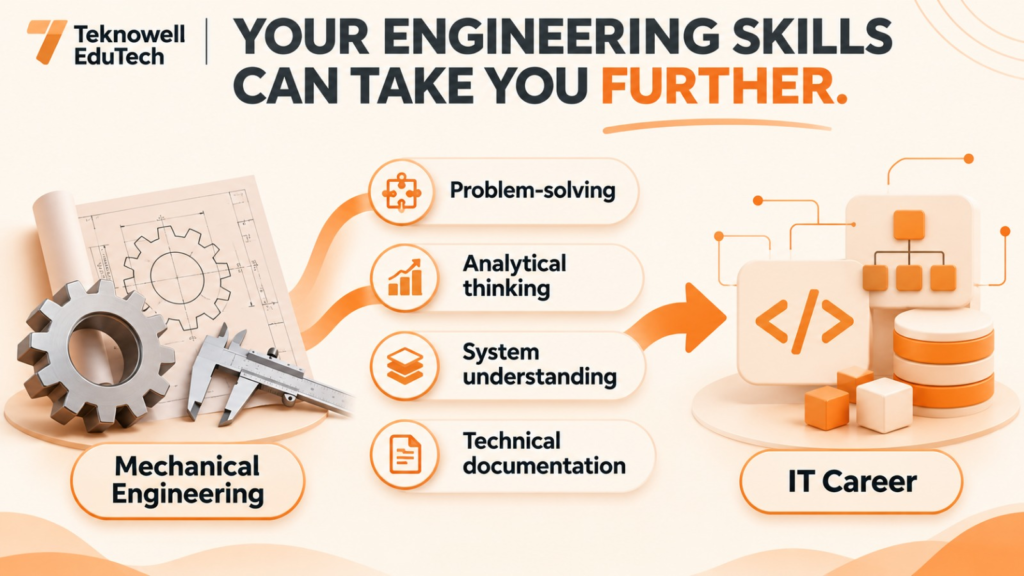
This is called root cause analysis, and it is very useful for IT testing, quality assurance and technical support professionals. Your engineering education may also have helped you build these skills:
- Problem-solving skills: Finding the true cause of a problem instead of fixing the obvious symptom.
- Analytical skills: Working with numbers, production figures and technical information.
- Systems thinking: Knowing how different parts interact and how one change can affect the whole system.
- Documentation skills: Keeping records, writing reports and explaining technical information.
All of these are transferable skills. They do not replace the need to learn SQL, programming or other IT technologies, but they give you an important base.
You are not stepping into a completely new field. You are applying your old way of thinking from a new angle.
IT Jobs for Mechanical Engineers in Pune: Which Roles Should You Consider?
Before you join a class or spend weeks on programming, take a few minutes to learn about the different types of IT careers.
Not every mechanical engineer will love coding, and that is completely fine. There are several career paths that could suit you.
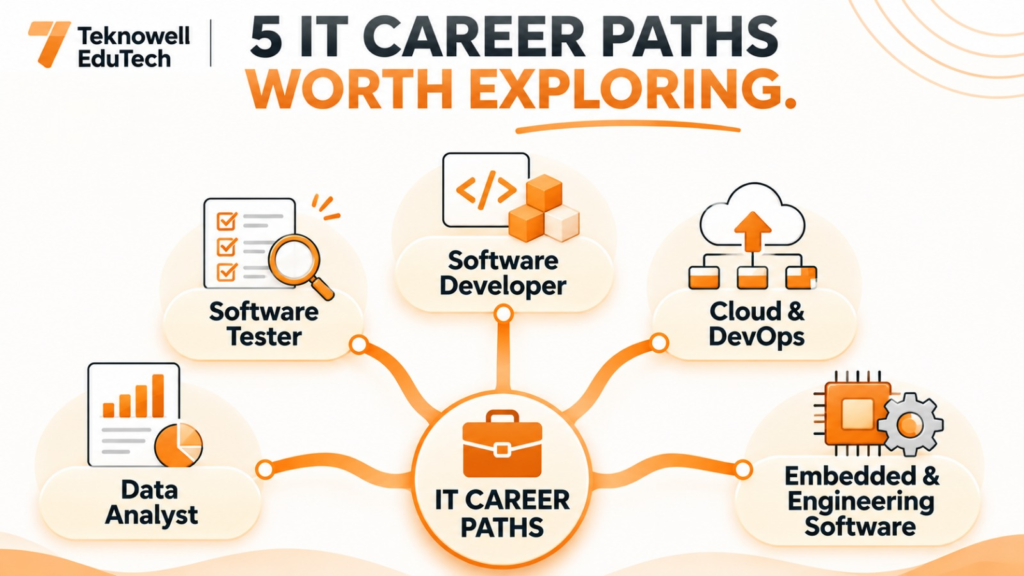
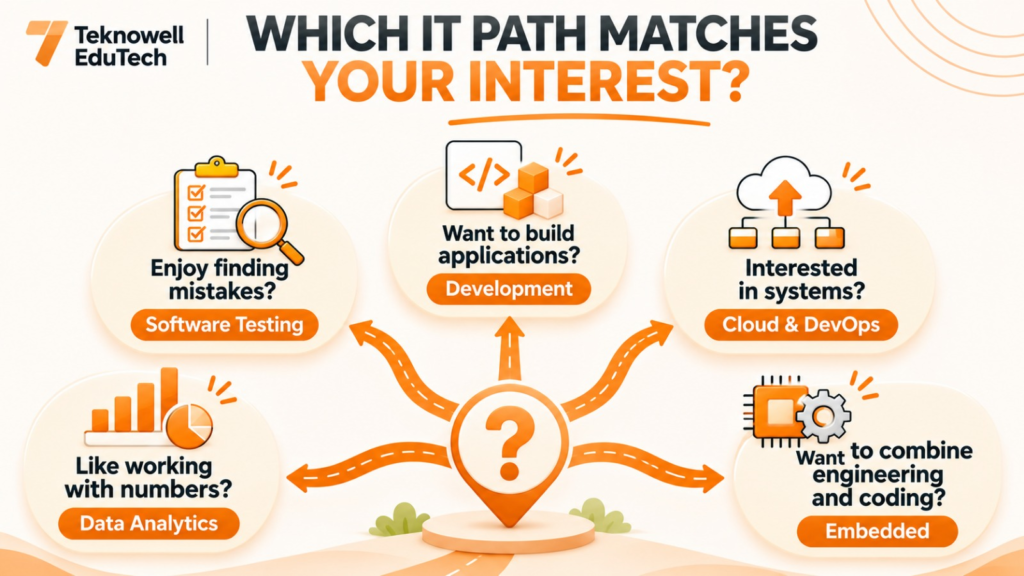
Here are five roles worth exploring:
| IT Role | Why It May Suit You | What to Learn |
| Data Analyst | Working with numbers, reports and measurements | Excel, SQL, Power BI |
| Software Tester | Identifying errors and checking processes | Manual testing, test cases, automation basics |
| Python or Full Stack Developer | Building applications and solving technical problems | Python or JavaScript, Git, frameworks |
| Cloud or DevOps Support | Understanding systems and troubleshooting issues | Linux, AWS basics |
| Engineering Software Roles | Applying programming to engineering problems | C, C++, Python and domain knowledge |
Let’s look at what these options actually involve.
1. Data Analyst
If you like working with numbers, production reports or simply Excel, data analytics may be worth pursuing.
In data analysis, you work with information, spot patterns and help organisations make better decisions.
Start with Excel, then move on to SQL and Power BI. You can use what you learned in mechanical engineering as a starting point.
For a clearer learning path, explore this data analyst roadmap for Pune. When you are ready for portfolio work, these data analytics project ideas give you a place to start.
2. Software Tester
Are you someone who always looks for mistakes and asks why things aren’t working the way they should?
Software testing could be right up your alley.
Testers check software and find defects to make sure it works the way it is supposed to. You can start with manual testing. Once you have the basics, you can move on to automation testing.
If you are not sure which one to learn, read this article on manual testing vs automation testing in Pune.
3. Software Developer
If you like building things and don’t mind writing code, you can consider development.
A shift from mechanical engineer to software engineer usually involves regular coding practice. You will need to know how to program, be comfortable with Git and pick up a framework depending on your development route.
Python and JavaScript are two options. Choose one depending on the direction you want to take. This MERN vs Python full stack comparison can help you decide.
4. Cloud and DevOps
Cloud engineer and DevOps positions involve working with systems, infrastructure, deployments and troubleshooting.
If you like knowing how different systems fit together and work, this area may appeal to you. Learn Linux and basic networking before moving to cloud platforms like AWS. Our cloud computing course in Pune covers AWS, Linux and DevOps tools.
5. Engineering Software and Embedded Roles
You don’t have to leave your mechanical engineering background behind completely.
Pune has a well-established automobile industry and a strong manufacturing base, especially in PCMC and Chakan. This creates opportunities in automotive software, embedded systems and engineering automation.
These jobs combine your core engineering knowledge with programming languages like C, C++ or Python.
So, which course should you choose?
There is no single answer to the question of the best IT course for mechanical engineers in Pune.
Depending on your interest, you can choose a data analytics course if you want to work with data, or an application development course such as Python or full stack development.
For testing, look for a course that covers manual and automation testing. The most important step is to identify the role you want first.
Where to Start: A Practical 6-Step Plan
Realising that you can change careers is one thing. Knowing what to do on Monday morning is another.
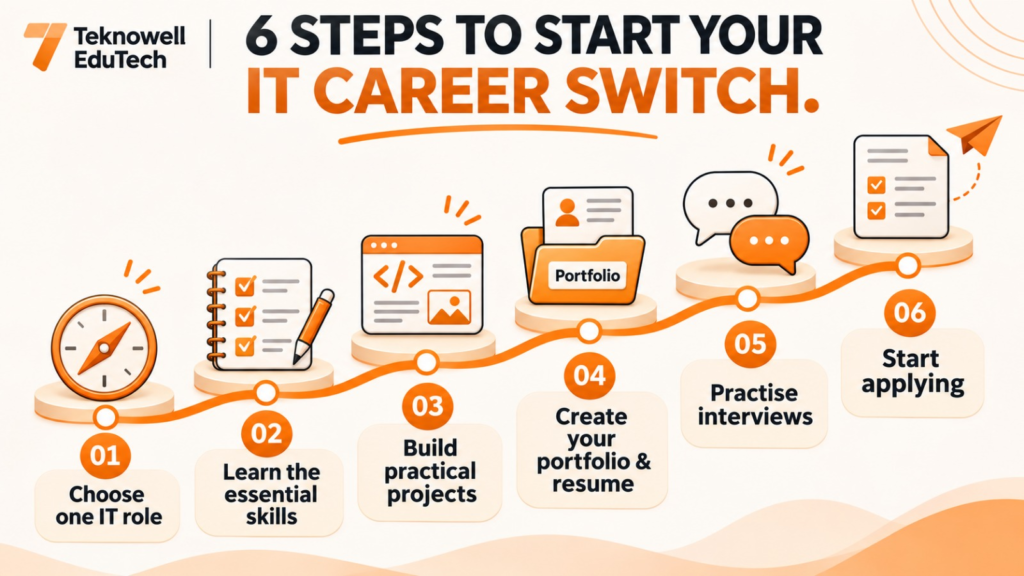
If you aren’t sure where to begin, follow these steps:
Step 1: Select one IT role. Don’t try to learn everything at once. Read several job descriptions for roles you are interested in and note which skills and tools keep repeating.
That way, you will get a clearer idea of what companies expect.
Step 2: Build your technical knowledge. Once you have selected a role, focus on its essential skills. For instance, if you plan to become a data analyst, you may start with Excel and SQL; a developer can begin with Python or JavaScript.
Take your time to absorb new information rather than rushing through tutorials.
Step 3: Focus on practical projects. This is where you start applying what you know. Think about projects related to problems you already faced as a mechanical engineer.
For instance, you can build a dashboard that shows machine downtime, analyse a report on production defects or develop an inventory management application.
The projects don’t need to be complicated. They need to show what you know.
Step 4: Build your GitHub portfolio and make your resume ATS-friendly.
Keep your projects on your GitHub profile so employers can check them. This guide on how to build a GitHub portfolio walks you through it. Also prepare an ATS-friendly resume that highlights your new technical skills without hiding your experience as a mechanical engineer.
Don’t present your earlier experience as irrelevant. Instead, show the responsibilities you handled and the problem-solving skills you built in your previous role.
Step 5: Practise for interviews. Knowing a concept is one thing; explaining it is another. Practise the questions IT interviewers commonly ask and be ready to explain why you want to switch from mechanical engineering to IT.
Do a few mock interviews with a friend or mentor. They will help you practise your answers and see where you need to improve.
Step 6: Start applying. You don’t have to wait until you have mastered every tool. Once you are comfortable with the core skills and have a few projects to talk about, start applying for relevant positions.
You will learn a lot from real interviews: what employers are looking for and what you still need to improve.
One thing worth remembering: building projects and preparing for interviews can be hard when you are doing everything alone.
At Teknowell EduTech in Pimpri Chinchwad, students learn with practical training and internship opportunities. Weekday and weekend batches are available, with online and classroom options at the Chinchwad centre.
You can book a free demo class to understand the course structure and see whether it fits your learning goals.
How to Explain Your Career Switch in an Interview
At some point, an interviewer will ask you a question that may feel a little awkward:
“You were a mechanical engineer. Why did you decide to change your career path and move to IT?”
Don’t panic. Nobody expects a long explanation or a story about your lifelong passion for programming. The interviewer only wants to know whether you have thought this step through and are really ready to change careers.
Your answer should cover three points:
- What you did in your previous role.
- What made you interested in IT.
- What steps you have taken to prepare for the transition.
For example:
“I worked as a mechanical design engineer, where I regularly analysed technical problems and improved processes. Over time, I became interested in working with data and in how technology can solve business problems. I learned SQL and Power BI and built a few projects. Now I am looking for an opportunity where I can apply this knowledge and gain more experience.”
Remember to tailor your answer to your actual experience.
One more piece of advice: avoid describing your mechanical engineering education as a mistake.
You spent several years gaining knowledge and learning how to analyse problems. That experience is valuable, whatever field you choose now.
How Long Does It Take, and What About Salary?
Let’s look at the two things career changers usually want to know before deciding: time and money.
How much time does it take?
There is no fixed timeline that applies to everyone.
If you study for 2 to 3 hours on weekdays and spend some extra time at weekends, you can build the groundwork within a few months.
But learning the skills is not everything. You also need time to complete projects, prepare your CV, practise interviews and find suitable openings.
The time needed also depends on the role you want. Preparing for an entry-level job in data analytics or testing may differ from preparing to become a full stack developer.
So there is no point in trying to become a specialist within 30 or 60 days.
Will there be a salary cut?
This is a real concern, especially if you have been working in the mechanical industry for two or three years.
Your starting salary in IT could be lower than what you earn now, because companies may value only your IT experience and not your total years of work.
That does not mean a pay cut is certain. Several factors will affect your offer, including your experience, skills, projects and the company.
Before switching, find out what your target role pays in Pune and which skills the job requires. This overview of IT jobs and salaries in Pune is a useful starting point.
Can the Switch Happen While Working in a Core Engineering Job?
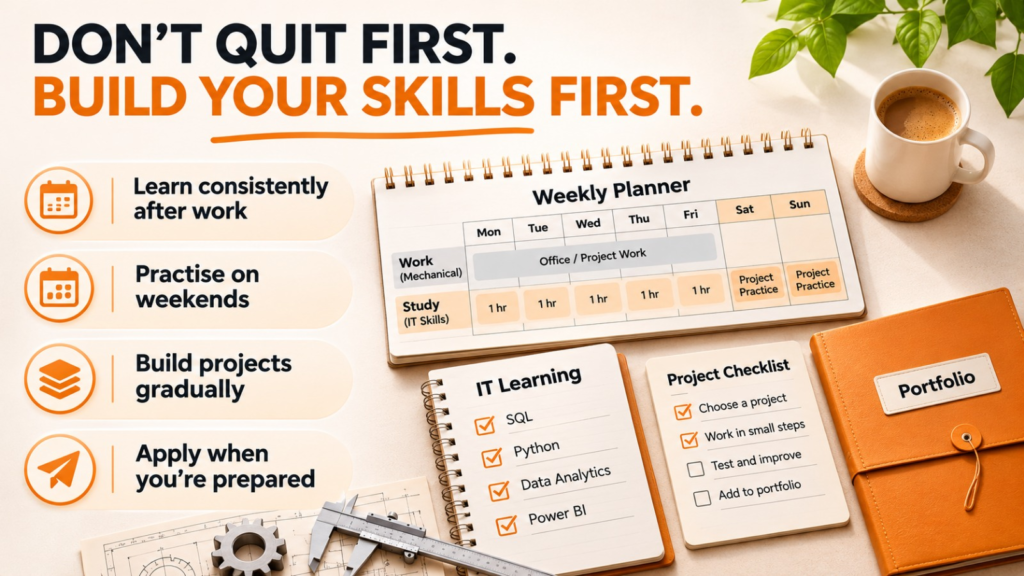
Yes. In fact, keeping your current job while preparing for an IT career is the sensible approach.
You don’t need to quit just because you want to change careers.
If you work at a manufacturing plant, shift work and project deadlines can make a strict study schedule difficult. Start with something you can keep up.
For instance, you can set aside an hour or two on fixed weekdays and use weekends for projects and revision.
And if you’re worried about making the move after several years in mechanical engineering, you may also find this guide useful: switching to IT after 30 in Pune.
The idea is to prepare yourself before making a major career decision.
Common Mistakes Mechanical Engineers Should Avoid
Changing careers gets a lot easier when you know what to avoid.
Watch out for these:
Learning too many technologies at once: Enrolling in several classes and collecting certificates may seem like a good idea, but mastering one technology helps far more than knowing several a little.
Underestimating your previous experience: Your mechanical background is not a disadvantage everywhere, so don’t hide it.
Applying without any practical experience: Finishing a course is only part of the process. Employers want to see how you apply what you learned.
Waiting for the perfect moment: You don’t need to be completely ready before applying for a job. You need a decent base.
Ready to Plan Your Career Switch?
The switch from mechanical engineering to IT is not an easy one, so it is natural to have doubts.
You may be unsure which path to take: data analytics, software testing or software development. Or you may already know the field that excites you but not which skills to learn first.
The first step is to work out where you stand and where you want to go next.
At Teknowell EduTech, you can talk through your career goals and find out how to prepare for the switch.
Book a free counselling session and take the first step towards your IT career in Pune.