

In the online vs classroom full stack course debate in Pune, there is no clear winner. Classroom courses suit students who prefer a set schedule and immediate help, and who don’t mind the commute. Online courses suit people with flexible schedules, provided the classes are live and doubts are cleared quickly. In short, what matters more than the format is the student’s schedule, the way they learn and how the institute runs both formats.
In a city like Pune, the commute alone can settle the debate. A student living in Chinchwad with free afternoons is in a completely different position from a working professional in Hinjewadi who only has evenings. Both are looking at the same full stack course in Pune and asking which format will make months of coding easier to finish. This guide compares the two formats, explains who each one suits and lists eight questions worth asking.
What’s the Difference Between Online and Classroom Full Stack Training?
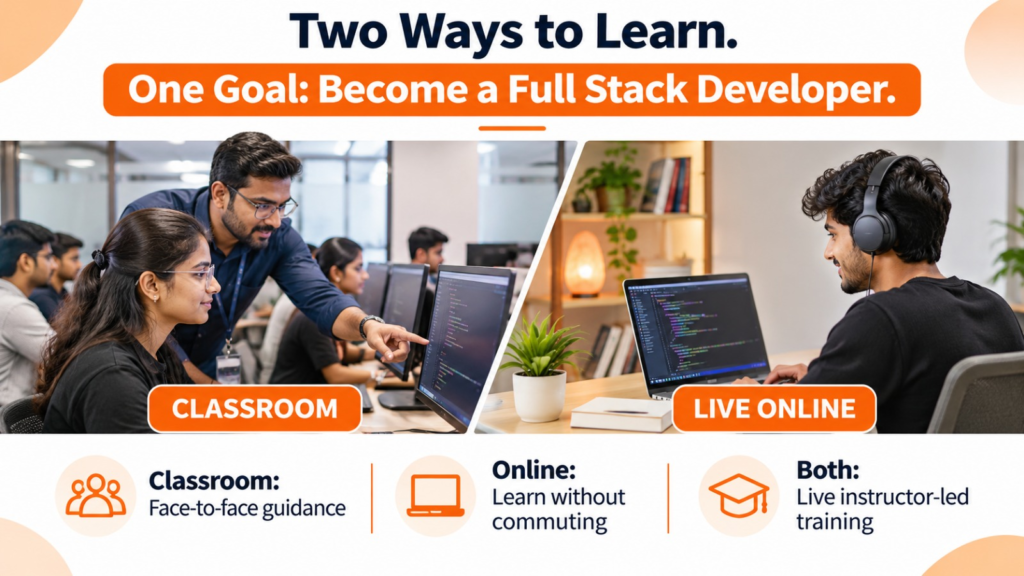
Classroom full stack training means attending sessions in person at a centre, while online full stack training in Pune means attending from home. The catch is that “online” covers very different things: live instructor-led classes, recorded videos, or a mix of both. This comparison is about live online classes versus classroom, because recorded-only courses are a different product.
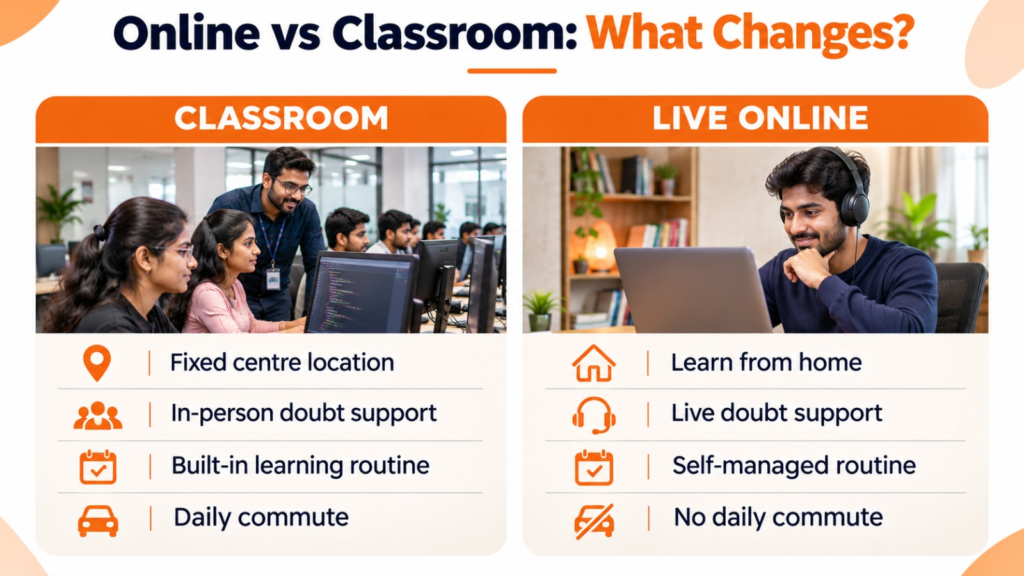
| Factor | Classroom | Live online | What to ask |
| Schedule | Fixed batch at the centre | Fixed batch from home, no travel | Which batch slots are available? |
| Doubt clearing | Face to face, instant | Instant if live, depends on the tools | How are doubts handled after class? |
| Discipline | The routine is built in | Needs self-discipline | What happens if a class is missed? |
| Commute and cost | Travel time and fare | No commute, needs internet and a laptop | What is the full cost? |
| Recordings | Depends on the institute | Depends on the institute | Are recordings available? |
None of these differences decides the question alone. They pull in different directions for different people.
Classroom Full Stack Course in Pune: Who It Suits
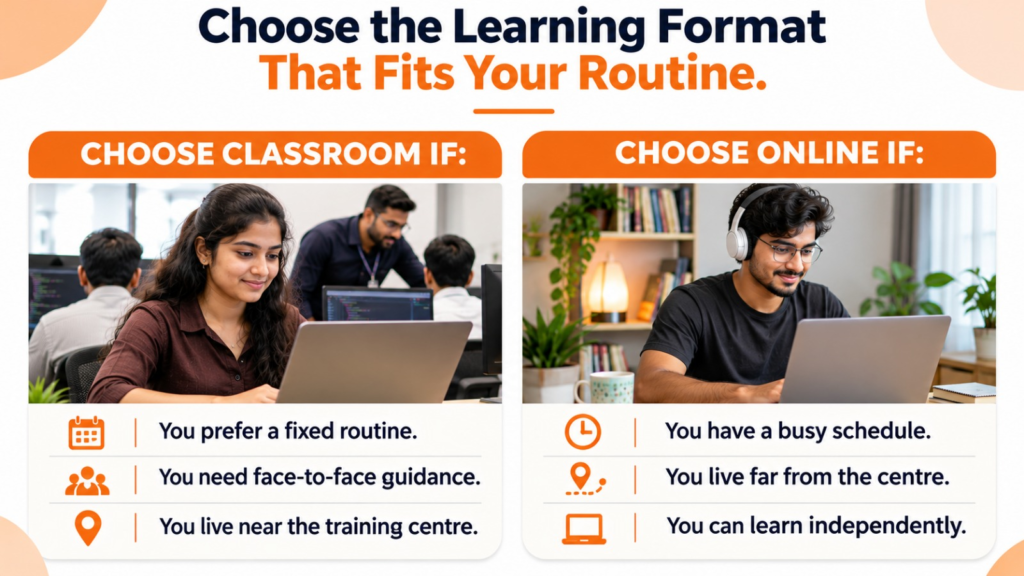
A classroom full stack course in Pune suits people who like a fixed routine, want help in person and get distracted easily at home.
The big plus is having a mentor a few feet away. Students can raise a hand when they are stuck, and debugging alongside classmates becomes part of the learning. Class time is also free from home distractions. The downside is fixed timings, a daily commute and a higher cost to missing a class. Classroom learning often works well for beginners, fresh graduates and anyone who has struggled with self-study before. For people living near Chinchwad Railway Station or elsewhere in PCMC, the commute is rarely a problem.
Online Full Stack Training in Pune: Who It Suits
Online full stack training in Pune suits working professionals, students who live far from a centre and anyone whose day leaves no room for a commute, provided the classes are live and the learner can stay disciplined at home.
The upside is time. There’s no travel, more batch options become reachable, and learning continues from anywhere. The downside is that nobody is watching. Home distractions, patchy internet and the temptation to watch passively instead of coding are the usual traps. Live online full stack classes also let someone outside the city join full stack developer classes in Pune without relocating. Online learners need to build projects actively, because a finished project is the best proof of skill, and the guide to full stack project ideas for freshers lists what to build.
Online vs Classroom Full Stack Course in Pune: Which One Should a Student Pick?
Pick classroom if structure and instant help matter most, and online if time and distance are the bigger problem. These six situations make it easier to decide:
- A final-year student with free afternoons and a short ride to the centre: classroom usually works well.
- A working professional with only evenings: online, or an evening classroom batch if the centre is easy to reach.
- A complete beginner who loses focus without a routine: classroom.
- Someone outside Pune or far from a centre: online.
- A learner returning after a career or education gap: either can work, but the one with more regular contact and quicker feedback usually helps more.
- A student who already codes a little and wants to level up: online can work well.
Some learners use both. A learner may start in the classroom to build the fundamentals and a study routine, then move online once Git, debugging and the daily process feel natural. Not every institute offers this, so it is worth asking.
Once you’ve settled on the learning format, the next step is choosing the right tech stack. This MERN vs Python full stack comparison can help you understand which path suits your goals.
Still unsure which format to choose? Teknowell EduTech offers instructor-led full stack courses online and at its Chinchwad centre. Attend a free demo class to understand the teaching style and decide which mode works best for you. Book your free demo class or explore the full stack course details.
8 Questions to Ask Before Choosing Online Full Stack Training in Pune
A classroom is easy to judge: walk in, look around, talk to people. Online takes more digging, and most of the differences hide in the details.
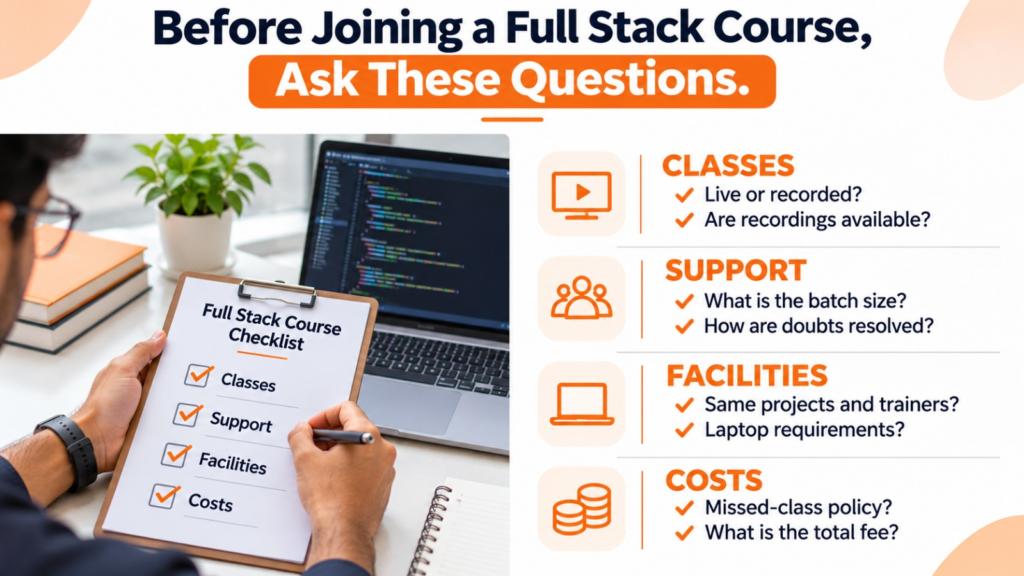
- Is the class live or recorded? A live class lets you ask questions and clear doubts as they come up. Recorded classes may not give you that chance.
- Are class recordings available? Check whether recordings are shared, in case you miss a class or want to revisit a topic.
- How many students are in a batch? Also ask how trainers help students with doubts, both in class and outside it.
- Do online students get the same trainers, projects and internship opportunities as classroom students? Check that both formats offer the same learning facilities. You can use this checklist for job guarantee courses in Pune too.
- What do you need to attend online? Check the laptop, software and internet requirements.
- What happens if your internet drops or you miss a session? Ask what arrangements are made for missed sessions.
- Are the fees the same for both formats? Compare the total cost of each. For classroom learning, add travel costs. For online learning, include the internet connection and any equipment you need.
- Can you attend a demo in the format you prefer? If you plan to study online, take the demo online, and if you prefer the classroom, take it there.
Does the Learning Mode Affect Placement?
Employers don’t usually ask how you learned. They look at your technical skills and how you perform in interviews. So the key is making sure both formats give you an equal chance to build those skills and prepare for interviews.
Before joining, ask whether online batches get the same project work, mock interviews and placement support as classroom batches. Teknowell EduTech provides placement assistance, mock interviews and internship assistance within its full stack courses. If you are considering online training, ask what is available for online batches.
How to Get the Most Out of Each Format
Any format works better when your habits fit it. In a classroom, arriving early, asking questions and coding the same day makes a big difference. In an online class, it helps to have a dedicated study space, keep your video on through the class, finish assignments right after class and set aside time every week for a project.
Working professionals often find it hard to balance work and study, which is where the guide to a career switch to IT after 30 in Pune becomes useful.
Ready to See Which Format Fits?
The best way to settle the online vs classroom question is to experience a class. Teknowell EduTech offers both formats for its full stack courses, so a demo class can be booked in whichever one feels closer to the right fit. Book a free demo class.