

You have already decided on full stack development. Good. Now you are stuck on the next question.
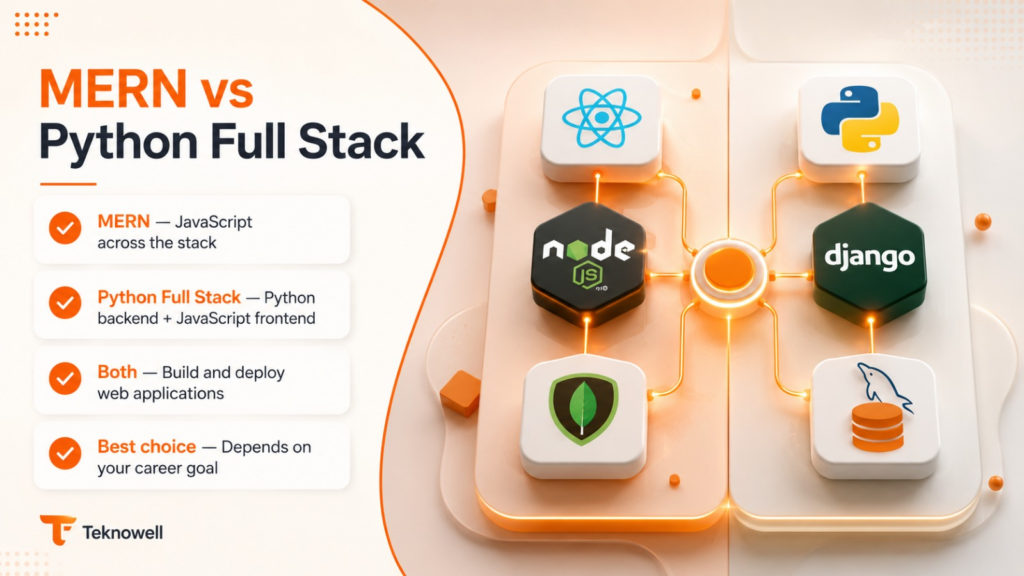
MERN or Python Full Stack? Both are popular. Both have real jobs at the end. Both are offered at Teknowell. But they are different enough that picking one and wishing you had picked the other a few months in is a real thing that happens.
So let’s settle this properly.
This blog covers what each course actually teaches at Teknowell in Pimpri Chinchwad, what each pays based on verified salary data, which one suits which type of person, and a clear recommendation at the end. No fence-sitting.
Quick answer if you are short on time:
| Factor | MERN Stack | Python Full Stack |
| Duration at Teknowell | 3 months | 4 months |
| Languages you use | JavaScript throughout | Python backend, JavaScript frontend |
| Backend framework | Node.js with Express.js | Django |
| Database | MongoDB (NoSQL) | MySQL (relational) |
| Best for | Startups, product companies, frontend-heavy roles | Beginners, backend-focused, AI-adjacent careers |
| Average base pay in India | ₹4 LPA (Glassdoor 2026) | ₹4 LPA (Glassdoor 2026) |
| Job titles | MERN Stack Developer, Full Stack JavaScript Developer | Python Developer, Full Stack Python Developer, Backend Developer |
What each course actually covers at Teknowell
A lot of comparison articles describe these courses in abstract terms. Let’s be specific about what Teknowell’s programmes actually teach.
MERN Stack: 3 months
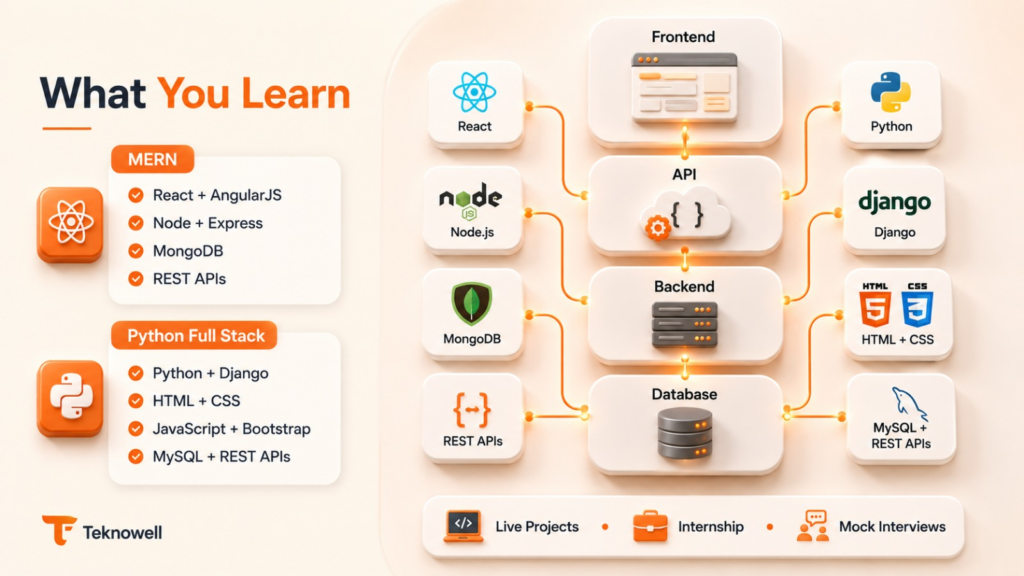
MERN is MongoDB, Express.js, React.js, and Node.js. The thing that makes MERN genuinely different from other full stack courses is the language situation. JavaScript runs on both sides: React.js builds what users see on screen, and Node.js with Express.js powers the server. MongoDB stores data in a format that looks and feels like JavaScript already. So from frontend to backend to database, you are working in one language the whole time.
Teknowell’s MERN course covers AngularJS as an alternative frontend option alongside React, REST API development, and building real applications from scratch. Students are not doing exercises in isolation; they are building things that actually work and can be deployed.
Job roles after completing the course: MERN Stack Developer, MEAN Stack Developer, Frontend Developer, Full Stack JavaScript Developer.
Who the course suits: startup-focused careers, product-based company roles, frontend-heavy applications, and developers who want JavaScript across the full stack.
Python Full Stack: 4 months
Python Full Stack is a different setup entirely. Django handles the backend; Python is the language behind it. On the frontend, students work with HTML5, CSS3, JavaScript, and Bootstrap. MySQL is the database. REST APIs connect everything together.
The reason this course runs one month longer than MERN is that it builds Python fundamentals first before moving into Django. That foundation matters because Django is a framework with real depth, and understanding what it is doing under the hood requires a solid grip on Python first.
Job roles after completing the course: Python Developer, Full Stack Python Developer, Backend Developer, Web Application Developer.
Who the course suits: beginners entering IT, backend-focused learners, students coding for the first time, and anyone interested in startup or IT services careers.
Both courses include live project work, placement assistance, mock interviews, ATS resume preparation, and an internship that runs alongside the training rather than after it ends.
Which one is genuinely easier to start with
This is probably the most common question before enrolling, and it does not have a simple answer. But it has an honest one.
About MERN and the JavaScript reality
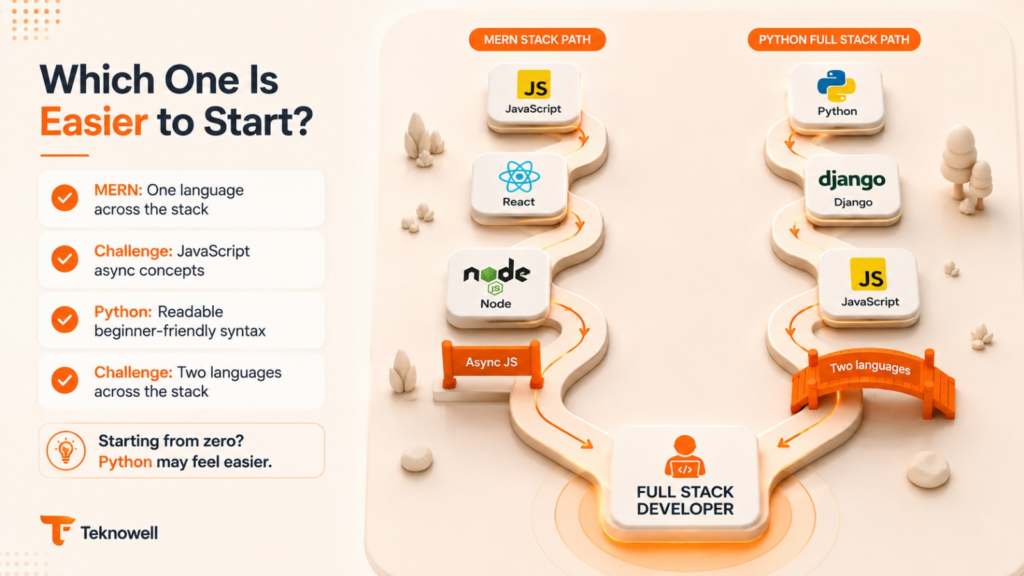
The one-language pitch for MERN sounds great on paper. One language, full stack, clean setup. In practice, JavaScript has some real complexity that catches beginners off guard. Asynchronous code callbacks, promises, async/await that’s not how most people naturally think about programming when they first start. And the difference between how JavaScript behaves in a browser versus how Node.js runs it on a server is not immediately obvious.
None of that is insurmountable. Students work through it. But if you have never seen an async function before and suddenly need to understand how Node.js handles a server request without blocking, the first few weeks have a specific kind of friction to them.
Where MERN has a clear advantage: if you have any prior JavaScript exposure at all from a college elective, from self-study, from building even a basic website, MERN builds directly on that. The pace is faster over 3 months, and React is genuinely one of the most relevant skills you can have when applying to startups in Pune.
About Python Full Stack and the two-language reality
Python has a reputation for being beginner-friendly, and it is earned. The syntax is readable in a way that most other languages are not. Logic in Python often reads close to how you would describe a process in plain English. For someone who has never written a line of code before, starting with Python genuinely feels less intimidating than starting with JavaScript.
Django builds on that with a framework that is opinionated in a helpful way. It makes a lot of decisions for you so you can focus on building rather than endlessly configuring. Many students find that Django’s structure actually helps them understand web application logic more clearly than a more minimal framework would.
The honest trade-off: Python Full Stack means learning two languages instead of one. Python on the backend, JavaScript on the frontend. The JavaScript depth required for the frontend in this course is not as heavy as in MERN, so it is manageable, but it is worth knowing before you enroll.
The bottom line on difficulty
Neither course will break someone who is genuinely trying. MERN has the async JavaScript hurdle. Python Full Stack has the two-language context switch. Students with any JavaScript background find MERN’s rhythm easier in the first month. Students starting from zero with no coding experience whatsoever find Python Full Stack’s opening weeks less overwhelming. That is the genuine pattern.
What each track pays: current Glassdoor salary data
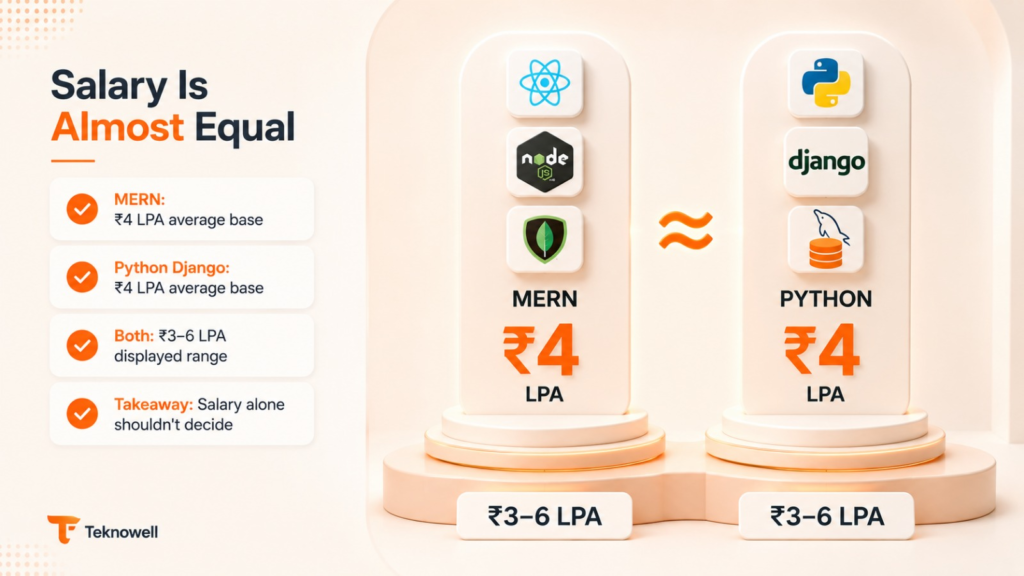
According to Glassdoor India, the current average base pay shown for a MERN Stack Developer in India is ₹4 LPA, with a displayed base-pay range of ₹3–6 LPA. The Glassdoor page currently shows 50 recent salary submissions
For Python Django Developers, Glassdoor currently shows an average base pay of ₹4 LPA in India, with a displayed base-pay range of ₹3–6 LPA. The page currently shows 50 recent salary submissions.
At the entry level, the current Glassdoor figures suggest that the two paths have broadly similar salary levels. Actual fresher packages in Pune will vary based on technical skills, projects, interview performance, and the company hiring.
| Salary indicator | MERN Stack | Python Django |
| Average base pay in India | ₹4 LPA | ₹4 LPA |
| Displayed base-pay range | ₹3–6 LPA | ₹3–6 LPA |
| Average additional salary shown | ₹24K | ₹55K |
| Current Glassdoor submissions shown | 50 | 50 |
What does that actually tell you? The current Glassdoor figures do not show a meaningful difference in average base pay between the two. So salary alone is not a strong reason to choose MERN over Python Full Stack, or vice versa. Your skills, projects, experience, location, and the type of company you join will have a much bigger influence on your actual package.
Where Python has an advantage: AI and data
Salary data alone does not give Python Full Stack an advantage, but Python does have a clear ecosystem advantage if you eventually want to move into AI, machine learning, data science, or automation. Python is widely used across these fields, so a developer who already knows Python can build on the same language rather than starting from scratch with another one.
That does not mean every Python Full Stack developer will earn more. It simply gives you a more direct route into adjacent technology fields if your interests change later.
Where MERN can have an advantage
MERN can be a strong choice for candidates targeting product companies and startups where React and Node.js are part of the technology stack. React experience can also open frontend and full stack roles beyond jobs that are specifically advertised as “MERN Stack Developer.” For experienced developers, the combination of React, Node.js, TypeScript, and modern frameworks can lead to strong opportunities, but the salary advantage depends heavily on the company and the individual’s skill level rather than the MERN label itself.
Jobs in Pune: which has more openings?
MERN stack jobs in Pune are concentrated in the startup belt: Baner, Balewadi, Hinjewadi, parts of Kharadi. Startups love MERN because one language across the stack means faster development with smaller teams. Frontend-heavy product companies with existing React codebases specifically look for Node.js backend developers who already understand how React thinks. Job postings for MERN Stack Developer and Full Stack JavaScript Developer roles at Pune startups are consistently active throughout the year. We have covered the hiring side in more detail in MERN stack jobs in Pune for freshers.
Python full stack roles come from a wider spread. IT services companies use Python backends on client projects. Startups building data-driven products often choose Django for its depth and convention. And in 2026, AI-first companies building Python backends specifically need full stack developers who are already working in Python. The Python Django developer career path in Pune runs across fintech, edtech, health tech, and enterprise software, not just startups.
On raw volume, MERN has more absolute job postings across India. But Python Full Stack opens a wider range of company types, and for candidates eventually interested in GCC roles in Pune’s Kharadi and Viman Nagar belt, Python’s connection to data science is a meaningful long-term advantage. The GCC jobs Pune guide covers what those companies look for and how the hiring process works specifically.
The full comparison across eight factors
| Factor | MERN Stack | Python Full Stack |
| Course duration at Teknowell | 3 months | 4 months |
| Backend language | JavaScript via Node.js | Python via Django |
| Database used | MongoDB (NoSQL) | MySQL (relational) |
| Frontend technologies | React.js and AngularJS | HTML5, CSS3, JavaScript, Bootstrap |
| Best company fit | Startups, product companies | Startups, IT services, AI-first companies |
| Average base pay in India | ₹4 LPA (Glassdoor) | ₹4 LPA (Glassdoor) |
| AI and data science path | Separate upskilling needed | Natural extension of existing Python skills |
| Best starting point for | JavaScript-familiar or frontend-leaning | Complete beginners or backend-preferring students |
Which one is actually right for you
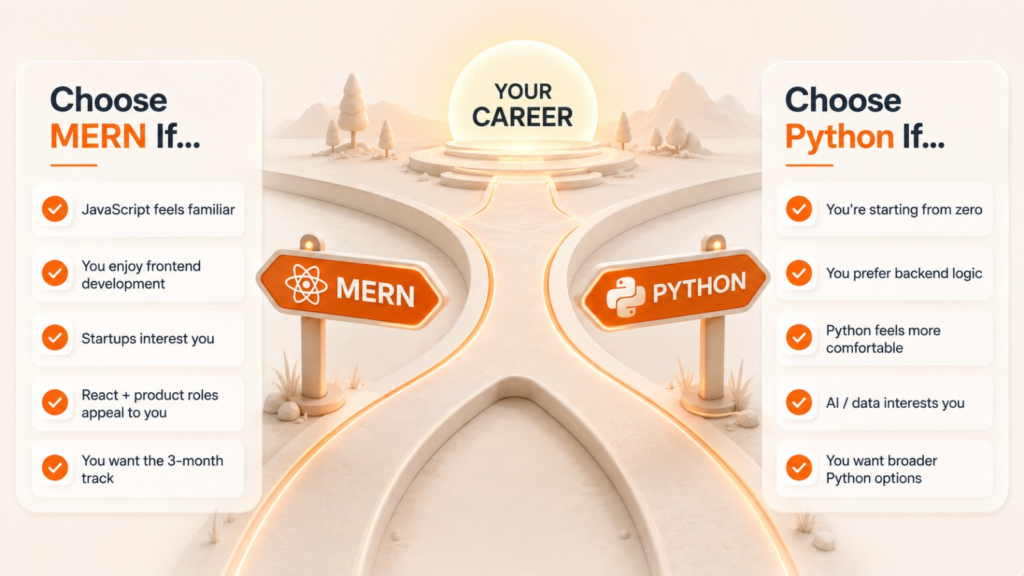
MERN makes more sense if JavaScript already feels somewhat familiar, even just from a college web design course or basic self-study. The 3-month duration is appealing if getting into the market sooner is a priority. React skills are relevant everywhere in Pune’s startup ecosystem. If the idea of building what users actually see and interact with is what excites you about development, MERN is the natural fit.
Python Full Stack makes more sense if starting from zero with no coding background. Django’s structure is genuinely helpful for people building their first real applications. And if there is any chance that data science or Gen AI interests you in the next few years, Python is already the language those fields run on; starting with Python Full Stack means that door stays open rather than requiring a separate language investment later.
Teknowell’s full stack development courses page has the full curriculum for both tracks alongside batch schedules, mode options, and everything you need before making the call.
If you are torn between Java vs Python rather than MERN and Python, the Java vs Python comparison covers that specific decision in detail. And if the Python question is actually broader data science versus web development, the Python data science vs web development comparison is worth reading before committing to the full stack direction at all.
Not sure which direction actually fits after reading all of that?
Sit in a demo class for each. Teknowell runs free demo sessions for both MERN and Python Full Stack at Pimpri Chinchwad. An hour in a live class tells you more about whether a course suits you than any amount of reading.
Book a free demo at Teknowell, Pimpri Chinchwad. Mention which track you want to see, or say you are undecided, and the team will help you figure it out.
Can you switch from one to the other later
Yes, and it is not as complicated as it sounds.
Both stacks share a meaningful foundation. HTML and CSS, JavaScript on the frontend, REST API design, Git, the general logic of how web applications work all of that carries across completely. What does not carry across is the backend language and database layer, and that is genuinely the part that takes time to learn.
Going from MERN to Python Full Stack: adding Python and Django on top of solid MERN knowledge takes roughly 6 to 8 weeks of focused effort. The web concepts, API patterns, and Git workflow all stay the same. What changes is the language the server is written in.
Going from Python Full Stack to MERN: React and Node.js are the additions. Python Full Stack students already use JavaScript on the frontend, so Node.js is less of a leap than it would be for someone coming from a completely different background. Four to six weeks of focused learning to get comfortable with MERN is realistic.
Neither switch is a restart. It is more like adding a module.
Picking one is not as permanent as it feels
Here is the thing about this decision. It feels high-stakes because you are about to commit months of your time to a direction. But the reality is that the foundational skills both tracks build how APIs work, how databases connect to backends, how to use Git, how to build and deploy a real application are largely shared.
MERN Stack is the right call if JavaScript feels comfortable to you, you want to be in the market in 3 months, and startup or product company roles in Pune are the goal. Python Full Stack is the right call if you are starting from scratch, prefer backend logic over frontend design work, or have any interest in data science or AI as a direction further down the road.
Either way, build real projects during the course. That matters more than the stack you chose.
Book a free demo at Teknowell to see the curriculum for whichever track you are considering before you decide.