

You did BCom or BBA. Maybe you chose it because it made sense at the time. Maybe someone in your family suggested it. Maybe you genuinely liked business and finance. Whatever the reason, you’re here now, a few years in, looking at IT job listings paying 6, 8, sometimes 12 LPA, and wondering if that world is even accessible to you.
And somewhere in the back of your head, there’s this voice saying: “IT is for engineers. I missed that ship.”
Here’s what we want you to know before we go any further: that voice is wrong.
Completely wrong.
Companies like TCS, Infosys, Wipro, and hundreds of growing product startups across Pune, Bangalore, and Hyderabad hire non-engineering graduates every single year, for Business Analyst roles, Data Analyst positions, QA teams, ERP implementations, IT sales, and more. According to the India Skills Report 2026, commerce graduates’ employability has risen sharply, a sign that the IT and business technology sector is actively opening up to non-engineering talent.
The switch is real. People are doing it. And a BCom or BBA background isn’t the barrier you think it is; in many cases, it’s actually an advantage.
This guide will walk you through everything: which IT roles actually suit a commerce background, how to get there step by step, what a realistic timeline looks like, and what salary you can genuinely expect. No fluff, no motivational poster language. Just the actual plan.
Quick answer: Can a BCom or BBA graduate get an IT job?
Yes. Especially in roles like Business Analyst, Data Analyst, ERP Consultant, QA Analyst, and IT Sales. These roles value business thinking, communication, and domain understanding, exactly what a commerce degree builds. For technical roles like Data Science or Full Stack, the switch takes 6 to 9 months of structured learning but is absolutely achievable.
The “IT Is Only for Engineers” Myth Let’s Actually Kill It
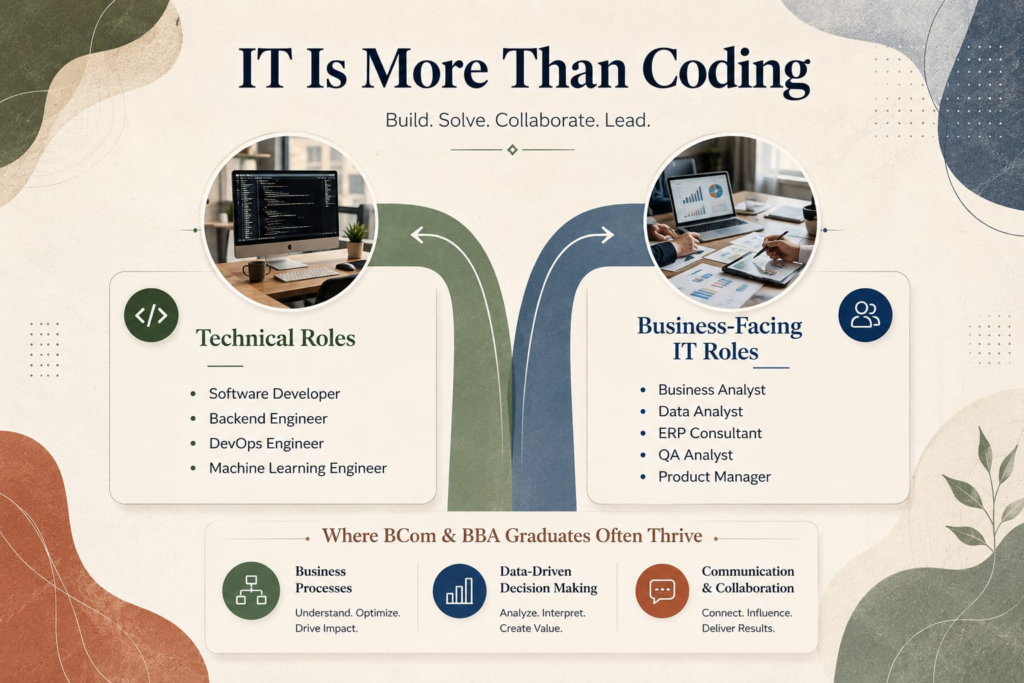
Let’s be really clear about something. The IT industry is not one thing. It’s a massive ecosystem with dozens of different roles, and most of those roles do not require you to write complex algorithms or build operating systems from scratch.
Here’s the real divide:
On one side, you have deeply technical roles: software engineers, backend developers, DevOps engineers, and machine learning researchers. These roles do require engineering fundamentals and typically suit CS or IT degree holders.
On the other side, you have business-facing IT roles: Business Analysts who translate between tech teams and business stakeholders, QA Analysts who test software and find bugs, ERP Consultants who implement financial systems, Data Analysts who pull insights from numbers, Product Managers who shape what gets built and why. These roles need sharp business thinking, strong communication, process understanding, and domain knowledge far more than they need advanced programming.
And here’s the kicker: a BCom or BBA graduate is often better prepared for that second category than a freshly graduated computer science engineer.
Why? Because you already understand how businesses work. You understand financial statements, business processes, client relationships, and organizational structure. A CS engineer has to learn all of that on the job. You’re walking in with it already.
That’s not a consolation prize. That’s a genuine competitive advantage in the right roles.
The students at Teknowell who come from commerce backgrounds often adapt faster to Business Analyst and Data Analyst training than engineering grads because they already think in business outcomes. They ask better questions. They understand the “why” behind the data. And companies notice that.
7 IT Roles That Are a Genuinely Great Fit for BCom and BBA Graduates
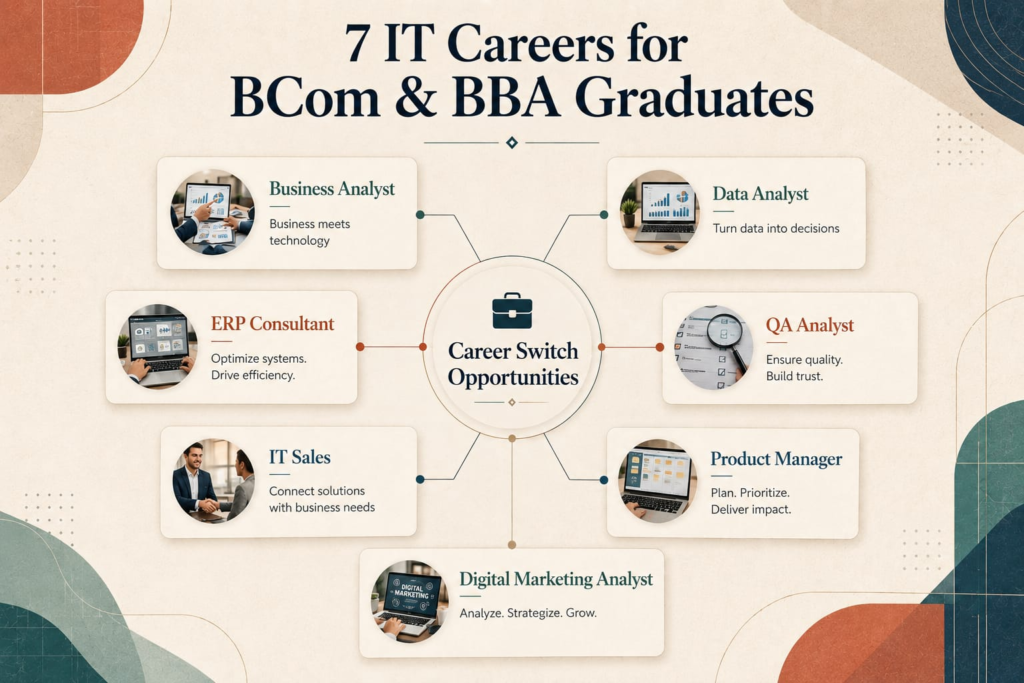
Okay, let’s get specific. Here are 7 roles where your commerce background works for you, not against you.
1. Business Analyst (BA)
This is likely one of the most fitting roles for BCom and BBA students who wish to transition into the world of IT.
A Business Analyst acts as a link between the requirements of a business and the development that happens in the technology team. It involves gathering requirements from various stakeholders, documenting processes, writing user stories, and collaborating with the developers to ensure the deliverables solve the problem.
Requirements: communication skills, process orientation, documentation of requirements, and some basic skills in JIRA, Confluence, and Excel. Coding not necessary.
Why BCom / BBA makes sense: Because you have an understanding of business processes and finance flows.
Salary range: Starting BA salary in India: ₹4 to 7 LPA. Experienced BA with 4-5 years experience: ₹10 to 15 LPA.
2. Data Analyst
As BCom students already deal with numbers, Data Analytics is the same thing with the use of some tools like advanced Excel, SQL, basics of Python programming, and data visualization tools such as Power BI/ Tableau.
A data analyst gathers the data, analyzes, visualizes, and draws conclusions, and shares those insights with the people who make the decisions. This is a business position that just happens to be done using some technology, and one does not have to be a programmer to excel in this field.
Starting Salary in India: ₹4 to 8 LPA. After working for 2 to 3 years: ₹8 to 12 LPA.
If you find the above-mentioned career interesting, we have specialized in Data Science programs at Teknowell designed specifically for you.
3. ERP Consultant (SAP / Oracle)
This one is massively underrated in the career-switch conversation.
ERP systems like SAP and Oracle manage everything from finance to supply chain to HR in large companies. Implementing and configuring them requires a deep understanding of business processes, accounting, procurement, inventory, and payroll, not deep coding.
And who has the best foundational knowledge of those business processes? Commerce graduates.
ERP consulting is a high-demand, well-paying niche. After a proper SAP certification, freshers are landing roles at ₹5 to 9 LPA, with senior ERP consultants earning ₹15 to 25 LPA.
4. QA Analyst (Quality Assurance)
QA is about making sure software works the way it’s supposed to. You write test cases, test features, find bugs, and report them clearly. It requires logical thinking, attention to detail, and good documentation skills, not advanced programming.
Many QA professionals start without writing a single line of code. Over time, some move into automation testing (which does involve scripting), but entry-level QA is genuinely accessible to non-engineers. We explain this route in detail in our guide to software testing without coding.
Starting salary in India: ₹3.5 to 6 LPA. Automation QA with 2 to 3 years: ₹7 to 12 LPA.
5. IT Sales and Pre-Sales
BBA graduates especially tend to thrive here. IT Sales and Pre-Sales roles involve understanding a software product deeply and then communicating its value to potential clients. You’re the link between the product team and the customer.
Pre-Sales specifically often involves creating demos, responding to RFPs (Request for Proposals), and customizing pitch decks, all things that require business communication far more than technical depth.
Starting salary in India: ₹4 to 7 LPA plus incentives. Senior pre-sales: ₹12 to 20 LPA.
6. Product Manager / Associate Product Manager
This is the “dream role” for many career switchers, and honestly, it suits BCom and BBA backgrounds extremely well.
A Product Manager decides what gets built, in what order, and why. It’s about understanding the market, the customer, the competition, and the business model, and then working with engineers to ship the right thing.
You don’t write code as a PM. You write a strategy. And that is very much a commerce skill set.
Getting here typically takes 2 to 3 years in a related IT role first (BA, QA, or IT operations), but the path is real, and the payoff is significant.
Salary range: ₹8 to 18 LPA depending on company and experience.
7. Digital Marketing Analyst
This one sits right at the intersection of business and technology, and it’s an entry point that many BCom graduates don’t consider.
Digital marketing today is data-heavy. Running paid campaigns on Google and Meta, tracking performance in analytics dashboards, doing SEO and content strategy, all of it involves tools, data, and systematic thinking. Your BCom foundation in marketing and business strategy is directly applicable here.
Starting salary: ₹3 to 6 LPA. With 2 to 3 years and strong performance data: ₹7 to 12 LPA.
How to Switch to IT After BCom or BBA: A Realistic Step-by-Step Plan
No vague advice here. This is the actual sequence that works.
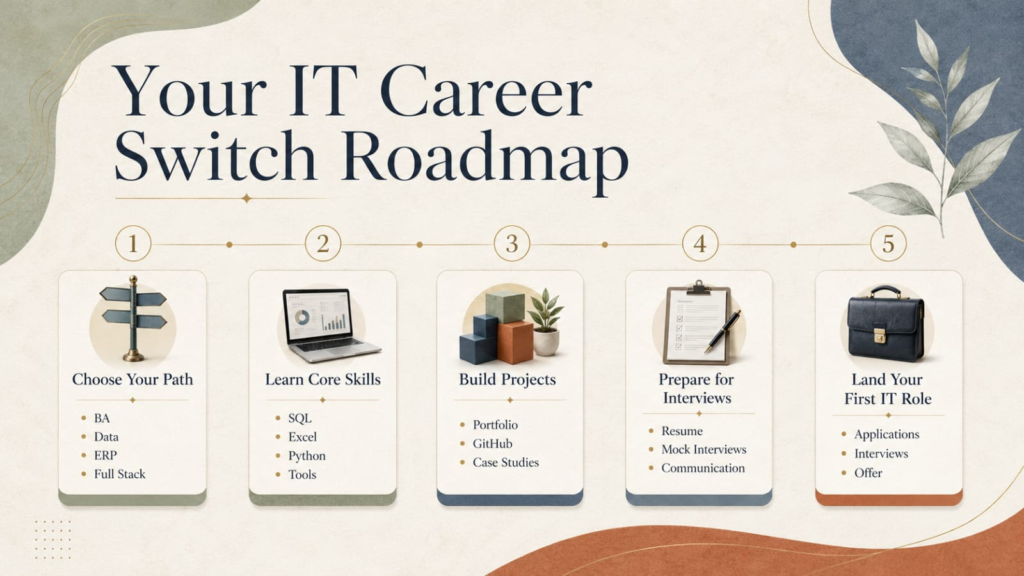
Step 1: Decide which IT path actually fits you
Before you pick a course, pick a direction. Because a Data Analyst and a Business Analyst need different skills, and a QA Analyst and a Full Stack Developer need very different training.
Ask yourself honestly:
- Do you enjoy numbers, patterns, and finding trends in data? Go toward Data Analytics or Data Science.
- Do you enjoy talking to people, understanding problems, and translating them into clear requirements? Go toward Business Analyst roles.
- Are you genuinely curious about how software is built and willing to learn to code? Consider Full Stack Development.
- Do you have a background in finance or accounting and want the highest-paying non-technical IT path? Look at ERP / SAP consulting.
Take 2 to 3 days with this question. It’s the most important decision in this process.
Step 2: Pick a structured course and commit to it
Self-learning from YouTube is possible. But for a career switch, it’s usually too slow and too unstructured. You need a course that covers the right things in the right order, gives you live projects you can actually show employers, and ideally includes internship experience.
Not every course is equal. Before enrolling anywhere, ask three questions: Does it include live projects? Is there placement support? Do trainers have actual industry experience?
At Teknowell, every course runs with a simultaneous internship so students are building real portfolio projects from day one, not after they finish. If you’re looking at Data Science, our Data Science course page breaks down exactly what’s covered. For Full Stack, check this page. For business-facing IT roles and upskilling, our upskilling courses cover BA fundamentals, tools, and more.
Step 3: Start learning before the course begins
This sounds unnecessary, but it makes a real difference. Before your course starts, spend 2 to 3 weeks with the basics:
- Excel (advanced functions, pivot tables, VLOOKUP): free YouTube tutorials are genuinely good for this
- SQL basics: There are free interactive platforms like SQLZoo and Mode Analytics
- Python intro (if you’re going the Data or Full Stack route): just the absolute basics, variables, loops, functions
You don’t need to master any of this. You just need to not start from absolute zero when the course begins. It changes how fast you pick things up in the first few weeks.
Step 4: Build 2 to 3 projects that combine your commerce brain with your new tech skills
This is where most guides go generic. Let me be specific.
The best projects for a BCom or BBA switcher are ones that use your domain knowledge plus your new technical skills. Not just a generic beginner project, something with a business angle.
Examples that actually work well in interviews:
A sales performance dashboard built in Power BI or Tableau using a public dataset. A financial data analysis notebook in Python that tracks revenue trends and anomalies. A simple inventory management system built as a web app. A business case study supported by data: “Here’s a dataset from a retail company, here’s what the data tells us, here’s what I’d recommend.”
Projects like these show something most freshers don’t show: that you can connect business thinking and technical execution. That’s rare. Recruiters notice it.
Step 5: Rebuild your resume for IT
Your BCom or BBA resume is probably optimized for traditional roles. For IT, you need to reframe it.
A few specific things:
Don’t hide your commerce background. Instead, frame it as domain expertise. “Understanding of financial processes and business operations” is genuinely attractive to companies hiring Business Analysts or ERP consultants.
Add a technical skills section that lists your new tools clearly: SQL, Python, Excel, Power BI, JIRA, whatever you’ve learned.
Lead with your projects. Create a portfolio section right near the top of your resume and link to your GitHub or any live projects.
Step 6: Target the right companies for your first IT role
Not all IT companies work the same way. For career switchers, some environments are much more welcoming than others.
Service companies (TCS, Infosys, Wipro, Cognizant) hire at scale and often have specific programs for non-CS graduates. They’re a solid first entry point, especially for BA, QA, and IT support roles.
Mid-size product companies (think 200 to 2,000 employees) are often the sweet spot for career switchers because they value practical skills over pedigree. If you have good projects and can articulate what you know, they’ll often give you a shot that a large company might not.
Startups are hit or miss. Some startups love career switchers because they bring a fresh perspective. Others are too resource-constrained to train someone who’s new to the field. Research carefully before applying.
If you’re worried that your lack of IT experience will make employers ignore your applications, that’s not necessarily true. We’ve broken down exactly how freshers and career switchers can position themselves effectively in our guide on How to Get an IT Job Without Experience.
Step 7: Prepare for the “why IT” question
Every single interview for a career switcher includes some version of this: “Why are you switching to IT after BCom / BBA?”
This question feels scary. It isn’t. You just need to own your answer.
Don’t apologize for your degree. Don’t say “I regret doing BCom.” Instead, explain the logic: you saw where IT was going, you recognized that your business background gave you a unique angle, and you made a deliberate decision to combine domain knowledge with tech skills.
That’s not a weakness story. That’s a strategy story. And hiring managers respect people who think strategically about their careers.
Also prepare for: technical screening questions specific to your chosen role, case study rounds (especially for BA positions), and tool-based tests (SQL queries, Excel tasks, data interpretation).
We wrote a detailed breakdown of what each interview round looks like across different IT roles in this guide: How to Prepare for a Software Developer Interview. Even if you’re not going for a developer role, the sections on aptitude rounds, communication rounds, and case studies are directly relevant for BA, QA, and data roles.
How Long Does It Actually Take?
Let’s be honest about this, because most articles either make it sound too easy or too hard.
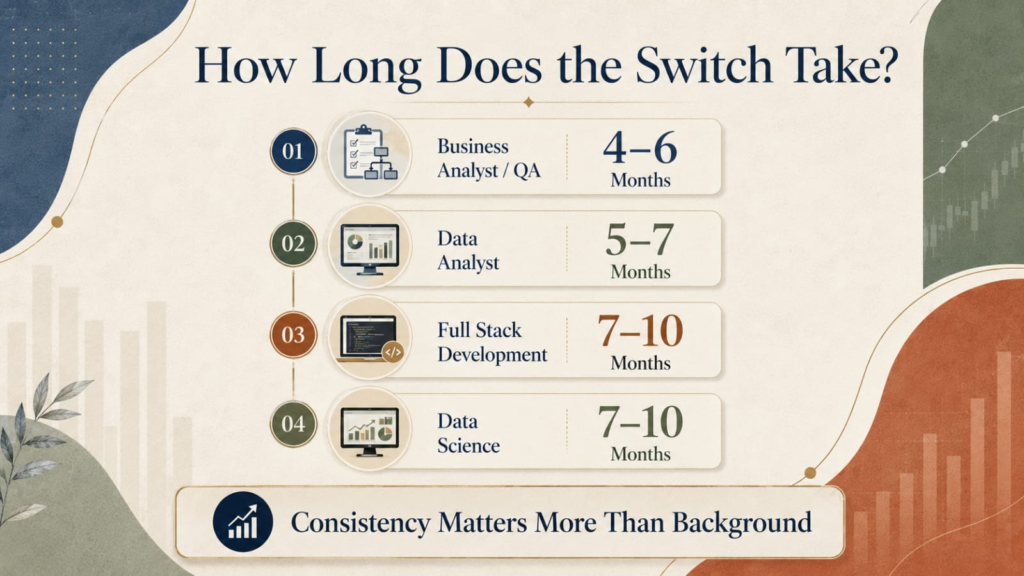
The realistic timeline, based on what we see at Teknowell:
Business-facing roles (BA, QA, ERP, IT Sales): 4 to 6 months. These roles don’t require great technical skills, so the ramp-up is faster. If you’re consistent, 4 months of structured training plus 1 to 2 months of job prep is achievable.
Data Analyst: 5 to 7 months SQL, Python, Excel advanced, Power BI, or Tableau; these take time to get comfortable with. Add a month for building proper portfolio projects.
Full Stack Development or Data Science: 7 to 10 months. More technical depth required. This is a longer runway, but the roles are higher-paying, and the path is well-defined.
Here’s what affects your timeline more than anything else: how many hours a day you’re putting in and whether you have a structured environment or you’re self-studying randomly.
At Teknowell, the internship and course run at the same time. So while you’re learning, you’re also building real projects. That compresses the timeline significantly because you’re not spending months after the course just trying to figure out what to build for your portfolio. It’s already done.
What Salary Can You Actually Expect?
Let’s look at real numbers.
| Role | Entry Level (0–1 Year) | Mid Level (2–4 Years) |
| QA Analyst | ₹3.5–5.5 LP | ₹6–10 LPA |
| Business Analyst | ₹4–7 LPA | ₹8–13 LPA |
| Data Analyst | ₹4–8 LPA | ₹9–15 LPA |
| ERP / SAP Consultant | ₹5–9 LPA | ₹14–22 LPA |
| IT Sales / Pre-Sale | ₹4–7 LPA + incentives | ₹8–15 LPA + incentives |
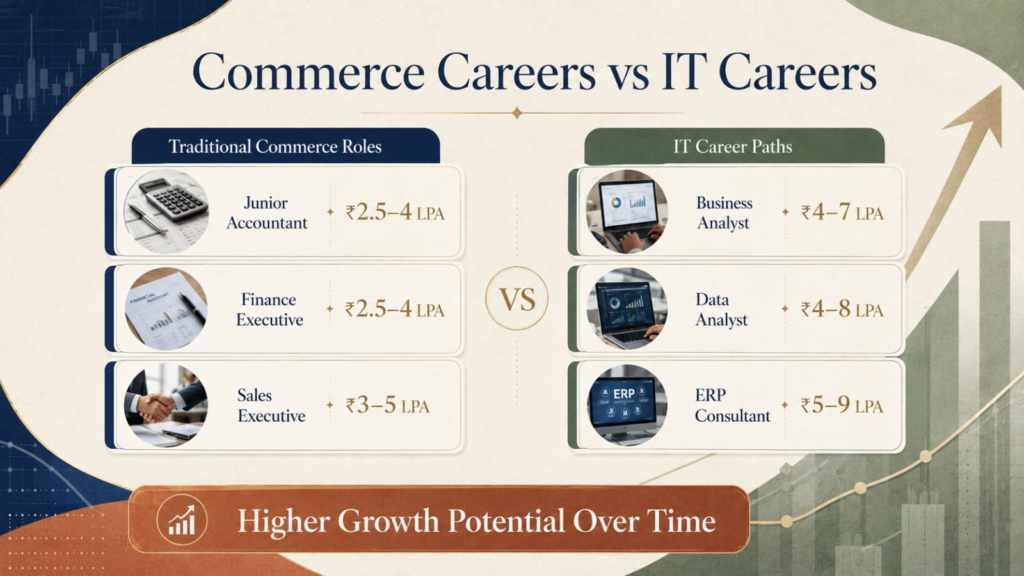
Now compare that with some common career paths many BCom and BBA graduates traditionally enter.
| Traditional Commerce Role | First 2 Years |
| Junior Accountant | ₹2.5–4 LPA |
| Finance Executive | ₹2.5–4 LPA |
| Sales Executive | ₹3–5 LPA |
Even accounting for variance, the difference between these tracks at the 3-year mark is usually ₹4 to 8 LPA in favor of IT.
That’s not a small difference. Over a 10-year career, that gap compounds significantly.
These are realistic numbers pulled from Glassdoor, AmbitionBox, and direct placement data. Not the best-case-scenario figures that some training institutes use to get enrollments. The actual median is for students who put in real effort.
“But I’m Not Technical Enough” And Other Fears, Answered
Let’s go through the most common ones. Because if you’ve read this far, at least one of these is probably running through your head.
“I don’t know any coding at all.”
For Business Analyst, QA, ERP, and IT Sales roles, you genuinely don’t need to. These are not coding roles. For Data Analyst and Full Stack, yes, you’ll need to learn some programming. But “learning to code” is a skill, not a personality trait. Thousands of people with zero technical background learn it every year with the right structure. The question isn’t whether you can learn it. It’s whether you’re willing to put in the time.
“I’m 26 / 27 / 28. Is it too late?”
The average age of someone making a career switch into IT in India is between 24 and 29. You are not an outlier. You are not late. Companies hiring for BA, QA, and data roles often prefer slightly older candidates because they bring maturity, better communication skills, and real-world business context. If anything, 26 to 28 is a sweet spot. Already past 30? Read our honest answer on switching to IT after 30 in Pune.
“What if I spend 6 months and don’t get placed?”
This is the most real fear. And it deserves a real answer.
Placement outcomes depend on three things: the quality of your course and mentorship, the effort you put into building a portfolio, and how you prepare for interviews. If all three are there, placement is not a question of if, it’s a question of when.
At Teknowell, we don’t stop at placement assistance for 3 months after your course ends. We offer 100% placement support with unlimited interview calls until you actually land the job you want. Because we know that some people take 3 months to place, some take 6. Both are fine. The support doesn’t have an expiry date.
“My degree is BCom. Companies will reject me before reading my resume.”
This used to be more true than it is now. In 2025 and 2026, a lot of mid-size IT companies and startups care far more about what you can demonstrate than what your degree says. A strong portfolio, a good GitHub profile or project documentation, and a confident interview will get you past the degree filter at more companies than you think.
“All my friends from BCom went into finance or traditional sales. What if I’m the only one doing this and it doesn’t work?”
Being the only one doing something isn’t a bad sign. It’s usually a good one. Your friends who went into traditional roles are competing in saturated markets with low mobility. You’re entering a field that is actively looking for people who combine business thinking with technical skills. That’s not a gamble. It’s a calculated move.
Your BCom or BBA Is Not a Limitation. It Never Was.
Here’s the honest summary.
The IT industry has roles that are perfectly suited to your background. The salary gap between traditional commerce careers and IT is real and significant. The switch is achievable in 4 to 10 months, depending on which role you’re targeting. And thousands of BCom and BBA graduates in India make this switch every year.
The one thing that separates the ones who make it from the ones who keep waiting is simply starting.
You don’t need to have everything figured out. You just need to take the next step.
Ready to Figure Out Which IT Path Fits You?
At Teknowell EduTech, we’ve helped BCom and BBA graduates switch into IT roles across Business Analysis, Data Science, Full Stack Development, and more. Our trainers have 10 or more years of actual industry experience, not just teaching experience. And every student gets simultaneous internship support, so you’re building a portfolio while you’re learning, not after.
We also offer 100% placement assistance with unlimited interview calls. That means we stay with you until you land the right role, not just until your course ends.
Book a free demo session here, and let’s figure out together which path makes the most sense for your background and your goals. No sales pressure, no commitment. Just an honest conversation about what’s possible and how long it realistically takes.