
Every week, there is a new headline. AI just built an entire app in 10 minutes. ChatGPT replaced a team of developers. Coding is dead.
And then you open NASSCOM’s latest Strategic Review and find a very different picture. India’s technology industry added 126,000 new jobs in FY2025, taking the total workforce to 5.8 million professionals. The industry also grew by 5.1%, adding $13.8 billion in revenue despite rapid advances in AI.
Both things are happening at the same time. That is exactly what makes this question so difficult to answer honestly.
This blog is not going to tell you that everything is fine. It is also not going to tell you that AI is coming for your job and you should panic. Instead, it looks at what the data actually says, which roles are genuinely at risk, which roles are growing, and what you, as a fresher, should do about it in 2026.
Quick answer: No, AI will not replace software developers. But it will replace developers who refuse to adapt. NASSCOM’s latest data shows that India’s technology sector is still growing, hiring, and investing in talent. What is changing is not the existence of developer jobs, but the skills companies are willing to pay for. Freshers who understand that shift will have a significant advantage in the years ahead.
What the Headlines Get Wrong About AI and Developer Jobs
Let’s start with facts, because the anxiety around AI and IT jobs is real but often pointed in the wrong direction.
India’s total IT jobs are growing, not shrinking
Despite all the headlines about AI replacing jobs, the technology industry is still growing and creating opportunities.
This is not a sector in freefall. If AI were replacing developers at the scale many people imagine, companies would be cutting technology teams across the board. That is simply not what we are seeing.
But the composition of those jobs is changing fast
Here is where freshers need to pay attention.
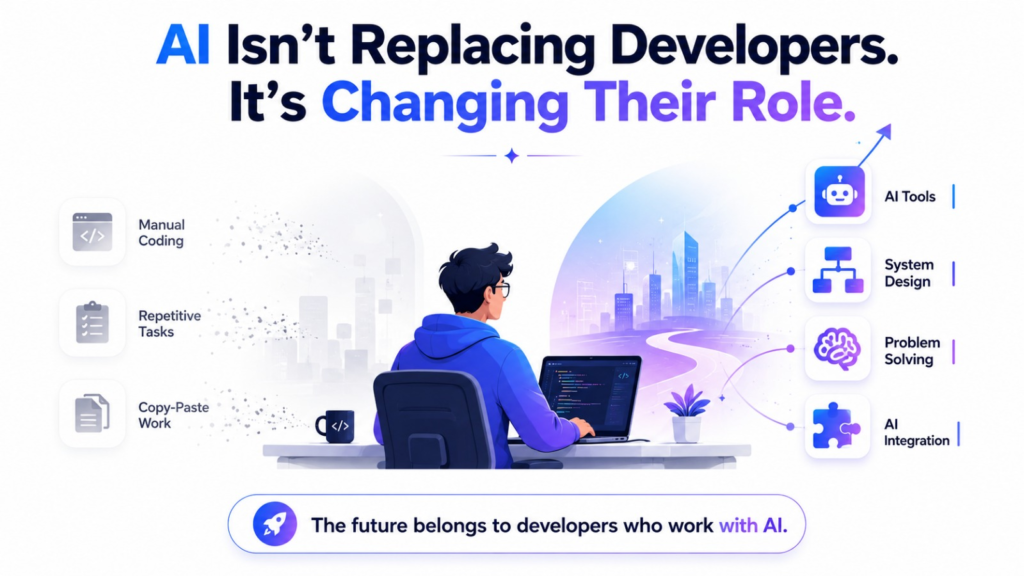
Companies are hiring fewer people for routine, repetitive work and placing greater value on developers who can solve problems, work with modern tools, and contribute beyond basic coding.
The fear is not wrong. It is just pointed at the wrong thing.
The risk is not “Will developers exist?”
The risk is “Will generic, low-skill developers remain employable?”
AI is both a threat and an opportunity
AI is automating certain tasks, but it is also creating entirely new opportunities.
As more companies adopt AI, the demand for professionals who can build, integrate, manage, and work alongside these systems continues to grow. If you are wondering whether it is too late to move into tech, read our honest take on switching to IT after 30.
The same technology that is changing some jobs is also creating new career paths that barely existed a few years ago.
And most freshers are paying far more attention to the threat than the opportunity.
Which Developer Roles Are Genuinely at Risk: and Which Are Not
This is the section most people reading this actually want. Let’s be honest about it.
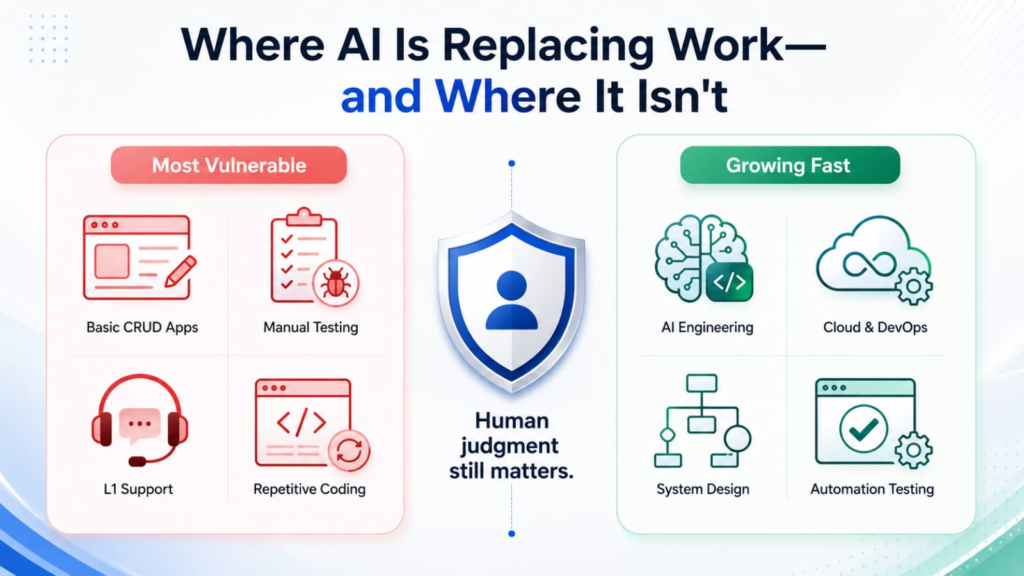
What is genuinely at risk
Entry-level IT roles shrank 20 to 25% in 2025-26 as companies shifted from hiring large fresher batches for routine roles to targeted, specialised hiring. Junior developers doing repetitive CRUD work face a 30 to 35% AI replacement risk.
The specific roles under pressure:
- Junior developers writing basic form-based apps with no design responsibility
- L1 technical support handling repeated, scripted queries
- Entry-level manual testers executing simple test scripts
- Data entry coders in BPO environments
If your entire value to a company is writing boilerplate code you found on Stack Overflow, that is the part AI is replacing. Not you as a person, but that specific task.
What AI cannot replace and will not anytime soon
Here is the table that matters for your career decisions:
| Factor | At risk (30-35% displacement) | Safe and growing |
| Task Type | Repetitive CRUD operations, basic form apps | Complex system design and architecture |
| Role | Manual software testing at the L1 level | Automation testing, AI testing, and engineers |
| Profile | Generic junior developer (copy-paste coder) | Developers who build and direct AI tools |
| Job Type | L1 tech support, basic BPO coding | AI/ML engineering, DevOps, cloud roles |
| Skill | Writing boilerplate without understanding it | Systems thinking, debugging, problem framing |
If you’re still deciding which technology stack to learn, our guide on Java vs Python: Which Career Is Better for Freshers in 2026? breaks down job opportunities, salary potential, and long-term career prospects for both paths.
AI currently cannot do any of the following:
- Design the architecture of a scalable system from scratch
- Debug a complex production failure under real-world load
- Understand what a business actually needs and translate it into a working solution
- Govern and secure AI systems themselves
- Take responsibility when something goes wrong
That last point matters more than people realise. AI generates output. It does not own outcomes. Someone has to.
The most telling data point from senior developers
A BairesDev survey of 501 senior developers conducted in Q4 2025 found that 65% expect their role to be redefined, not replaced. Of those:
- 74% expect to shift from writing code to designing technical solutions
- 61% expect to spend more time integrating and reviewing AI-generated code
- 50% expect a greater focus on architecture and strategy
The future developer is an architect and reviewer of AI output, not a line-by-line coder.
What AI Is Actually Doing Inside Real Companies Right Now
Theory is one thing. Here is what is happening at actual companies in India.
AI is a productivity multiplier, not a headcount replacement
GitHub Copilot, Cursor, and similar tools are now used daily by developers at TCS, Infosys, and Wipro. These tools generate boilerplate faster, autocomplete functions, and flag common errors.
What they do not do: understand the business problem, architect the system, or decide what to build. Developers using these tools are producing more output with less effort. But the developer is still required to direct, review, and own everything the tool generates.
GCCs are expanding aggressively in India
India’s Global Capability Centres leased a record 9 million square feet of office space in early 2026 alone, according to a report. JPMorgan, Goldman Sachs, Google, Microsoft, Target, and Walmart are actively hiring in Pune, Bangalore, and Hyderabad primarily for AI-integrated engineering roles.
This is the opposite of what happens when a technology is genuinely replacing people at scale.
What is happening in Pune specifically
Hinjewadi IT services companies are reducing large fresher batches for routine development work. Kharadi and Baner product companies and GCCs are simultaneously hiring aggressively for specialised, AI-integrated roles.
The same Pune market is getting harder at the bottom and more lucrative at the top. At the same time.
The Skills That Make a Developer AI-Proof in 2026
Let’s convert the anxiety into action. This is the part that actually changes your outcome.
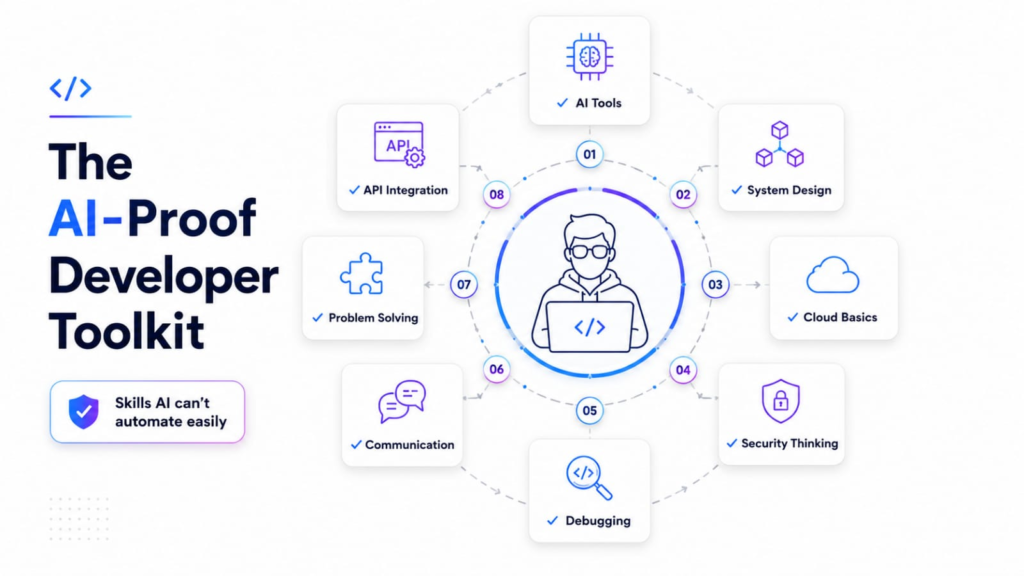
Use AI tools from day one, do not fear them
The fastest way to become AI-proof is to become the developer who uses AI better than anyone else. GitHub Copilot, Cursor, ChatGPT for code review, and AWS CodeWhisperer are now part of standard developer workflows. A fresher who arrives knowing how to prompt, verify, and refactor AI-generated code is more valuable than one who writes everything manually from scratch.
Hiring managers in 2026 are actively asking, “Do you use AI tools in your workflow?” in technical interviews. The answer “no, I don’t use those” is no longer a badge of purity. It is a red flag.
Build the skills AI cannot perform
These are the capabilities that keep you relevant regardless of how AI tools evolve:
- System design: How to architect a scalable application from scratch, thinking about databases, APIs, load, and failure scenarios
- Debugging: Finding why a production system is failing under real load, not just running the code locally
- Security thinking: Identifying vulnerabilities in code, including vulnerabilities in AI-generated code
- Domain expertise: Understanding the business deeply enough to know whether the AI’s solution actually solves the problem
- Communication: Explaining technical decisions clearly to non-technical stakeholders
None of these are features in any AI tool.
Add AI integration to your existing stack, and the salary premium is real
Developers with Gen AI integration skills, OpenAI API, LangChain, and prompt engineering as part of a full-stack or data science role earn 30 to 50% more than peers without those skills at the same experience level. This is visible right now in Naukri and LinkedIn job postings across Pune, Bangalore, and Hyderabad.
A MERN stack developer who can also build an AI-powered feature into their app belongs to a much smaller, much better-paid candidate pool.
This is exactly why Teknowell has added Gen AI integration modules to both the Full Stack and Data Science tracks. Students graduate with AI tools already in their workflow, not as something they plan to learn later.
Many freshers know they need these skills but aren’t sure where to start. Our detailed guide on Best IT Courses for Freshers in 2026: Fees, Duration, Salary & Placement Guide compares the most popular career paths and helps you choose the right one based on your goals.
Should Freshers in India Still Learn to Code in 2026?
Yes. Absolutely. But learn it differently from how it was taught five years ago.
The goal is not to memorise syntax. It is to understand systems, build real projects, and use AI tools as part of your workflow from the first week.
A course that still teaches “print Hello World in Java” as its central output without connecting it to deployment, APIs, AI integration, and system design is already teaching you for a market that no longer exists.
What learning to code in 2026 should actually look like
- Frontend, backend, and deployment as one connected system, not isolated modules you never use together
- Real projects deployed to the web, not just running locally on your laptop
- Git and GitHub are treated as first-class tools from day one, not an afterthought in the last week
- At least one AI integration project before you start applying for jobs
- Understanding what AI-generated code is actually doing, not just copying and pasting it
- Cloud deployment basics so your work is accessible and demonstrable to anyone
AI will not replace developers. It will replace developers who do not know how to use AI.
If you’re concerned about getting hired without prior industry experience, read How to Get an IT Job Without Experience in 2026, where we break down the exact steps freshers can take to build a portfolio and land their first opportunity.
Which IT Course Gives You the Best AI-Proof Career Foundation in Pune?
If you are deciding what to study right now, here is an honest breakdown by track.
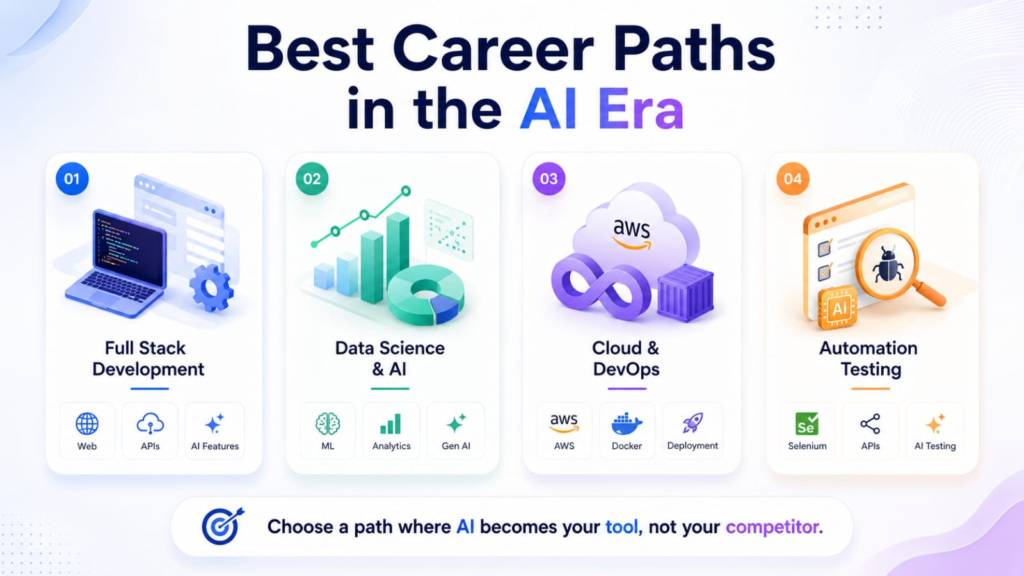
Full Stack Development (MERN or Java)
Full-stack development has one of the lowest AI displacement risks among all developer roles. It requires system thinking, architecture decisions, and integrating multiple technologies simultaneously, all things that current AI tools cannot do on their own.
Adding AI-powered features to full-stack applications is now expected in interviews, not optional. Teknowell’s Full Stack track includes Gen AI integration, so you graduate with this already in your portfolio.
Data Science and AI/ML
This is the direct path into the roles that AI is creating, not replacing. ML Engineers, AI Engineers, and Gen AI specialists face that 2:1 demand-supply gap in India right now. The highest salary ceiling in IT and the lowest displacement risk of any track.
Cloud and DevOps
Every AI model deployed at scale runs on cloud infrastructure managed by DevOps engineers. AI cannot automate the engineers who manage the systems AI runs on, which is structurally circular. It is one of the most stable, well-paying, and underappreciated AI-proof careers in India right now.
Software Testing Automation Track
AI generates code. That code needs testing. AI-powered testing tools need automation engineers to configure, govern, and improve them. Manual testing at the entry level is under pressure. Automation testing is not. The demand is growing alongside the volume of AI-generated code being shipped.
The Future Belongs to Developers Who Build With AI
You have read the data. The picture is clear.
India’s IT sector is growing. The demand for AI-integrated developers is outpacing supply by a ratio of 2:1. The risk is real but specific. It is concentrated in routine, repetitive, low-skill coding work, not in developers who think, design, and build with AI tools.
The window to build those skills and stand out in a less crowded candidate pool is right now, before the market becomes even more competitive.
Teknowell’s Full Stack and Data Science courses in Pune are designed for this new reality. Every track includes AI tools, real-world projects, and placement support that continues until you are hired.
Ready to build an AI-proof tech career? Book your free demo class today and see how the curriculum prepares you for the jobs companies are hiring for in 2026.