

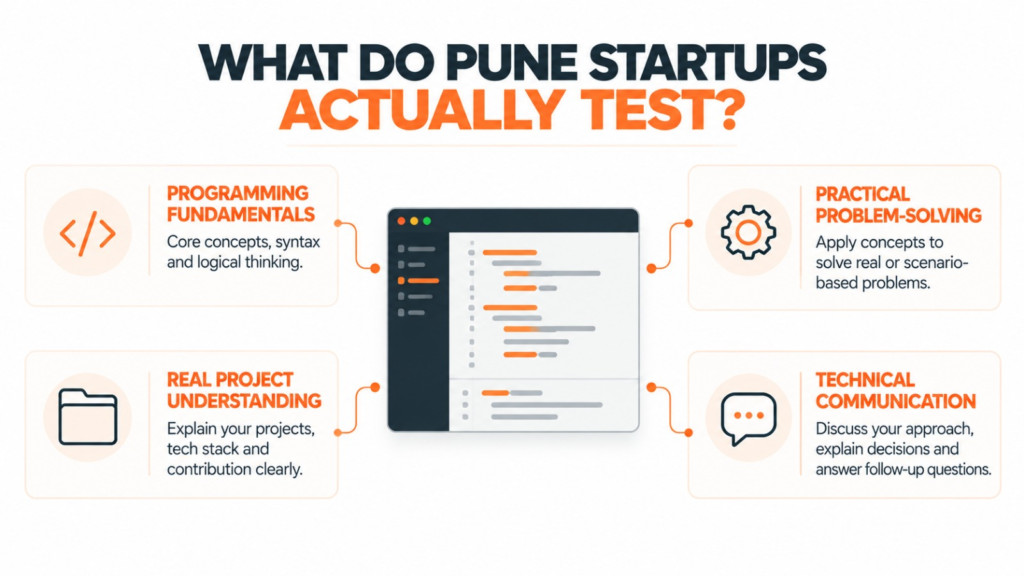
In a startup technical interview in Pune, you will mostly be tested on programming fundamentals, problem-solving, your projects and how well you can write and explain code. Depending on the company, you may get a coding question, a practical programming exercise, a discussion about your project and a final conversation with a senior engineer or the founder. You don’t need to know everything. You need to understand what you have learned and show that you can apply it.
If you’ve been preparing for TCS or Infosys interviews, you have probably practised aptitude tests and questions on OOP and SQL. Some startups follow a similar process, while others ask you to walk them through your project and solve a problem on the spot.
So, what should you practise if you’re hunting for a startup job in Pune as a fresher? Let’s go through it step by step.
Startup vs Service Company Interview: What’s the Difference?
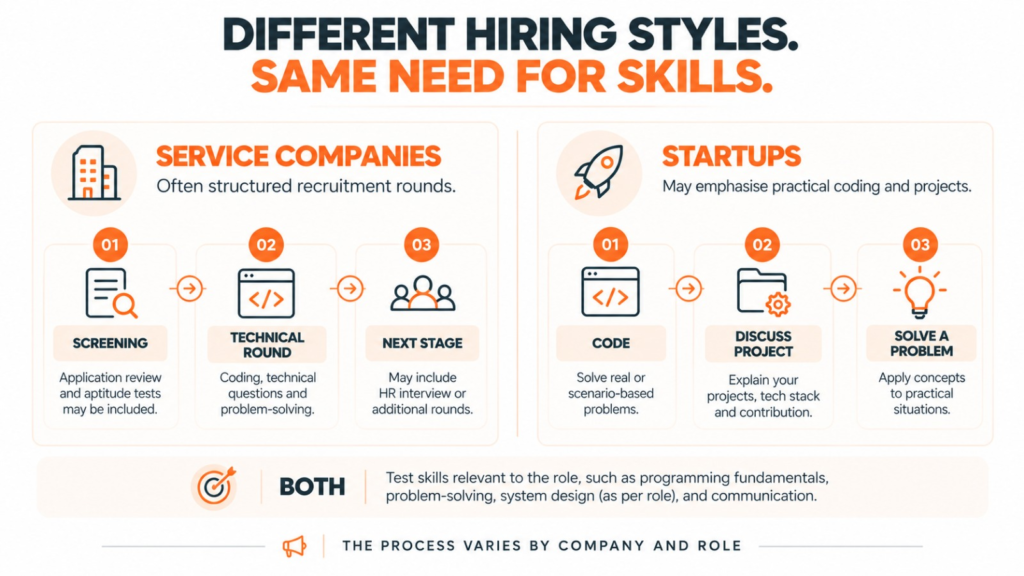
The main difference is that large service companies often use more standardised hiring processes, while startups may tailor interviews to their team, product and immediate hiring needs. Neither approach is automatically easier.
| What to expect | Service companies such as TCS and Infosys | Startups |
| Aptitude round | Common in many hiring drives | Depends on the company |
| Number of rounds | Often follows a defined process | Can vary by role and team |
| Technical depth | Fundamentals, coding and role-specific skills | Fundamentals plus practical application |
| GitHub or portfolio | Depends on the role | May receive closer attention |
| Project questions | Usually part of technical discussions | Can involve detailed code and design decisions |
| Hiring speed | Depends on the recruitment drive | Depends on the team and vacancy |
| Salary | Varies by role and hiring programme | Varies by company, role and funding |
This is a general comparison, not a rule for every employer. A startup can conduct a difficult DSA round, and a service company can ask you to solve a practical coding problem.
How Do Startup Interviews in Pune Differ From Service Company Hiring?
Startup interviews usually revolve around one question: can you do the work the team needs done? You may be asked for a definition, then asked to write a small piece of code, and then asked how you would use that code in a real application.
Suppose you are interviewing for a fresher software developer position.
One interviewer may ask you to define a REST API. Another may ask you to build a simple API for a student registration form. Both questions test your knowledge, but the second one also tests whether you can apply it.
You may also speak with a senior developer, an engineering manager or even the founder. Smaller teams often combine the technical and team discussions into a single round.
If you’re looking at software developer fresher roles in Pune, the takeaway is simple: know your basics, and go beyond definitions.
If you want to compare your preparation with larger IT employers first, read Teknowell’s guide to IT interview questions for freshers in Pune, including TCS, Infosys and startups.
What Is the Typical Round Structure at a Pune Startup?
There is no single interview format followed by all Pune startups. However, these four stages are worth preparing for, because companies often use some combination of them.
- Initial screening call: A recruiter or hiring manager checks your educational background, technical interests, projects, communication skills and availability. They may also ask why you want to join the company.
- Technical or live coding round: You are given a programming problem and asked to solve it while explaining your logic. It can cover strings, arrays, loops, basic DSA or a feature related to the role. If you get stuck, the interviewer may give you hints.
- Project discussion or machine coding round: You explain your college or personal project, or build a small solution yourself. A machine coding round may ask you to build one feature of an application while keeping the code clean.
- Final technical, team or founder round: You discuss how you make decisions, how you handle feedback, what you know about the company and whether the role is right for you.
What about take-home assignments?
Some companies send you a task to complete outside the interview, for example building a mini API, creating a webpage or fixing a bug in an existing application.
Don’t assume that every startup will conduct all four stages. Check the job description and ask the recruiter what the process involves.
What Do Pune Startups Ask in Technical Interviews?
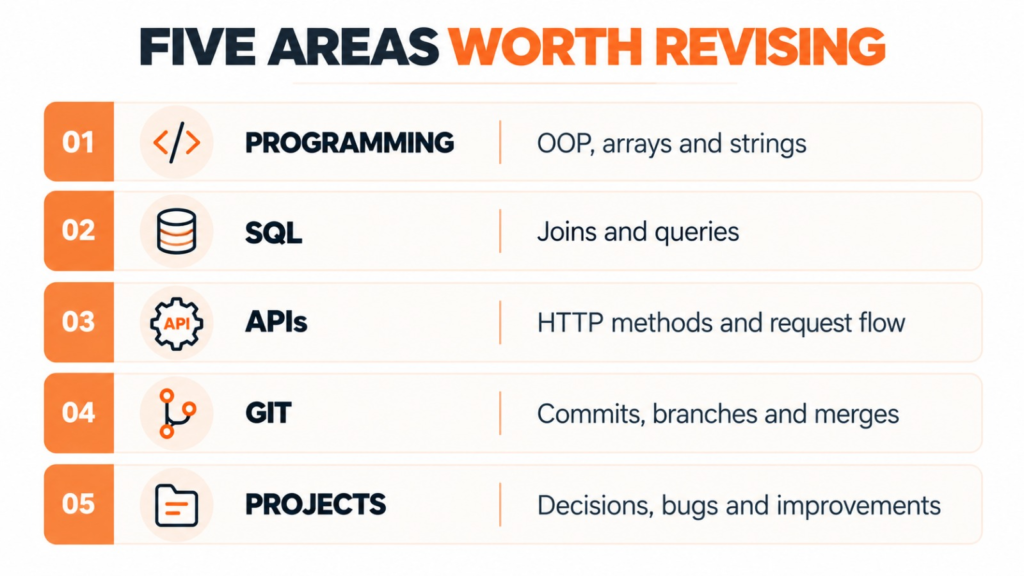
The questions depend on the job and technology stack, but freshers applying for developer roles should be ready for programming fundamentals, databases, web development, version control and detailed questions about their projects.
1. Core programming and OOPs
Choose one programming language you are comfortable with, such as Java, Python or JavaScript. Make sure you understand the basics: how to write code, which data types are available, how loops work, how to define functions, how arrays are used and how to handle errors.
For object-oriented programming, go over these common interview questions for freshers:
- What are the four pillars of object-oriented programming?
- What is the difference between a class and an object?
- How are inheritance and polymorphism different?
- What is the difference between method overloading and method overriding?
- Can you explain encapsulation with an example from a real application?
Don’t just memorise the answers. If you say inheritance lets one class reuse another class’s behaviour, be ready to explain why that helps and when you would actually use it. Keep an example ready.
2. SQL and database basics
Even if you want to join as a frontend developer, knowing basic SQL helps you understand how applications store data.
Pune startup interview questions for freshers include:
- What is the difference between a primary key and a foreign key?
- What is the difference between INNER JOIN and LEFT JOIN?
- What is the difference between WHERE and HAVING?
- Write a query to count the students in every department.
- How will you find the second highest salary in an employee table?
Practise by writing queries yourself, because reading answers and writing queries are two very different things.
3. REST APIs and how the web works
You should understand how a browser or frontend application communicates with a server.
Prepare to explain:
- What is a REST API?
- What is the difference between GET and POST?
- What are HTTP status codes such as 200, 400 and 404?
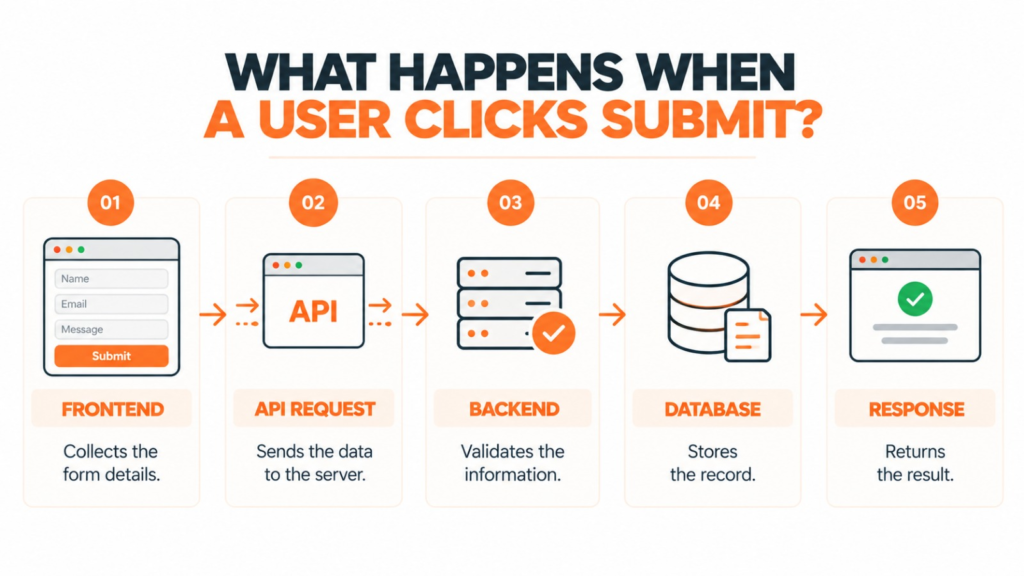
- What happens after a user clicks the Submit button on a form?
- How does the frontend send data to a backend?
For example, in a student registration application, the frontend collects the student’s details, sends a request to the backend, and the backend validates and stores the information. Be able to explain this flow in your own words.
4. Git and version control
Before your interview, get comfortable with Git basics. You should know ideas such as repository, commit, branch and merge, and practise common commands like git add, git commit, git pull and git push.
The interviewer may ask how you keep track of changes, how you work on a feature or how you undo a mistake. You don’t need to master every Git command, but you should understand how version control fits into your daily work.
5. Questions about your own project
Take this part especially seriously. A project on your resume gives the interviewer something concrete to discuss.
Be ready for questions such as:
- What problem does your project solve?
- Why did you choose these technologies?
- What part did you build yourself?
- How does the frontend communicate with the backend?
- What was the most difficult bug you fixed?
- What would you improve if you had another week?
Suppose you built a task management application. You should be able to explain how a user creates a task, where the task is stored, how it is displayed and what happens if the request fails.
You don’t need a huge project. You need one you understand well enough to discuss honestly.
A practical preparation tip: Pick your strongest project and practise explaining it in two minutes. Then ask a friend to keep asking “Why?” until you can explain your decisions clearly.
Want help building stronger technical foundations?
If you understand the theory but struggle to turn it into working projects, structured practice can help. Teknowell EduTech offers IT training in Pimpri Chinchwad, with courses covering areas such as full stack development, data analytics, data science and cloud computing.
How Do Startups Evaluate Your GitHub Portfolio?
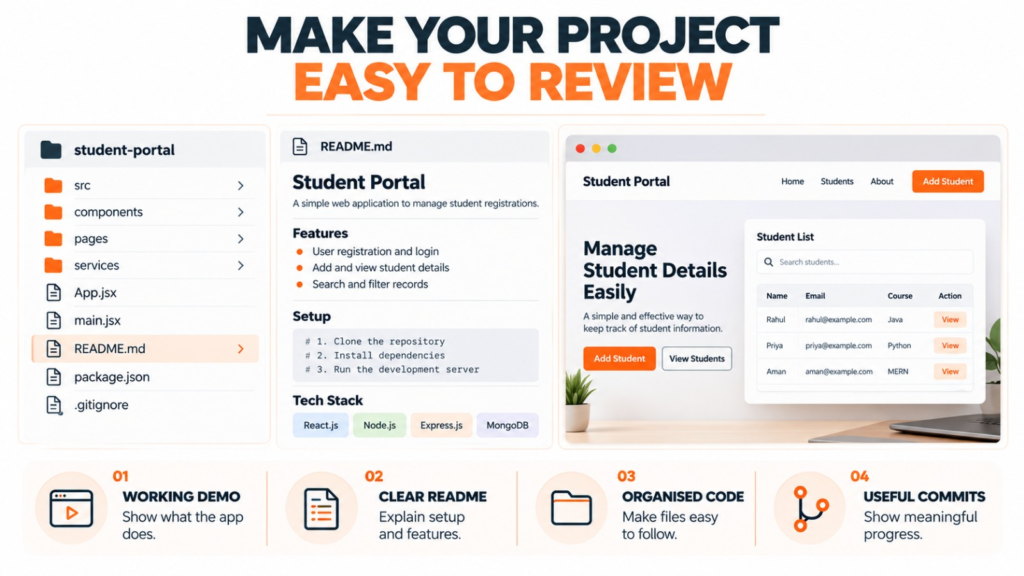
Your GitHub account shows an interviewer what you can build and how you work as a developer. It doesn’t need a long list of projects. Two or three well-explained projects often say more than ten unfinished ones.
Before applying, make sure you do these four things:
- Working demo: Add a live demo if you can. If that is hard, give clear steps to run the project.
- Clear README: Explain what the project does, the technologies used, how to set it up and the main features.
- Organised code: Name and arrange your files so another person can easily follow what the project does.
- Useful commits: Keep each commit meaningful and update the project as you work on it. The history should show work you are proud to discuss.
GitHub’s official README documentation explains how a README helps people understand a project’s purpose and how to use it.
Before an interview, open your own repositories and check that you can explain the important files without relying on a tutorial.
For a full walkthrough of setting up your profile and projects, see our guide on how to build a GitHub portfolio that gets you hired.
What System Design Basics Should Freshers Know?
For entry-level roles, system design means understanding how an application is put together. You don’t have to design the architecture of a giant platform from scratch.
Four key concepts:
- Client and server: A client is usually a web browser or mobile app. A server receives requests and sends back responses.
- Database: Understand why an app needs a database like MySQL or PostgreSQL, and when a document database is useful.
- API design: Understand how endpoints, HTTP methods and the request/response cycle tie the different parts of an app together.
- Scaling: Understand why more users lead to more requests, slower responses and a heavier database load, and how caching and adding servers help a system cope.
Try a small exercise. Describe how you would build an application to manage a library. What data will it store? Which endpoints do you need? How does a user find a book?
If you can walk through that logic clearly, you already have a basic grasp of system design.
How Can You Prepare for a Startup Technical Interview in 30 Days?
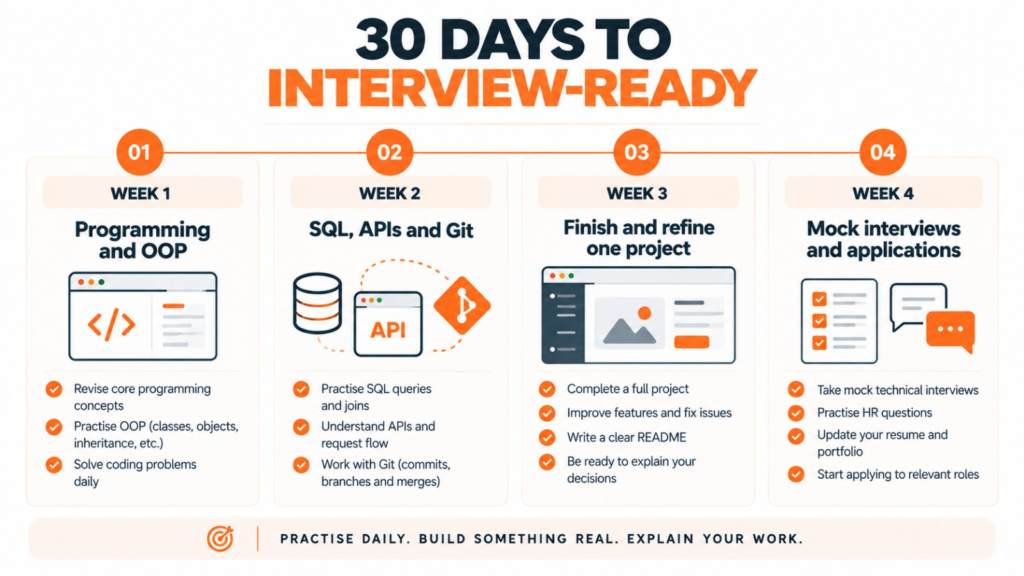
You don’t need to study every technology in one month. Pick a target role, identify the skills it requires and follow a routine you can maintain. Even one to two focused hours a day can give your preparation a clear structure.
Week 1: Strengthen your basics
Choose one programming language and revise the basics: variables, loops, functions, arrays, strings and OOP. Solve one beginner-level coding problem each day and try explaining your solution out loud.
Week 2: Revise databases and web development
Practise SQL queries and joins, work with REST APIs, understand HTTP methods and use Git. Build a small application that uses a database or connects a frontend with a backend.
Week 3: Refine your project and GitHub account
Finish one project instead of starting several. Test it, improve the README and organise the code. Practise explaining your project decisions and use the project to practise basic system design.
Week 4: Practise interviews and apply for positions
Take mock coding interviews, solve problems without looking at solutions and practise explaining your projects. Shortlist a few relevant jobs and send your applications.
While searching for startup jobs in Pune for freshers, look at areas such as Baner, Hinjewadi and Kharadi, but don’t limit yourself to one location. Always check each company’s current careers page and the skills it asks for.
What Mistakes Should Freshers Avoid?
These avoidable mistakes can make even a well-prepared candidate look less confident than they really are.
- Learning definitions without understanding how to apply them.
- Listing technologies on your resume that you can’t explain.
- Copying a project without understanding how all its parts work.
- Giving up as soon as a coding task gets difficult.
- Focusing only on DSA and being unable to answer questions on SQL, Git or your own projects.
- Applying for a role without reading the job description.
If you don’t know something, say so honestly. Then share what you do know and how you would work out the answer.
Final Thoughts
You don’t have to know everything to crack a startup interview in Pune. You need solid fundamentals, practical experience and the ability to explain your work clearly.
Start with one programming language, build a project you genuinely understand and practise answering questions without memorising scripts. If you need structured help with your skills and projects, explore the relevant Data Science and Data Analytics courses at Teknowell EduTech and check whether the curriculum matches your career goal.
The aim isn’t to sound like an experienced developer on day one. It’s to show that you understand the basics, can learn from feedback and are ready to grow.