You know the concepts. You’ve done the course. You’ve built a project or two. But when someone asks you to explain your code out loud, or reverse a linked list on a whiteboard, something goes blank. That’s not a knowledge problem; it’s a preparation problem. Most freshers prepare for interviews by reading.
Interviews are won by practising. This guide walks you through every round of a software developer interview in India in 2026, exactly what each round tests, how to prepare for it specifically, and the mistakes that cost freshers the offer when they were otherwise ready.
How the process works (2026):
- Round 1 Online Assessment: Aptitude + coding (60–90 minutes)
- Round 2 Technical Interview: DSA, OOP, projects, CS fundamentals (45–60 minutes)
- Round 3 HR Round: Communication, career goals, culture fit (20–30 minutes)
Product companies and GCCs may add a second technical round or managerial round. Total time from application to offer: typically 2–4 weeks.
What the Interview Process Actually Looks Like at Indian IT Companies in 2026
Before you can prepare, you need to know what you’re preparing for. The process differs meaningfully depending on who is interviewing you, and a lot of freshers realise this too late.
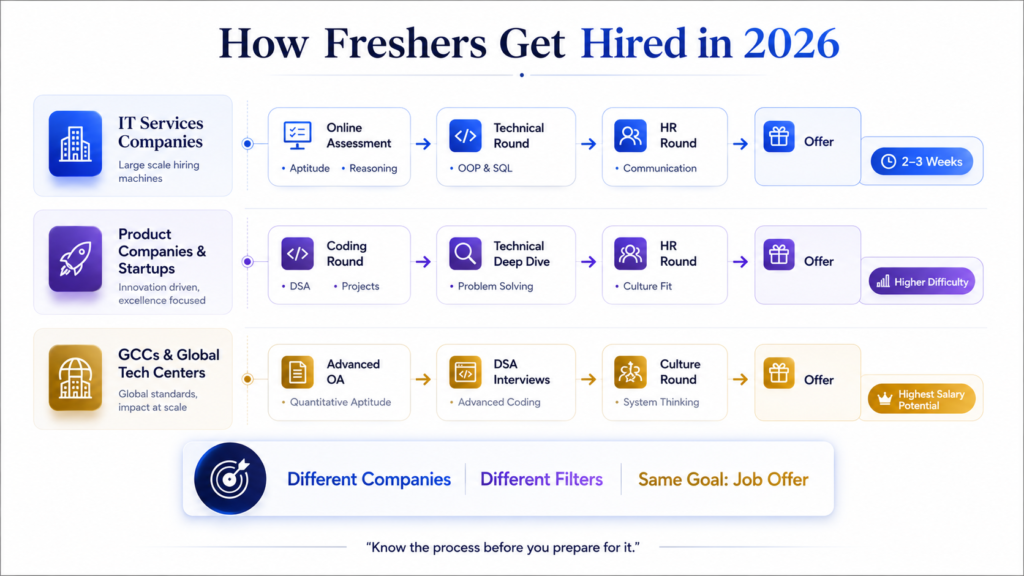
IT services companies: TCS, Infosys, Wipro
These companies follow a reliable three-round process: Online Assessment, Technical Interview, and HR Round. The OA covers aptitude, logical reasoning, verbal ability, and, for some companies, a basic coding section. There is no negative marking in most OAs, but sectional cutoffs apply more to that in the next section. The technical interview covers DSA basics, OOP concepts, SQL, and your project. The HR round evaluates communication and cultural fit as formal pass/fail criteria, not a rubber stamp. Based on Glassdoor fresher interview experiences from 2025–26, the full process from application to offer runs about 2–3 weeks.
Product companies and startups in Pune
Companies like Persistent Systems and KPIT run fewer rounds but make each one harder. Expect two technical rounds and one HR round, with no aptitude test at all; you go straight to code. The first technical round typically includes one or two DSA problems followed by a deep dive into your project. The second goes into system design basics and culture fit questions embedded into the technical conversation. The bar is higher, but so is the pay and the learning curve.
GCCs: JPMorgan India, Deutsche Bank Tech, Goldman Sachs India
These are the hardest filters for freshers and deserve their own category entirely. The online assessment includes quantitative reasoning at a higher level, not just standard aptitude. Technical rounds have stricter DSA expectations and often include a culture-fit round specific to the parent company’s values. These roles pay two to three times what IT services pay at the fresher level, but the preparation timeline is longer. Budget three to four months of focused work if a GCC is your target.
Interview preparation is only one part of the hiring journey. If you’re still struggling to get interview calls, read our guide on How to Get an IT Job Without Experience in 2026 to learn how freshers can build a stronger profile and improve their chances of getting shortlisted.
Round 1: How to Crack the Online Assessment (The Round Most Freshers Underestimate)
Here is a number that should change how you’re spending your prep time: the online assessment eliminates 60–70% of applicants before a single human being reads their resume. Most freshers know the technical content well enough to pass the technical interview. They never reach it because they treated the OA as a warm-up.
What the OA actually tests
The three standard sections across most IT companies are quantitative aptitude (percentages, ratios, time-speed-distance, probability, this is basics, not CAT level), logical reasoning (series, coding-decoding, blood relations, seating arrangements), and verbal ability (reading comprehension, fill in the blanks, para-jumbles). TCS adds a pseudocode or coding section on top of these. Infosys does not include coding for L1 roles. Know which companies you’re targeting before you decide where to spend your preparation hours.
How to prepare specifically
Aptitude is not knowledge; it’s speed. You don’t pass the OA by knowing how to solve a percentage problem. You pass it by solving it in under 90 seconds, consistently, under time pressure. That comes from repetition, not from understanding the concept once. Practice 20–30 questions daily for four weeks. Use IndiaBix for aptitude and reasoning, and LeetCode easy problems for the coding section. The student who answers 60 questions in 90 minutes beats the student who spends 90 minutes on 40 questions perfectly because the scoring is based on total correct answers, not the quality of the best ones.
The one mistake that eliminates good candidates
Sectional cutoffs are the silent killer of OA performance. You can score 90% overall and fail because your verbal section was below the cutoff. This happens constantly with technical candidates who ace the coding section but haven’t touched verbal prep in months. Distribute your preparation time across all three sections from day one. Do not specialise. Every week, practice all three areas, even if reasoning comes more naturally to you than verbal. The OA does not care about your strongest section; it cares about your weakest.
Round 2: The Technical Interview: What Interviewers Actually Look For
The technical interview is the one most freshers think they’ve prepared for and the one most freshers are surprised by. Reading about DSA and actually explaining your approach while writing code on a whiteboard are two completely different experiences. Let’s break down what the interviewer is actually evaluating in each part of this round.
The four areas every technical interview covers
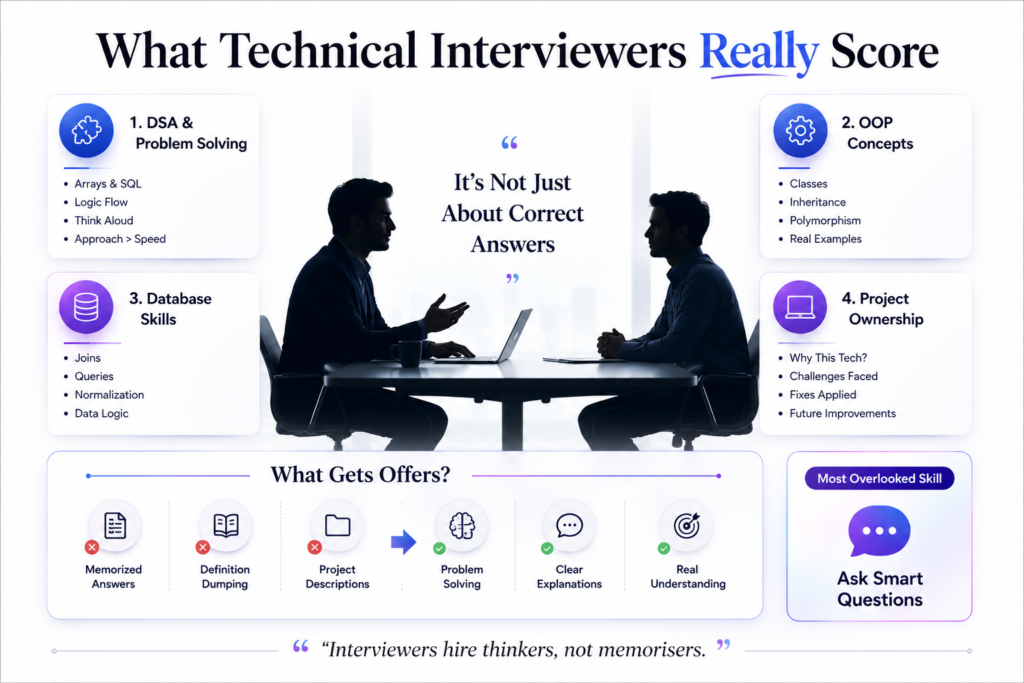
Data Structures and Algorithms sit at the centre of most fresher technical rounds. For IT services companies, the focus is on arrays, linked lists, stacks, queues, and basic sorting, not hard LeetCode mediums. For product companies, trees and basic graph traversal get added to the list. The key is not just solving the problem, but explaining your reasoning while you do it. Interviewers at companies like Persistent Systems and Wipro have confirmed in Naukri Campus fresher guides (2026) that candidates who think aloud while solving a problem consistently rate higher than those who solve it silently.
Object-Oriented Programming is tested through definitions and through code. Saying “polymorphism means many forms” will get you a polite nod and a lower score. Drawing a class hierarchy on the whiteboard that demonstrates polymorphism in action will get you the offer. Understand all four pillars classes and objects, inheritance, polymorphism, and encapsulation deeply enough to write code examples for each without needing to think about it.
Many freshers preparing for technical interviews also wonder which programming language offers better career opportunities. If you’re deciding between two of the most popular options, check out our comparison of Java vs Python: Which Career Is Better for Freshers in 2026?
Database basics come up in almost every fresher technical interview. You need to be comfortable writing SQL queries from scratch, not recognising them, writing them. Practice SELECT with conditions, JOINs across multiple tables, GROUP BY with HAVING, and subqueries. Write ten different queries by hand every day for a week, and you’ll be prepared for anything a fresher interview will throw at you.
Core CS fundamentals fill in the rest. OS basics: the difference between a process and a thread, how memory management works. DBMS normalisation (1NF through 3NF) and ACID properties. Networking HTTP vs HTTPS, how DNS works, TCP/IP basics. None of these needs to be graduate-level depth for IT services interviews. Know them well enough to explain each concept in plain English, and you’re covered.
The project discussion: where most freshers lose marks
The project discussion is the part of the technical interview that has the widest gap between how freshers prepare for it and what interviewers actually want. Strong project experience often becomes the deciding factor in fresher interviews. Students looking to build industry-relevant projects can explore our Full Stack Developer Course in Pune, designed around practical development and interview preparation. Most freshers prepare a clean, feature-by-feature description of what their project does. Interviewers do not want that. They want to know what problem the project solves, what technology decisions you made and why you made them that way, what broke during development and how you actually fixed it, and what you would do differently if you built it again today. The happy path description is the weakest possible answer.
Prepare for the edges of your own project. Ask yourself the questions you’d find hardest to answer: “What happens if the database goes down?” “Why did you use MySQL over MongoDB for this?” “How does your app handle a user logging in from two devices at the same time?” If you can’t answer those questions, you haven’t finished preparing your project presentation. The interviewers will ask them.
Is system design asked for freshers?
At IT services companies, system design questions are rare for freshers. You do not need to prepare for a full system design interview if TCS or Infosys is your target. At product companies and GCCs, the picture is different. Basic system design questions are appearing more frequently in fresher interviews, even for entry-level roles, not “design WhatsApp from scratch,” but questions like “how would you design a URL shortener?” or “what database would you choose for a real-time messaging feature and why?” Knowing the basics of scalability, load balancing, and database selection (SQL vs NoSQL trade-offs) is enough. If you’re targeting a GCC or a product company, spend a few hours on this; it costs you little time and creates a meaningful impression.
One thing that consistently impresses interviewers and costs nothing
Ask a thoughtful question at the end of the technical round. Not “what are the work timings?”, a technical question. “What does the team’s code review process look like?” or “What’s the biggest technical challenge the team is working on right now?” Both questions signal that you’re thinking like a professional, not a candidate filling a seat. Almost no fresher does this. The ones who do are remembered when the hiring decision is being made.
Round 3: The HR Round: It’s Not a Formality
Every interview guide you’ve ever read treats the HR round as a cooldown after the real interview. It is not. At IT services companies, especially, the HR round is a formal evaluation with its own pass/fail threshold. You can clear the OA and the technical round and still not get an offer because of how you performed in HR. The things being evaluated are specific, and you can prepare for all of them.
What the HR round actually evaluates
Communication clarity is the first thing you can explain a technical concept to someone who doesn’t have your background. Self-awareness comes next: do you have an honest, grounded understanding of your own strengths and what you still need to develop? Career intent matters more than most freshers realise. The interviewer is assessing whether you actually want this role or whether you applied to 40 companies and this is just one of them. Stability signals matter too. Will you leave in three months because something better came up? And salary alignment is assessed explicitly, not implied. Each of these has predictable questions attached to it, which means you can prepare real answers in advance.
The five HR questions every IT fresher gets
1. “Tell me about yourself” is not a request for your education history. It is an opportunity for you to present yourself as a professional. Structure it: your name, your most relevant technical skills, one project that demonstrates those skills, and why you’re genuinely interested in this role. Keep it under 90 seconds.
2. “Where do you see yourself in 5 years?” needs to be ambitious but grounded. “I want to grow into a senior developer who contributes to architectural decisions” lands well. “I want to start my own company” is not what they’re looking for in a fresher role.
3. “Why do you want to join this company?” needs to be specific to that company. Generic answers (“it’s a great place to learn and grow”) are immediately recognisable and ineffective. Research one specific thing about the company before your interview: a product they’ve launched, a technology they’re known for, a value they publicly emphasise and reference it.
4. “What is your biggest weakness?” requires an honest answer paired with what you’re actively doing about it. Saying “I’m a perfectionist” is seen immediately. Saying “I haven’t worked much with cloud platforms yet, which is why I’ve been spending time on AWS fundamentals this month” is honest, self-aware, and shows initiative.
5. “Are you willing to relocate?” deserves an honest answer. If you’re not willing to relocate and say yes to get the offer, the subsequent offer rejection or resignation three weeks in creates problems for everyone. Be honest here.
How to introduce yourself in an IT interview
This question gets searched more than any other individual interview question, and the answer is simpler than most people make it. Write a 90-second version of your introduction: your name, your degree and institution, your most relevant technical skills, one project you’re proud of in one sentence, and why you’re interested in this role specifically. Then practice it out loud, not in your head, out loud until it sounds like a natural conversation opener rather than a memorised speech. Record yourself once. Listen to it. You will immediately hear every place it sounds rehearsed, and you’ll know exactly what to fix.
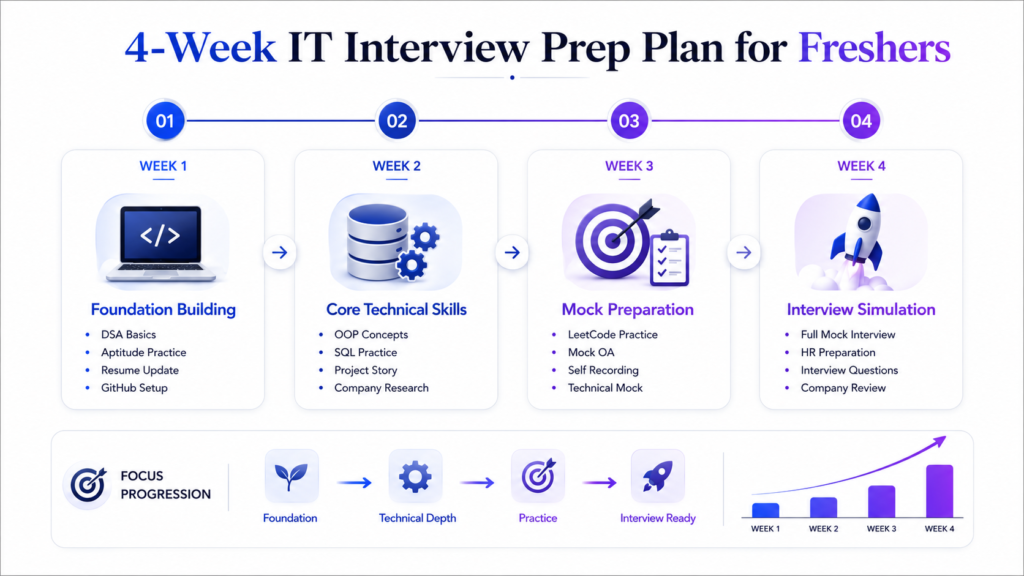
A Realistic 4-Week Interview Prep Plan
Four weeks is enough time to go from anxious to genuinely ready for most IT services interviews. Eight weeks if you’re targeting a product company or GCC. Here is how to use that time without burning out or wasting it on the wrong things.
Week 1: Build the foundation
Revise DSA basics: arrays, strings, linked lists, and sorting algorithms. Don’t jump to hard problems yet; understand the fundamentals well enough to code them from scratch without referencing anything. Run 20 aptitude questions daily, timed. Rewrite your resume this week, one page, projects listed before education, each project described with what it does and what technology you used. If you don’t have a GitHub account with your projects pushed, do that before the week is out. Recruiters look at GitHub.
Week 2: Go deeper
OOP this week, all four concepts with code examples, not definitions. SQL every day: write ten queries from scratch covering joins, group by, and subqueries. Prepare your project explanation using the four-part structure: problem solved, technology decisions made, a specific challenge you hit, and what you’d do differently now. Pick two companies you’re targeting and look up their exact OA pattern on Glassdoor. The pattern is documented by freshers who’ve been through it.
Week 3: Practice, not study
Solve two LeetCode easy problems daily with a timer running, not to find the optimal solution, but to practice thinking aloud and writing clean code under time pressure. Run a full mock OA this week, 90 minutes, timed, no breaks. Record a “tell me about yourself” answer and a project explanation, and watch them back. The gap between what you think you’re saying and what you actually sound like is always instructive. Ask a friend, a mentor, or a trainer to run a mock technical interview. Identify what felt weak and give that a focused extra session.
Week 4: Full simulation
Run a complete mock interview this week all three rounds, back to back, treated as seriously as the real thing. This matters more than it sounds. How you feel walking into the HR round after a difficult technical round is a real variable in your performance, and the only way to manage it is to have already experienced it once. Prepare three questions to ask the interviewer. Write them down. The night before your actual interview, read about the company for 30 minutes. Not the morning of, when you’ll be anxious the night before, when you can absorb it.
The mock interview in Week 3 is where most self-prepared students hit a wall. It is genuinely hard to simulate a real interview environment alone. Teknowell’s placement programme includes a structured mock interview modelled on actual TCS, Infosys, and startup interview formats, with specific trainer feedback after every session, not generic encouragement, but identified gaps and how to close them.
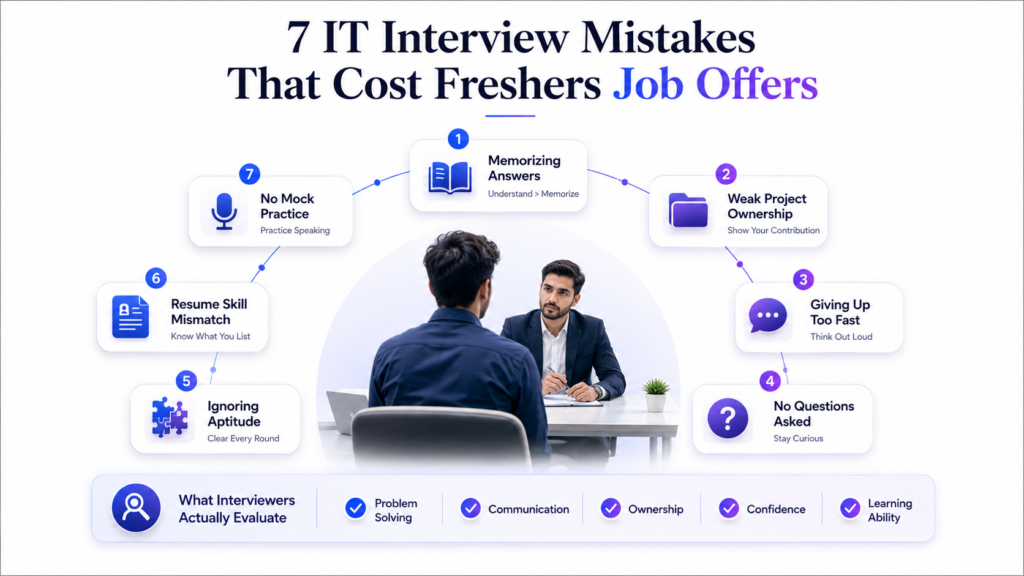
7 Mistakes Freshers Make in IT Interviews, And How to Avoid Each One
These are not theoretical mistakes. They are the specific patterns that come up again and again when freshers lose offers they were technically capable of getting.
1. Memorising definitions instead of understanding concepts. “Polymorphism means many forms” is a Wikipedia answer. It fails every time. The interviewer will ask you to show a code example, and the definition tells them nothing about whether you understand it. Go into every interview able to draw or write code that demonstrates each concept you claim to know.
2. Describing the project instead of owning it. “We built a food delivery app using React and Node”, tells the interviewer nothing useful. “I built the cart and payment integration. Here’s the specific problem I ran into with session management and how I fixed it:” tells them you can build, debug, and take responsibility. The difference between these two answers is often the difference between a hire and a pass.
3. Saying “I don’t know” and stopping. This is the single most common mistake in technical interviews, and the most avoidable. When you don’t know something, say: “I haven’t worked with that specifically, but based on what I know about [related concept], I’d approach it like this…” That answer demonstrates problem-solving under uncertainty. Silence demonstrates nothing except that you stopped.
4. Not asking questions at the end. You now know this. Prepare two thoughtful, technical questions before every interview. Have them written down so you don’t forget them when the adrenaline is running.
5. Neglecting the aptitude round. Technical candidates who hit the sectional cutoff in verbal or reasoning never reach the technical round, where they would have excelled. This happens every hiring cycle. Distribute your prep time evenly from day one.
6. Listing skills you can’t discuss on your resume. Every item on your resume is fair game for a probe. “Familiar with Docker” means you should be able to explain what Docker is, what problem it solves, and why a developer would use it. If you listed it to fill space and can’t hold a two-minute conversation about it, remove it. Interviewers remember when a candidate can’t speak to their own resume.
7. Practising entirely in your head. Thinking through an answer and saying it out loud are two completely different cognitive experiences. Answers that feel complete and clear in your head frequently fall apart when spoken. You lose the thread, you repeat yourself, you use filler words. Record yourself answering two or three common questions once, and you will immediately understand why mock interviews exist and why they work.
Your First Interview Is Closer Than You Think
Reading about interviews and practising interviews are two completely different things, and the gap between them shows up immediately when you’re sitting in the room. Teknowell’s training includes structured mock interviews across technical rounds, HR rounds, and project presentations, all run by trainers who have been on the other side of the table at companies like Persistent Systems and TCS. You get real feedback that identifies specific gaps, not general encouragement that leaves you guessing what to fix.
The prep work is yours to do. The feedback environment doesn’t have to be something you figure out alone.
Book Your Free Demo Class and see what the mock interview process looks like before you commit.